Hyacinth: Can you Smell It?

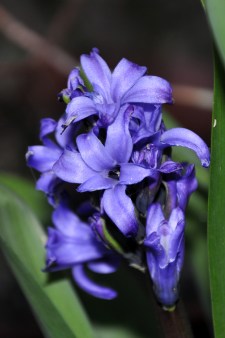
Purple Hyacinth

Purple Hyacinth

When I was a teenager, our mom gave each of us a hyacinth bulb one year for Christmas. As I recall, it came with a glass that allowed the bulb to sit suspended, with the roots growing into the cup of water below. Having the chance to grow one indoors was magical. With just one to focus on, I could see the changes day by day.  The scent was intoxicating.  It’s been a favorite ever since.

Several years ago I bought a half a dozen hyacinth bulbs at our local Costco.  They’ve moved from place to place over the years, but just when I think they’re spent, a few come back.  Three of them popped up on the back patio last week. They’ve been nibbled here and there, but they’re pretty just the same.  The scent carries me back, as they often do, to our small apartment growing up: powerful, fragrant and at times bittersweet.

Hyacinth in Bloom

Hyacinth in Bloom

Hyacinth Leaves

Hyacinth Leaves

Hyacinth Closeup

Hyacinth Closeup

Magnolia Scale: It’s Not For Wimps

My house is super clean which can only mean one thing. I’m procrastinating.

The decorations are down and the house is back in order. The sun is shining. I’m all out of excuses.  It’s time to tackle the Magnolia Scale. Blech!!!

Adult Scale

Adult Scale (Red)

Last summer we discovered a severe scale infestation on our Tulip Magnolia.  It was everywhere!  I removed numerous branches, perhaps close to a third, since the infestation was so bad.  We ordered beneficial lacewing eggs, hoping they would finish off the rest.

Now that the tree is dormant, it’s easy to see what remains.  Though not nearly as bad as last year, dozens of red scales (the adult female) along with the immature male and female nymphs, cling to the young branches.

Scale Removal

Scale Removal

Today, with my bucket and gloves in hand, I spent an hour scraping off scale.  They’re easy to see (bright red) against the trunk, but I had to stand on a step stool to reach all of them.  After tossing them into a bucket, I went back with a warm, wet rag and wiped off the nymphs.

The overwintering nymphs are all over the tree!  There is no way I could get all of them, but I sure gave it a try.

Scale Nymphs

Scale Nymphs

After giving the tree one last look, I sealed the scale in a plastic bag for disposable, and soaked the bucket, rag and gloves in hot, soapy water.

Scale in a Bag

Scale in a Bag

I’ll check on the tree again tomorrow, and if the weather warms up, I might take a hose to the underside of the branches to remove some more.

Here’s what I’ve learned:

  • When purchasing a young Magnolia tree, check the inner branches first for infestation.  Apparently many of the trees have scale before you bring them home.
  • Prune judiciously.  Magnolias, especially mature ones, don’t handle heavy pruning.
  • Time your pruning appropriately.  I’ve read the best time to prune is late winter, early fall, after flowering and before new buds set.  Given those parameters, you really need to stay vigilant.

Resources:

Mercury News Garden Calendar: An Annual Tradition

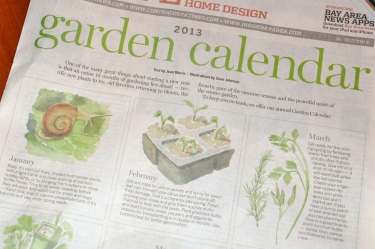
DSC_0047Our local paper publishes a garden calendar every January. The 2013 version arrived with Saturday’s paper. The calendar is a single page, always beautifully illustrated, with general gardening guidelines arranged by month.

I hang the calendar on the back of the garage door and refer to it throughout the year. It doesn’t hold any special advice or information that I couldn’t easily find online, but I hang it up anyway and check in to be sure I’m on track.

I used to be a haphazard gardener. My intentions were good, but also easily derailed when my boys were young. Months would pass before I checked in with the calendar again, but I hung it up just the same.

In this era of declining print, I wonder how long ‘the papers’ will stay in business?  Though I enjoy the immediacy of the internet and the incredible access to information, I still enjoy the feel of a newspaper.  It’s fun looking forward to the yearly calendar.  We check the local section for “spare the air” days and my boys check the weather.  Yesterday’s news is great for catching debris when you re-pot a plant.  You can even add it to your compost pile.

Of course newsprint comes from lumbar, so less paper means more trees.  I can certainly get behind that.  Change is both good and inevitable, but as annual rituals go, I’ll be sorry if and when this one is gone.

For a closer look at the San Jose Mercury news Garden Calendar (available, of course, online) follow this link.  Illustrations by Dave Johnson.

A Little of This and That

Guess what?

I was out on the deck taking pictures when a bright yellow flower caught me eye. There aren’t any yellow flowers growing this time of year, so it really took me by surprise.  Then I realized little visitors stopped by the fairy garden.  What a nice surprise.

If you are reading this post and you know who the fairies are, please be sure to extend my thanks.  It was such a treat to find those flowers.  I spotted a tiny mum tucked in as well and a few greens.  Thank you, from the bottom of my heart!!!

Flower Surprise

Flower Surprise

Pumpkin Countdown

Last summer we grew several pumpkins.  Four of them were over 40 pounds.  My husband carved one, but they were really thick and not well-suited for ‘Jacks.  We lined the wall of our garden pathway with the remaining pumpkins, and they’ve weathered the months beautifully.  Twice in recent weeks, someone came to the door and asked if they could take one for cooking.  We happily obliged, with a warning to please lift carefully.  We now have one large pumpkin sitting on the wall, with a smaller, autographed one nearby.  That one is just now starting to soften and will probably be headed to the compost bin in another week.  We’ll be down to one ‘little’ pumpkin, sitting on a wall.  :-)

two little pumpkins

Two ‘little’ pumpkins, sitting on a wall

Avoiding the Scale

I know what you’re thinking.  It’s January and I can’t hide from the scale forever.  Time to put away the treats and face the music.  All true.

I’m avoiding the scale that remains on the now-dormant Magnolia.  Honestly, it creeps me out.  We had quite the infestation last summer.  We did a bit of research and got down to business. I ordered beneficial insect larvae. While waiting for them to arrive, I heavily pruned the tree. The inner crown was far worse, so I removed as many of those branches as I could. Left unchecked, scale can kill a tree.

Scale

Magnolia infested with scale

Now that the Magnolia is dormant, it’s easy to see what remains. I need to scrape the scale into a bucket, before it takes hold again.

To think I thought putting away the chocolate was hard.

Viburnum Tinus: Odoriferous With a Side of Thrips

A row of Viburnum Tinus grow below the window of our den. The plants fill the space nicely between the ramp to the deck and our house. It’s a good-looking shrub, producing pretty flowers and berries during the winter months.  But…that smell.

We naively thought the pungent smell was coming from under the house. I thought a small animal might have died in the crawl space. My husband thought a neighborhood cat was spraying and tried a deterrent in the immediate area. The smell was so overpowering when we opened our window in the spring that we started keeping it closed while we researched the cause.

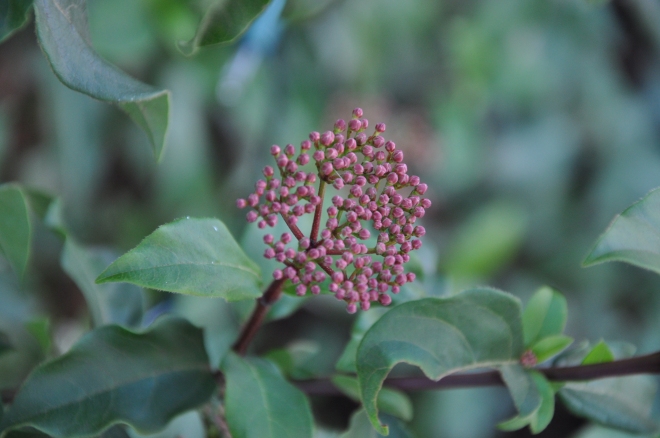
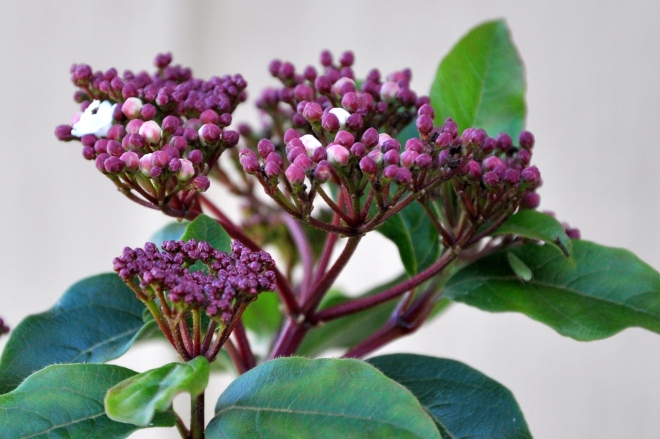
Viburnum tinus

Viburnum tinus, early buds

Viburnum tinus, buds

Viburnum tinus, small buds look like stars and beads

Last summer we noticed the lower leaves were a grayish brown. Turns out we had thrips. Was that what caused the smell?  We ordered beneficial insects (the larvae eat the thrips), reassured that we had good insectary sunflowers nearby for the mature adults. Further, I heavily pruned the lower branches, cutting away as much damage as possible. I hauled all the underbrush away from the plants to allow air circulation.

I noticed today that the thrips are back (along with the tell-tale brown leaves) though the plant continues to grow, flower and fruit.  I did a little research, and it seems the smell and the thrips are exclusive. According to Plants For a Future  the tinus “plants give off an offensive smell in wet weather.” Several writers on the forums describe it as something a dog left.

That’s it! At long last we have our answer. Now what to do about that odoriferous smell?

Viburnum tinus

Viburnum tinus, opening blooms

Viburnum tinus

Viburnum tinus, flowering white

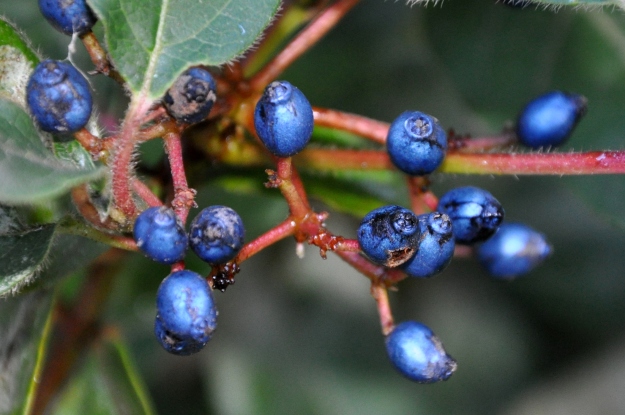
Viburnum tinus berries

Viburnum tinus berries (inedible)

Planting the Strip: Pros and Cons

Like most gardeners with small, suburban lots, I’m always on the look out for ways to maximize my annual planting. This year I have my eye on the sidewalk strip, the space between our city sidewalk and the street.

There are several pluses (and a few minuses) to planting there. I’m going to toss out both, and you can let me know what you think.

Pros:

  1. Full sun!  (Need I say more.) We have limited full sun in the backyard. I have a pair of raised beds tucked up against the back of the house and last year added a two moveable City Pickers.  Beyond that, the yard is either landscaped or shaded by large trees, or both. The sidewalk strip is prime, vegetable and flower real estate.
  2. A long, narrow strip. It’s perfect for vegetable gardening due to the already narrow space.  It would be easy to manage the box or boxes planted there.
  3. Water. The existing sprinkler system would be easy to tap into. My handy husband could run drip irrigation directly into the boxes.
  4. The view. I can see the strip from my kitchen window, and from the front deck.  A flower and vegetable bed is infinitely more interesting than grass.
  5. Additional yields.  More dirt, equals more fruits and vegetables.  I can taste those sweet tomatoes now.

Cons:

  1. Cost.  I no longer have the back to dig out heavy sod, nor the means of easily getting rid of it.  I would need to hire someone to dig out the existing lawn.  Additional costs include the raised bed (built or purchased), soil and seeds or plants.
  2. Public access. We have great neighbors who’ve openly expressed enjoyment when we’ve grown pumpkins and tomatoes in the front yard. Not everyone that walks by, however, will  respect the garden’s sanctity.
  3. Street parking.  The space in front of our house accommodates two cars. Maintaining my good-neighbor creed means maintaining continued access to those spots.
  4. Late-season doldrums.  Not everyone appreciates the messiness of a vegetable garden going to seed.
Sidewalk Strip

Sidewalk Strip (to the right of the Chinese Pistache

Lots to think about in the next few months.  I hope you’ll weigh in on the poll below.

San Jose Frost: The Garden Goes Under Cover

Galileo Thermometer, Out in the Cold

Galileo Thermometer, Out in the Cold

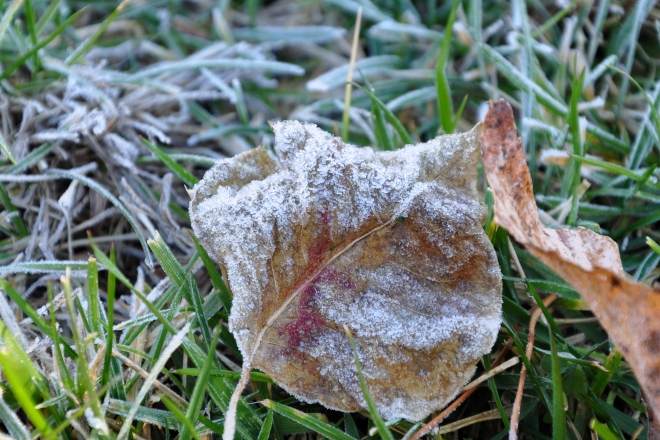
The temps were mighty chilly last night, the coldest we’ve seen this season. Yesterday’s low was 37 degrees F (2.7 C), though still ten degrees warmer than our city’s record low . Though we have overnight lows hovering around freezing, it generally warms up with the rising sun. Today, we still had frost on the grass at 10 am. Parts of our deck had a thin layer of ice. Good thing I noticed the ice before slipping across the deck and landing on my keister. It made for a better day.

My husband took his Galileo Thermometer outside so he could enjoy the novelty of the visual changes, though it doesn’t measure lower than 62 F (16 C).

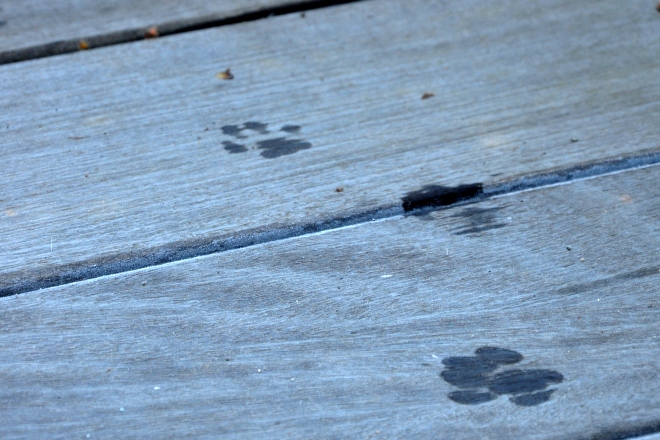
Icy paw prints

Icy paw prints

It’s interesting to note the micro-climates in one’s garden. Though both the front and back gardens receive morning sun, the front garden took much longer to thaw.

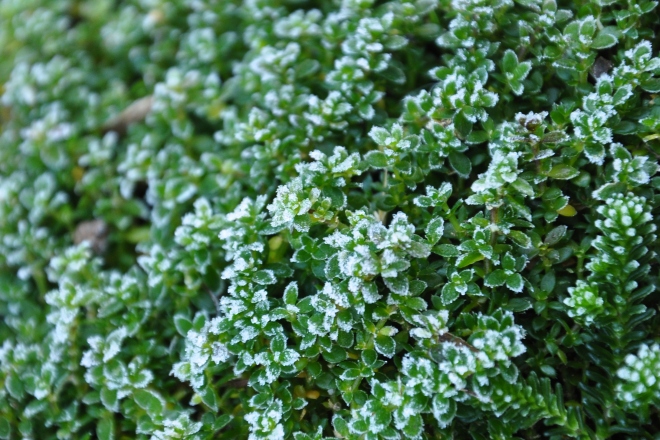
Crisp, frosty leaves

Crisp, frosty leaves

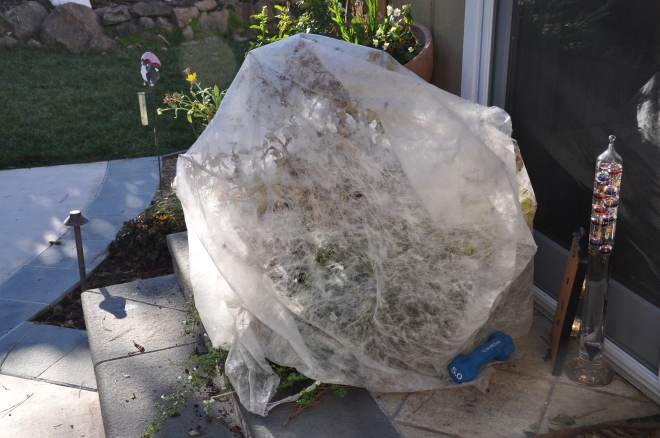
I’m still holding out hope that the coleus survive the season, but the more reading I do, the more it seems unlikely. Never one to give up hope, they’re bundled against the chill in a blanket of frost cloth.

There are differing opinions on the benefits of frost cloth. Some of my reading suggests heavy watering to reduce a freeze. Others recommend strings of holiday lights to increase the temps by a degree or two. Since I have the frost cloth, I figured it couldn’t hurt.  I’ve been watering as well when the rain stops for a day or two. I’ll have the definitive answer come spring.

Frost cloth protects Coleus

Frost cloth protects Coleus

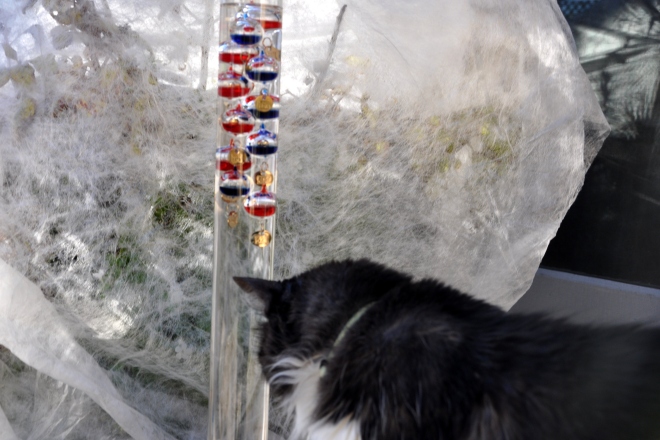
Galileo Thermometer

Lindy checks the temps

In the meantime, I’m enjoying the novelty of the colder temps and the pretty pictures it affords.  My boys are still hoping it will snow here one day. The last time it snowed in San Jose (and remained on the ground) was 1976. I think we’re long overdue!

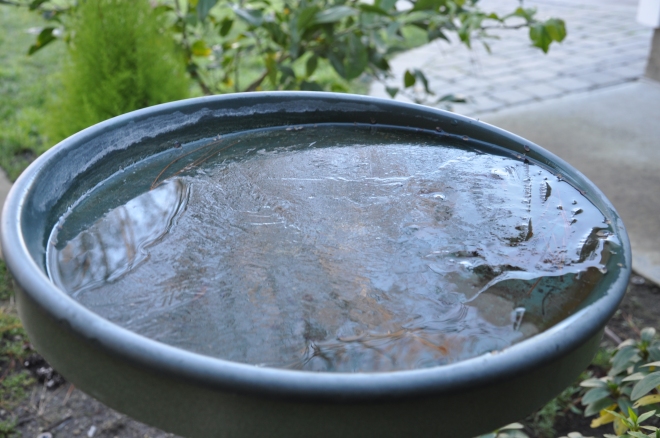
Frozen bird bath

Frozen bird bath

Frosty tips

Frosty tips

Kissed by Frost

Kissed by Frost

Kitty-corner

According to Merriam-Webster’s online dictionary, kitty-corner means

“in a diagonal or oblique position” <the house stood kitty–corner across the square>

Silly me!  All this time I thought it meant the garden corner where kitties congregate.
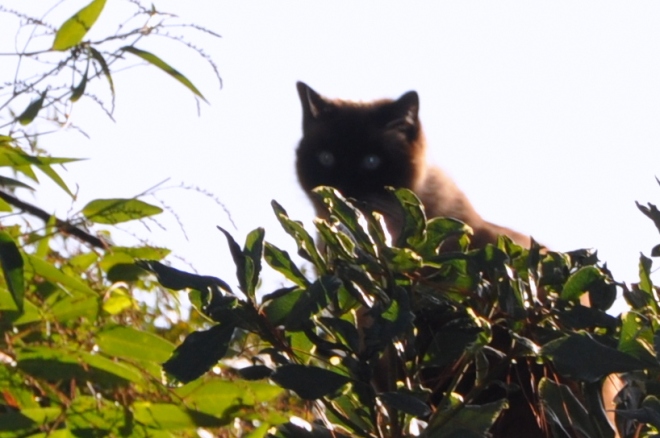
Our kitty corner saw a lot of activity this week. One morning, a stunning Siamese cat appeared, staying just long enough for a picture. I’ve not seen her before but what a lovely.  She has a chocolate-brown face and brilliant blue eyes.  I wonder what she’s looking at?
Handsome Kitty

Handsome Kitty Drops By

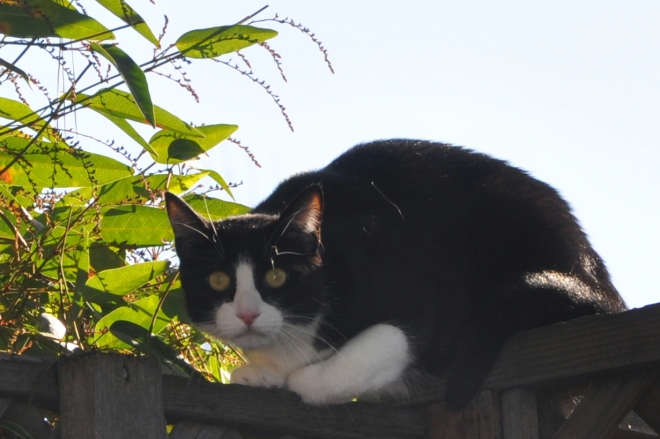
An hour later our neighbor’s cat showed up in the same spot. Kitty should be on the other side of her own cat fencing.  She’s found a way to escape the yard, but they never see her do it so they don’t know how. We keep hoping we’ll discover her escape route. So far, no luck.  She’s got that “I’m not supposed to be here” look on her face, doesn’t she?

Flash

Flash Looking Sheepish

Flash on the Move

Flash on the Move

There she goes.
In the inside corner pocket of the garden, Beijing likes to drape herself on both sides of the door.  She keeps her torso outside for maximum sun, while resting her head on the threshold.  This sends a less than subtle message to the resident felines that they’ll have to go around.
Beijing

Beijing Warms Up

Taking Sun

Lindy and Beijing taking sun (Sorry, Lindy, this corner’s taken)

We love our garden’s kitty-corners. Perhaps I should send a note to Merriam Webster to suggest an additional dictionary entry: where cats congregate. What do you think?

Sailing into the New Year: Party in the Fairy Garden

I’ve been sprucing up the fairy garden today.  Word has it there will be a party going on.  I cleared away the furniture to make room on the dance floor.  It’s freshly swept and covered with fairy dust.  You haven’t really danced till you’ve danced atop some fairy dust.

Aerial View

Aerial View

I was fresh out of fairy-sized disco balls, so I improvised using a glass bauble from an old flower arrangement.  I squeezed out the last drops of Stickles™ glitter, brushed it on all the surfaces, then rolled it in sparkles for that extra-special glow.  What do you think?  Won’t those fairies have fun!

Please have a seat

Please have a seat

I tucked the table inside the garden yurt, decorated with pink candles (their favorite).  The party theme is “Sailing into the New Year.”  Will you look at that fancy ice sculpture?  It almost looks like…glass.

Candles and Sculpture

Candles and Sculpture

I draped some glittery blue ribbon flown in all the way from Canada to create a small, flowing walkway.  Fairies have wings, but they enjoy slippery ramps as well.  The invitations read: B.Y.O.B. or bring your own bauble, so I’ll be anxious to see what they bring.

Entrance to the Fairy Garden

Entrance to the Fairy Garden. Won’t you please come in?

Blue Ribbon ramp

Blue Ribbon Ramp

As for you, my dear reader, wishing you all things wonderful in the coming year.  Thanks for your love and support, your likes, votes and comments.  I’ve learned so much this year and I’ve had a great time along the way.

Happy New Year!!!

Looking for more blogging fun, inspiration, and joy?  Here are a few of my favorites (in alphabetical order):

Dusting and Polishing the House Plants

The days have been cold and dry most of this week.  With our central heating running more than usual, the house plants needed some extra TLC.

Dusting and polishing are never high on my to-do list, but I made an exception for the plants.  Just like nick-knacks, the broader the leaf, the greater the dust.  I use a damp, micro-fiber cloth for the taller plants, wiping the leaves when possible. The Ficus don’t seem to collect much dust, so a gentle tap to the branches loosens what’s there.

The small plants in the kitchen window are the easiest to revive.  I set them in the sink for a thorough soak, giving the leaves a quick, warm-water rinse while I’m at it.  Even the saucers got a nice cleaning.

Kitchen windows are such a great place for houseplants.  They enjoy the natural humidity of an active kitchen, and they rarely dry out with a water faucet just inches away. I generally have a small planter with kitty grass for KT and if we’re motivated, we try growing from an avocado pit.

It’s amazing how well some houseplants do living in cramped pots, with dry air and sometimes dryer soil. This coffee plant, below thrived in the kitchen for many years, sitting on top of the fridge.  After remodeling, we had to relocate the plant to another room.  It’s still quite healthy, producing these lovely shiny leaves.

Here’s what we have growing indoors:

shiny leaves

Freshly “polished” leaves

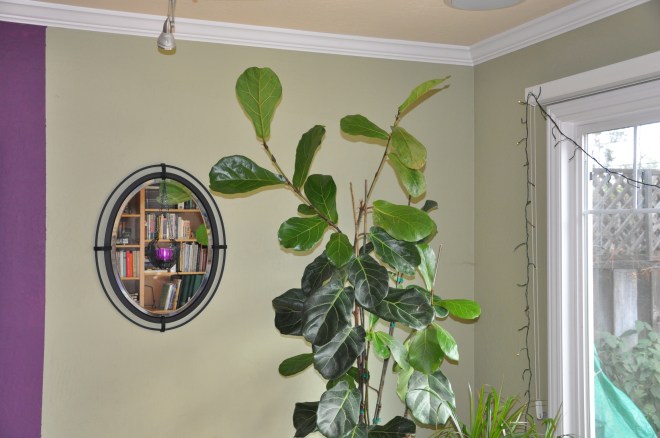
Fiddle-leaf Fig
Fiddle-leaf Fig

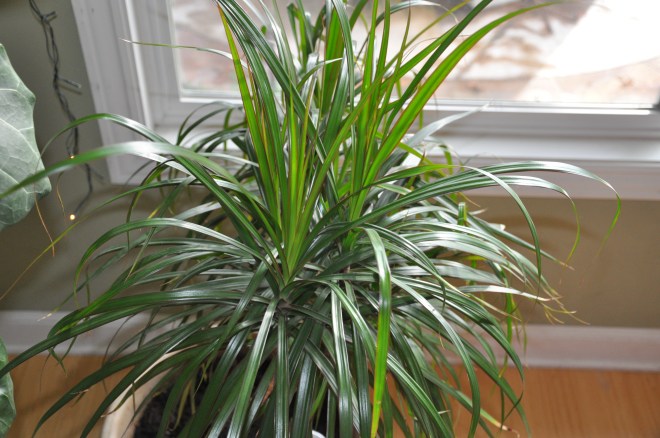
Dracaena

Dracaena

Kitchen Counter Collection

Kitchen Counter Collection

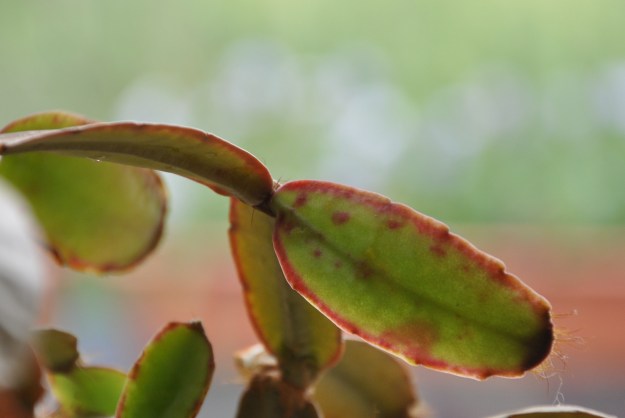
The current windowsill collection includes three “Christmas Cactus,” a small yellow rose and an as yet unidentified bulb.  I must have picked it up from the garden and had it stored in a kitchen drawer with my seed keeper.  It started sprouting, so I popped into a plastic martini glass, leftover from my Halloween costume.  Crazy, eh?

Martini with a twist?
Martini with a twist?

Sunrise Cactus

‘Sunrise Cactus’ gorgeous, even when not in bloom

Christmas Cactus Bloom

Christmas Cactus Bloom

Do you have anything growing on your window sill?