The Lone Radish

Look, Ma!  I grew a radish!

No thanks to the kitties of the house, my first attempt at a winter crop failed miserably.  I didn’t cover the box in time, so they all assumed it was a nice, big, fresh litter box.  They were mistaken.

By the time I realized what was going on, I had to start over. Feline waste and vegetables are not a good mix. Rabbits, cows or any other herbivorous animal, yes. Carnivores, no.

So, back to the garden center for me. Since time marched on, I went with cell packs instead of seeds the second time and limited the crop to cauliflower and broccoli. Once planted, I surrounded the boxes with heavy-duty wire to discourage cats and squirrels alike.  It worked!

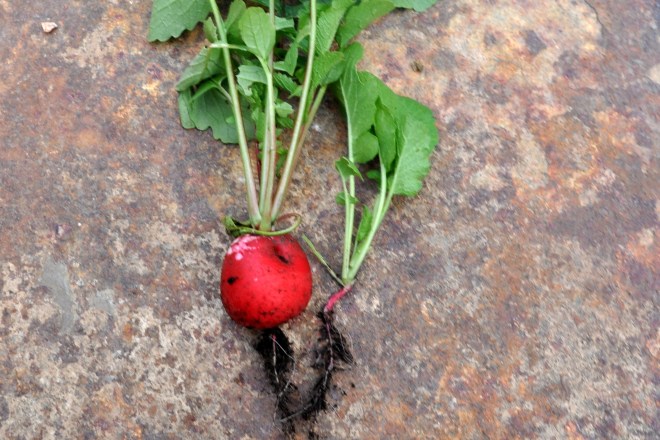
Imagine my surprise this week when a vibrant red radish appeared at the soil line. One seed survived (two if you count its tiny neighbor). We have a crisp and peppery addition to our next salad.

Radish

Survival of the Fittest


We have a dwarf lemon tree growing in our side yard, currently draped in frost cloth. It’s young, so it hasn’t produced fruit yet, but we’re hoping this is the year. Meanwhile, here are some fabulous tips from What’s Green With Betsy. After reading, I’m thinking a lemon a day should be my new mantra. Enjoy!

betsywild's avatarWhat's Green with Betsy?!?

One of my readers sent me a write-up about the secret of frozen lemons.  Rather than just using the lemon juice and wasting the rest of this nutrient-rich fruit, freeze it.  Wash it first and once frozen, grate the unpeeled lemon and add it to salads, soups, stews, ice cream, cookie dough, chicken and fish dishes, rice, martinis, whatever, for much added nutrition and taste.  What a great idea!

We all know that lemons are chock full of Vitamin C, which helps to neutralize free radicals linked to aging and most types of disease, as well as fight colds and flu.  But did you know that lemons contain more health benefitting nutrients than other citrus fruits like oranges or tangerines?  They contain citric acid, flavonoids, B-complex vitamins, calcium, copper, iron, magnesium, phosphorus, potassium, and fiber.   Surprisingly, the lemon peel contains as much as 5 to 10 times more vitamins than the…

View original post 212 more words

Smile! You’re On Gardening Nirvana

Some days you get lucky.  Today was one of them.

Like the felines in the house, many of the garden visitors put on a show till the camera comes out. Then they’re off, lickety-split.  Today I was able to snap some cuties.

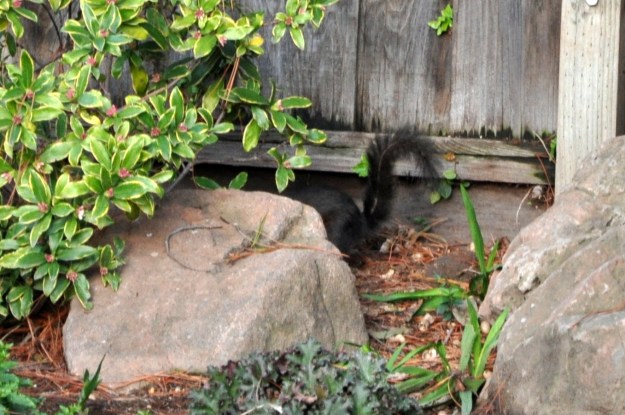
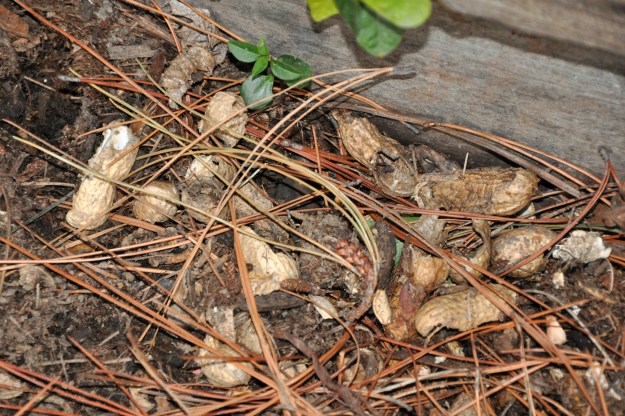
First up, this dark brown squirrel.  Most of our native squirrels are grey with a white belly.  This little fellow is dark brown with an amber belly, pressed up against the fence. He’s been busy stashing peanuts in a corner behind a rock. They nab the peanuts from our neighbor’s yard, then head over our fence to either bury them or eat them.

Dark squirrel with amber belly

A dark squirrel with amber belly hugs the fence

Stashing his peanuts behind the Daphne

Stashing his peanuts behind the Daphne

Peanut Wasteland

Peanut Wasteland

A more typical gray squirrel passed through with a peanut in his mouth.  Isn’t he adorable?  He jumped into one of the planters when he saw me, then ran back to the lawn to squirrel away his peanut.

Grey Squirrel with Peanut

Grey Squirrel with Peanut
I wanna hold your hand!

We enjoy frequent visitors at our hummingbird feeders.  Today I ‘searched’ the orange tree with my camera lens to see if I might spot a nest. In retrospect, given the number of squirrels and rats that visit each day, the tree is probably far to active for nesting. I followed the bird’s flight with my camera lens and captured a few shots of a hummingbird new to our area.  I’ve never seen one like it.  My research says there are a dozen hummingbird species in California, but none of them resemble this little one.  Take a look at this species list and let me know what you think.

DSC_0014

It’s been bitter cold for several days, down to freezing most nights.  I’m keeping the feeders topped off, especially after learning that the non-migratory birds are nesting from now until May or June.  I wonder where they go to stay warm?

I originally planned to hang bags of laundry lint for nesting material in the spring.  Since learning that hummingbirds are nesting now through May, I plan to hang lint tomorrow.

In my fantasy world, I have an invisible cloak like Harry Potter.  I would spy on all the wildlife up close without fear of detection. Would you like to join me?

Falling in Love with Phoebe the Hummer

Hummingbird in January

Visiting our Yard Today

Phoebe is an Allen Hummingbird living in a rose-bush in Southern California.  Through the magic of modern technology, you can watch Phoebe and her young on a live webcam, courtesy of Phoebe Allens WebCam.  It is a sight to behold.

According to the site owner, Phoebe built several nests in their garden rose-bush over several years. Sometimes she spruces up a nest for reuse or she builds a new one. She’s been coming back to the same rose-bush since 2007! In addition to the live stream, they’ve kept a nest log, detailing the number of eggs laid, hatched and fledged.

Nature being what it is, not all of the eggs or fledglings survive. I would be an emotional wreck if I saw one of the crows swoop in while I was watching.  That said, peering into a nest up close like that is incredible. Over 12 million visitors have come to the site. Once you take a look (day time hours, Pacific Standard Time) you’ll see why.

So far I’ve seen Phoebe feed her babies (twice).  I’ve seen infant birds wiggling alone in the nest and I’ve seen mama fly in and out several times. I’ve already trained my ears to the sound of her wings, so I click over when I hear them.

Here are a few more details about Phoebe from the site:

Phoebe is a non-migratory Channel Islands Allen’s Hummingbird She builds her nests in a rose-bush, and the nest is about the size of a golf ball, with eggs being about the size of a tic-tac candy. The season for nesting is October through May/early June, and Phoebe will lay four to five clutches per season. Two eggs are laid per clutch, they hatch after 17 days, and the chicks typically fly three to four weeks later. Phoebe will sometimes build a new nest, but frequently repairs old nests.

Special thanks to Boomdeeada for sharing this site. I keep it open on my computer when I’m working at home and pop over whenever I can.  If you take a peak, please let me know what you think.  I’m in love. ♥

Hummer at the feeder

The End


Garden Calendar Lives Another Day

Have you hung up your 2013 wall calendar?  Do you love a new calendar as much as I do?

My sister gave me The Old Farmer’s Almanac Gardening Calendar this year.  It’s always been one of my favorites.  The pages are beautifully illustrated with helpful notations and interesting quotes. Here’s one:

Benjamin Franklin introduced kohlrabi to colonial America.The vegetable’s German name originated from the Italian words cavolo rapa, meaning “cabbage turnip.”

You learn something new every day! ;-)

It’s fun turning over a new page to a new month and a fresh beginning.  Conversely, I removed my 2012 gardening calendar with great anticipation. In the past few years I’ve been re-purposing the beautifully designed pages into envelopes and stickers, tags and the odd bookmark.

This year I’ve challenged myself to use all of last year’s garden calendar in new and different ways. Here’s what I’ve been up to:

Gift Card Holder

This design simply evolved based on the pattern of the flower.  The gift card holder folds into thirds and is held in place by a sleeve.  When the sleeve is in place, the butterfly keeps the top flap from opening.

gift card holder

Gift Card Holder (cutaway with sleeve)

Gift Card Holder

Gift Card Holder (closed)

Desk Top Organizer

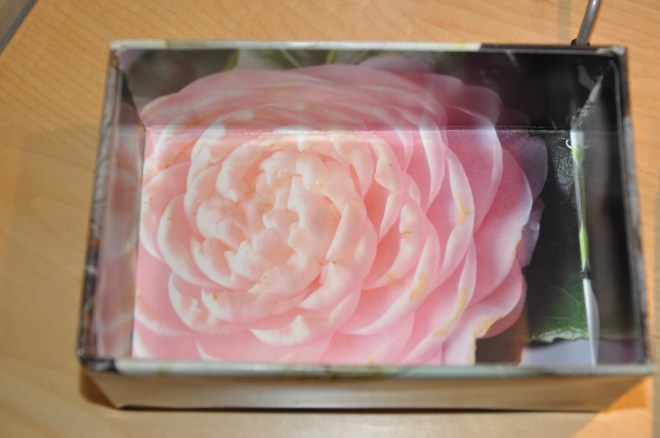
I’ve always loved little boxes, and this one is no exception.  It arrived with some unexpected treasures from a dear friend.  Rather than pack it away with the Christmas gear, I covered the box with four different calendar pages. I used the stiffer cardstock from the front of the calendar to make a pair of dividers.  Now I can easily get my hands on what I need.

Christmas Gift Box

Christmas gift box from a dear friend

Desk Top Organizer
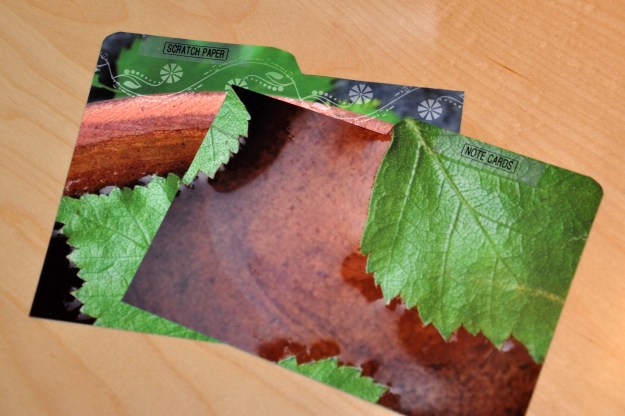
Desk Top Organizer

Dividers

Dividers

Box Lining

Box Lining

Napkin Rings

Once folded in half and glued together, the pages are quite sturdy. I cut them into strips, formed a ring, and stitched them together with a scrap of raffia.  Now I’m all set for Thanksgiving.

Napkin Rings (8 for next fall)

Napkin Rings (8 for next fall)

Envelopes, gift tags and stickers

Assorted gift tags and labels

Assorted gift tags and stickers

Envelope

Envelope

Wine Tag

Wine Tag

Postcards from the Edge

I used the only bit of white from the calendar to create a writing space.  The reverse side of the postcard has a quote.
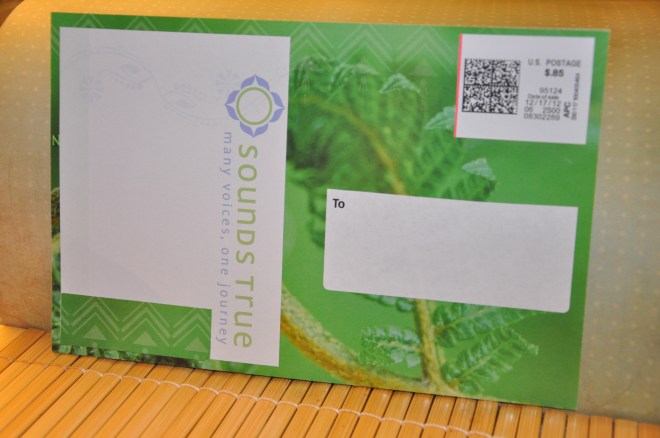
Two-sided postcard (back side has quotation)

Two-sided postcard (back side has quotation)

Bunting

For the Fairy Garden…of course.  :-)

fairy garden bunting

Drawer Liners and a Poster

Drawer Liner

Drawer Liners (My husband swears we need all these remotes)

Poster

Poster (back of guest bath door)

Check this out:

Katherine at Pillows a-la-Mode likes to re-fashion or re-purpose clothing in a similar fashion. She held a contest a few months back. The lucky winner mailed her a beautiful embroidered jacket (that not longer fit), and Katherine turned it into a tote bag, a tissue holder, a pillow and more. You can check out the contest winner and lots of other fun ideas at Pillows a-la-Mode.
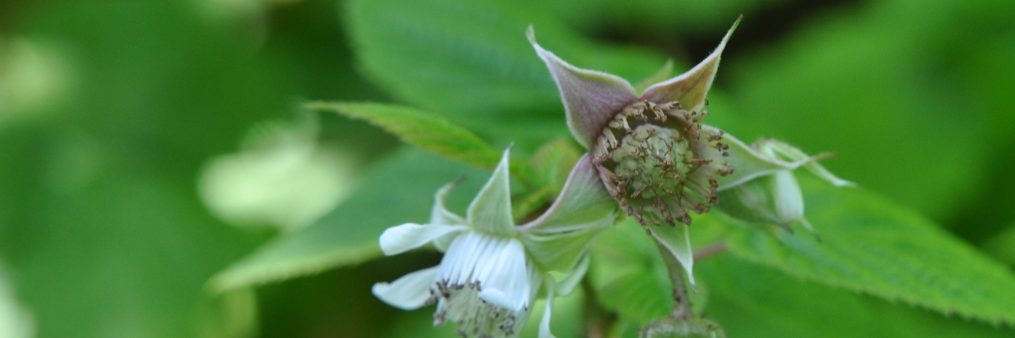
Hyacinth: Can you Smell It?

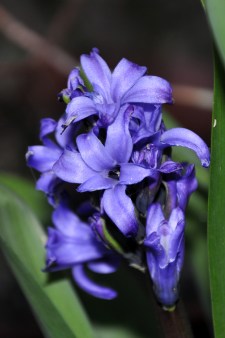
Purple Hyacinth

Purple Hyacinth

When I was a teenager, our mom gave each of us a hyacinth bulb one year for Christmas. As I recall, it came with a glass that allowed the bulb to sit suspended, with the roots growing into the cup of water below. Having the chance to grow one indoors was magical. With just one to focus on, I could see the changes day by day.  The scent was intoxicating.  It’s been a favorite ever since.

Several years ago I bought a half a dozen hyacinth bulbs at our local Costco.  They’ve moved from place to place over the years, but just when I think they’re spent, a few come back.  Three of them popped up on the back patio last week. They’ve been nibbled here and there, but they’re pretty just the same.  The scent carries me back, as they often do, to our small apartment growing up: powerful, fragrant and at times bittersweet.

Hyacinth in Bloom

Hyacinth in Bloom

Hyacinth Leaves

Hyacinth Leaves

Hyacinth Closeup

Hyacinth Closeup

Magnolia Scale: It’s Not For Wimps

My house is super clean which can only mean one thing. I’m procrastinating.

The decorations are down and the house is back in order. The sun is shining. I’m all out of excuses.  It’s time to tackle the Magnolia Scale. Blech!!!

Adult Scale

Adult Scale (Red)

Last summer we discovered a severe scale infestation on our Tulip Magnolia.  It was everywhere!  I removed numerous branches, perhaps close to a third, since the infestation was so bad.  We ordered beneficial lacewing eggs, hoping they would finish off the rest.

Now that the tree is dormant, it’s easy to see what remains.  Though not nearly as bad as last year, dozens of red scales (the adult female) along with the immature male and female nymphs, cling to the young branches.

Scale Removal

Scale Removal

Today, with my bucket and gloves in hand, I spent an hour scraping off scale.  They’re easy to see (bright red) against the trunk, but I had to stand on a step stool to reach all of them.  After tossing them into a bucket, I went back with a warm, wet rag and wiped off the nymphs.

The overwintering nymphs are all over the tree!  There is no way I could get all of them, but I sure gave it a try.

Scale Nymphs

Scale Nymphs

After giving the tree one last look, I sealed the scale in a plastic bag for disposable, and soaked the bucket, rag and gloves in hot, soapy water.

Scale in a Bag

Scale in a Bag

I’ll check on the tree again tomorrow, and if the weather warms up, I might take a hose to the underside of the branches to remove some more.

Here’s what I’ve learned:

  • When purchasing a young Magnolia tree, check the inner branches first for infestation.  Apparently many of the trees have scale before you bring them home.
  • Prune judiciously.  Magnolias, especially mature ones, don’t handle heavy pruning.
  • Time your pruning appropriately.  I’ve read the best time to prune is late winter, early fall, after flowering and before new buds set.  Given those parameters, you really need to stay vigilant.

Resources:

Mercury News Garden Calendar: An Annual Tradition

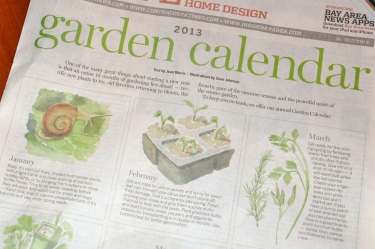
DSC_0047Our local paper publishes a garden calendar every January. The 2013 version arrived with Saturday’s paper. The calendar is a single page, always beautifully illustrated, with general gardening guidelines arranged by month.

I hang the calendar on the back of the garage door and refer to it throughout the year. It doesn’t hold any special advice or information that I couldn’t easily find online, but I hang it up anyway and check in to be sure I’m on track.

I used to be a haphazard gardener. My intentions were good, but also easily derailed when my boys were young. Months would pass before I checked in with the calendar again, but I hung it up just the same.

In this era of declining print, I wonder how long ‘the papers’ will stay in business?  Though I enjoy the immediacy of the internet and the incredible access to information, I still enjoy the feel of a newspaper.  It’s fun looking forward to the yearly calendar.  We check the local section for “spare the air” days and my boys check the weather.  Yesterday’s news is great for catching debris when you re-pot a plant.  You can even add it to your compost pile.

Of course newsprint comes from lumbar, so less paper means more trees.  I can certainly get behind that.  Change is both good and inevitable, but as annual rituals go, I’ll be sorry if and when this one is gone.

For a closer look at the San Jose Mercury news Garden Calendar (available, of course, online) follow this link.  Illustrations by Dave Johnson.

A Little of This and That

Guess what?

I was out on the deck taking pictures when a bright yellow flower caught me eye. There aren’t any yellow flowers growing this time of year, so it really took me by surprise.  Then I realized little visitors stopped by the fairy garden.  What a nice surprise.

If you are reading this post and you know who the fairies are, please be sure to extend my thanks.  It was such a treat to find those flowers.  I spotted a tiny mum tucked in as well and a few greens.  Thank you, from the bottom of my heart!!!

Flower Surprise

Flower Surprise

Pumpkin Countdown

Last summer we grew several pumpkins.  Four of them were over 40 pounds.  My husband carved one, but they were really thick and not well-suited for ‘Jacks.  We lined the wall of our garden pathway with the remaining pumpkins, and they’ve weathered the months beautifully.  Twice in recent weeks, someone came to the door and asked if they could take one for cooking.  We happily obliged, with a warning to please lift carefully.  We now have one large pumpkin sitting on the wall, with a smaller, autographed one nearby.  That one is just now starting to soften and will probably be headed to the compost bin in another week.  We’ll be down to one ‘little’ pumpkin, sitting on a wall.  :-)

two little pumpkins

Two ‘little’ pumpkins, sitting on a wall

Avoiding the Scale

I know what you’re thinking.  It’s January and I can’t hide from the scale forever.  Time to put away the treats and face the music.  All true.

I’m avoiding the scale that remains on the now-dormant Magnolia.  Honestly, it creeps me out.  We had quite the infestation last summer.  We did a bit of research and got down to business. I ordered beneficial insect larvae. While waiting for them to arrive, I heavily pruned the tree. The inner crown was far worse, so I removed as many of those branches as I could. Left unchecked, scale can kill a tree.

Scale

Magnolia infested with scale

Now that the Magnolia is dormant, it’s easy to see what remains. I need to scrape the scale into a bucket, before it takes hold again.

To think I thought putting away the chocolate was hard.

Viburnum Tinus: Odoriferous With a Side of Thrips

A row of Viburnum Tinus grow below the window of our den. The plants fill the space nicely between the ramp to the deck and our house. It’s a good-looking shrub, producing pretty flowers and berries during the winter months.  But…that smell.

We naively thought the pungent smell was coming from under the house. I thought a small animal might have died in the crawl space. My husband thought a neighborhood cat was spraying and tried a deterrent in the immediate area. The smell was so overpowering when we opened our window in the spring that we started keeping it closed while we researched the cause.

Viburnum tinus

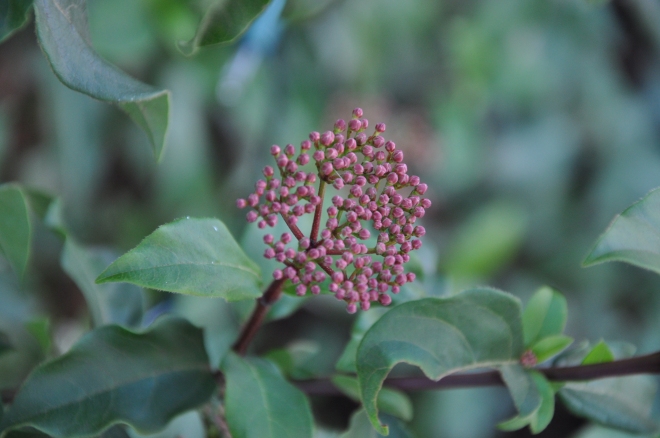
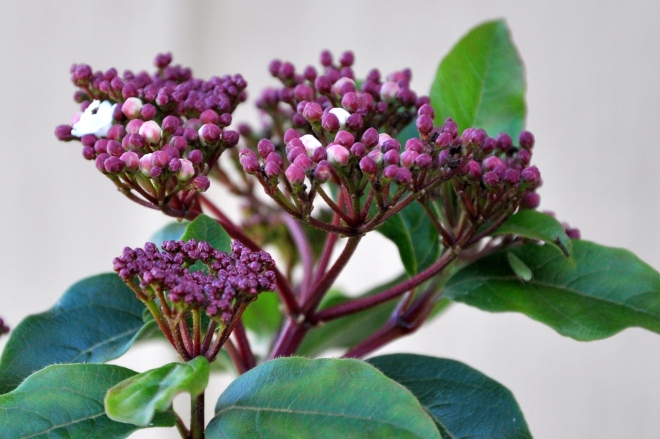
Viburnum tinus, early buds

Viburnum tinus, buds

Viburnum tinus, small buds look like stars and beads

Last summer we noticed the lower leaves were a grayish brown. Turns out we had thrips. Was that what caused the smell?  We ordered beneficial insects (the larvae eat the thrips), reassured that we had good insectary sunflowers nearby for the mature adults. Further, I heavily pruned the lower branches, cutting away as much damage as possible. I hauled all the underbrush away from the plants to allow air circulation.

I noticed today that the thrips are back (along with the tell-tale brown leaves) though the plant continues to grow, flower and fruit.  I did a little research, and it seems the smell and the thrips are exclusive. According to Plants For a Future  the tinus “plants give off an offensive smell in wet weather.” Several writers on the forums describe it as something a dog left.

That’s it! At long last we have our answer. Now what to do about that odoriferous smell?

Viburnum tinus

Viburnum tinus, opening blooms

Viburnum tinus

Viburnum tinus, flowering white

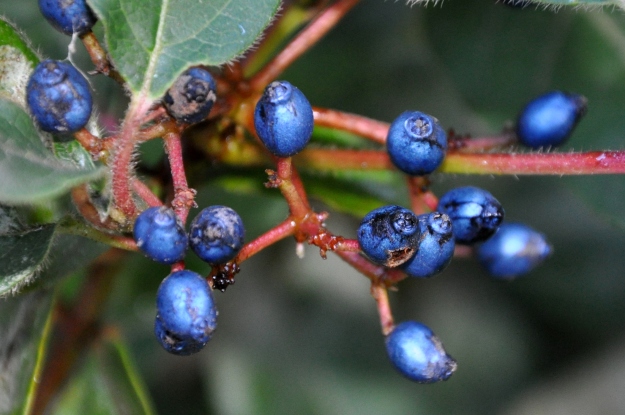
Viburnum tinus berries

Viburnum tinus berries (inedible)