Harvesting Pumpkins: Three to Get Ready


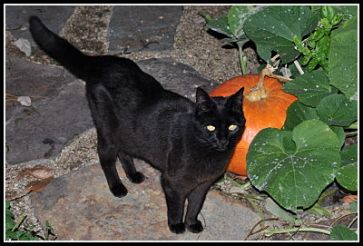
Black cat with pumpkin

Slinky is ready for Halloween

What a joyous day!  Fall is in the air and pumpkins are in my house.  We harvested three orange lovelies this morning, then brought them indoors for safe keeping.  Two have been ready for a while but I left them on the vine for up to the minute ripening.  The third pumpkin was a surprise, in more ways than one.

We still have four extra-large pumpkins on the vine, hoping they’ll turn a bit darker.  Currently they have a peach complexion.  I lifted one of these large pumpkins away from the beds to give it more sun, and discovered a smaller pumpkin had been growing just below.  It has multiple cracks in an interesting geometric pattern, but each of the cracks healed over.  I can’t wait to take a picture and share it with you.  We’ve never seen anything like it.  I’m wondering if the extraordinary weight of the pumpkin above caused it to slowly crack, giving it time to heal as it split.  My husband and resident carver is looking forward to hollowing it out.  He thinks it will look like a star burst.  We’ll restrain ourselves until Halloween.
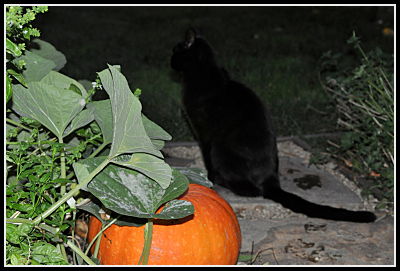
Slinky near the pumpkins

Do you think she’s waiting for The Great Pumpkin?

The plan is to give each of the larger pumpkins a name on our Wii Fit, so we can weigh them one by one.  Won’t that be fun?

Meanwhile, I’m practicing sitting on my hands.  Every time I go out there I want to harvest the fruit and make way for the winter garden.

Ò Ó Ò
 

Sunflowers: Setting Sun on the Season

I knew this day would arrive, but oh how I’ll miss them.  The row of sunflowers lining the deck are starting to go to seed.

Impatient birds knocked over one of the lightweight planter boxes last week, smashing the largest flower head clean off the stalk and into a heap on the deck. My son helped me move the planters from the deck to the narrow space behind the lavender to stabilize the planters.  Now wedged in place, they won’t fall over, but they look like they shrunk two feet.  Hopefully the rest of the flowers will go to seed on the stalk. It’s a beautiful thing to behold.

Last year I placed the seed heads along our stone wall, just outside my office window.  There I could watch the squirrels pick them clean.  I don’t know why I find those cute little hands at work so appealing.  I’m annoyed when they chew off the pumpkin leaves, but delighted when they snack on the seeds.

For my readers living in different parts of the world:

Sunflower (Helianthus annus) is an annual plant native to the Americas. It possesses a large inflorescence (flowering head). The sunflower is named after its huge, fiery blooms, whose shape and image is often used to depict the sun. It has a rough, hairy stem, broad, coarsely toothed, rough leaves and circular heads of flowers. The heads consist of many individual flowers which mature into seeds, often in the hundreds, on a receptacle base. From the Americas, sunflower seeds were brought to Europe in the 16th century, where, along with sunflower oil, they became a widespread cooking ingredient. Leaves of the sunflower can be used as cattle feed, while the stems contain a fibre which may be used in paper production. – Wikipedia

Today I’m wearing my worn out but much-loved sunflower t-shirt with the saying “Love this Life” across the front.  It’s my own little sendoff to Helianthus annus, flower of the sun.

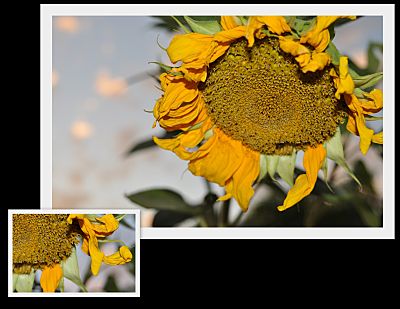
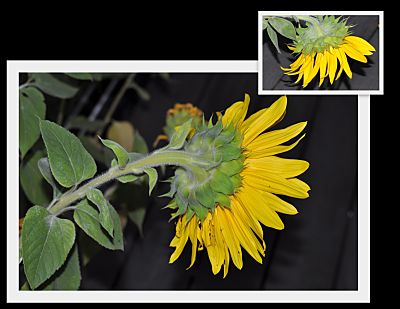
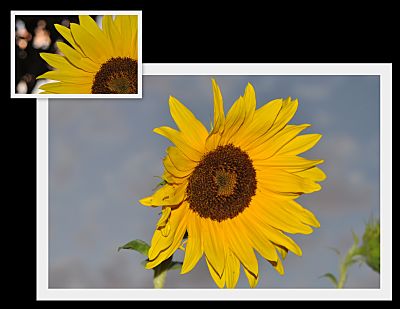
Here are the last of them, photographed at dusk.

Sunflower
Sunflower at Dusk
End of Season Sunflower

Floating rafts of sunflowers are being used to clean up water contaminated as a result of the 1986 accident at the Chernobyl nuclear plant in the former Soviet Union. The roots of the sunflower plants remove 95% of the radioactivity in the water by pulling contaminants out of the water.”

Birdhouse Gourd: Racing the Biological Clock

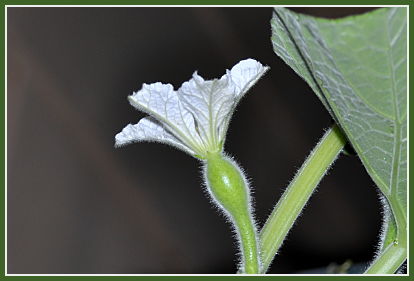
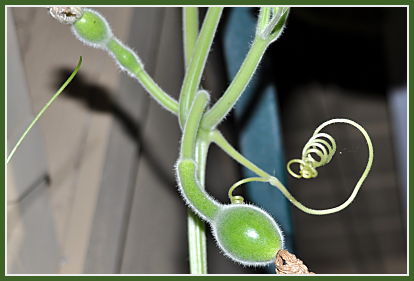
Our birdhouse gourd vines are sporting several small fruits, each one about two inches long. They’re the color of limes and about as large as an over-sized peanut. Aren’t they cute?

The question of the hour is will they grow up?

We found the seed packets on one of our nursery rounds, but not until after planting the rest of the garden. The idea of growing a birdhouse was irresistible so of course the packet made its way into my cart. I envisioned a garden full of birdhouses, just waiting for a feathered mama to claim them.

We have at least another month of warm weather, but will it be enough? Please send your happy-garden energy vibe. I’ll be sure to report back.

birdhouse gourd flower

Birdhouse gourd bloom

Birdhouse gourd bloom

birdhouse gourd fruit

Blooming Thursday: Garden Friendships

My friend Liz has been back in the States for several months, but it took her imminent departure for us to finally get together.  Our friendship is such that we can simply pick up where we left off, regardless of time passed.  Liz is also a gardener I admire and look up to.

Liz has the unique distinction of gardening through one spring and two summers.  She spends part of her year in California, the rest in beautiful New Zealand.  She taught me and some friends how to felt on one of her trips home.  I hope to learn how to eco-dye from her one day, too.

On her visit today, she came bearing gifts…and lunch!  So much for my hosting skills. We enjoyed delicious, home-made, vegetarian burritos while sitting on the patio talking shop.

You probably need to be a gardener to fully appreciate the first gift: a bag of worms and worm castings. I feel like a real gardener.  I have a worm bin, a kitchen scrap container, and soon my tumbling composter will arrive at my door.  I’ll be brewing garden goodness all winter long.

Worm Bin

Worm Bin

In addition to worms, I am also the lucky recipient of several eco-dyed pieces, one-of-a kind art made with natural dyes, leaves and flowers. The small pouch is made from reclaimed materials, printed with leaves, dyed, then hand-stitched.

Eco-dyed Pouch

Eco-dyed Pouch

The three pieces pictured below use a similar technique, but with paper. I love the artistry.

eco-dyed print

Eco-dyed Art Print

Eco-dyed paper

Eco-dyed Paper

My dear friend is not a fan of pictures, but she did let me take a closeup of her t-shirt. She bought the shirt at a thrift store, wrapped it around rose leaves, and dipped it in a natural dye. It’s exquisite.

Eco-dyed T-shirt


Eco-dyed T-shirt

You can learn more about eco-dying from India Flint.

Kitty Bouquet: Catnip on a String

It’s always nice to bring your hostess a bunch of flowers from your garden, but what about the resident cat?  Since kitty usually calls the shots in feline-centric households, it only seems fair.  I propose catnip on a string.

Not all cats are susceptible to the intoxicating oils of the catnip or cat-mint plant.  When presented with a fragrant bunch of greens, about half of all cats will respond.  Be sure to offer your gift in an appropriate setting.  If kitty drools green catnip all over your hostesses white couch, you probably won’t be invited back.

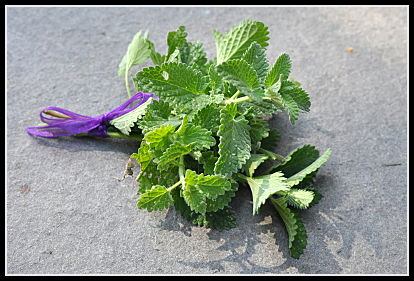
Catnip with Bow

Hostess Gift
Catnip with a Bow

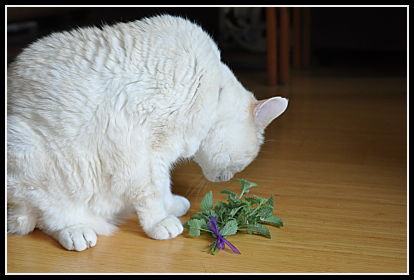
Cat inspecting the catnip

I hope this is organic

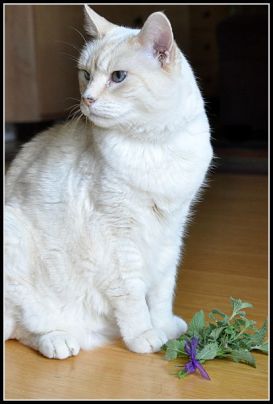
Cat with catnip

Shall I go ahead and give it a try?

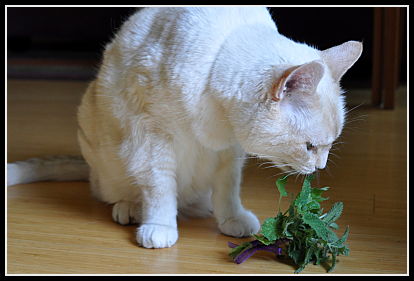
Tasting the catnip

Tasty!

Catnip Bouquet Tutorial

  1. Turn at least 70% of your growing space into a catnip garden.
  2. Pinch a few leaves from the plant once it’s fully grown.
  3. Tie a bow around the bunch (six inches or less, please so kitty doesn’t get tangled).
  4. Deliver to your feline host.

If you follow these instructions carefully, you’ll be invited back again and again.  Enjoy!

Costume Pieces Made From the Garden

Finally I have some dead and dying flowers from the garden to work with.

She’s lost her marbles, you say?  Not at all.  I’m helping my sister make her Halloween costume.  She’s dressing up as The Corpse Bride, from the movie of the same name. We’re big Halloween fans in our household. It’s license for silliness and creativity.

Tim Burton's Corpse Bride

Tim Burton’s Corpse Bride
(photo credit Yahoo Movies)

Here is what we have so far.

The Veil and Headpiece

We found a sheer ivory curtain panel at a local thrift shop to create the veil. I’ll distress the fabric in a bath of tea to add character. I made the crown from Mexican Sage flowers tied around the base of a headband, then wrapped in purple ribbon. As the flowers dry between now and October, they’ll take on a dusty hue.

Corpse Bride Crown

Corpse Bride Crown
(Mexican Sage)

Sage and Ribbon Closeup

Sage and Ribbon Closeup

The Bouquet

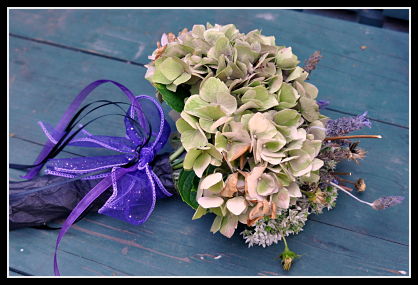
I used spent hydrangea blooms, now a mottled pink and green, and added dried lavender. I mixed in dead Cosmo stems and a few Allium Stellatum, also known as Prairie Onions. (She can smell the part, too). I wrapped the dried stems in garden twine, covered them with black tissue paper, and added leftover bits of purple and black ribbon.

Corpse Bride Bouquet

Corpse Bride Bouquet

Corpse Bride Flowers

Corpse Bride Floral Bouquet

The Gown

We picked up a white sheer blouse and a long linen skirt for a few dollars at a thrift shop.  They’re both made of natural fibers so they’ll die well.  (Oh the puns). Together they’ll make her wedding gown.

There are a few more details, but for the most part the costume is coming together.  Halloween is about eight weeks away.  Can’t! Wait!

Do you celebrate Halloween in your area?  Do you plan to dress up?

Tumbling Composter: Waiting for UPS


Forest City Tumbling Composter

Forest City Tumbling Composter

It’s all coming together.  The Tumbling Composter I ordered online will arrive this week. My counter-top food scrap bin is almost full. There’s a bucket in the garage collecting spent flowers and the leaves on the Chinese Pistache are starting to turn!  I’ll have all the ingredients for my first batch of compost.

I looked at several varieties before settling on this model. My criterion was simple:  It had to be portable, affordable and resistant to rodents.  It’s constructed from recycled materials, also a plus, and the compact size is perfect for my small vegetable garden.

Why Compost?

  • Composting reduces the amount of waste you send to the landfill
  • Composting turns your waste into a useful product—and it does so without requiring additional resources.
  • Using compost in your garden reduces the need for water and fertilizers and helps eliminate the need for pesticides.
  • Composting provides you with a valuable experiential lesson in the cycles of nature and the folly of our throwaway culture that is likely to lead to other waste-saving measures as time goes by.   (Source: Sheryl Eisenberg, Natural Resources Defense  Council NRDC)

Additional Resources


Eastwooding: An Empty Chair with Flare


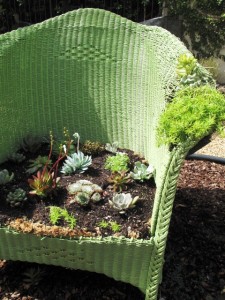
Boomdeeada got me rolling this week, when she shared this clever (empty) chair from Pinterest with the term Eastwooding.

Cactus Chair Made by Valentina Gonzales Wohlers

Cactus Chair Made by Valentina Gonzales Wohlers
(Thanks Boomdee)

Eastwooding

Someone coined the term “Eastwooding” after actor Clint Eastwood addressed an empty chair at the  Republican National Convention. He was pretending to address President Obama.   Memes are spreading across the web, parodying the awkward, at times rambling, unscripted speech.

A meme is a cultural item that is transmitted by repetition in a manner analogous to the biological transmission of genes.

In his book The Selfish Gene (2 ed.) Richard Dawkins states “We need a name for the new replicator, a noun that conveys the idea of a unit of cultural transmission, or a unit of imitation. ‘Mimeme’ comes from a suitable Greek root, but I want a monosyllable that sounds a bit like ‘gene’. I hope my classicist friends will forgive me if I abbreviate mimeme to meme. If it is any consolation, it could alternatively be thought of as being related to ‘memory’, or to the French word même. It should be pronounced to rhyme with ‘cream’.”

I will leave the clever memes to the talented folks that create them, but thought it would be fun to share empty chairs with a gardening flare.  Be sure to let me know if you have a favorite in the comments below.

Garden Chairs with Flare

Artistic garden chairs by De Castelli

Artistic garden chairs by De Castelli
(This chair is really growing on me)

Debra Prinzing Planted Chair

Debra Prinzing Planted Chair
(What a ferny arm)

Dragonfly Garden Bench

Dragonfly Garden Bench
(Heavy duty bench won’t fly off in the wind)

Leaf Chair and Bench

Leaf Chair and Bench
(It might be best to just leaf this one alone)

Artscapes Garden Furniture

Artscapes Garden Furniture
(Is it your turn to mow the lawn?)

Of possible interest:


Double Dentate: The Shape of Leaves to Come

Flowers and fruit are the garden darlings, but where would they be without leaves?  As a seed set roots, tiny leaves quickly follow, the building blocks of things to come.  Leaves are:

“a plant’s principal organ of photosynthesis, the process by which sunlight is used to form foods from carbon dioxide and water. Leaves also help in the process of transpiration, or the loss of water vapor from a plant.”

The shape of a leaf, known as the leaf margin, helps to determine the type of plant.  Leaf margins, or edges, include dentate, double dentate, crenate, ciliante, entire and lobate.  I traveled the garden with my camera this week, so I could get up close and personal with the powerhouse leaf.

The Shape of Leaves to Come

I enjoyed studying the different leaves in my garden, viewed with a more observant eye. Each plant has leaves that are fully formed, but it was also fun to observe the shape of leaves to come.  Some leaves stack in pairs, in alternating patterns, while others climb up the plants stem. My garden favorites:

Inky Leaf Coleus

Inky Leaf Coleus: Lobed

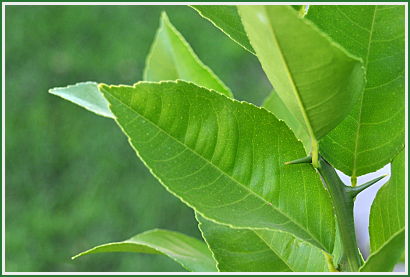
Lemon leaf

Dwarf Lemon: Entire Leaf

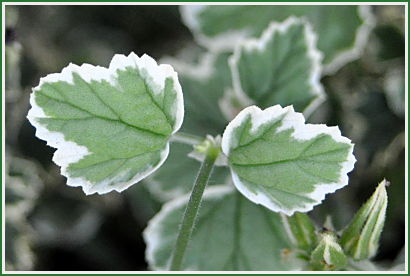
Scented Geranium Leaf

Scented Geranium Leaf: Dentate (or Serate)

Star Jasmin Leaf

Star Jasmin Leaf: Lobate

Clover Leaves

Clover Leaves: Entire

Resources:

Complimenting the Sunflowers: The Color Purple

In color theory, yellow compliments purple. The colors are directly adjacent to one another on the color wheel, in the same way green is to red, and orange is to blue. Without consciously realizing it, I’ve complimented brilliant yellow sunflowers with purple Lavender, Ageratum and nearby Mexican Sage.

The sunflowers line the top of the deck, while the lavender shrubs grow in front. The fragrant flowers bump up against the steps, softening the hard edges. Lavender is one of my favorite plants. It blooms for months on end, with a distinctive scent, valued for its restorative and relaxing powers.  I dried a bunch of lavender in the garage, and used a few blossoms in my bath.  I’m dreaming up ways to share these powerful blooms this Christmas.

Lavender

Lavender Lines the Deck

This week I planted Ageratum and Baby Tears in a moss bowl, added some LEGO® Brick furniture and called it a Fairy Garden. It wasn’t until I took a step back from the arrangement that I realized I had surrounded the sunflowers with purple goodness. I love the shape of the fluffy blooms, but I also delight in the little saucer shapes with the dotted edges just before.

Ageratum

Ageratum Graces the Fairy Garden

Dominated by tall grass, the Dwarf Plumbago is easy to miss. It resides in the lower garden and to the right of the steps leading to the deck. Don’t you just love the red burst of seed pods in the center?

Dwarf Plumbago

Dwarf Plumbago

The magnificent Mexican Sage grows at the curb, in an otherwise unremarkable section of the sidewalk strip. The sage goes dormant around December, when we give it a hard prune, then resumes its show of color, spring through fall. It’s a popular plant with children on the block due to its soft, velvet-like flowers. The hummingbirds are also big fans, frequently tussling over the right of territory.

Mexican sage

Mexican Sage
Drought-Tolerant and a Hummingbird Favorite

On the subject of territory, my sister Sharon “owns” the color purple. It’s been her favorite her entire life. Sharon, this one’s for you.