Monterey Pine: A Shave and a Haircut

If trees could talk...

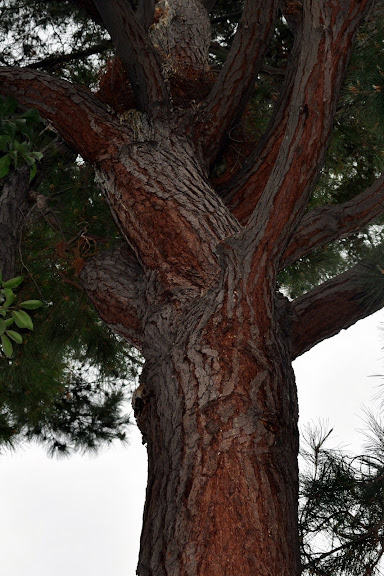
As borrowed landscaping goes, you can’t beat the majesty and grace of a native Monterey Pine. This beauty lives at the fence line of our neighbor’s yard but we share the bounty year round. I’m humbled when I look at a tree this old and grateful that it continues to thrive in our urban setting.  The invasive pitch canker disease threatens to destroy 85% of the native Monterey pine forests by 2015.  According to this article by Linda Boston Franke:

In the last decade, this hearty pine tree species, which adorns west coast beaches, populates coastal mountain sides, accents both urban and rural neighborhoods, and flourishes in Christmas tree farms, has been threatened by a disease known as pitch canker, leaving beloved backyard monuments and entire forests alike scarred with scraggly decaying branches, gaping bare spots, and in many cases with the complete demise of the tree itself.

I’m so happy that “our” tree is still standing.

We’ve used the professional services of Ian Geddes Professional Arboriculture for 15 years.  They come out periodically to check on the health of our trees, pruning when necessary.  We were happy to learn last summer that the tree remains in good health.  Geddes team came out today to give the pine a “shave and a haircut” while the temperatures remain cool.  They thinned the inner branches to increase circulation, removed dead branches and tucked back some of the limbs to a safer distance from our homes.

PG&E sends out a crew every two years to trim the tree near the power lines, leaving it looking lopsided with a c-curve carved on one side.  Today’s prune was more aesthetic in nature, not to mention an amazing thing to watch.  Three men, tethered to one of the tallest limbs, scaled the tree and removed dead and crossing branches.  They were sure-footed and agile as they went about their work.  I heard singing from one of the branches, a clear sign in my book that at least one of the men tethered to the tree is doing something he loves.

As for our towering pine, I hope I’m still writing about the squirrel escapades as they circle the trunk, or the wonderful smell of the tree after a rainstorm in the years to come.  We’ve planted our own roots in this neighborhood, and this tree is part of what makes our house a home.
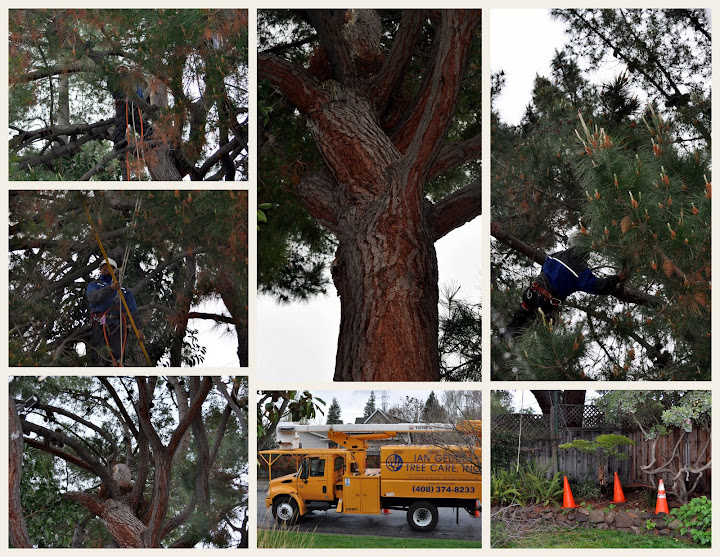
Ian Geddes Tree Crew
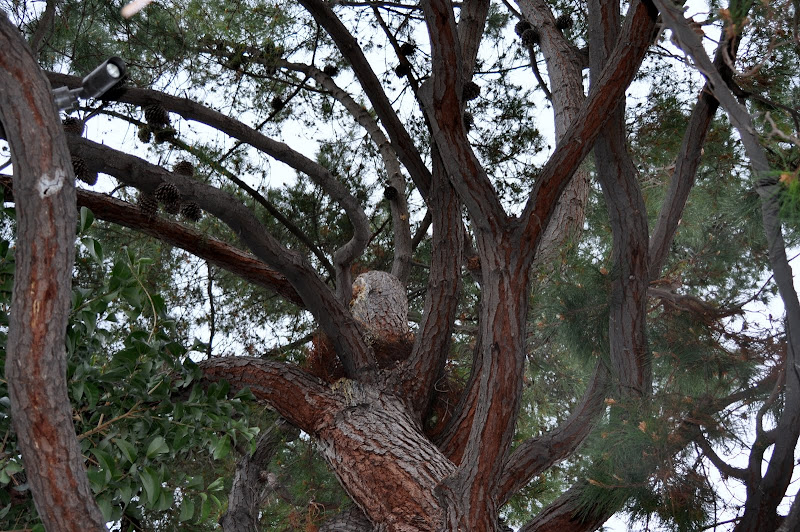
More Air Flow to the Tree
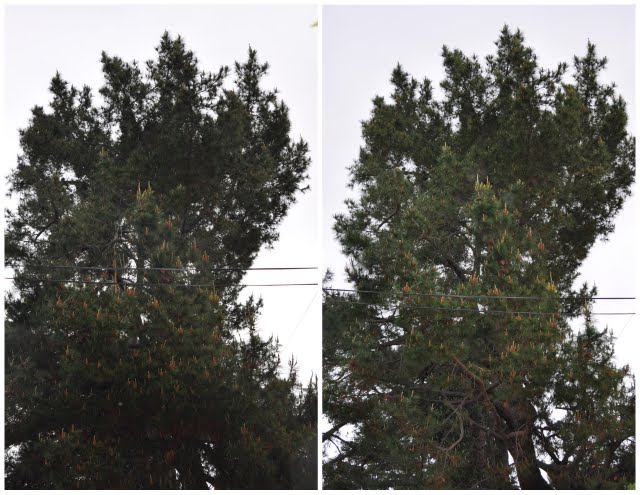
Before and After the Trim
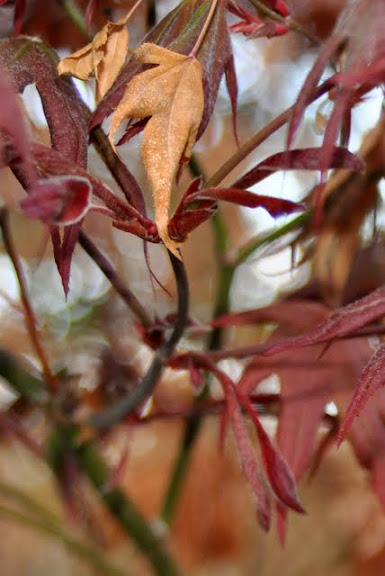
Maple Musings

Close Up

Rain is in the forecast again this week, but I’m trying not to get my hopes up. As we come to the end of this La Niña year, experts predict one of the lowest rainfall seasons recorded for San Jose. Other than a few cold days here and there, it’s been a surprisingly mild winter as well. All this adds up to confusion in the garden.

Our beautiful maple tree generally starts dropping leaves in the fall, and after a few good storms, the branches remain bare till spring. Around March, the maple’s internal clock knows to send out buds and shoots and little fruit known as winged samara. In a matter of days the tree dresses in rich, red leaves.

This year, only a few leaves dropped. They turned brown on schedule, but without the rain or wind, the leaves remained. A friend asked if the tree was dead and who could blame her: such odd behavior for a deciduous tree.

It’s been a rough season for allergy sufferers as well. Early blooms from over-stressed trees wreak havoc on sinuses. In my California backyard, one lone maple provides color and shade, but states like Vermont have cause for concern. Trees need cold nights followed by warm days to produce maple syrup.  According to Tim Perkins, director of the University of Vermont Proctor Maple Research Center:

“Sap flows best on warm, sunny days followed by nights that dip below freezing. The fluctuations are key: Cold nights contract air bubbles within the tree, producing suction that draws sap from the ground into the tree, where it mixes with sugar and freezes; warm days thaw the sap and expand the air bubbles, creating pressure that makes the sap flow into buckets or tubing, said Tim Perkins, director of the University of Vermont Proctor Maple Research Center, who has studied climate change’s impact on the maple industry.

Perkins predicts that climate change over roughly the next hundred years will result in the loss of maple trees across much of New England, according to congressional testimony he offered in 2007.”

As I muse on our lone maple tree within our suburban setting, I’m intrigued at the parallels on a grander scale, and what it means for us all. I’m worried.

The Old and the New

The Gardener: “I’ve tried to remember everything you taught me about beauty…”

The Gardener: by Sarah Stewart, Illustrated by David Small

We treasured books in the home I grew up in, and that tradition lives on in my home today.  One of the greatest joys when my boys were young was the time we spent snuggling and reading.  We punctuated our weeks with trips to the library, weekly storytelling at our local Barnes and Noble and the occasional author reading at the eclectic, one-of-a-kind Hicklebee’s children’s book store in Willow Glen.  I can say without exaggeration that I’ve read thousands of pages of kid lit: the good, the great and the regrettable.

From those piles of books, emerged one of  my all-time favorites: The Gardener by Sarah Stewart.

I remember the day I pulled it off the shelf, delighted to find a beautifully illustrated book that wasn’t about trains or bunnies.  I stood skimming it, then sat down on the floor so I could give it my full attention. I knew I was holding something special.  My little one was enjoying his own book selection, so I was free to savor every page. What I found was an incredibly moving, poignant, and hopeful book with joy on every page.  The illustrations, by award-winning artist David Small are lovingly rendered with charming details tucked into the corners of each page.  This review sums it up beautifully:

“A moving, wonderfully rich illustrated story. It is that rarity, a pictorial delight that in 20 double pages gives more and more of itself each time it’s read, and whose silent complexities reveal themselves with continuing pleasure.” —The New York Times Book Review

You needn’t be a child or a gardener to appreciate this gem.  Go flop down on some cushions somewhere and give it a read. You’ll be glad you did.

Blooming Thursday: Star Jasmine

Ready to Burst

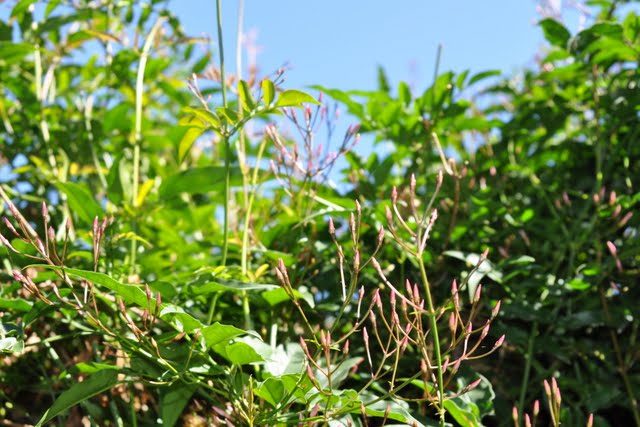
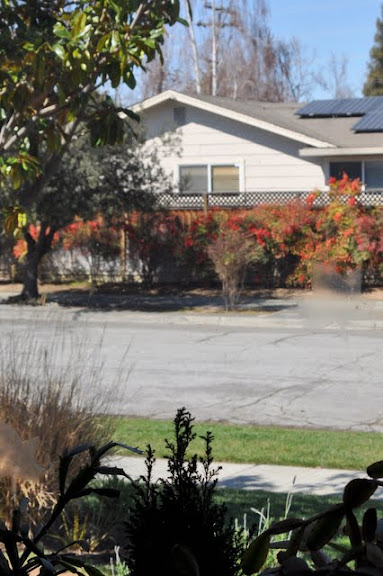
At the corner of our house, between two suburban lots lives the harbinger of spring: that heady, scented, intoxicating bloom star jasmine.

Against clear blue skies, the contrast of buds at the ready, the plant will burst into bloom any day. When it does, I’ll find myself lingering by the drive, taking in the scent and savoring it for as long as possible. Jasmine evokes the approach of summer. It puts a bounce in my step. I feel alive, connected and even amorous when it blooms.

Is it any wonder they’ve tried to bottle and sell it?

Beautiful Pinks against the Blue Sky

Tomorrow's Blooms

Lions and Tigers and Bears, Oh My!

March Haiku

March Winds

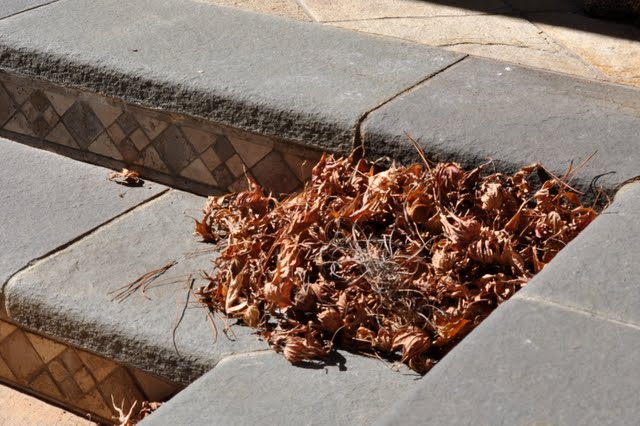
March winds fiercely blew.
Leaves gathered on the doorstep
I don’t need a rake!

Icy Water

Icy water flows,
fallen leaves how you vex me.
Mold in one hour.

Visiting Feline

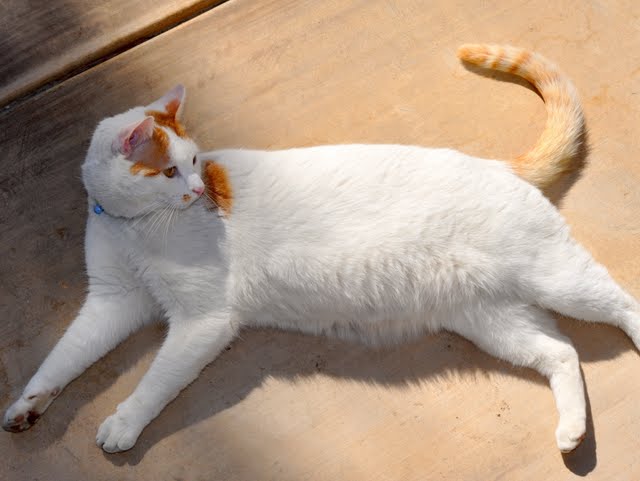
Visiting feline
graces our garden each day.
Does your mama know?

Neighborhood Squirrel

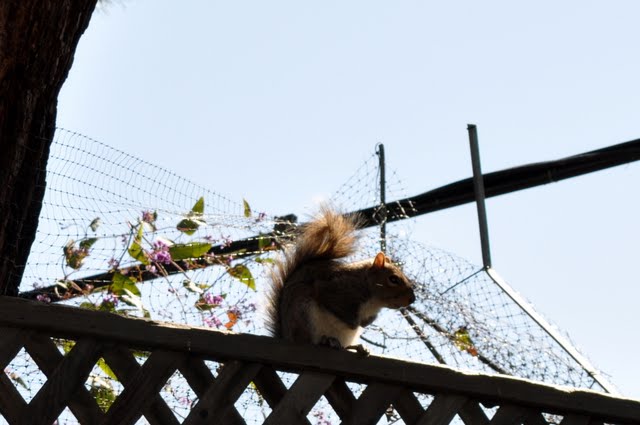
Neighborhood tree squirrel
amassing a trove of nuts,
please spare my new lawn.

Hardenbergia

Hardenbergia
Monosyllabic flower
you’re one-third haiku.

You can learn more about the origins of the ancient Japanese poetry style Haiku here.

How to write a Haiku poem from Creative Writing Now.

About the Haiku Master From Wikipedia:

Matsuo Bashō (松尾 芭蕉?, 1644 – November 28, 1694), born Matsuo Kinsaku (松尾 金作?), then Matsuo Chūemon Munafusa (松尾 忠右衛門 宗房?),[1][2] was the most famous poet of the Edo period in Japan. During his lifetime, Bashō was recognized for his works in the collaborative haikai no renga form; today, after centuries of commentary, he is recognized as a master of brief and clear haiku. His poetry is internationally renowned, and within Japan many of his poems are reproduced on monuments and traditional sites.

Spider Plant Sprawl

Spider Plant Sprawl

One by one, the root-bound spider plants relocated to the fence line.  We jokingly refer to that area of the garden as the back-forty.  It’s also where big, hairy spiders go, so they can do their garden business without scaring me on my daily rounds.

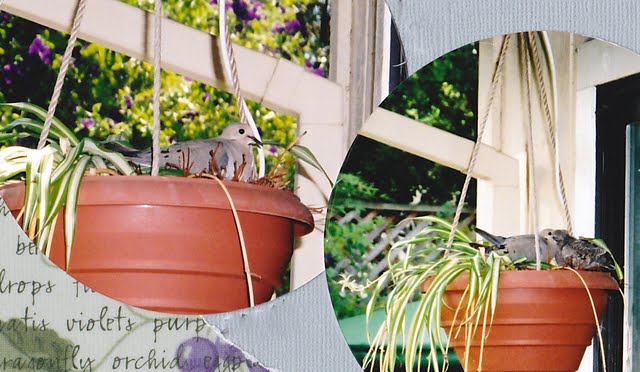
The back-forty is a transitional home for plants who’ve outgrown their pots but don’t currently have a good place to go.  One of the potted spider plants sheltered a nest of mourning doves one year.  Eventually the pot was too crowded for a nest or a plant. Time to visit the back-forty.  Sometimes I empty a bit of soil left in a pot, and a forgotten bulb rolls out.  I give it a toss into the mix  and carry on with my gardening chores.  It’s every plant for herself back there: find a place to put down your roots, or move over for the next plant.  Since nothing that we’ve purposefully planted under the pine tree lives for very long, I’m hoping my stealth plan takes root.

Two spider plants and an asparagus fern have been up to the challenge so far.  The acidic soil and shade agrees with them and they seem impervious to a steady shower of pine-needles.  At the rate they are multiplying, the back-forty relocation plan is looking like a success. Gardeners know that hope springs eternal or perhaps it’s spring that brings eternal hope.

Asparagus Fern Spider Plant Tango

Mourning Doves

Catnip: Intoxicating Perennial

Catnip Seeds

Not all cats like catnip. (Not everyone likes chocolate either, to my dismay). In my own personal experience, however the vast majority of  felines take some pleasure from this fragrant herb.  My cat Estare literally drooled the first time I introduced it.  He rubbed his little chin through the crushed leaves, over and over again.   His brother liked it okay, but for Estare it was an experience.  Our current passel of kitties also enjoy it.  We have a few handmade cat toys, sewn by our local vet and  I buy loose-leaf nip as well. It seems to relax, intoxicate or invigorate, depending on the mood.

I planted catnip several years ago and  enjoyed watching it grow into a magnificent plant.  I didn’t know it would produce such pretty little flowers or that it would grow so large.  It filled most of the space below the lemon tree, supplying us with fresh leaves for a year.  Unfortunately the lemon tree split in two during a storm.  When we removed the damaged tree, the catnip went along with it.  I never got around to planting it again.

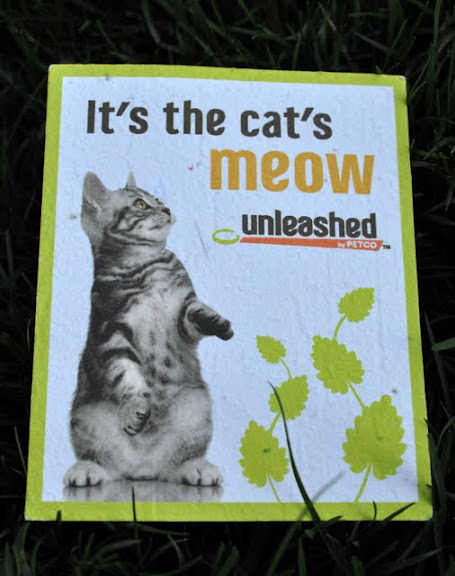
Earlier this year Unleashed by Petco passed out a catnip-embedded card as a thank you for supporting one of their programs.  Perhaps one of the cats slipped them a fiver to remind me to get back on track.  Catnip here we come!

Freebie from Unleashed by Petco

WindowAlert: Protect your Songbirds

We invite birds to our garden in a variety of ways using fragrant flowers, flowing fountains and feeders.  To that end, it was disheartening when the occasional feathered friend mistook our window for the sky.  That unmistakable thud left an indelible mark on our soul.

The good news: by applying WindowAlert™ Decals, collisions are largely a thing of the past. According to their site:

WindowAlert is a window decal that may be applied to home and office windows. The decals contain a component which brilliantly reflects ultraviolet sunlight. This ultraviolet light is invisible to humans, but glows like a stoplight for birds. Birds have vision that is up to 12 times better than that of humans. WindowAlert decals help birds see windows and avoid striking the glass.

The decals are removable and re-positionable.  The static cling variety can be cleaned by rinsing in warm water as necessary.  I purchased the Decorative Leaf Decal, but they are  available in a variety of shapes.

Support your local garden center or nursery if you can.  I shopped at Los Gatos Birdwatcher in our community.  You can also buy directly from the WindowAlert site.

Rehabing the Swing

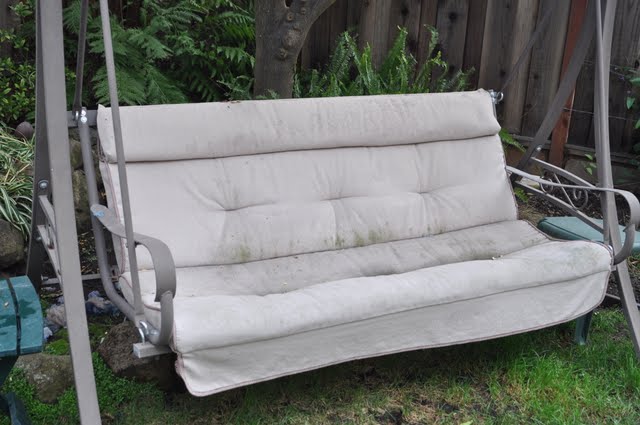
In need of some TLC

My readers know how I love my swing.  Sadly, it took a tumble in a wind storm, flipping heals over casters into the rock wall. The lower frame is sound, but that brief flight and subsequent landing tore one inch gashes into the canopy frame.

Before dismantling the canopy frame this winter, I thought it was simply bent and needed straightening.  Now that we’ve taken it apart, the mechanical fix is more complex.

The no-cost fix is simple: we’ve relocated the swing to the shady part of the garden, where it now rests under the orange tree.  Who needs an artificial canopy when nature has provided one in my backyard.

The seat cushions are a different story: they need a good overhaul.  I used an old, flocked table-cloth to cover the cushions off-season and it worked well.  Then spring rolled around and the neighborhood squirrels decided it would make excellent nesting material.   They had that cloth de-flocked in two days!   I get lazy in the colder months so between the unceremonious toss of the swing and the table-cloth dismemberment, I simply turned a blind eye.  Last summer I put a towel over the cushions, and made do with the bent top.  Neither one had any affect on my impromptu nap schedule.

Now that the yard is spruced up, my swing looks neglected.  It resembles a dorm room couch, minus the cookie crumbs, but with plenty of mold to give one pause.

Time to call on my sewing skills.  I’ll let you know how it goes.

Lavender Caper

"...Here's flowers for you: Hot lavender, mints, savory, and marjoram." The Winter's Tale

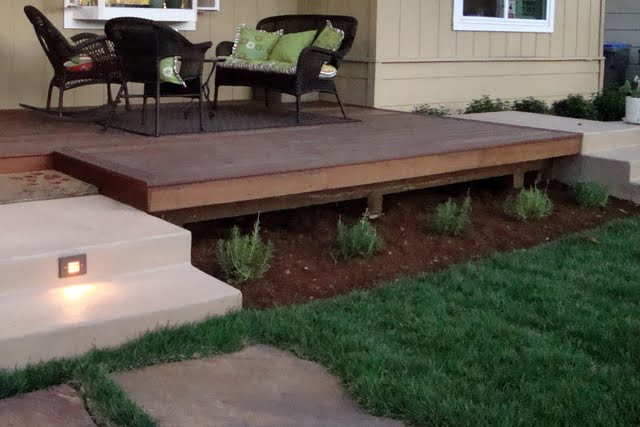
It’s a mystery. Two summers ago we planted a row of lavender along the front deck. Five small plants with big potential. Within a few months they would be peeking over the edge of the deck, covered in fragrant blooms.

The plants doubled in size, supporting each other as they grew out and up. They bumped up against the lawn; spilled on to the stairs. Except for one. One of the five plants was still below deck. Like the runt of the litter, I reasoned, the smaller plant needed more time.

My well-honed sense of symmetry was eschew; I wanted each of these plants to grow into one cohesive row. The plant seemed healthy. It branched, it flowered, and it grew. Every few days I would lean over the edge of the deck, lifting its branches skyward. Perhaps this lovely lavender had simply lost its way.  “Stand tall,” I encouraged; that space is yours to fill.

I sought the advice of a couple of garden experts. One suggested it was something in the soil. I asked if it was possibly a dwarf variety but they didn’t think so. Nearly two years later the plant is still small.

I’m pragmatic when it’s time to pluck annuals from the earth and I can thin seeds and pull weeds with impunity. Giving up on an established perennial, however, feels like the gardener’s equivalent of throwing in the towel. If only the plant would send me a sign by turning brown, falling over or displaying a visible blight. Then I would be ready to let it go.

June, 2010

February, 2012: One of these plants, is not like the other...

Dwarfed by the Others