Loving and Losing Sylvia

It was 1982. Freshly graduated from the theatre program at San Jose State University, I had just landed my first theatre job. Feeling both excited and terrified, I also felt entirely out of my league. That’s when I met Sylvia.

Sylvia Muzzio

With Sylvia in the San Jose Rep costume shop, November, 1982

If you follow the money, you won’t find it in the theater. San Jose Rep’s small costume shop occupied a couple of classrooms in a vacant elementary school, in an unremarkable part of town. Yet between those walls, magic happened.  Under Resident Costume Designer Marcia Frederick’s guidance, Sylvia Muzzio, Marcia and I crafted some of the most extraordinary costumes you’ve ever seen.  We were three  creative women working in very close quarters, yet we always got along.

Sylvia mentored and mothered and minded the shop and taught me about theater and life along the way. She personified warmth and care. I shared things with her that I didn’t feel comfortable sharing with others. Her open nature and gentle soul invited you in. It was a gift at the time, though it took age and maturity to fully grasp how special she was.

Sylvia nurtured her children, her grandchildren and those of us lucky enough to be part of her circle. She always wanted the best for people. She was modest and unassuming, but honest and direct as well. I loved her.

While I was in an unhappy relationship in those early years at The Rep, Sylvia told me that I needed to find an Italian, someone warm and affectionate (like her). When years later I met and married Mike Francini, I enjoyed recalling that memory with her. “Sylvia,” I said, “I found my Italian.”

Sylvia Muzzio

The four of us gathered for the first time in many years in 2010. Alys, Jim, Marcia and Sylvia

Marcia Frederick, Sylvia Muzzio, Alys and James Reber

Marcia Frederick, Sylvia Muzzio, Alys and James Reber, Founder of San Jose Repertory Theatre, November, 2013

Sylvia Muzzio

Sylvia and Rick share a laugh at a reception for The Snow Queen, November, 2013, San Jose Rep

Sylvia had a year of major health problems, hospitalizations and treatments, then seemed to miraculously kick every last one of her ailments to the curb. I saw her earlier this year for lunch, and though frail, she was upbeat and engaged. I started one of those “let’s get together when you get back from Shasta” emails and hoped to see her again this fall.

Sylvia Muzzio

With Sylvia and Marcia, 2015

Marcia called me on Monday to let me know that Sylvia was gravely ill. Sylvia and Marcia have remained close friends for many years. It came on suddenly in the last two weeks.

I spoke with Sylvia for the last time Wednesday morning. She was groggy from her pain medication, but she knew who I was and said it was good to hear my voice. She died this morning in her sleep.

And so I weep.

Death lies on her, like an untimely frost
Upon the sweetest flower of all the field.

Romeo and Juliet (1597) IV, scene 5, line 28.

Goodbye dear friend.

Halloween Cards: Crafting from my Garden

This year I’m crafting Halloween cards from my garden. It’s been a lot of trial and error, but I’m having fun.

My approach to crafting Halloween cards is often catch-as-catch can. I’ll spot a few things here and there in a store, or I’ll pull together items from my stash. No two cards are alike, and I’m fine with that. For me, that’s part of the fun.

Halloween cards

Halloween cards from prior years

This year, using my Big Shot die-cutting gadget, I’ve made several chlorophyll prints from the abundant pumpkin leaves trailing across my garden. The leaves transferred beautifully, revealing wonderful detail.

pumpkin leaf chlorophyll print

Pumpkin leaf impression

With success on my side, I decided to try making prints using the bright yellow pumpkin flowers. I had to be judicious, because although the pumpkin’s leaves last for weeks, the flowers close and drop within a day or two. I made flower impressions in phases, also enjoying the process.

Pumpkin flower impression

A: Pumpkin blossom, B: Pressed pumpkin blossom, C: Partially removed, and D: pumpkin flower imprint

Though the flowers transferred well, the color didn’t last. Within a few days the brightness faded to a soft peach. I used the imprints anyway, for a subtle suggestion of color and because they work well with my Halloween theme.

Since I was on a roll, I braved the crazy heat, and gathered a few more items: the drying flowers of the Nepeta (cat mint) and some of the dropped pine needles from a neighboring tree. The dried flowers left a mottled brown impression, perfect for the pumpkin stems, also known as a peduncle.

nepeta going to seed

Nepeta going to seed

Drying Nepeta flowers and leaves on paper before pressing

Drying Nepeta flowers and leaves on paper before pressing

nepeta impressinos

Nepeta impressions for peduncles and background

The pine needles made a wonderful textured paper. I wanted to suggest the ribbing you would see on a real pumpkin. It’s subtle, but I like the way they turned out.

I rubbed yellow ink on the textured paper, then stamped two more layers of the stamp set with orange and russet ink. After stamping two different pumpkin shapes, I cut the small pumpkin images using my Big Shot. I made the stems using the Nepeta paper print.

Here’s the design:

I used a clever die to create the black card-stock base of the card. I used the pumpkin leaf imprint on one side and the flower imprint on the other. In the center I cut two small pumpkins from the pine needle paper using a clever die and stamp set that allows layering for a more realistic effect. I cut the stems, known as a peduncle, from the mottled Nepeta print for a natural look.

This particular style is labor-intensive, so I only managed to make eight cards. That said, I did a lot of experimenting along with using new tools. Next year I’ll be able to apply what I learned.  I punched squared out of all the different materials I used and mounted them on a piece of card stock. This will help me remember the different techniques for next year.

I used the remaining chlorophyll prints to make traditional fold-over cards. They were equally fun. I’ll blog about them later this week.

Are you trying something new and interesting?

Note:

To my friends out of the area, please know that we are safe. There is an active series of fires, 100 miles north of San Jose. Though we are sheltering from the heavy smoke as best we can, we are not in danger. My friends in Santa Rosa are safe. You can read more at the link below.

http://m.sfgate.com/news/article/2-big-wildfires-prompt-evacuations-in-Napa-County-12262945.php

Save

Save

Save

Save

Save

Save

Save

Save

Save

Save

Save

Save

Save

Save

Save

Not a Zucchini?

There are three volunteer pumpkin vines growing along the side of our deck. At least I thought so. Upon closer inspection, one of the plants might be a zucchini.

Zucchini or Pumpkin plant

Zucchini or Pumpkin? July, 2017

Zucchini or Pumpkin?

Zucchini or Pumpkin? August, 2017

Zucchini is an American term for courgette or summer squash. They’re harvested when the fruit is small and cooked in a variety of ways. When left unchecked, they will grow substantially. I learned from Sarah the Gardener that overgrown courgettes are known as marrows.

I’ve never been a fan of zucchini. People wonder “how can you be a vegetarian and not like zucchini!?”  I don’t mind it in soups or zucchini bread, but otherwise I’ll give it a pass. My favorite greens, in the following order, are broccoli, green beans, snow peas, bell peppers, and several others I’m forgetting and then zucchini. Technically, zucchini are a fruit, but most of us think of them as a vegetable. That said it still doesn’t make the list when I could be eating pears, green apples, kiwi, grapes, and melon. Sorry zucchini.

I digress.

Pumpkins and zucchini (or courgettes) are members of the Cucurbita pepo or Cucurbita genus. The leaf and flower of both plants look quite a bit alike. Our plant, however, didn’t develop a trailing habit. It grew more like a shrub.  While making the garden rounds, I notice the unusual growing habit of the fruit. Unlike a typical pumpkin it was long and narrow. When Mike returned from a long trip to South America, he pronounced “It’s a zuke.” He grew up in an Italian family where his mom prepared lots of zucchini in her day.

Apparently I had an overgrown zucchini (marrow) on my hands. I would follow Sarah’s lead and prepare it for eating. Sarah made marrow chips with her overgrown fruit. She’ll show you how here.  Sarah says they’re delicious. I could disguise the flavor and texture through food preparation. Brilliant!

I cut the fruit from the plant and left it to harden off on the deck for a few days. I kept an eye on it outside my kitchen window.

Zucchini or Pumpkin?

Miniature Buddha for scale

You know where this is going, right? It started turning orange!

Not a zucchini?

Time will tell.

Save

Save

Save

Save

Save

Save

Save

Save

Save

Save

My Ever-Changing Garden

One of the simple pleasures of gardening is the ever-changing landscape. No two plants are alike and no two seasons are quite the same. There are happy accidents everywhere, helping balance the ever-present and predictable weeds.  San Jose summers are hot and long, but occasionally nature serves us a reprieve. I relish those days when the stars align and I have both the time and the weather to spend outdoors getting things done.

Of all the things you can grow in a small garden, pumpkins are among the most spectacular. It seems you can witness the change every day. Within 90 to 100 days, one healthy seed can sprout, grow, flower and fruit, trailing across the landscape at amazing speed.

Self-seeded pumpkin vine

Self-seeded pumpkin vine growing along the side yard

A couple of pumpkin seeds took root in our narrow and shady side yard, with one of those two vines traveling the length of the house and eventually rounding the corner. That vine is now winding its way across the patio.  With leaves the size of a platter and flowers as broad as your hand, watching pumpkin plants grow evokes a certain optimism and joy.

pumpkin vine on patio

The pumpkin vine emerging from the side yard and crossing the patio

Years of drought brought about many changes to our garden. It started with the removal of the “grass strip” between our sidewalk and the street. My husband grew up with spacious, green lawns. His reluctance to remove the lawn took some time to overcome, but in the end we replaced all of our lawn with native plants.

In preparation, I sheet-mulched half of the back yard for close to a year. The process destroyed the lawn, amended the soil, and prepared the area for native plants, all at the same time.

sheet mulching

The process of sheet mulching: cardboard, dried leaves and other organic material

We replanted the entire area with California native and drought tolerant plants. They use far less water than a lawn, attract beneficial insects and birds, and are healthier than the monoculture of a lawn.

sheet mulched back garden

Healthy soil, several months after sheet mulching

back garden patio and native plants

Back garden replanted with natives (Mouse and Lindy on the chairs)

Back Garden: Half of the dried out lawn and half sheet-mulched lawn

Back Garden: Half of the dried out lawn and half sheet-mulched lawn

native plants back garden

Back garden replanted with natives about a year later

Removing the front lawn also brought about interesting changes. The act of turning the soil for native plants invigorated dormant seeds. The year after the lawn came out, we not only had native plants but sweet peas, cornflowers, California poppies and Nigella.

When the  garden looked bare after the sweet peas went to seed, I hit upon the idea of planting pumpkin vines in their place.

front garden pumpkin vines

I planted a few pumpkins in the front garden (the only plants that are not self-seeded this year)

I’m enjoying the variety of successive planting.  I smile when I see a neighbor through my kitchen window slowing down to look at the garden. Tending a healthy garden means others can passively enjoy it too.

Learning to love succulents has been another big change for me. One by one though, I’ve been replacing potted annuals with succulents.

Succulents are well suited to our dry, arid climate. They get along well sitting in sandy soil. I water them sparingly, perhaps once a month, and in turn they reward me with color change and tiny blooms.

I planted a miniature peace garden earlier this year, only to see it collapse during a heat wave. The baby tears baked in the sun, even under the eaves of our house. I slipped out a few times to water the plants, but that tiny garden didn’t survive in  the shallow bowl and the pounding sun.

miniature peace garden fizzle

Peace garden fizzle: triple digit temperatures were too much

miniature peace garden

Replanted miniature peace garden, sheltered by a coleus

Since I refuse to embrace any metaphors about a dead or dying peace garden, I composted the dried plants and started over. This time I changed out the annual baby tears for succulents and added chamomile, which can go almost dry between watering. I shaded the entire mini garden with a coleus, my one concession this summer to a water-loving plant. I find the color variations irresistible.

There is a twinkle of autumn in the air today, a reminder of the seasons ahead. My garden is a wonderful teacher, regularly reminding me that change is good.

Are there interesting changes going on in your life?

Save

Save

Save

Save

Save

Save

Solar Eclipse in My Garden

It’s been an exciting day here in North America. Depending on where you live, you could witness the first total eclipse of the sun in the U.S. from the Pacific to the Atlantic since 1918.

AccuWeather total solar eclipse

Map of total solar eclipse route. We live in the 70% range – Source: AccuWeather

Here in San Jose, we witnessed a partial solar eclipse for about 2 1/2 hours. It reached its maximum impact at 10:21 a.m. when I popped outside with my camera to take some garden pics.

The occluded sun cast crescent-shaped shadows on the ground and the side of the house. I took this photo one minute before maximum impact.

crescent shaped shadows eclipse

During the eclipse: Crescent shaped shadows cast by the tree on the side of the house

Here’s what I noticed in the garden:

Most of the flowers in bloom remained open with one exception: the pumpkin blossoms. The flowers started curling in, and when I checked on them after lunch, they had closed up tight. Fascinating!

pumpkin blossum during solar eclipse

During the Eclipse: Pumpkin blossom closing in 10:23 am

It was eerily quiet when I went outside. We had less birdsong than usual.  The bees, however, continued on with their day.  I admire their industrious nature and silently thanked them for keeping our planet afloat.

bees during solar eclipse

During the eclipse: the bees didn’t seem to register any difference

National Public Radio aired live updates throughout the day, and though it’s radio and not TV, they managed to convey the excitement as the eclipse crossed a thin ribbon of states.

Back in the garden, I enjoyed the interesting shadows.

Pumpkin in shadows solar eclipse

During the Eclipse: Pumpkin fruit in shadows 10:23 am

California poppies during the solar eclipse

During the eclipse: California poppies 10:24 am

pumpkin shadow during solar eclipse

During the eclipse: Arching ribbon of shadow on the pumpkin’s surface 10:35 am

Indoors, the cats were oblivious. (See Monday through Sunday for comparison…ha!)

Did you witness all or part of the eclipse today?

Save

Save

Save

Save

Save

Garden Tomatoes: An Uninspired Tale

I’m not sure what to think about this season’s garden tomatoes. The expression “failure to thrive” comes to mind. Sadly, the basil and the corn in this box aren’t doing so hot either.

VegTrug with corn, basil, tomatoes

VegTrug planted with basil, tomatoes and corn. They’ve all remained small

Generally speaking, tomatoes are fairly easy to grow. The plant is part of the nightshade family, so their poisonous leaves remain untouched. The small yellow flowers attract the bees and before you know it (usually!) you have a vine of ripening tomatoes. Sometimes it’s hard to keep up with the production as they fruit all at once. That has not been a problem this year.

I planted half a dozen bedding plants in the spring. Some years I start from seed, but I didn’t save any last year so I went the lazy route. I put several small tomato plants in my raised VegTrug and three more in my vegetable box.

native garden and veg trug

May, 2017. Everything looked healthy in May. The nasturtiums surrounded the tomatoes, until the heat set in

I had one more plant in need of a home, so I popped it into the curb garden where it would get plenty of sun in the company of the perennials.

It’s taken nearly four months for three of the plants to produce.

orange cherry tomatoes

The first of the tomatoes

orange tomatoes in planting box

The first of the tomatoes in the planting box. They’re small but delicious

The plant in the curb garden never grew more than a few inches tall and the same goes for the plants in the VegTrug.

curb garden tomatoes orange

Tomatoes growing on the left side of curb garden box…all five of them!

I amended the soil, and watered faithfully once the rain stopped. The plants aren’t drooping or diseased and there is no sign of garden pests. They’re just small and sad and completely unremarkable.

Poor soil could be the culprit though I amended the soil with coffee grounds which I got for free at our local Starbucks. I kept an eye on the water and I know they’re getting full sun.

Since I really wanted at least one healthy tomato plant, I bought a larger bedding plant in a different variety and planted it in the curb garden. It’s too late in the season to start over with a small plant or from seed. All the perennials are thriving in the box so I know the soil is robust. The new plant looks healthy so far, no thanks to my mad gardening skills.

tomato plant curb garden

Newly planted curb garden tomato plant

newly planted tomato

Flowers on the newly planted tomato

Time will tell.

Meanwhile, fire season is upon us. Locally, we’ve seen three small fires, two in San Jose and one in nearby Saratoga. They were all extinguished within 24 hours. A fire in nearby Saratoga burned on the other side of the ridge from the camp where my son volunteers. That definitely gave me pause.  The emergency alert system sent out a text saying to shelter in place, but when I checked on my son he said all was fine. We learned the following day that the alert went out to everyone in the county!  I’m glad the system works, but the error unnecessarily alarmed a lot of people, including this worrywart of a mom.  The largest active fire is in Mariposa/Detwiler. It’s burned 76,000 acres so far, but crews have it 40% contained. My hat is off to these firefighters that work tirelessly under unimaginable conditions throughout the fire season.

2017 Detwiler Fire map

Source: Google Maps

Save

The Sketchbook in all its glory!

What a joy to be a part of The Sisterhood of the Traveling Sketchbook. The completed sketchbook returned home this month, to the welcoming hands of the artist and blogger who brought so many of us together on the journey. Here is Anne’s lovely post, with links to all the contributors. You’ll find sketches, recipes, crochet, free-form embroidery and more. Come have a look. Thank you, Anne!

anne54's avatarAnne Lawson Art

The other day the Fella brought in a box left by the postie. Immediately I knew it was the Sketchbook. Normally I dive right into things, but this was one parcel I wanted to savour. I sat down with a cup of tea, marvelling at the journey it had made. Then I carefully opened the box, and again, just took my time to enjoy looking. There was a card from Trish that I opened and read.

Then it was time to slowly take the sketchbook out of the bubble wrap and hold it in my hands. Oh it felt good! Deliciously fat, full of all the creativity that the Sisters had put in.

20170710_135838

And more delights……Alys had attached some ladybird stickers, to be added next to each Sister’s address before sending on.

Jan had crocheted a pouch with Cambrian wool, “from the flocks of Wales”. The Sketchbook sat snuggly…

View original post 833 more words

Growing Pumpkins: A Seasonal Favorite

If you’ve been following along for a while, this will come as no surprise: I love pumpkins.

I love growing them, harvesting them and finding creative ways to show them off leading up to Halloween. Mike takes over from there, carving extraordinary Jack o’ lanterns for the front deck.

After growing pumpkins for a decade, I had two bad seasons in a row. Squash bugs infested my small patch the first year, claiming a few pumpkins entirely, forcing an early harvest of what remained. I relocated the pumpkin crop from the back garden to the front the following summer, but as soon as the plants fruited the squash bugs were back. Then the drought dragged on and I stopped planting them altogether.

The pumpkin growing hiatus did the trick and sent those dreaded squash bugs packing. Further, I’ve now had a couple of self-seeded pumpkin vines grow without a single drop of additional water, at least from me. All the reading I’ve done says that pumpkins like warm, moist soil and lots of water. I learned last summer, though, that they can hydrate from the morning dew using their straw-like stems. Don’t you just love nature’s resilience?

Late last year, after Halloween had come and gone, I did what any self-respecting gardener would do. I harvested the seeds, dried them and stored them for the winter.

Ha! I’m kidding!

Instead of saving the seeds, I sent a “written invitation” to the neighborhood squirrels. What exactly does that look like, you ask? The first invitation was subtle. I placed a pumpkin in the center of the garden and carried on with my day. I glanced out the window from time to time, and sure enough, this cautious squirrel showed up for a meal.

They don’t like the fruit or the skin, but there are plenty of other garden visitors to take care of that. It wasn’t long before it looked like pumpkin mush.

The second “invitation” landed on the back steps in view of the sliding glass door. I kept the camera nearby and sure enough another squirrel came along and helped him or herself to the seeds.

I love watching squirrels eat as they sit on their haunches keeping watch.

Fast-forward to this spring, and I’ve got pumpkins growing throughout the garden. There are a couple of large specimens growing along the side of the house. As an aside, I removed three large flowering vines last year so we could replace the dilapidated fence. I didn’t want to replant anything till the new fence went in. Long story short, it will be October before it’s replaced. Meanwhile, the pumpkins showed up and off they grew.

One of the pumpkin plants actually made it into a planter box and it’s also the first to produce fruit. It’s getting the best sunlight and moisture from a drip system so it’s doing well.

There are three smaller pumpkin vines, struggling to take hold but refusing to give up. I’m just letting them be for now.

The biggest surprise showed up in the last couple of weeks under our home office window. After freshening up the front garden after the sweet-peas went to seed, we replanted the area under the window with a gardenia and a few sunflowers.  A week or so later, in the blazing heat I might add, I brought home 36 bags of redwood mulch and covered every bit of exposed dirt. We upped the watering to twice a week to help establish the new plants, and with that several more pumpkin plants arrived on the scene.

I love checking on the vines each day, following the traditional progress of male flowers, then the female flowers and with good pollination, wonderful fruit. If our luck holds, and the rats, opossums and squirrels let them be, we’ll have carving pumpkins once again.

Fingers crossed.

Save

Save

Save

Save

Save

Save

Save

Save

Save

Save

Save

Save

Summer Arrives with a Brutal Heatwave

Summer solstice is just two hours away. It officially hits this coast at 9:24 pm Pacific Time.

Unfortunately, a brutal heat wave arrived over the weekend, ushering in summer in San Jose with a three-digit preview: 104 F (40C).  We don’t have central air conditioning at home, so one day we escaped for a few hours to a mediocre movie, just for the excuse to sit in a cool theater for a few hours. All three kitties dragged themselves around the house from spot to spot to benefit from the ceiling fans and the cool tile floor. The heat really crept up on us.

In the past, heatwaves lasted for three days, then cooler temperatures prevailed. This week, however, it’s going back up again, expecting to peak at 101 F on Thursday. They’ve called a heat advisory along with a request to turn off all unnecessary appliances between noon and 9 for fear of over-stressing the grid. Good times!

I added ice cubes to one of the bird baths, and we’re keeping the other one topped up with rain water from the tanks.

I halfheartedly pulled a few weeds that stubbornly grow between the ground cover making them hard to reach. Every time I hear them snap, I know they’ll be back the following week.  Honestly, though, it’s just unbearable to be outdoors for long. My peace garden is in terrible shape. Even with extra watering the baby tears turned brown. What a sorry sight.

What’s up with the weather in your neighborhood? For my southern hemisphere friends, you’ve reached the shortest day of the year. It’s all up hill from here.

The Summer Solstice is Upon Us: Check out the gorgeous graphics and photos in this article. My favorites are the mobile pics at Stonehenge and the rainbow map of North America.

Tips for Planning for a Power Outage

Excessive Heat Warning: Public Alert


Save

Save

Time with Tessa and the Last of the Sweet Peas

Our Tiny Tessa is relaxing and getting used to her new surroundings. She’s sleeping on top of things, rather than hiding under the bed. She met Lindy (who hissed once and left the room) and she met Mouse (who did the same). We’re giving the resident cats lots of TLC, letting them know they’ve not lost their standing.  I haven’t lived with a kitten for nearly thirty years. I’d forgotten how tiny they are and how energetic and curious. She’s a delight.

Tessa on Bob the Cat pillow

Tessa meets Bob the Cat…sort of

My friend Barbara Oertli painted this picture of her ginger cat, Bob, eyeing a squirrel on her deck. Since I’m out of wall space, I ordered a print on a pillow through Fine Prints America.

It took several attempts to get this shot. She’s always in motion. She nearly threw herself off the edge of the bed yesterday, jumping into the air and then backward. She’s keeping us happy and alert.

Outdoors, my beloved sweet pea garden has come to an end for the season. The self-seeded, rain-enhanced jungle, as one of my neighbors called it started folding up shop at the end of May. Sweet peas don’t like the heat so after the temperatures creep, they’re done. Interestingly, I have one more small plant in the back garden, blooming in a raised bed. It’s the only one I actually planted (versus self-seeded), which makes me wonder if staggered planting might extend the crop. I’ll see how much longer this one lasts and I’ll let you know.

It’s taken many hours pulling the dead vines from the ground, while at the same time collecting some of the seed pods. I also tried to save the cornflowers awhile longer, as the flowers are still blooming and attracting the bees. The birds love their seeds as well, so though it looks a little sad and droopy, it continues to provide for the birds and the bees.  Mike helped me tie the plants together to keep them from flopping over. Mouse sat with me while I pulled weeds along the walk way, then went under the cornflowers for a nap. Oh-oh.

I’m working on keeping him indoors when I can or supervising his time in the garden so that the birds have a fighting chance. I also experimented by putting a few of the cut flowers across the limb of a tree. The birds continue to come for the seeds, and surprisingly, the bees are taking nectar as well. There is always something to learn in the garden.

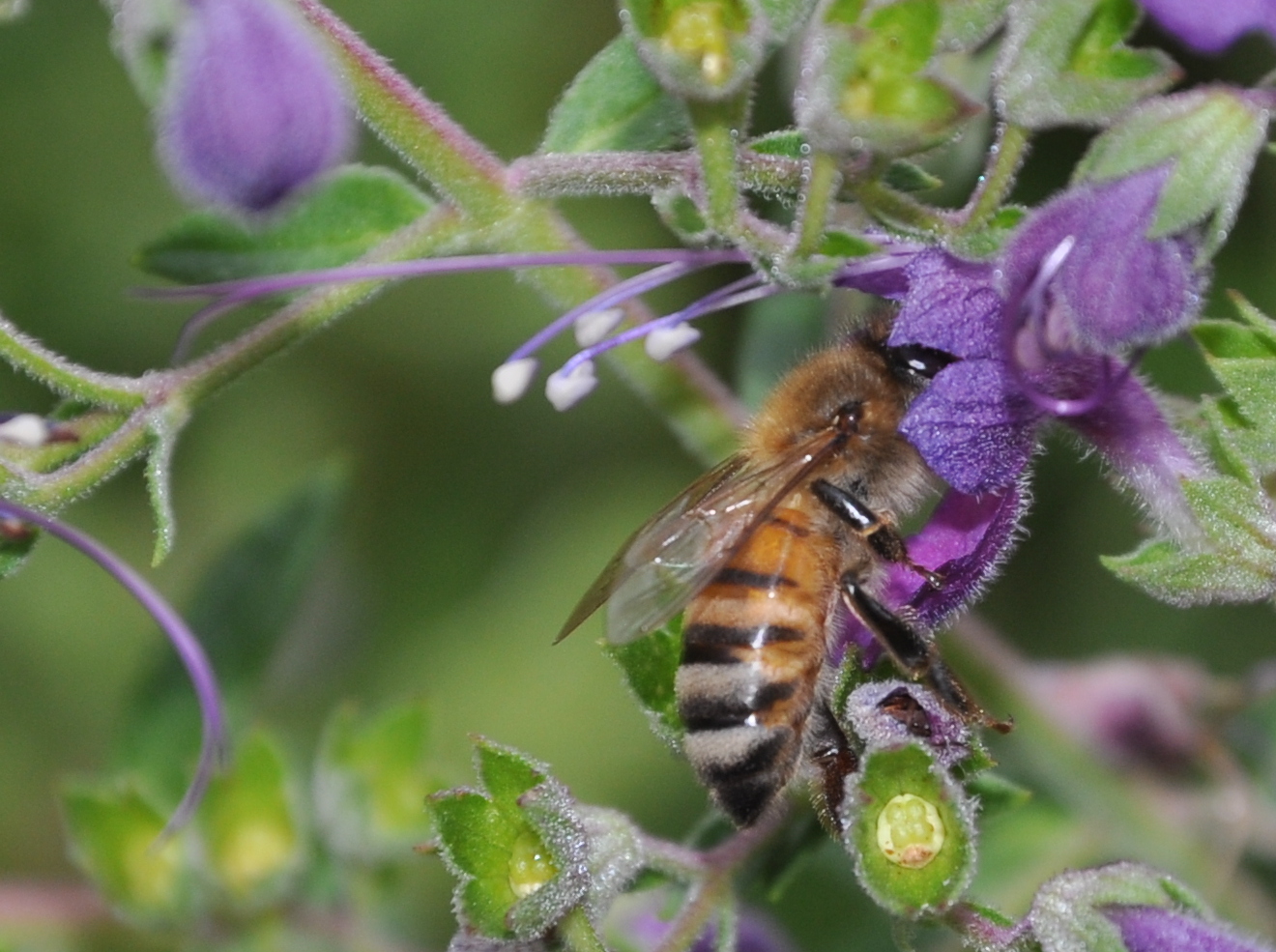
Check out the nectar pouch on that bee

Today was trash/recycle day. I waved at the crew as they took away the piles of spent sweet peas along with some trimmed branches and weeds. The city converts it into compost while at the same time diverting it from landfill.

There is so much happening in the garden all at once. Pumpkins, corn and sad little tomatoes are the main summer crops. I planted a pair of basil plants, too. Last year I planted them at the same time, but the basil bolted before the tomatoes were ready. This year I waited, only to be vastly disappointed in the tomato plants. I bought a six-pack of them before leaving for my trip in early April.  Two months later and they’ve barely grown.  This far into the season, I may go back and find larger plants that are further along so I can hedge my bets.

New clients, the end of the boy’s school years, a tiny kitten and home projects are keeping me a bit busier than I would like, but I’m still managing time in the garden every day.

Here in the northern hemisphere the summer solstice is just two weeks away.  I can almost taste that first red, juicy, vine-ripened tomato.

Save