Xylocopa varipuncta: Love and Romance in the Garden

What a romantic! Did you know that the Xylocopa varipuncta, also known as the male Valley Carpenter Bee emits “a rose-scented blend of volatiles”  from within “massive thoracic glands.”¹

You can’t make this stuff up, folks.

While courting the shiny black females,

female carpenter bee

Female Carpenter Bee

the amber male, with his bright green eyes and fuzzy amber body, emits a special cologne.²

Valley Carpenter Bee

Valley Carpenter Bee

The female decides if she likes his cologne and only then does nature takes its course.

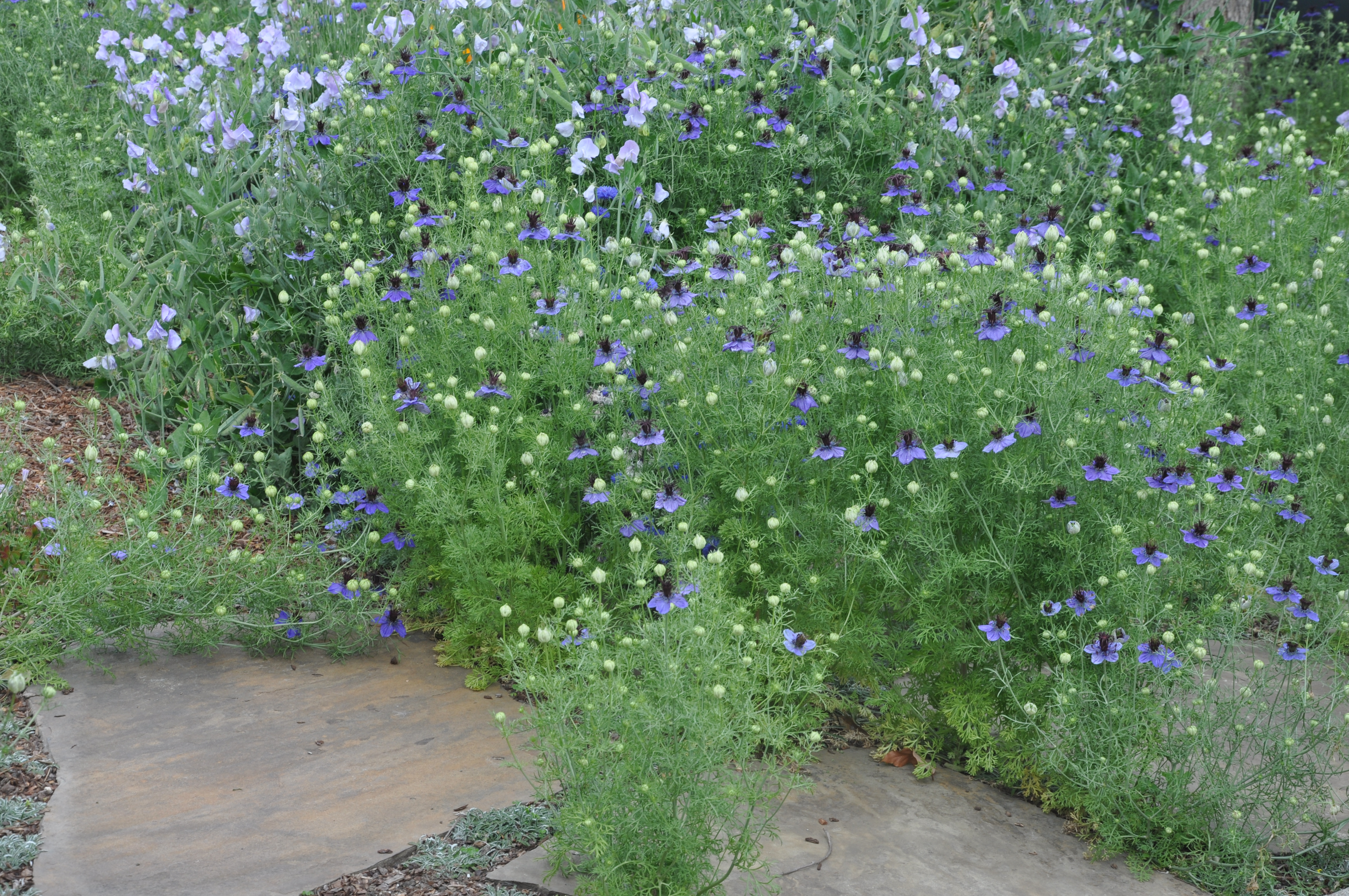
When Love-in-a-mist met the Valley Carpenter Bee, it was a match made in gardening heaven.

love in a mist with Valley Carpenter Bee

Valley Carpenter Bee circling a Love-in-a-mist flower

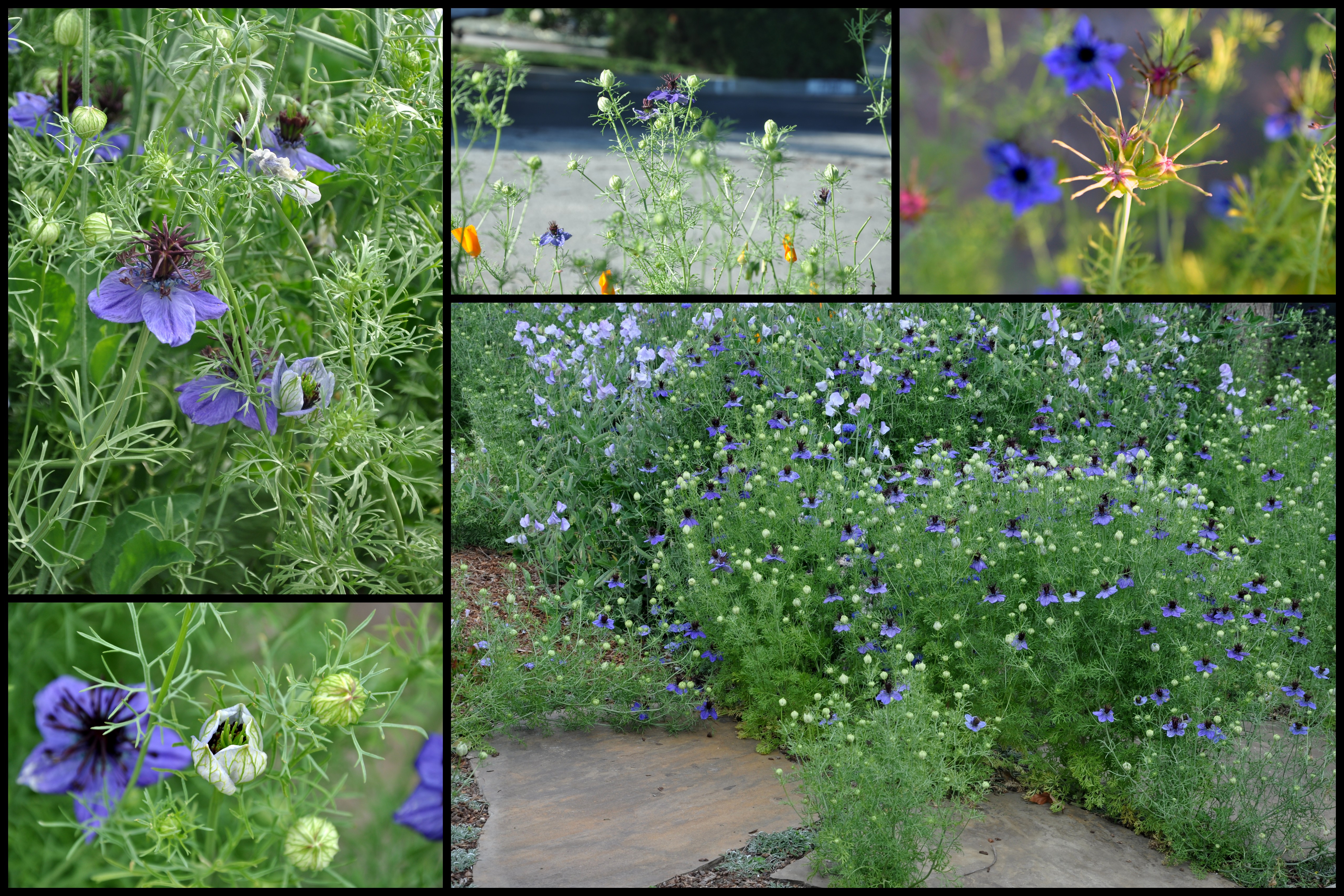
Love in a mist flowered all over the garden this spring, both front and back and the bees love it. It makes me so happy to see them buzzing from bloom to bloom. Sometimes I just sit nearby and watch them work.

bee on love in a mist

The more typical, seen daily be the dozen

What surprises me is that most of the bees are small with stripes. There are dozens of them throughout the day working in the garden.

Conversely, the golden hunk of bee is an occasional visitor.

Meanwhile, his female counterpart is out back pollinating the pumpkin planted by the squirrel.

pumpkin vine

Runaway Pumpkin Vine…and yes, love in a mist

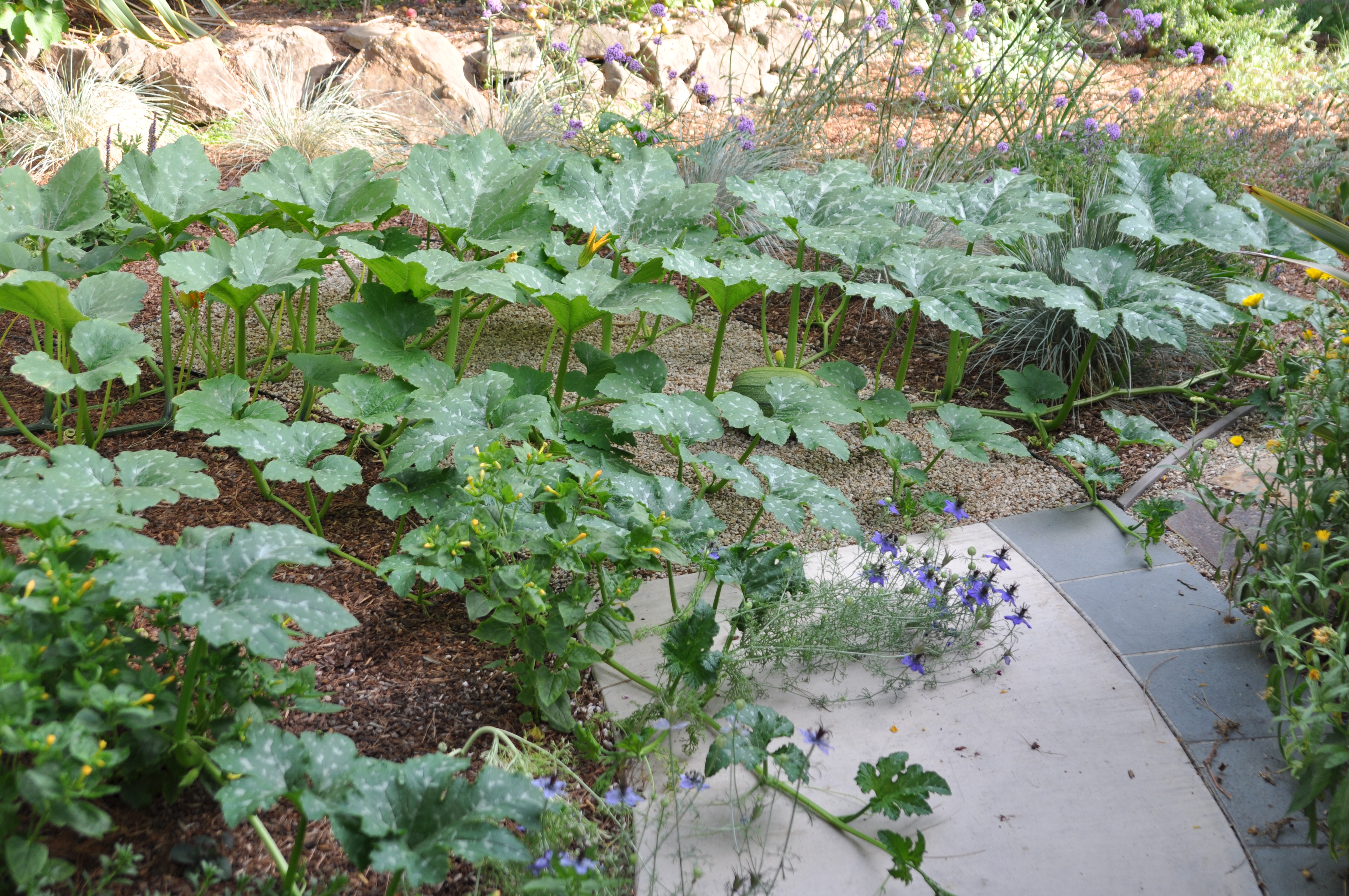
The pumpkin vine is racing across the garden at record speed and it’s only June. In all my years of gardening, I’ve never seen anything like it.

The bees working in my garden are docile. They don’t mind my presence as I brush up against the flowers, currently referred to by my family as “the jungle”. Love in a mist has completely taken over.

love in a mist takes over

The Jungle

slinky love in a mist

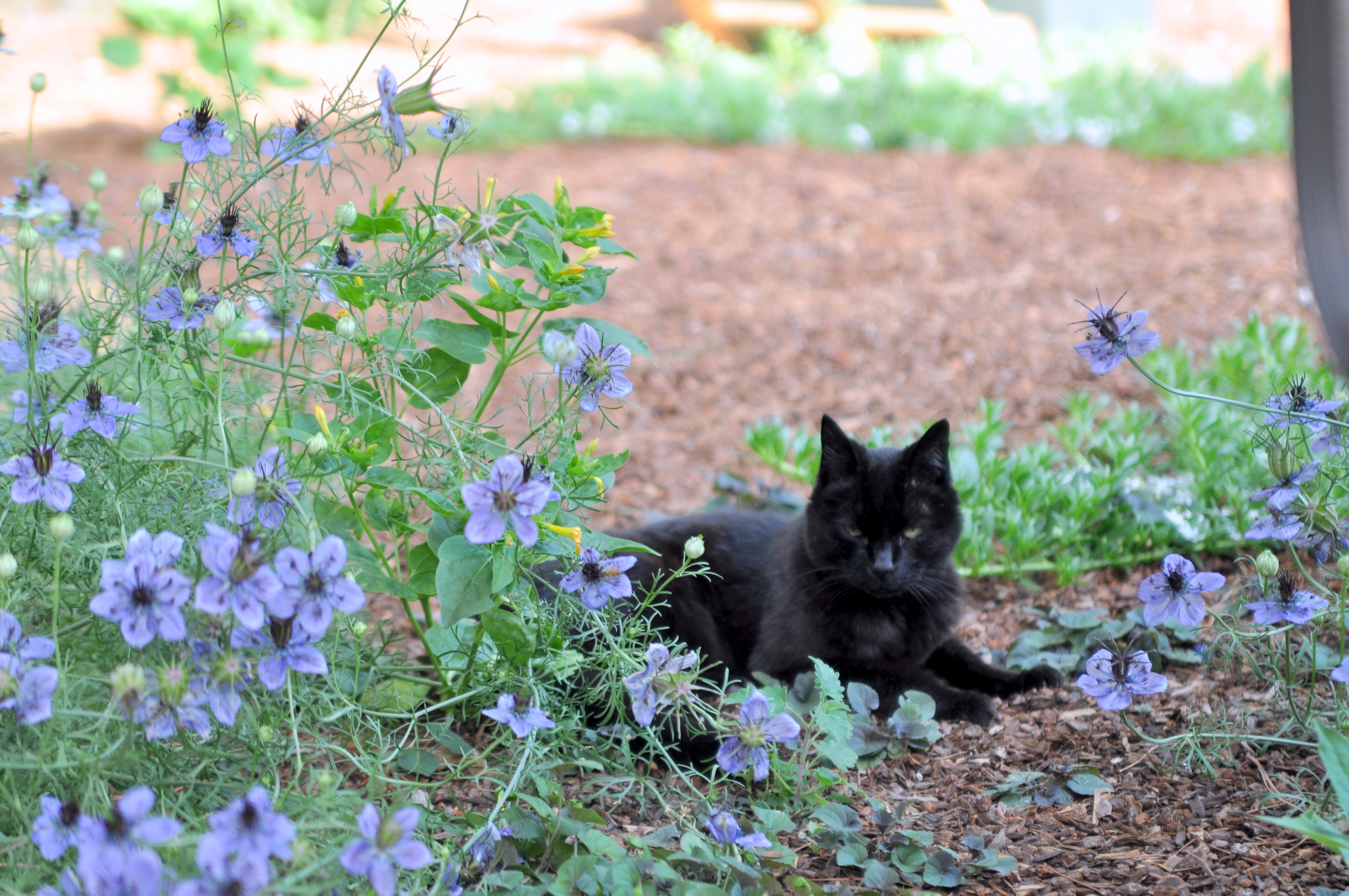
Slinky guards her catnip near the love-in-a-mist

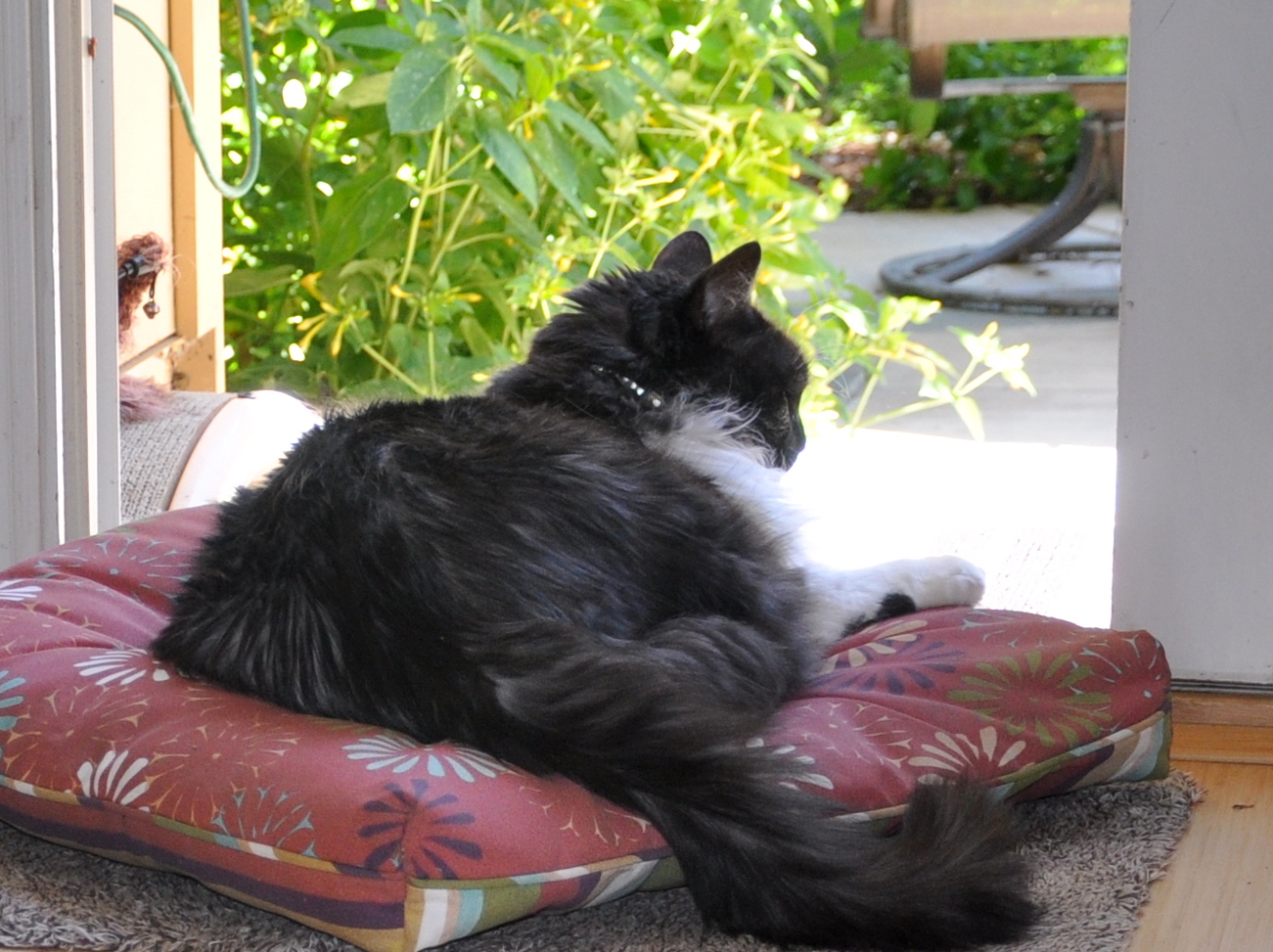
Slinky likes to rest near one of the flowers in the back, but to be fair, it’s also close to her secret Nepeta plant, also known as catnip.

Mouse is also enamored with this flower, attracting lots of camera time with his antics.

In case it’s not obvious by now, I love this beautiful plant and the ease with which it grows. The original seeds were part of a “seeds that attract hummingbirds and bees” packet a few years back. They didn’t do much throughout the drought, but they’ve loved our season of rain.

We’re in the midst of a long heat wave now, so it could spell the end. I’m enjoying them while they last.

¹Wikipedia: Xylocopa varipuncta

²Native Bees: What’s the Buzz

Friends Who Blog and an Enchanted Light-Catcher

Washington DC and Virginia

The Gathering of the Bloggers, Washington DC and Virginia, Spring, 2015

A year ago last spring, I spent an extraordinary week gathering with bloggers from around the world. It was an experience I’ll never forget. We traveled from Canada, parts of the US and as far away as New Zealand, gathering in Washington, D.C. and Virginia.

Laurie of Life on the Bike, and Julia of Defeat Despair, invited us to stay in their homes. They were excellent tour guides, showing us the sites and sharing stories about their community. Shelley, of Peak Perspective hosted several of us for an engaging afternoon atop a hill in Virginia. We enjoyed laughter and an amazing spread of food under the watchful, curious eyes of Haggis the dog.

Lisa of Arlingwoman provided local perspective as she guided us through the enormous Washington Mall. Her knowledge increased my enjoyment of the incredible history that resides there. We toured Lisa’s community garden and learned about her Plot Against Hunger.

We shared a meal with Lisa as well as Stacy of  Visual Venturing and Patti of Displaced Beachbums.

Rounding out this amazing journey: Kelly who blogs at Boomdeeadda and Kelly’s Korner  and Pauline of The Contented Crafter.

What started as “blogging friends” became “friends who blog.”

One of the visual reminders of our time together is my beautiful light-catcher. Pauline made one for each of us, selecting charms to reflect our interests and our lives.

You can see the amazing details in the short video below.

Five years and 940 posts later the most amazing statistic is this: there are nearly 16,000 comments on this blog. Comments become conversations, conversations lead to friendships and in this great big world of ours,  interesting, like-minded, bright, clever, talented, and wonderful people from around the world, log on and add sparkle to my day. I can’t thank you enough.

Waging Peace: The Carter Center, The Old Globe and an Extraordinary Day in San Diego

Camp David old globe

The Old Globe Camp David Program

Jimmy Carter is one of my heroes.

Theater has long been my passion.

So when an invitation arrived to attend a west coast premiere of Camp David at The Old Globe theatre in San Diego, I pounced. The program exceeded my expectations and left me feeling hopeful for our troubled world.

The Carter Center

Founded in 1982 by former U.S. President Jimmy Carter and former First Lady Rosalynn Carter,  the Atlanta-based Carter Center has helped to improve the quality of life for people in more than 70 countries. The Center, in partnership with Emory University, is committed to advancing human rights and alleviating unnecessary human suffering.

Our Weekend

We gathered at The Old Globe for a luncheon and a presentation by Hrair Balian. Balian is the Director of the Conflict Resolution Program at The Carter Center.

carter center Hrair Balian

Hrair Balian, The Carter Center

I could have listened to him speak all day. His presentation was brief, but informative, touching on many subjects that I would like to learn more about.  I was able to appreciate all of the Center’s efforts towards peace. In conversations about the Middle East and North Africa (MENA), The Carter Center involvement includes:

  • Relations with all, across multiple divides
  • Involvement of women, siting UN Security Council Resolution 1325
  • Factual conflict analysis
  • Coordination with the UN
  • Peaceful transition for Syria

and more. We were able to chat with Mr. Balian before lunch and sat with him during the play, which we loved.

The Old Globe, San Diego

Waiting for the start of Camp David at The Old Globe

Camp David received a standing ovation from a sold-out crowd. Playwright Lawrence Wright is also an awarding winning journalist. His thorough research, including access to the Carters, led him to add Rosalynn Carter as the fourth character in the play. Rosalynn Carter is a powerful force in her own right, advocating for mental health care around the globe.

Conversations with Playwright Larry Wright

Pulitzer-prize winning journalist, author and playwright Lawrence Wright wrote the play, Camp David, and a follow-up book called Thirteen Days in September Days. It chronicles the thirteen days at Camp David that led to a peace accord between Israel and Egypt, facilitated by the President Carter. Peace between those two countries remains thirty years later.

Wright spoke with us after the play, and we joined in a question and answer session; also far too brief. What a fascinating man. They hope to bring Camp David to Broadway in the near future.

Special thanks to Seema Shams and Marian Dickson of The Carter Center

If you’re interested in learning more, here are a few links:

Here are a few snapshots from the rest of our weekend. We walked along the Shelter Island harbor, ate dinner near Balboa Park, and enjoyed an outdoor breakfast at our hotel.

A Garden Under the Influence of Rain

wisteria vine

Wisteria refreshed

It’s been an extraordinary spring!

Everywhere I turn I see a happy garden under the wonderful influence of rain. I’m taking none of it for granted.

From the self-seeded pumpkins,

2016 garden pumpkin near patio

Self-seeded pumpkin, impervious to the cool night temperatures

to the spontaneous cottage garden

2016 sweet peas love in a mist poppies

My all-volunteer (self-seeded) garden

everything seems larger than life.  It’s rare for San Jose to get rain this far into the year, but we continue to get small storms every week or so keeping things fresh and alive.

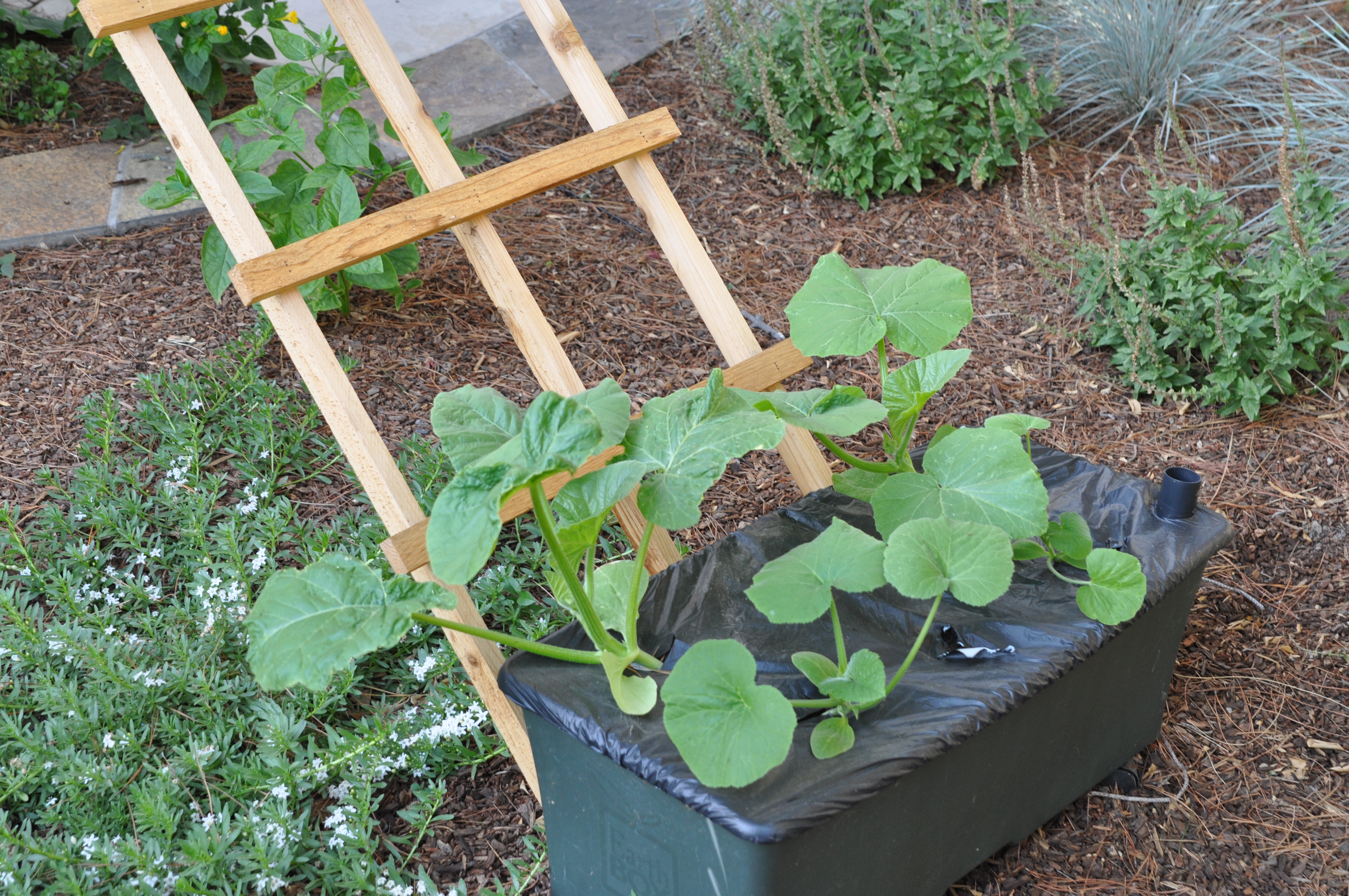
I prepped an Earth Box for some pumpkin seeds, and following the package instructions, waited for warmer nighttime temps. I needn’t have bothered. There are two self-seeded pumpkins growing across the back garden doing just fine. They don’t mind the cooler nights and show no signs of slowing down. Emboldened by last year’s pumpkin success (no water, no squash bugs) I’m happy to see these two doing well.

2016 pumpkin vine self seeded

Another self-seeded pumpkin, already setting flowers

The tomatoes doubled in size within a few weeks. I’m glad I staked them from the start. They always looks so small when they’re just getting started, but I’ve learned the hard way how difficult it is to stake them once they are under way.

2016 garden tomatoes

Tomatoes Doubling Down

The raspberry canes survived the move and several of the canes are setting flowers. There is nothing quite so good as a fresh, warm berry from your garden. Grow, berries, grow!

I missed the memo about Nasturtiums taking over the garden, but I don’t mind. They’re beautiful, colorful and edible and they’re supposed to keep the bad bugs away. So far so good so I say “go Nasturtiums.” There are strawberries hiding under the flowers which is probably just as well. If the birds don’t see them, they can’t eat them.

nasturtiam close up

Variegated Nasturtium

Thanks to the heat and rain, the basil is already flowering. The flowers are pretty but they take away all the energy from the leaves so I’m pinching them back every other day. I made this same mistake last year. The tomatoes take longer to fruit so while I’m waiting for tomatoes, I’m having to discourage the basil from flowering. Hopefully I can stay on top of it. Caprese salad is in my future!

I’m really happy with my raised (Trug) planting bed. I wrapped the legs with copper tape before adding a single plant, and it worked. No snails! I used strips of burlap as mulch this year, with plenty left on the roll for years to come. It was also supposed to discourage the cats from using the boxes for other purposes, but they think it’s a delightful place for a nap.

2016 slinky in the planter box

Slinky found her way to the planting box

slinky in the planter box

Cozy

mouse in the garden bed

Nasturtiums and Mouse the Cat

What an incredible spring.

March 10th vegetable garden

March 10th, 2016

vegetable garden may 5th

May 5th, 2016


Indexing the Garden: It’s a Whole New Page

I’ve been toying with the idea of creating a plant index for my blog. It’s been easy to put off because listing a bunch of plants seemed fairly mundane.

I started it last week  and worked on it here and there and it’s now (mostly) done. Once I got going, I actually enjoyed the process. I worked from memory, notes, trips to the garden, some landscape plans, more trips to the garden and my good ol’ blog. Thank you to those of you who encouraged me, through comments, to give this a go. Since so many of the plant names are Latin, I typed first, then proofed, then added the words to the dictionary. Spell check can only take you so far: Thymus pseudolanuginosus for instance. Do you know if I spelled that correctly?

Here’s the intro and a snippet from the page:

Here’s What I Grow

When introduced to someone new, I exchange pleasantries but let them know that I’m bad with names. I’ve tried using mnemonic devices and sometimes they work. I’ve learned that I need constant reinforcement before a name sticks.

So it goes with the names of plants. Hence this page: Here’s What I Grow

This page will remain a work in progress, because that is the nature of gardening. I plan to keep it as up to date as possible, hoping it will help with my memory along the way.

Links highlighted in green will take you to an image of that plant in my garden unless otherwise noted.

Annualsannual plant blog banner

Alyssum

Cornflowers ‘Bachelor Button’

Hypoestes phyllostachya ‘Polka dot plant’

etc, etc

Using Picasa I created narrow photo-banners for each category, i.e. annuals, succulents, trees, to break up the sections. I have a lot more linking to do, but may just start adding links as I go forward.

Here is my new Page in its entirety. I’ve documented over 70 plants, trees and shrubs so far with a few more to go. I’m toying with the idea of adding a weed section, since they too grow in my garden. Making it official might only encourage them.

Have you considered adding a page to your blog lately?


Who’s That Pollinator: Wasp or Bee?

flower garden poppies love in a mist sweet peas

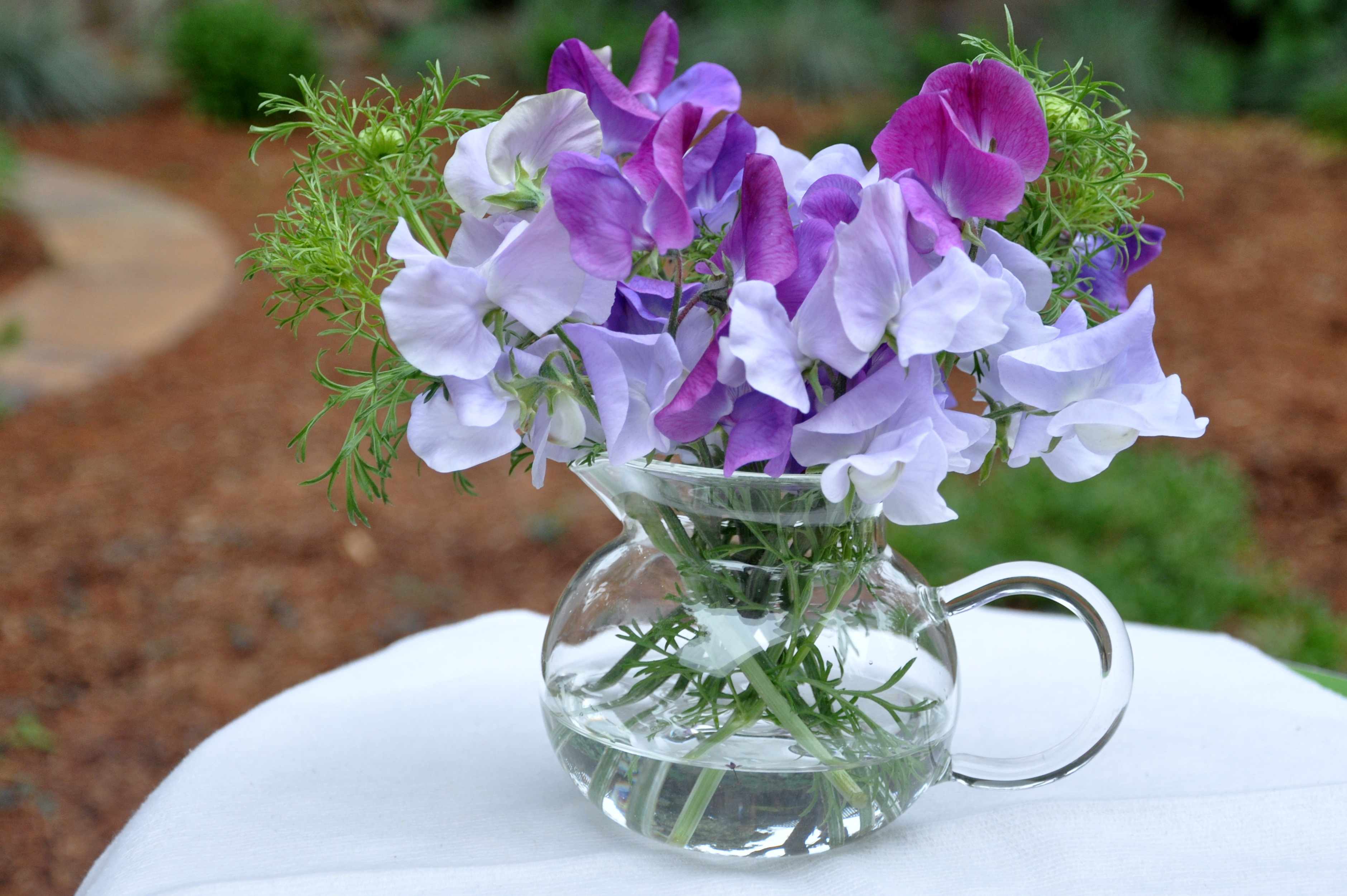
An Amazing Spring: Everything you see here self-seeded thanks to gentle, frequent rain. The Love in a Mist are now blooming, along with California poppies and sweet peas which appear to have swallowed the trellis

Late afternoon is a happy time in the garden. With spring in full bloom, bees and possibly wasps are doing what they do best: pollinating.

One of the many joys of blogging is learning new things. Though humbling, it’s also interesting when a long-held belief is knocked off its center.

For starters, take a look at this all-black bee.

Xylocopa tabaniformis

Xylocopa tabaniformis visiting the sweet peas

Someone told me years ago that these were carpenter bees. I took that at face value, having no reason to contradict it. They love traveling between my pumpkins and sunflowers. They’re frequent and welcome visitors in my garden, moving quickly from bloom to bloom. I’m always enamored with the yellow coating after they’ve dipped into the center of a flower. They’re docile as well, a nice quality when you’re up close taking pictures.

I was also told they would eat wood, including your house and that they were “bad” bees. I’ve since read that some carpenter bees are more problematic than others, but that overall they should not be viewed as pests but as beneficial pollinators. Are you as confused as I am?

Xylocopa varipuncta

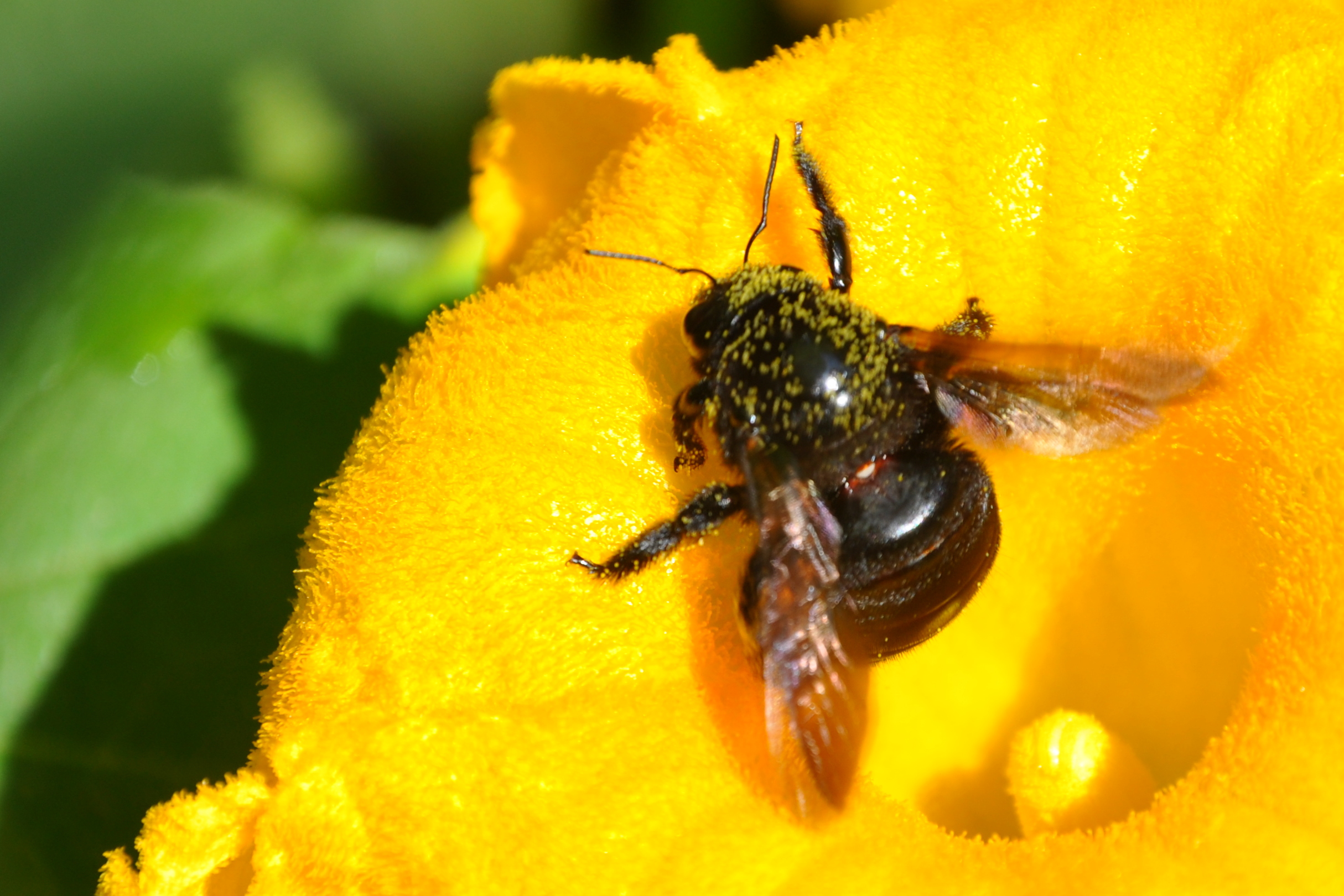
Xylocopa varipuncta gathering pollen on a love in a mist

I spotted this beauty today touching down on the love in a mist. Research tells me it’s also a carpenter bee, though the golden color is quite distinct from its shiny black cousin. Varipuncta looks like it’s wearing a golden fur coat, making it hard to distinguish between the bee and the pollen it gathers.

Xylocopa varipuncta

Xylocopa varipuncta alternate view

Rounding out the collection is a pollinator formerly known by yours truly as “A bee”, a nondescript, generic term I use for any sort of flying, pollinating “bee” in my garden. Now I’ve been forced to reconsider this description as well, allowing for the possibility that this is a wasp or a hover-fly. Any guesses?

bee or waspEvery year I find a paper wasp’s nest under the eaves, but they’ve never been aggressive. Today I read that yellow jackets and hornets are aggressive, but like most bees, paper wasps are gentle.

Why We Need Bees:

If you’re as fascinated as I am, here are a few links:

Re-covering the Garden Swing: The 2016 Edition

It’s become a bit of a hobby of mine. I like re-covering the garden swing every year.

Not!

I just finished sewing my third cover, not counting the original, for my beloved swing.

garden swing cover 2016

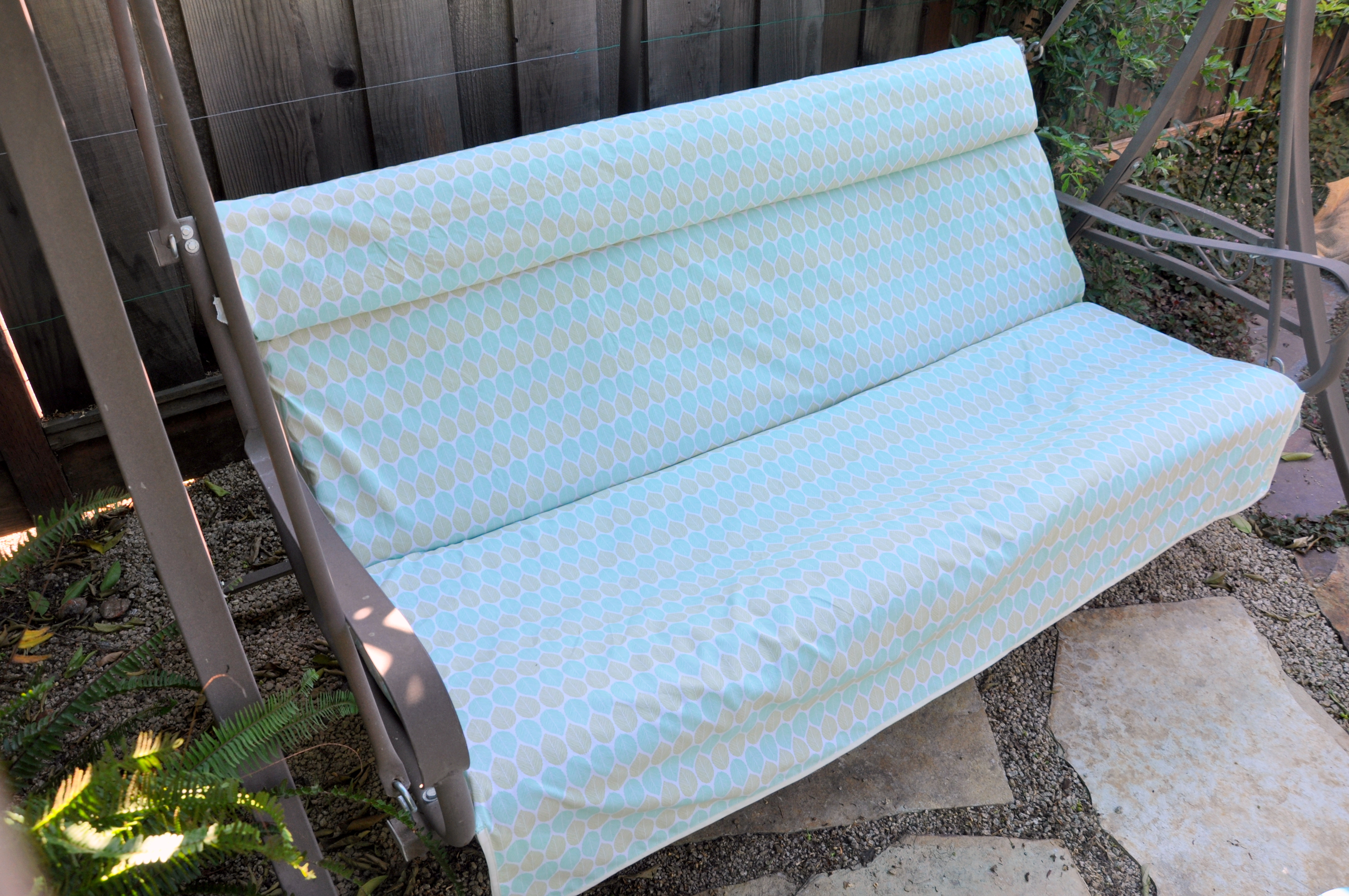
Garden swing cover, the bed sheet edition

I blame the squirrels. I’m not being mean here. I have photographic proof of the carnage. It’s become a bit of a neighborhood tradition to dismantle parts of my swing cover each year. Apparently they haul it off and line their nests.

My boys gave me this swing for Mother’s Day in 2009. I love it! It’s a relaxing place to hang out during the warmer months, and it gives me a wonderful view of my garden.

garden swing may 2009

Mother’s Day, May, 2009

The swing came with a tan-colored cover, suitable for the outdoors. It lasted a few years, but weather and time took its toll. I decided to buy some nice upholstery fabric to make a colorful slip cover for the swing. I bought contrasting pink fabric and soft, cotton piping for trim and fashioned my pattern after the original.

garden swing cover

My first swing cover, 2012

It turned out well.

Then one 4th of July I came home to a squirrel chewing on the back of the swing. She was after the soft cotton piping. How she knew it was there under the fabric is anyone’s guess. She chewed through the fabric to access the cord, then pulled it out and was on her way. Our block party was under way, so I couldn’t stay long. I came back inside, found the leftover piping and cut it into smaller strips. I draped them over the back of the swing, and sure enough, they were all carted away by the following day. Sadly, they didn’t stop there and by year’s end they had damaged the slip cover AND part of the original cover, this time after the fluff.

aqua swing cover collage

Garden swing rehab using a thrift store shower curtain, 2015

Last summer I went with a quick and easy cover. I found a blue cotton shower curtain at a thrift store for $4. Instead of putting a lot of time into sewing a cover, I simply attached a few ties to the back using a scrap of material on hand and called it done. Of course I had to re-stuff and repair the swing seat first, which I did using an old pillow and a tired looking tea towel.

My shower curtain fix worked for months, but eventually the squirrels got to it as well. Not quite as bad, but chewed nonetheless.

Off I went to my favorite thrift store, but this year no luck. I couldn’t find any shower curtains or fabric remnants that would work. I drooled over some pretty fabric at JoAnn’s Fabrics, but left after coming to my senses. I finally settled for a set of soft, cotton sheets from Target.

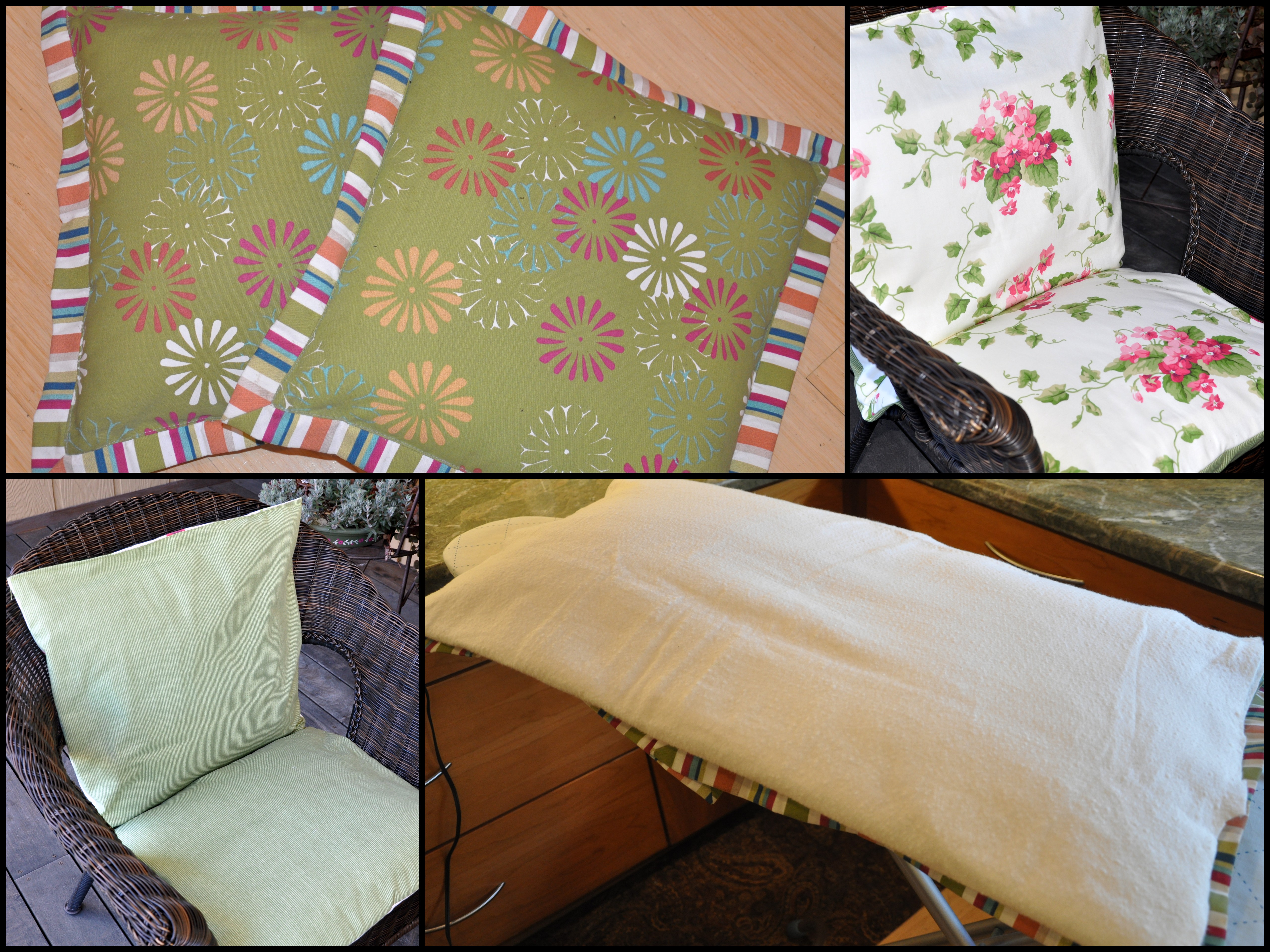
I used the fitted sheet to make the cover and bought some $3 bias trim in a coordinating color to trim the bottom edge. Now I have a second sheet to use next year and a pair of pillowcases for another project. Score!

I removed the elasticized edge of the fitted sheet and set it aside. In order to keep the sheet cover from slipping, I stitched the elasticized pieces together into one long length, then tied it at the back of the swing.

garden swing elastic

Removing the elastic from the fitted sheet

garden swing cover sewing machine detail

Stitching the lengths of elastic together to hold the swing cover in place

garden swing cover detail

This holds the cover in place, staying hidden under the fold

Here’s the definition of a hobby:

noun:

1.
an activity done regularly in one’s leisure time for pleasure.
“her hobbies are reading and gardening”

Using this definition, it makes perfect sense that I would “regularly” make a garden swing cover “in my leisure time” while the squirrels laugh at me “for pleasure.”

Little stinkers!

squirrel closeup on umbrella

No Bigger Than Thumbelina

fairy garden jungle

Fairy garden jungle?

Imagine for a moment that you’re no bigger than Thumbelina. You’ve been away for a while, and when you return your garden is overgrown.

Nature’s been kind this year. The longed-for rain finally fell and the earth smiled. Precious seeds pushed up through the dampened soil, welcomed by the warming sun.

curb garden pink flower

They grew healthy and strong. Encouraged by continued rains, seedlings turned into plants. Starter leaves became true leaves and from there they spread. Tiny greens stretched out across the land, filling the once-vacant landscape.

The fairy house still stands, but the garden surrounding it looks more like a forest. The giant gardener who presides over the land retreated for quiet contemplation.

Allowing nature to be her guide, the giant gardener issued a decree:

The land heretofore known as the fairy garden will be given over to the trees and any tiny deer passing by.

fairy garden deer

Foraging in the forest

And it was so.

The giant gardener waved her magic spade and a lake-side, fairy-sized, mossy, watery retreat appeared.

fairy garden lake

Fairy Garden Lakeside Retreat

Verdant moss to tickle the toes blankets the earth. Tiny succulents line the edges for privacy and a break from the wind.

fairy garden chair and lantern

For reading by lamp light

A small chair for reading nestles in the greens, and a hammock is at the ready nearby.

fairy garden hut with canopy

Lots of places to relax, but it’s particularly fragrant under the umbrella

Fairies can cool off in an improvised lake, a ceramic bowl rescued from a nearby thrift shop.

fairy garden ceramic pond

On Fairy Garden Pond

All our welcome in the wee-sized, lake-side fairy garden retreat.

A straw umbrella, made from the shell of an orange and a few strips of raffia give shelter from the hot sun.

fairy garden grass hut

Refreshed from a recent rain

There is, however, a small price of admission: one must possess a child-like imagination and the ability to leave one’s worries at the foot of the tiny ladder below.

fairy garden rope ladder

Leave your troubles at the foot of the ladder

Catnip Tomfoolery

Slinky Malinki has impaired hearing and her overall senses are dulled, but her sense of smell is superb. How else to explain her catnip tomfoolery?

A domestic cat’s sense of smell is about fourteen times as strong as human’s. Cats have twice as many receptors in the olfactory epithelium (i.e. smell-sensitive cells in their noses) as people do, meaning that cats have a more acute sense of smell than humans. Cats also have a scent organ in the roof of their mouths called the vomeronasal (or Jacobson’s) organ. When a cat wrinkles its muzzle, lowers its chin, and lets its tongue hang a bit, it is opening the passage to the vomeronasal.- Source: Wikipedia

Working in the garden at dusk, I looked up to see Slinky crossing the patio with determination. She headed toward a small mulch-covered patch of earth. Mouse the Cat looked on with interest, but kept a respectable distance. Slinky is a cranky, aging cat, and not one to be trifled with. He (generally) knows his place.

slinky finds some catnip

Mouse the Cat keeps his distance, hiding behind the love-in-a-mist

As I watched, she bowed her head, twisted it to one side and dove in. What odd behavior.

I crawled towards her since I was down at her level anyway pulling weeds, to see what she’d discovered. Sure enough she’d found a tiny sprig of catnip (Nepeta cataria) growing near the edge of the patio.

slinky finds some catnip

Slinky enjoys a catnip moment

slinky smelling catnip

Mmmmm, this catnip smells yummy

I planted catnip several years ago and it thrived.  Last year it died off, another causality of the drought. This year, thanks to the recent rains, volunteers are sprouting everywhere.  There are many things I didn’t set out to grow, happily filling patches of bare earth. Nepeta is one of them. It’s nice to see this perennial come back, and even nicer to see Slinky enjoying it. The plant is small and partially crushed after her romp, but it looks like it will recover.

slinky guards the catnip

This is my catnip. Don’t make any false moves

I suspect that once Slinky is slumbering on her cushions nearby, Mouse will help himself to. Lindy is quite a fan as well.

I too enjoy the subtle, herbal scent when you crush the leaves. The herb is also sold as a tea. It’s easy to understand why the kitties enjoy it so much.

I guess I better get in line.

Top Ten Reasons to Grow a Fairy Garden

Everyone loves a top ten list.*

If you’ve been on the fence about starting a fairy garden, read on. By the end of my top ten, I hope you’re ready to let your creative juices take flight.

Lets dig in.

10

Fescue yurt and an orange peel umbrella

Fescue yurt and an orange peel umbrella

Fairy gardens are a short cut to our inner child. Not the cranky, I-don’t-want-to-take-a-bath-and-go-to-bed inner child but the child that loves digging in the dirt with a spoon.  Remember chasing butterflies and dandelion fluff on a warm summer day? Fairy gardens are a wonderful way to express that carefree joy once again.

9

Replanted Fairy Garden, The Long View

Fairy Garden on the Deck

You don’t need a lot of space to grow a fairy garden. You can plant in a pot on your patio or fill an old wheelbarrow in your back yard. Grow your tiny garden indoors or out. Let your imagination be your guide.

8

fairy garden lavender bed

Lavender mattress frame

Fairy gardening is affordable…or free. You don’t need to buy a thing. A traditional fairy garden might live under a shrub or near the forest floor. Smooth stones make wonderful seats and twigs are perfect for fences, walkways and four-poster beds.  Fairies enjoy resting on the soft side of a flower petal with a blanket fashioned from a sprig of fern.

7

One spooky Halloween night

One spooky Halloween night

Decorating on a dime. If you love decorating but have run out of money or rooms, this is the hobby for you. You can switch out the decor of your tiny garden as often as you like. It’s fun to put up lights for the holidays or lay down green stones for St. Patrick’s Day. The sky’s the limit, without the price tag.

6

fairy garden chairs and tableFairy gardens are a fun way to up-cycle household items. I’ve used wine corks, empty tea light holders, scraps of ribbon and the cap from a bottle of champagne, pictured above. You can use up old paint, or give a second life to a discarded toy. I love the challenge of using things I have on hand.

5

Fallen Log Bridge

Fallen Log Bridge

Scavenging for your fairy garden is a great way to spend time outdoors. I brought home a tiny “log” from one of my hikes and turned it into a bridge. I used broken twigs from a pine tree to make a small rope ladder. One year I fashioned a hammock from the soft petal of a magnolia. Using nature’s discards is fun.

4

fairy garden birthday

Celebrating birthdays in the fairy garden

At a loss for words? Fairy gardens are wonderful conversation starters for guests five through 105. People always have questions or comments when they see my fairy garden. Chatting about fairies is a terrific icebreaker.

3

Fairy House

This fairy house roof line is decorated with straps from an old pair of sandals, a bottle cap and a bit of glitter. The door is cut from the tough bark of a large fern with a seed for a door handle.

Fairy gardening is a unique way to express thoughts and emotions that are hard to put into words. Creative endeavors help lower stress and anxiety. An hour in your fairy garden can help you feel calmer and happier. It allows you to create something uniquely yours which in turn can bring you a sense of pleasure.

2

fairy garden sign and hammock

Tiny garden gifts from friends: a wee little welcome sign, a small hammock and a woodland chair

Your friends will join in the fun. A few of my friends started their own fairy garden. Several others send me wonderful little garden treasures in the mail. I’ve found a few anonymous surprises on my doorstep and even more in the garden. My neighbor’s daycare children add flowers and the odd sticker to let me know they’ve stopped by. It’s fun to be a part of this not-so-secret society of fairy lovers.

1

fairy garden rope ladder

This way to the fairy garden

Designing and tending a fairy garden allows your imagination to soar. There are no rules, no guidelines and no restrictions. Creative endeavors relax the mind and feed the soul. Even the busiest among us can carve out time to tend to a wee garden. In exchange, the tiny garden will tend you.

Stay tuned for my latest fairy garden creation: time at the lake.

*There’s a website called ListVerse that publishes top ten lists. According to their About page: “We publish lists that intrigue and educate, specializing in the bizarre or lesser-known trivia.”