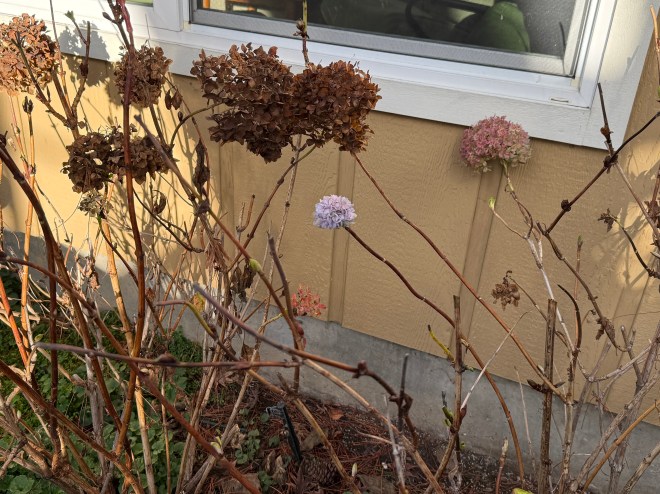
An impromptu browse through the garden this morning revealed unexpected pinks and purples on a dark and drizzly day. December rain cleared most of the remaining foliage on the dormant hydrangea bringing into focus a pair of out-of-season blooms blushing against the grey sky. These garden anomalies make me smile.
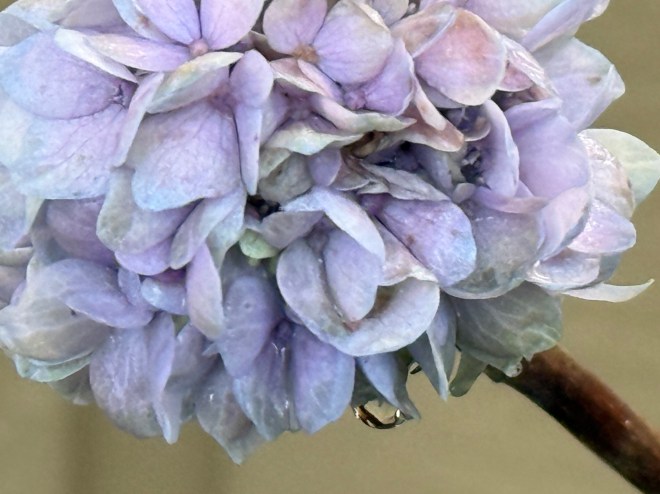
Raindrops linger amid the lavenders, pinks, and blues of this small, January hydrangeaOff-season pink hydrangea
According to Jafe Decorating, “Pink is widely recognized for its calming and soothing effects on the human psyche. Studies have shown that exposure to the color pink can reduce feelings of anger, aggression, and anxiety, creating a serene and tranquil environment, helping to alleviate stress and tension.”
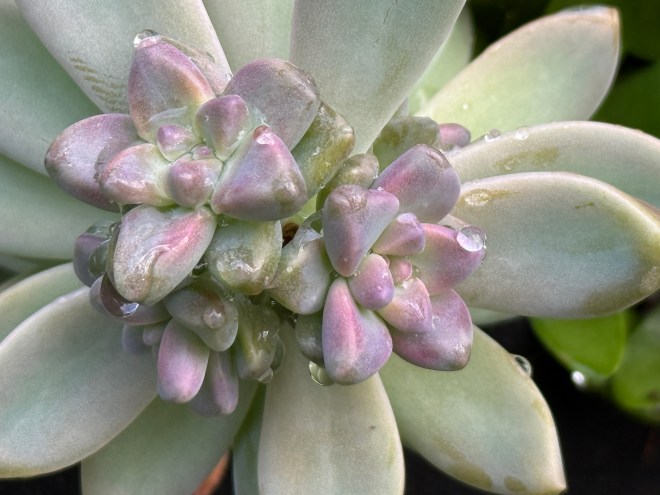
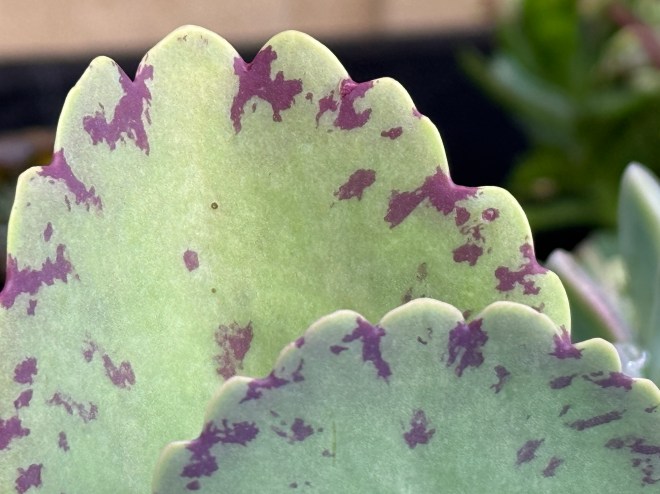
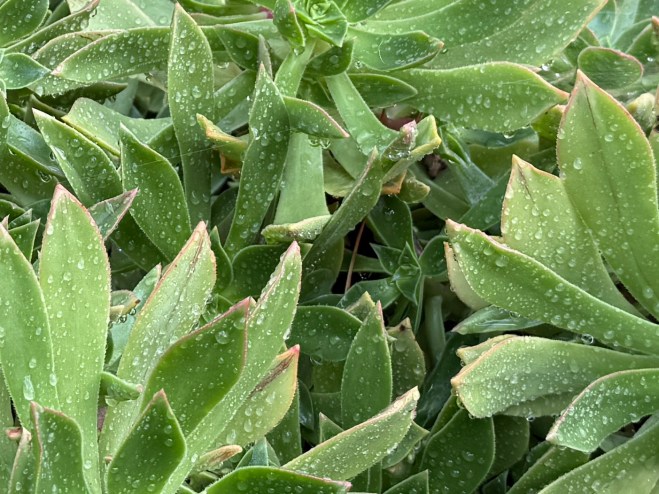
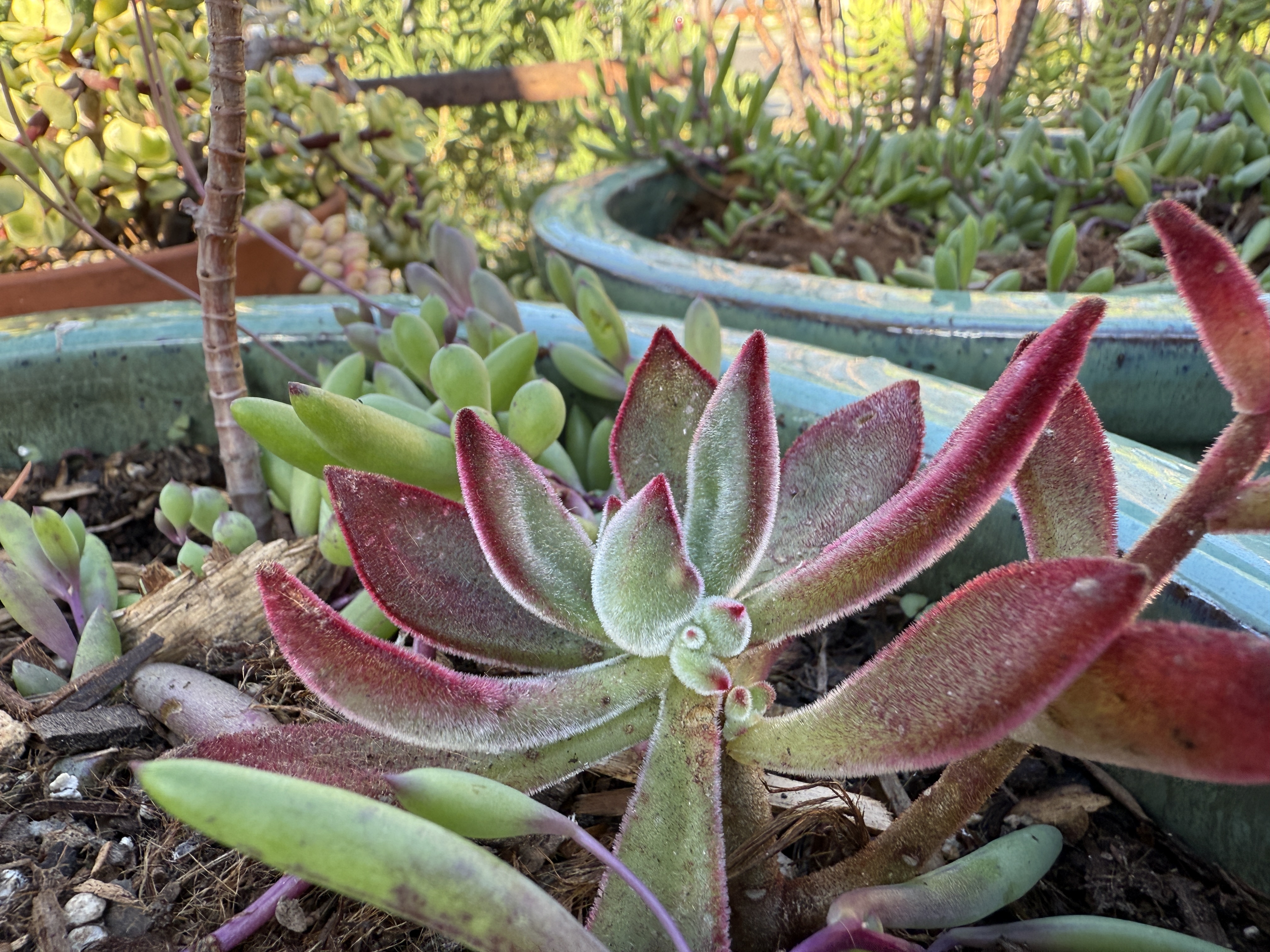
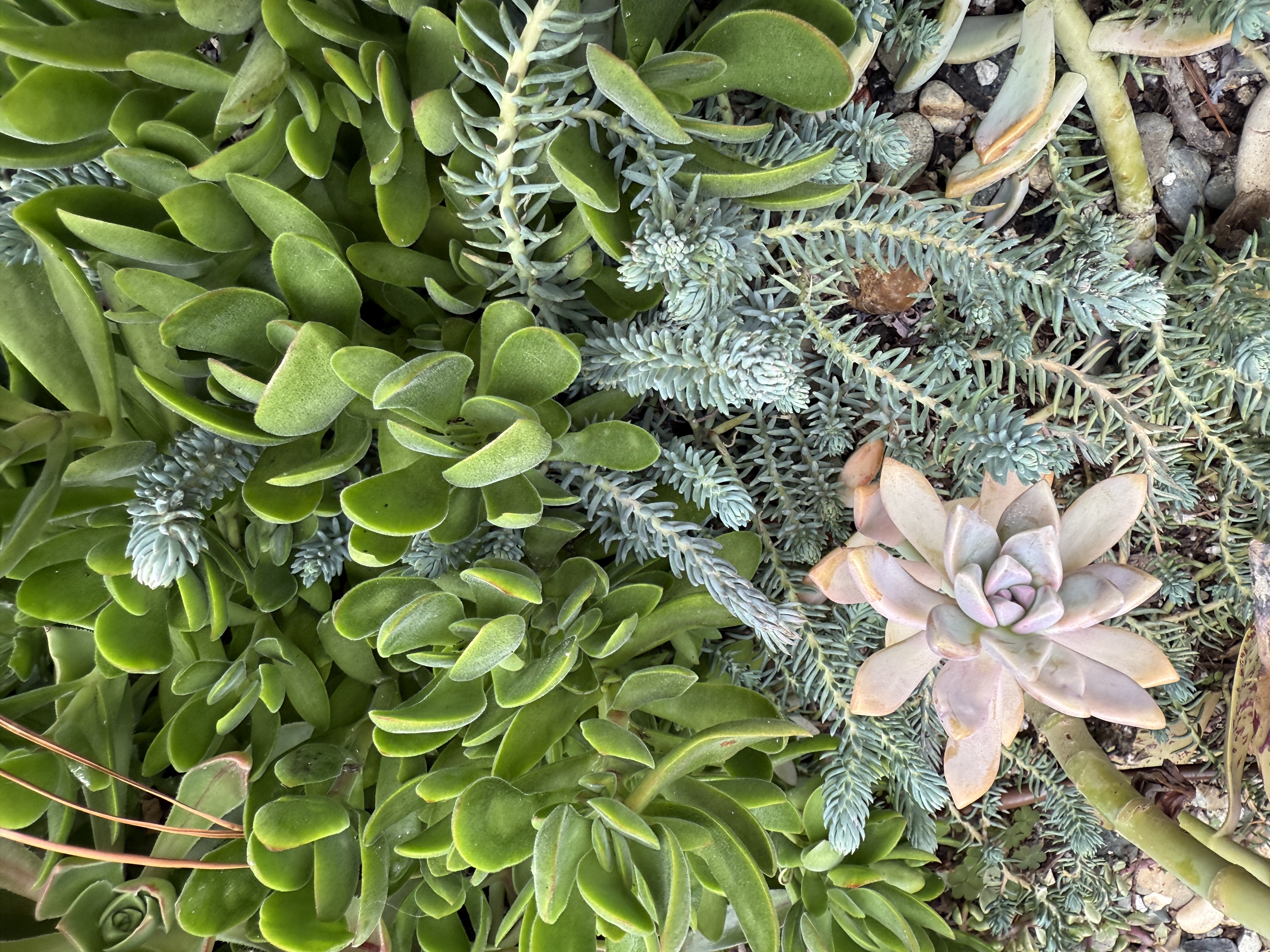
Shades of pink and purple appear in the center of this succulent
Succulent, possibly a Pachyphytum
and along the edges of its companion.
Penwiper Plant (Kalanchoe marmorata)
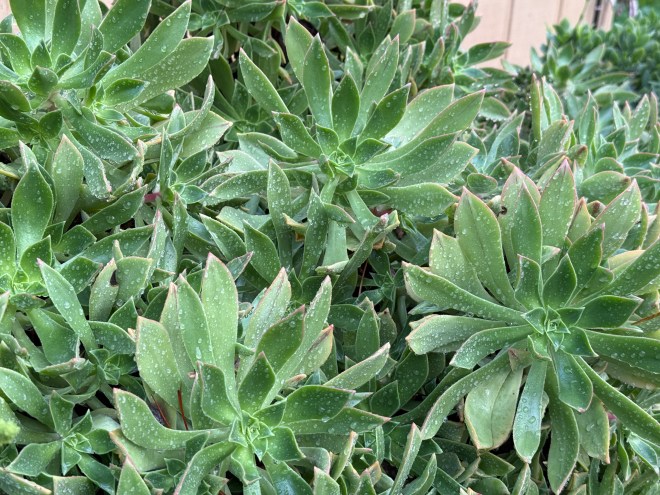
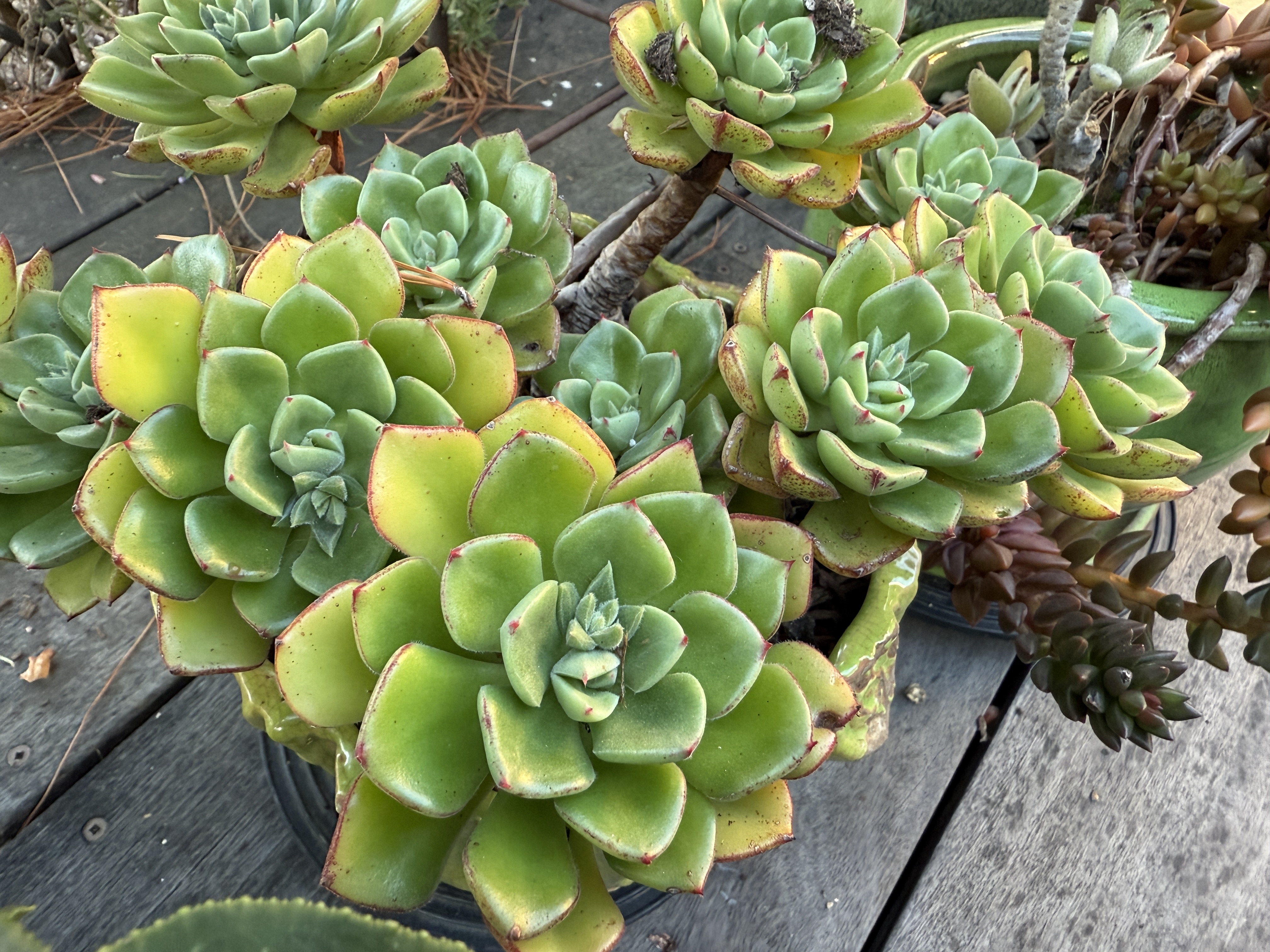
These plants came in a hanging basket and made do with cramped quarters for some time, but once they had room to spread out, they quickly dominated this raised bed. They tolerate the cold and can mostly handle the heat, though they get a bit of sunburn on scorching days.
Aeonium haworthiiAeonium haworthii
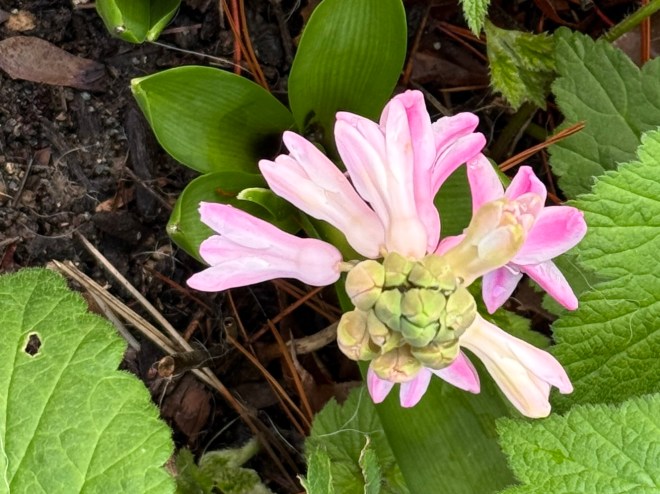
At the corner of our patio, the first of the pink hyacinths is up, with more pinks and purples to follow. They remind me of Mom, who once gave each of us one for Christmas along with a glass bulb-growing vase. I still remember what a thrill it was seeing that fragrant flower emerge from the top, but being able to see the roots, too.
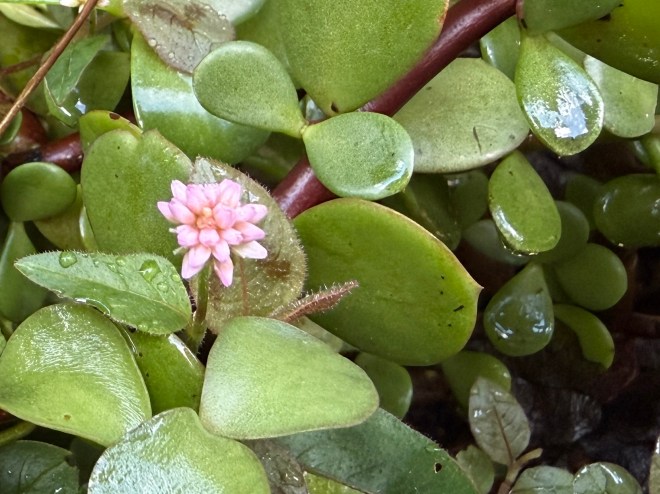
By now, I was on a mission to find anything remotely pink or purple in the garden. Everything smells wonderful after a rain, so I took my time and turned up one more, this tiny flowering ground cover that self-seeds as it pleases, and has done so for thirty years.
Pink knotwood (Persicaria capitata)
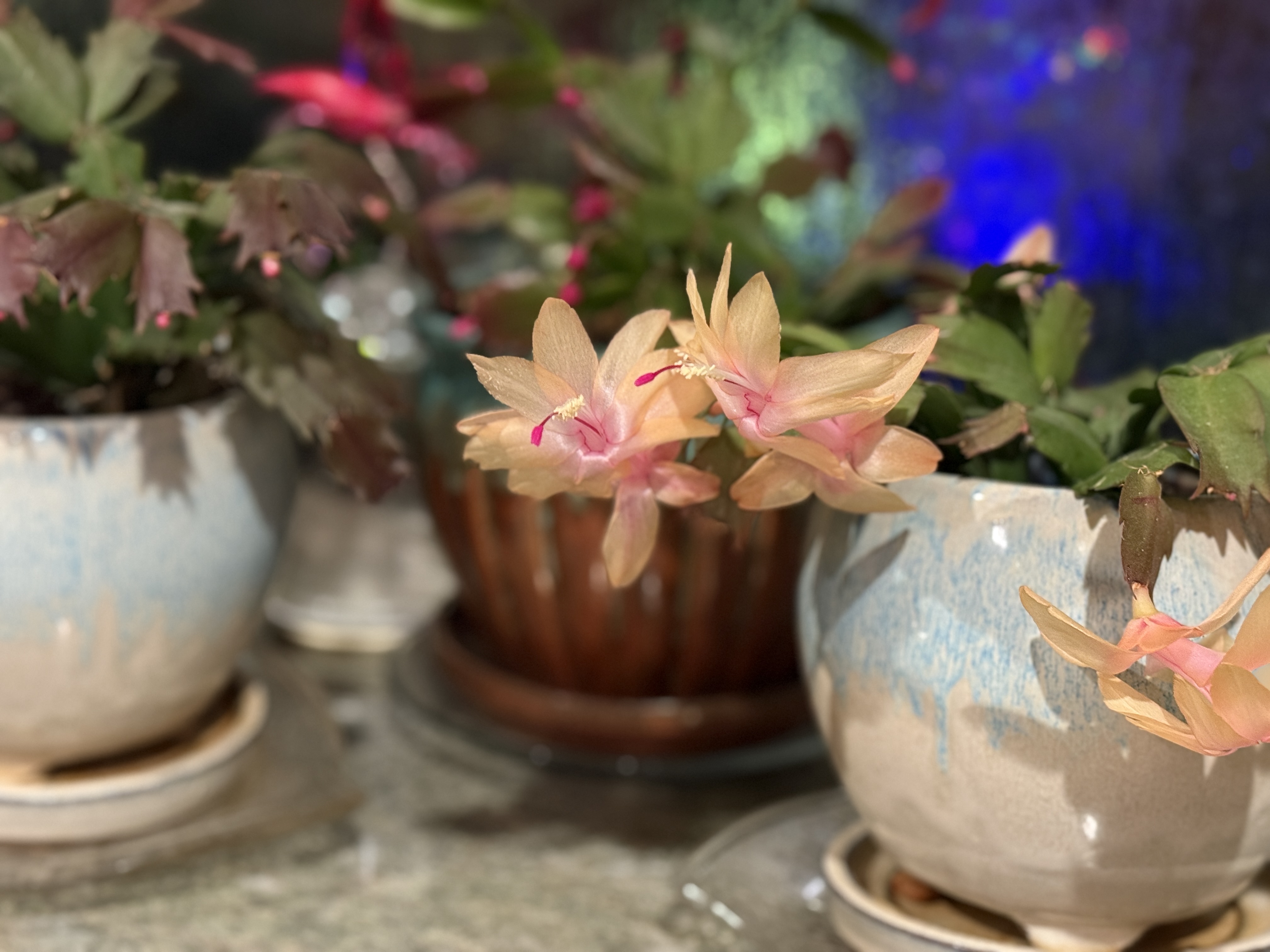
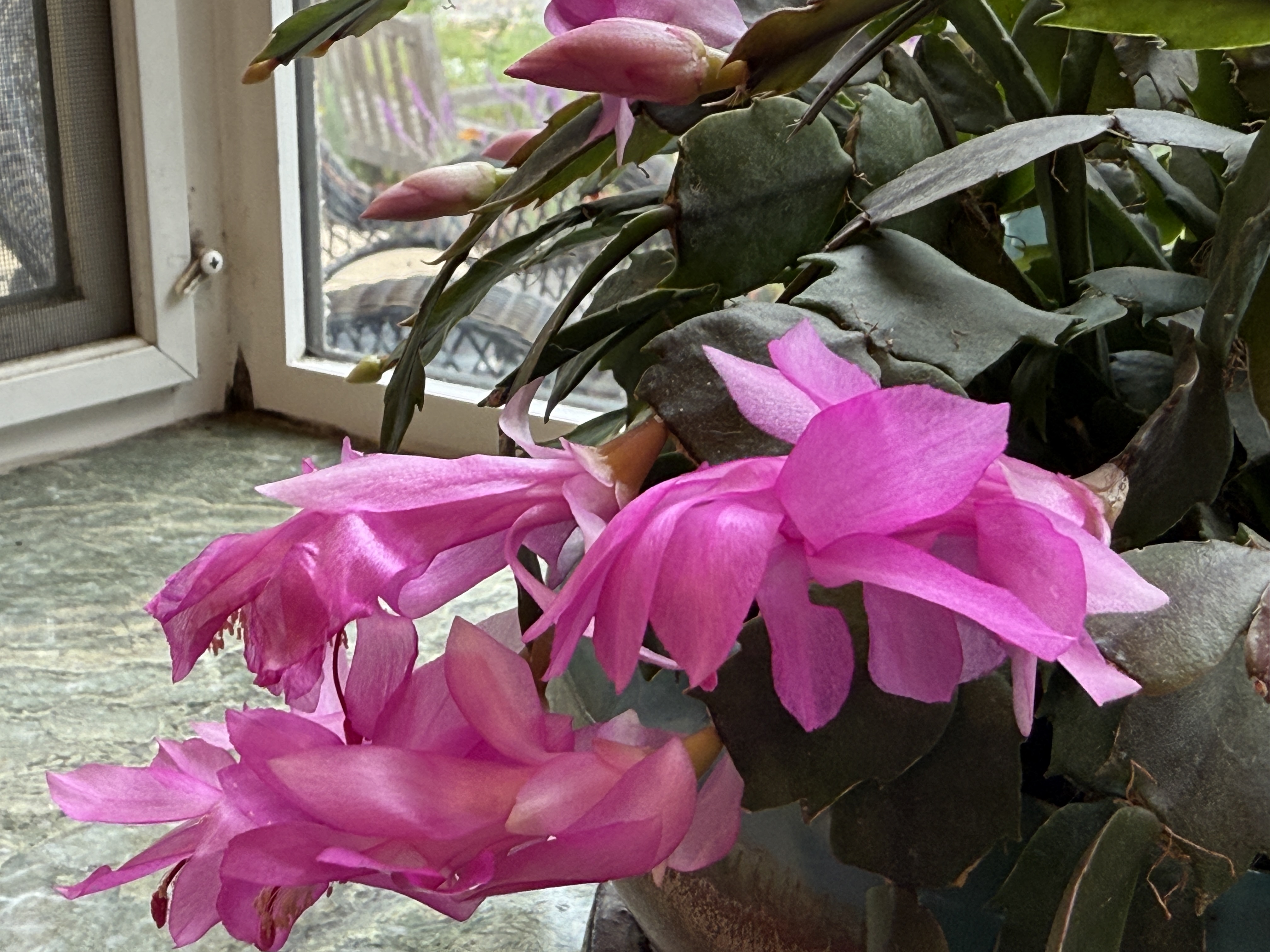
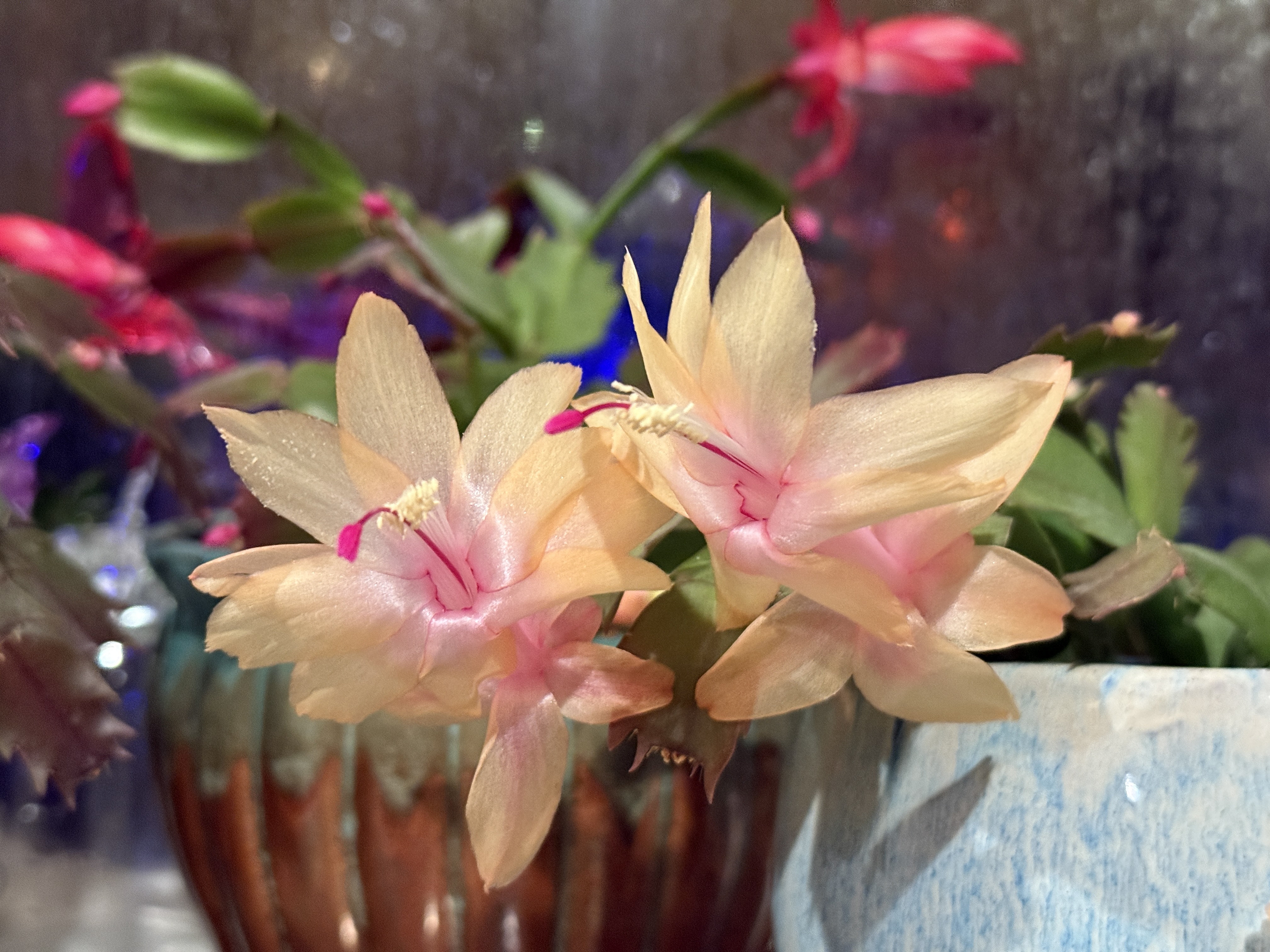
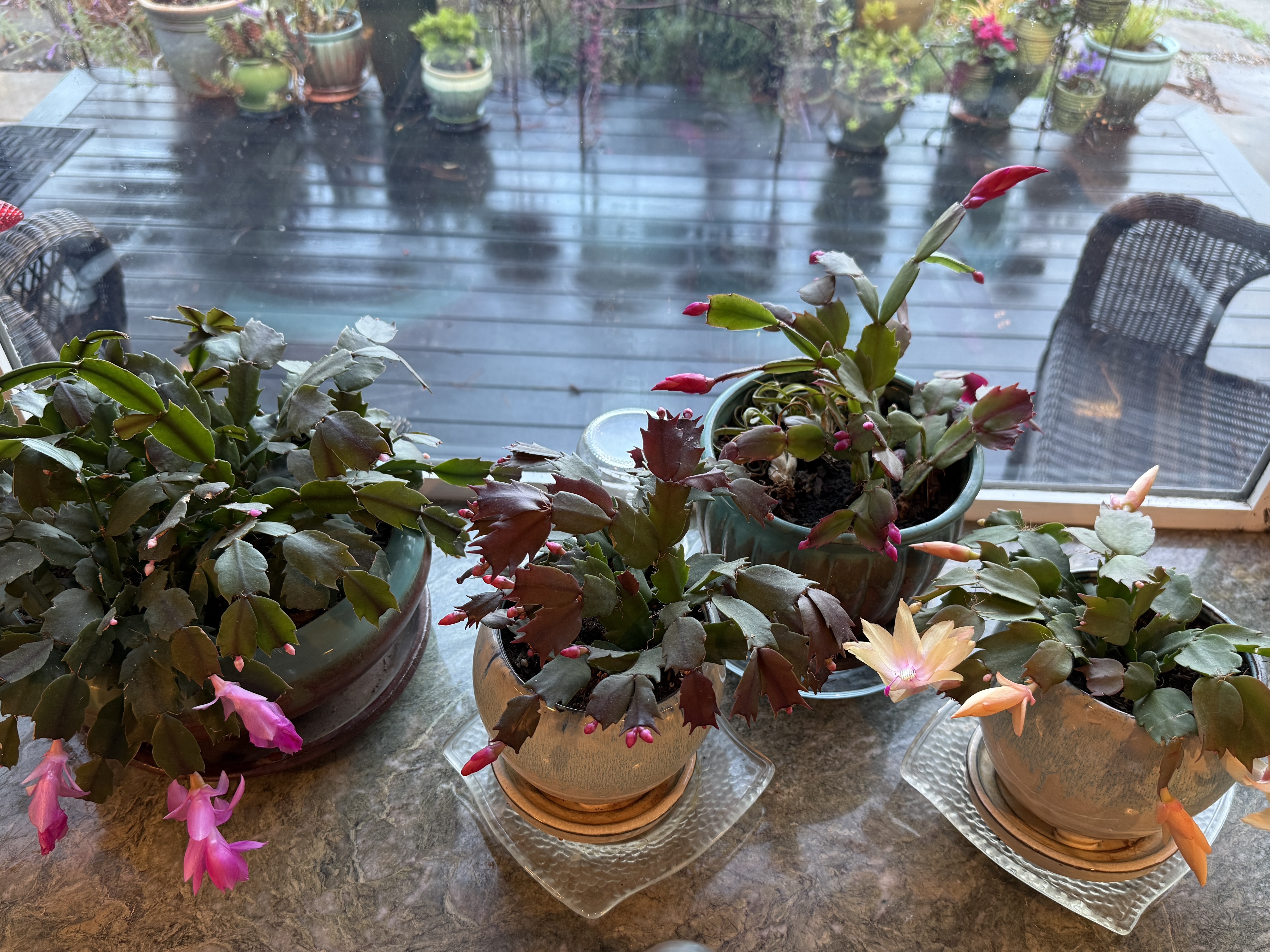
The last of the pinks is a collection of Christmas cacti that live on the kitchen counter under diffused light. I can’t remember a time when they bloomed so profusely. They are a balm for the weary soul.
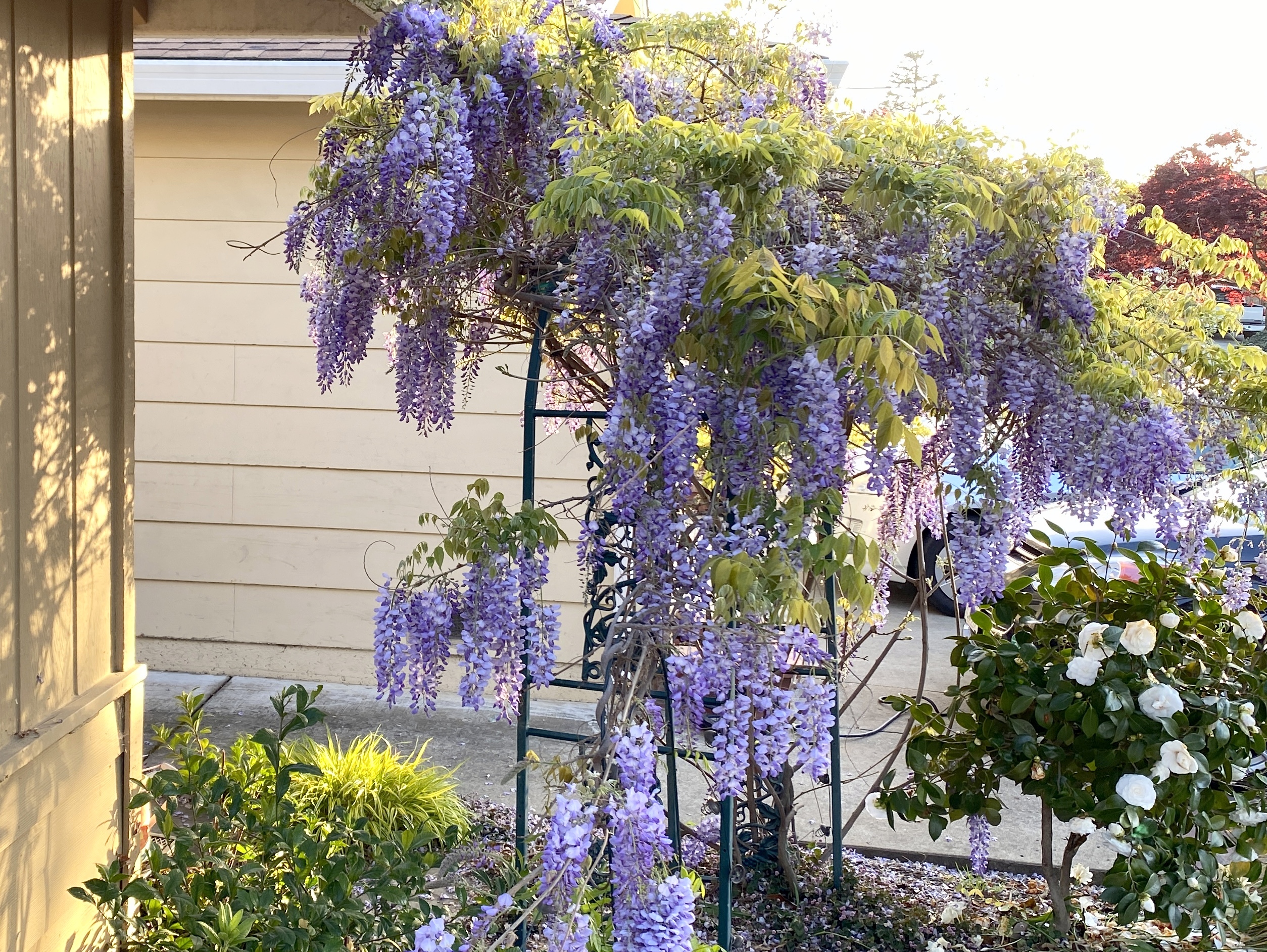
Wisteria symbolizes longevity and grace. For years I longed to have one in our garden. Aren’t they stunning? They need space to grow, though, and space is always at a premium in the garden, because nature abhors a vacuum, and this gardener feels compelled to plant any available earth.
Then opportunity knocked.
When our young Magnolia became infested with scale, I tried to save the tree by manually scraping the scale into a bucket —an arduous, odiferous task. The scale quickly returned, along with ants. I pruned away the center, looked at organic options, and eventually contacted an arborist, but it was all for naught.
It’s tough losing any tree, but here was my chance to grow a Wisteria vine. We repurposed an arch from the back garden, placed it at an angle in the front garden, and planted the vine. The first year of growth was underwhelming, as it often is, but in the years that followed, the vine took off. It flowered vigorously in early Spring, then sent out a second set of blooms later in the year.
At some point, though, the tree went from vigorous to invasive. I couldn’t keep the tendrils off our roof, our neighbor’s roof, a nearby tree, and so on. Clearly, I should have done my research, as I recently read that it is “known for its vigorous and potentially destructive growth.” Now they tell me.
I get attached to plants and trees, and this was no exception, but I’m pragmatic as well. Risking life and limb, damage to the house and the tree nearby meant it had to go.
It was labor-intensive. I started with small garden shears, graduating in size to the base of the tree’s substantial girth. I tried digging out the roots, then Mike had a go, until it became apparent the roots would need to be removed by a tree stump removal service.
Space after removing Wisteria
The space looked empty for a time, but I’ve since planted several succulents that had outgrown their pots. They took to the spot immediately, and by next Spring, they will be well established. They’re also water-wise plants that don’t require much fuss. The freesias came up quickly around the stone walkway, but it will be several months before they flower.
Nasturtiums have taken over the garden this spring. They bloom exotic oranges, sunny yellows, and a few brilliant reds. Leaves shaped like small lily pads are often as big as saucers. Leaf size varies, each slightly ruffled around the edges with a stem supporting the leaf like a delicate umbrella, filtering the sun yet inviting the light.
Nasturtiums are happy in the sun and the shade. They return year after year, asking for little in the way of watering and pruning. A gentle rearranging of the meandering vines keeps the walkways safe from trips. They play well with others, happy to twine themselves up nearby shrubs or carry on down the path.
Depictions of nasturtiums appear in botanical art and paintings, much like geraniums. They’re a flower for the people. These garden gems stand tall, faces lifted toward the sun, gently bending with the breeze that moves across the garden late in the day.
The flower and the nasturtium leaves are edible, containing various minerals and antioxidant compounds. They could feed the masses if we could replicate all that goodness.
If nasturtiums ruled the world, they would remind us daily how nice it is when we all get along. They would stand for justice, fairness, honesty, and respect, leaning on each other for support in all their beautiful shades.
Thank you, planet Earth, for all your gifts.
On this Earth Day, we will all try to do better.
A bit about Earth Day from Wikipedia:
“In 1970, the seeds that grew into the first Earth Day were planted by Wisconsin Senator Gaylord Nelson. An ardent conservationist and former two-term governor of Wisconsin, Nelson had long sought ways to increase the potency of the environment as a political issue. The extraordinary attention garnered by Rachel Carson‘s 1962 book, Silent Spring, the famous 1968 EarthriseNASA photograph of the Earth from the Moon, the saturation news coverage given to the Santa Barbara oil spill[18] and the Cuyahoga River catching fire in early 1969[19] led Nelson to think the time was ripe for an environmental initiative. As a result of interactions with his staff and with Fred Dutton,[20] a prominent Democratic operative who had been Robert Kennedy’s presidential campaign manager, Nelson became convinced that environmental teach-ins on college campuses could serve as such a vehicle.[21“
After a parched January, the skies opened up and delivered much-needed rain. I’m grateful for every drop. It’s fun to imagine droplets trickling down to the garden’s roots, perhaps encountering an earthworm as they travel. After years of gardening and drought in this semi-arid state, I take nothing for granted.
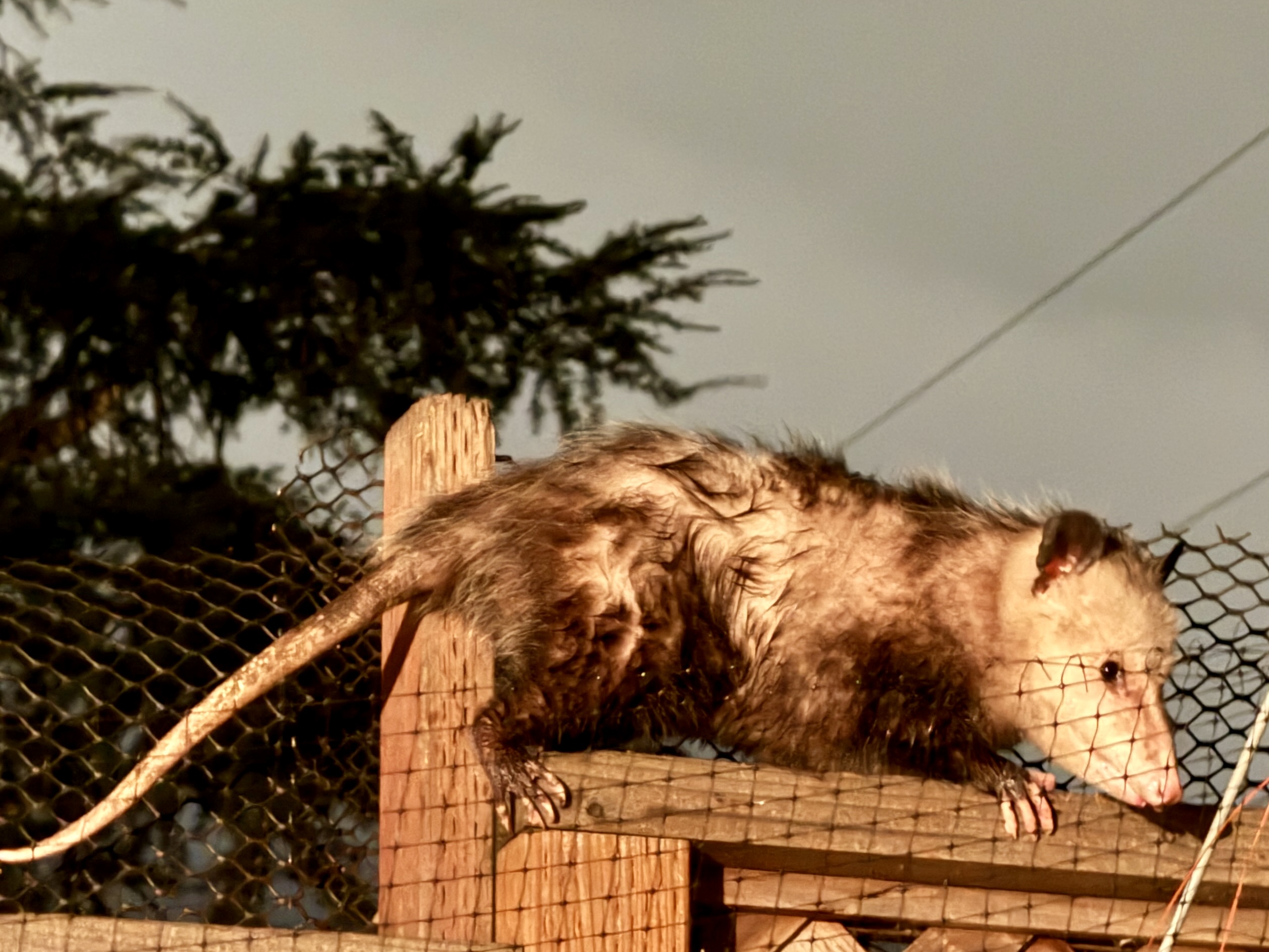
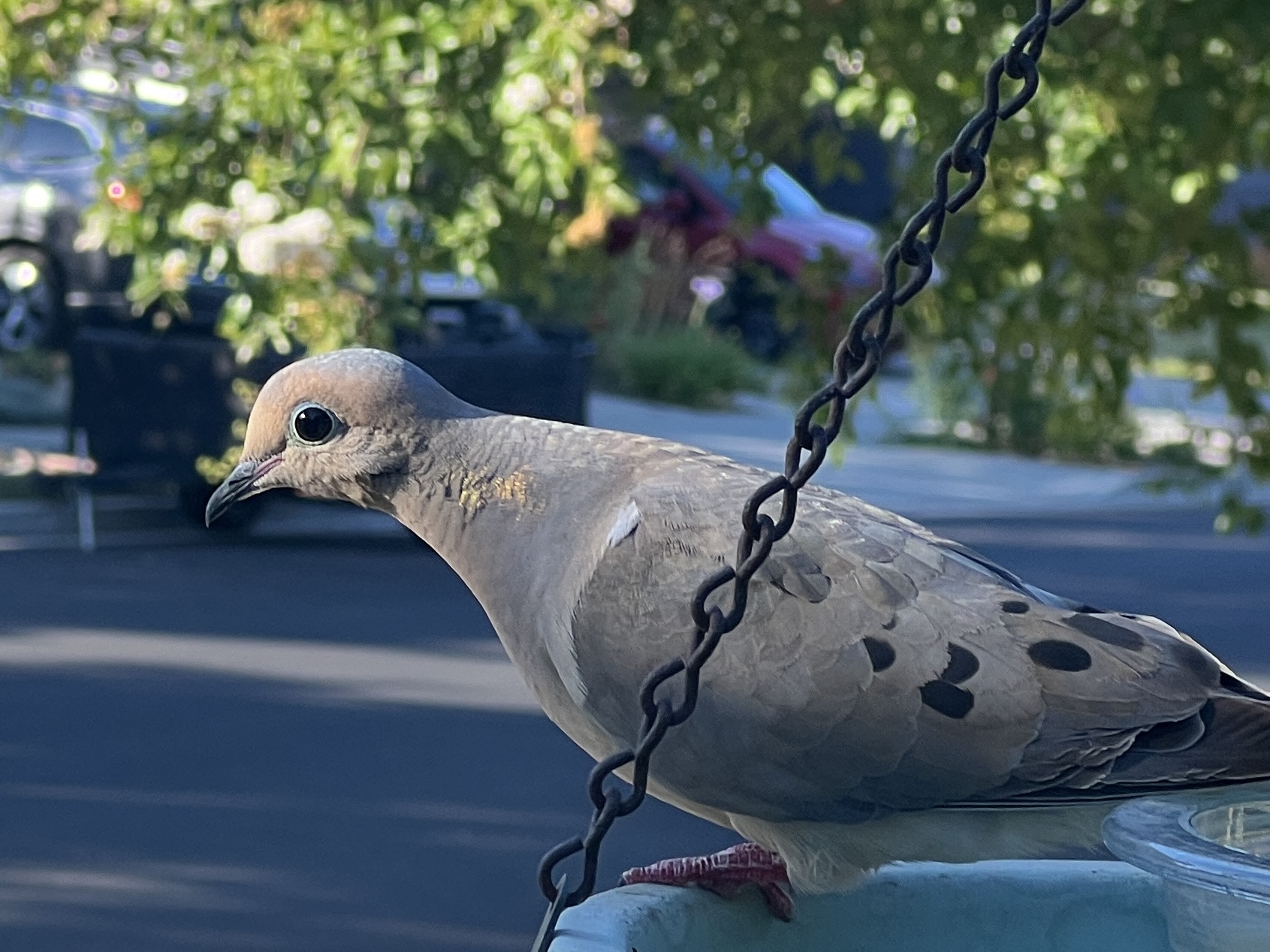
Various birds, squirrels, and perhaps this Virginia Oppossum drink from our fountain and the smaller birdbath on our deck. All thirsty guests are welcome.
We had one week in January with unseasonable temps in the seventies (F) and no rain; Mike ensured these water sources were clean and full.
Over time, I’ve replaced potted plants along the deck with succulents. Succulents store moisture in their leaves, allowing the plant to go one to three months without water. Conversely, most summer annuals need near-daily watering, so I’ve learned to (mostly) resist when I head to the garden center.
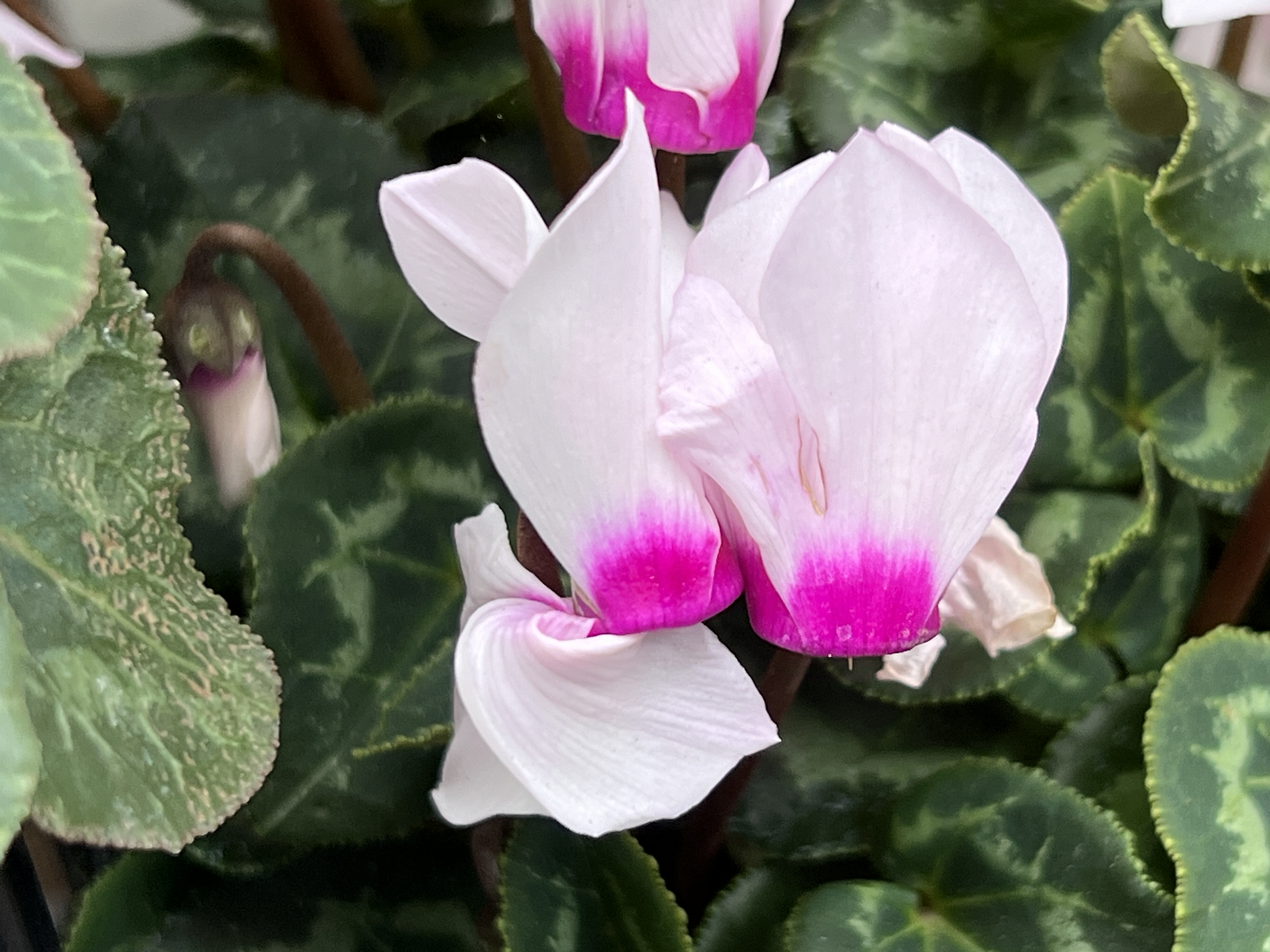
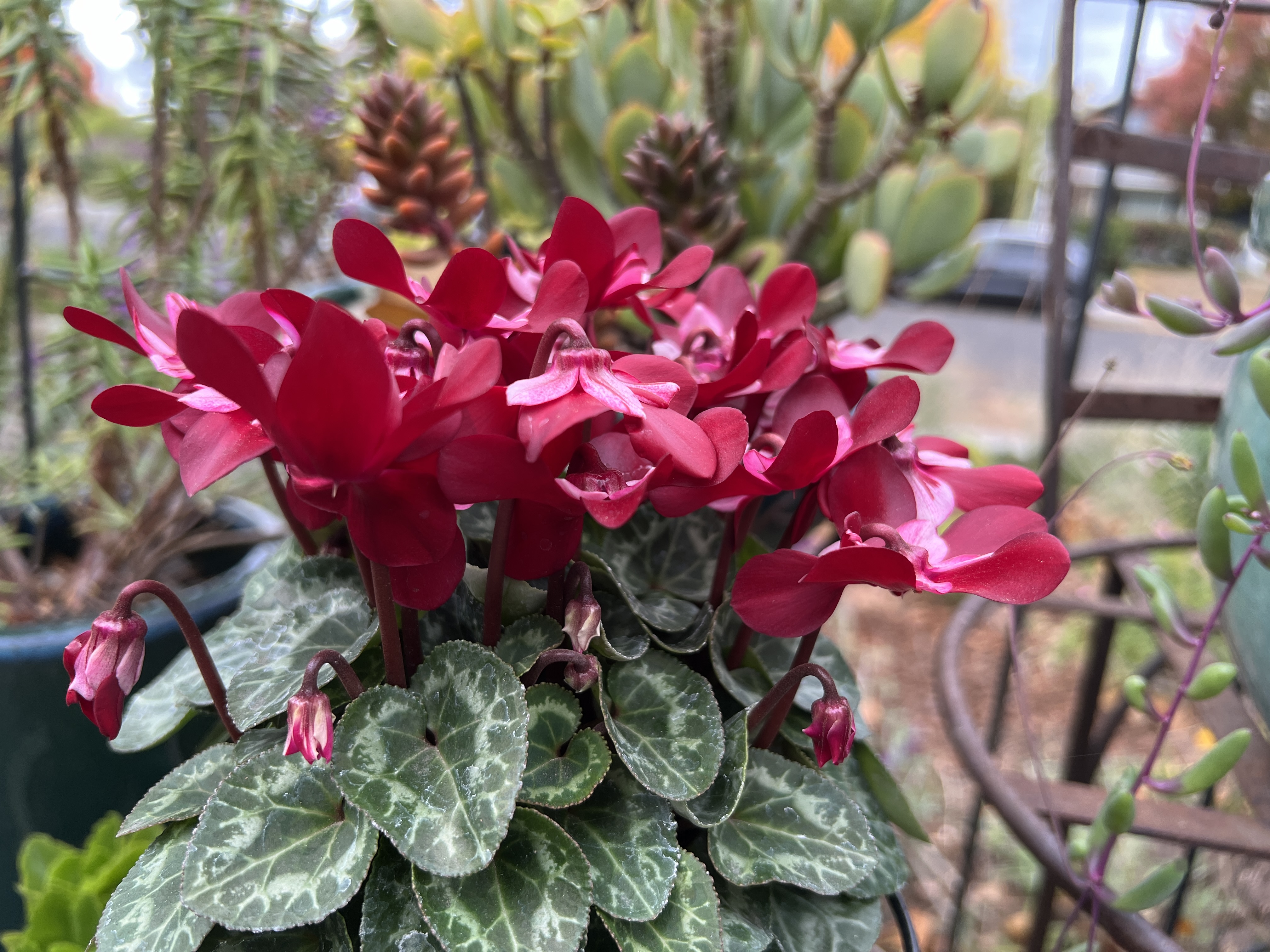
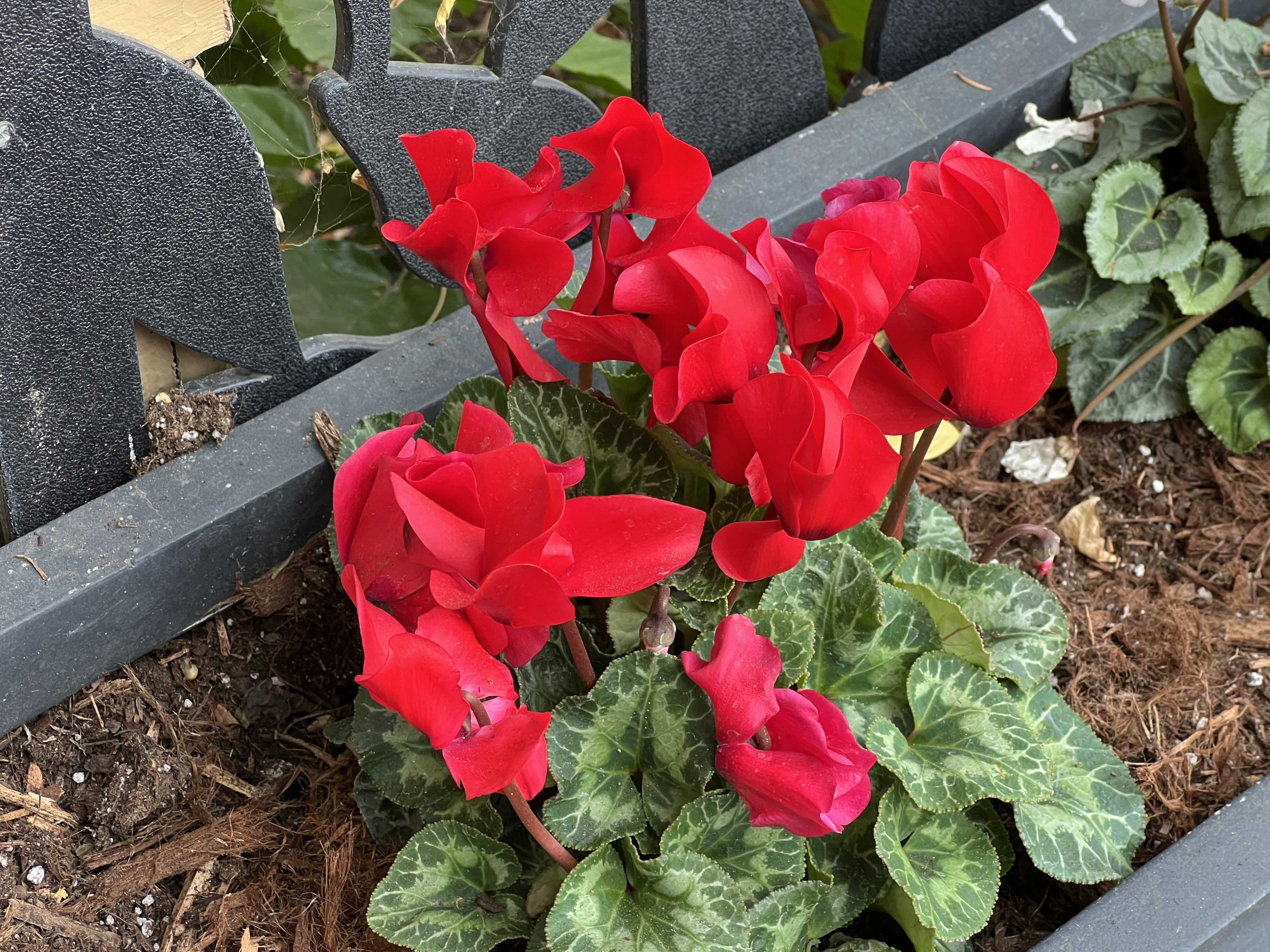
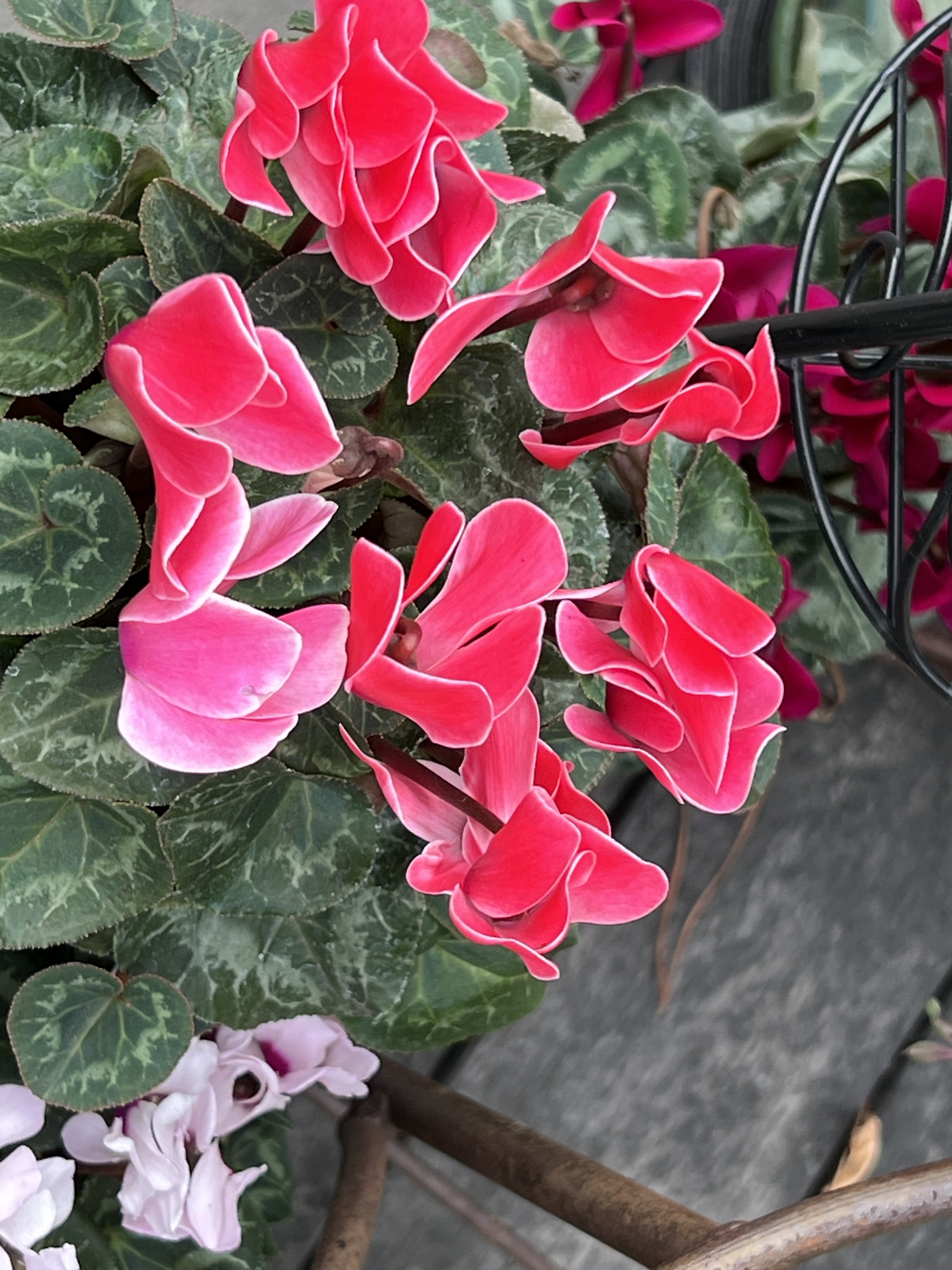
The newest addition to our deck is called an Othonna Capensis. It has thin purple stems and tiny yellow flowers. I transplanted it last summer into a waiting pot, but I wasn’t sure it would make it. The roots were loose and thin. To the contrary, it’s filled the pot nicely and its sending trailing purple offshoots down the sides. I add a few potted cyclamen for color in the fall, and when the corms go dormant, I replant them in different parts of the garden for color the following year.
Working in my garden has been physically challenging these past few years as the pain in my hips worsened. After five years of maneuvering through the US medical system, I finally had a complete hip replacement this past Wednesday. From a medical perspective, the surgery was unremarkable, and I was able to come home the same day. I need to replace the left hip in the future, but I want to fully recover before contemplating another surgery.
If you garden in the Northern Hemisphere, you’ll know February is a decent time to be off your feet. The first six weeks of recovery will carry me through the end of winter, leading to the effervescent gifts of spring.
As the autumnal equinox approaches, I’m pining for fall colors and cooler days. October is my favorite time of year, and it’s fast approaching. Sometimes, I miss the fun we had growing pumpkins when my boys were young, but with my sons launched, not to mention back-to-back years of squash bug infestations, I’m happy to leave it to the professional growers.
Also, I’m out of room. When you love gardening, a patch of exposed earth is a planting opportunity. I’ve filled pots, borders, raised beds, and the surrounding soil with living things. Potted succulents line the deck, the back steps, and the walkway leading to our back gate. I once joked that it would be fun to buy the house behind us, remove the fence, and extend the garden. Ha! A gardener can dream.
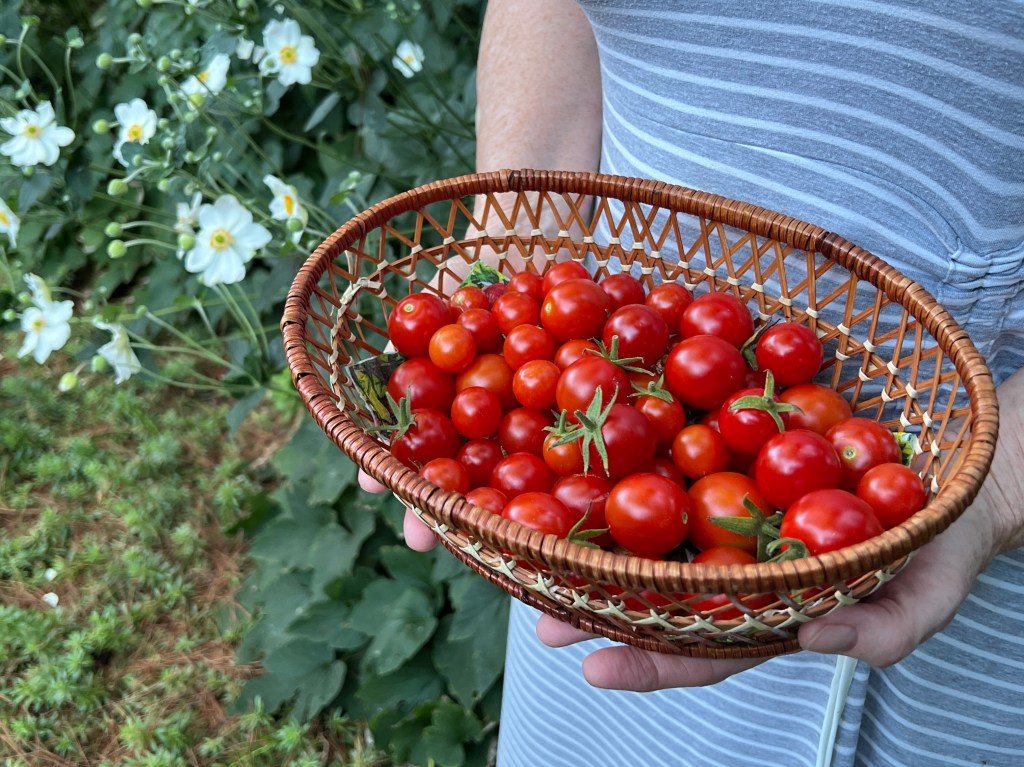
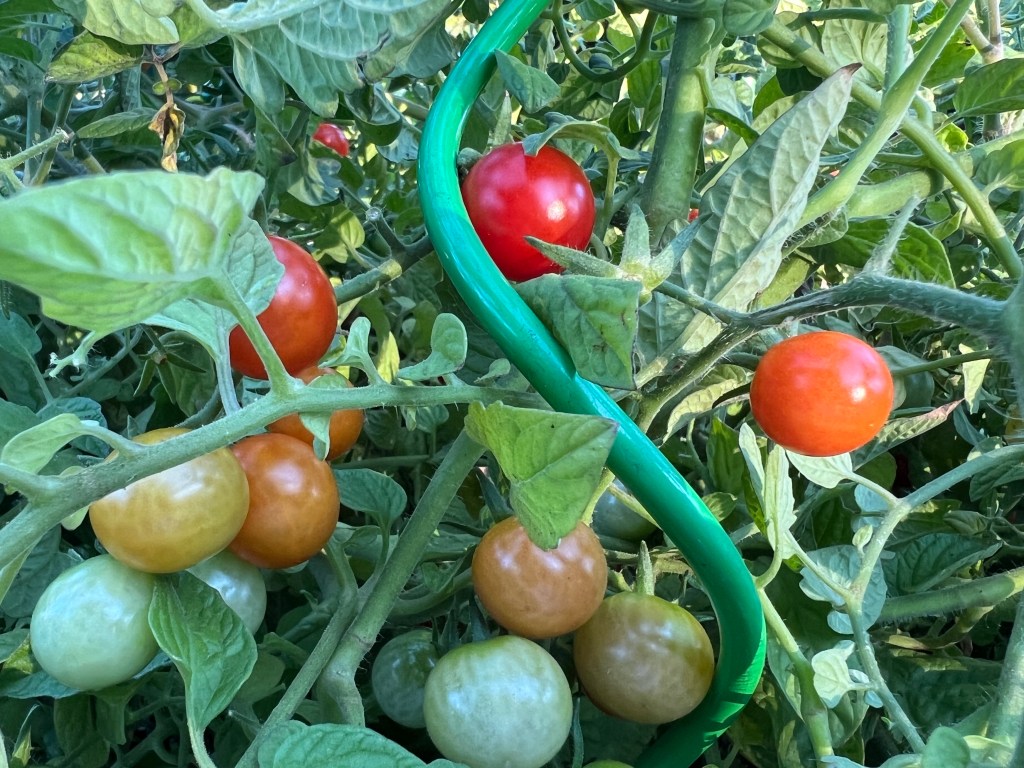
We have a decent tomato crop for the first time in several years. I was starting to think I’d lost my gardening mojo, but the cherry tomatoes are sweet and delicious, not to mention prolific.
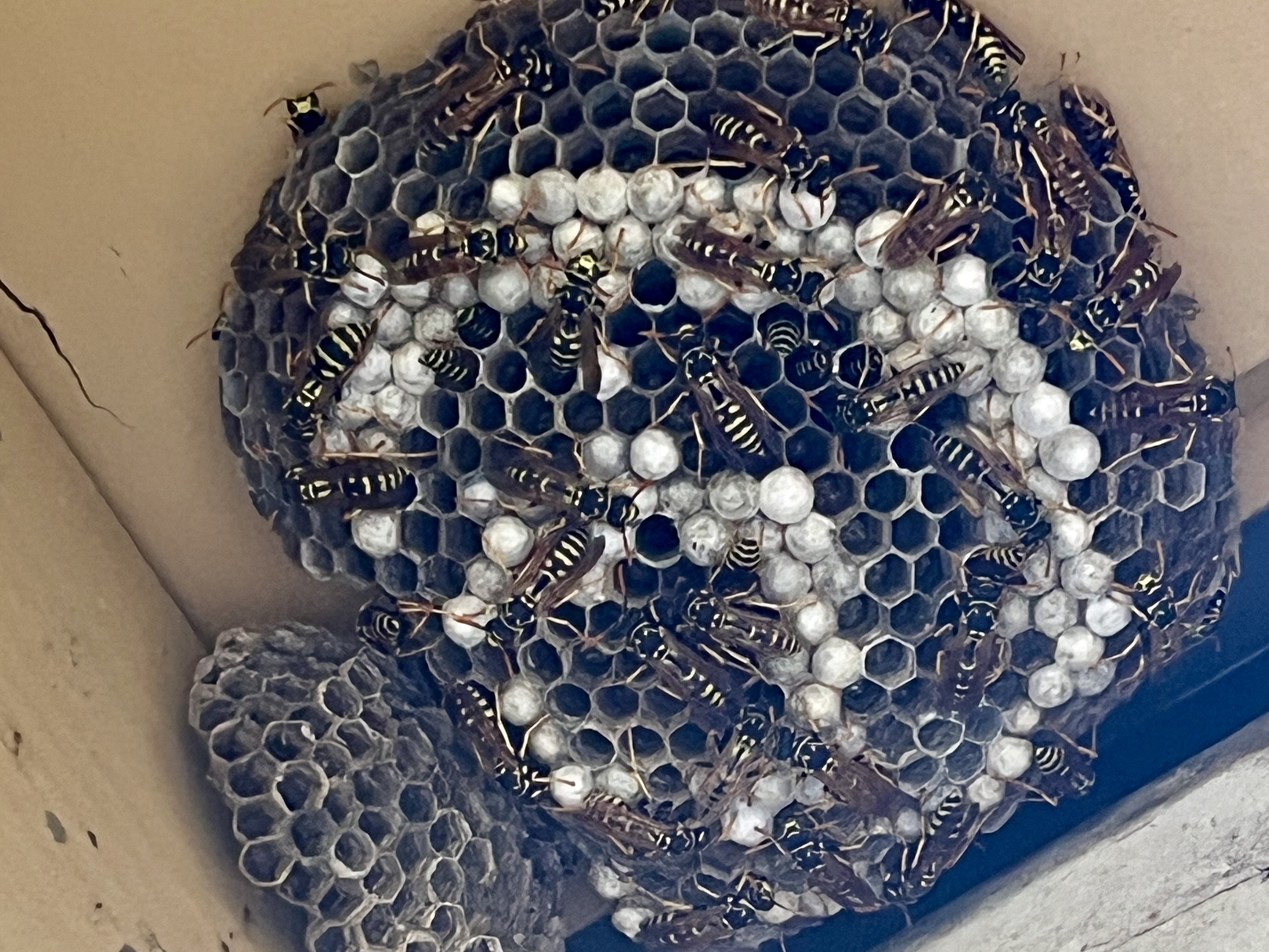
I spent several hours last weekend taming the garden paths from the rapidly spreading nepeta and an annual called a 4’0clock. They fill the beds quickly and spill over on the path. The nepeta is a garden darling favored by cats, birds, bees, and paper wasps.
Last weekend, I spotted a mantis near the catmint. I coaxed him onto a stick and relocated him to a higher elevation for his safety.
Earlier in the year, we hired someone to replace the sideyard walkway, a project on my list for two years. When I met with a company specializing in hardscape to discuss our needs, the sales rep lacked the imagination and flexibility to do the job, prompting me to put it on hold again. The rep said they couldn’t repurpose the flagstone but would instead break it up and haul it away, providing their own material in its place. Go figure?
Fortuitously, a handyman we know reached out looking for work, so we hired him to do the job. It looks great.
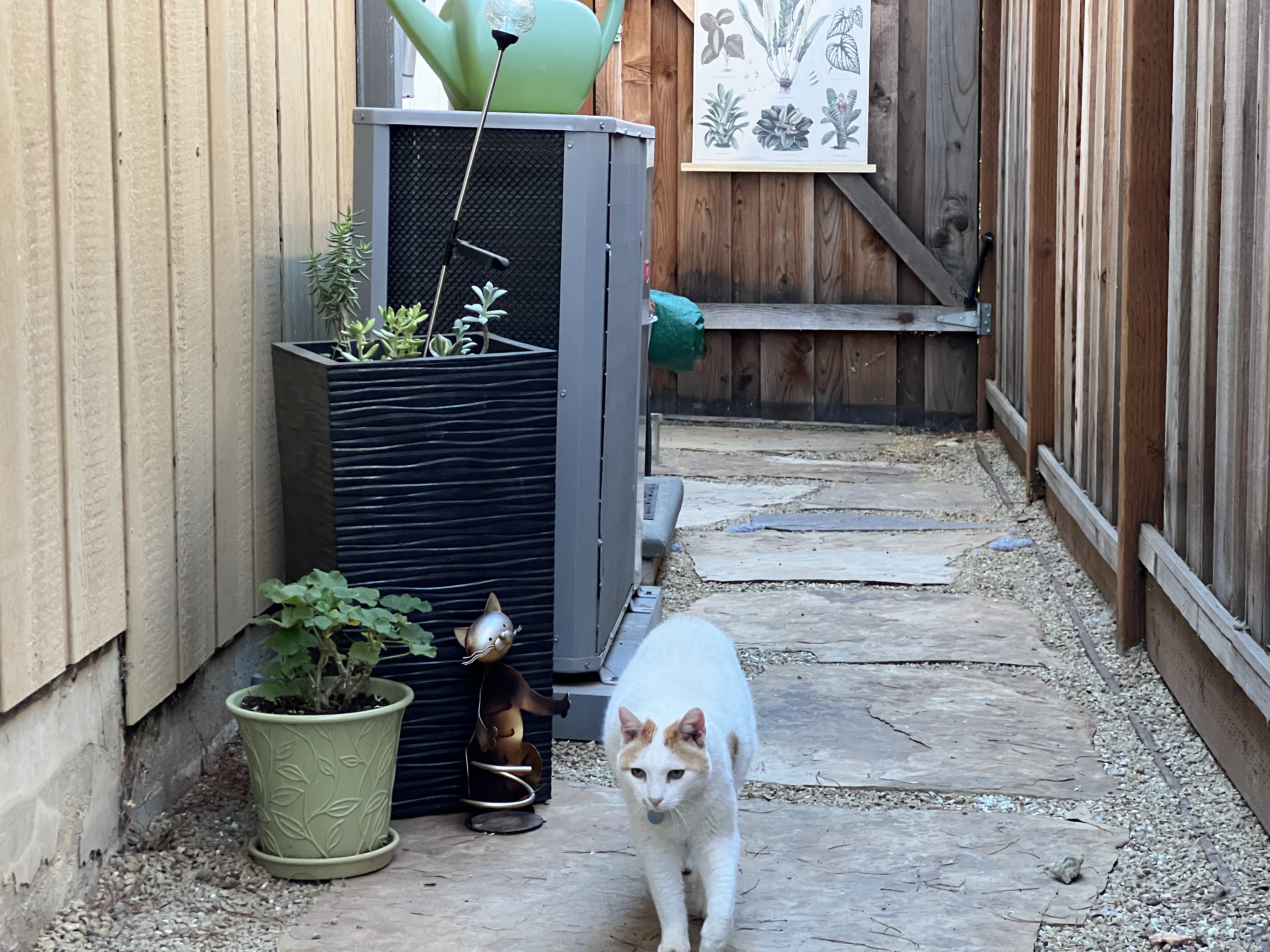
The goal for the sideyard was one of safety as much as aesthetics: the stepping stones in place were small and uneven, presenting a tripping hazard. The ground cover that grew on either side looked great in the winter but dried to a crisp under the summer sun. I missed the green, so I added a few potted plants along the new path and hung a botanical print on the gate to create a focal interest. It feels good to check this project off the list.
Most of our spring plantings have done well, but we misjudged the placement of the Hostas.
They prefer shade, and we thought they would be ok, but the excess heat early this year and the sun’s rotation exposed them to more than they could handle. We’ll dig them up next month and hope they’ll survive a transplant to a shadier spot. I’m always learning.
I’ve missed blogging these past few months. August took on a life of its own. My younger sister sustained a foot wound on her wheelchair when a caregiver smashed her exposed heel on the footrest. The wound progressed to stage 3, requiring a trip to the emergency room and a three-week stay at a skilled nursing facility. I brought her kitty home to stay with us while Sharon healed. My sister was in pain for several days, but rest and good care helped. She was able to return to her assisted living home after three weeks and continues to receive care from a visiting nurse at home.
I had an appendicitis scare the Friday after Sharon went home. My doctor ordered an abdominal CT scan due to lower right abdominal pain. She thought it was my appendix. The on-call doctor called me that evening and said they saw something on the scan (a thickening of the appendix), and he sent me to the ER to have a surgeon make the call. I spent the night at Stanford Hospital, expecting surgery in the morning.
Saturday morning the on-call surgeon took a wait-and-see perspective, and I went home on antibiotics. The findings were atypical: My white blood cell count fell in the normal range, my pain was minimal, and I wasn’t running a fever. The surgeon suggested I try the antibiotic approach, and they gave me the warning signs to look for should things get worse. They did not.
Our son Chris managed the three cats, and friends came up and brought me home the following day.
It was a scary night. Mike was still in Argentina, and I couldn’t talk to him till the following day because of the five-hour time difference. He was already asleep by the time they admitted me. He was sad to be so far away in my time of need, but it all worked out.
Good riddance to August, and hello, early autumn days.
My father traversed an interesting path, one of travel, adventure and creativity. Born in England on October 6th, 1915, today would have been his 101st birthday. Daddy studied botany and horticultural science at Wimbledon Technical College. He worked as a student gardener at the John Innes Horticultural Institution in London. Now you know where I got my love of gardening.
In a letter he saved dated October 1st, 1937, it says:
“Mr. E. Milner came to us on Sept. 16th 1935 as a Student Gardener. Since that time he has spent 4 months in the Fruit Department, 2 months in the Rock Garden, 8 months on general outdoor work and 10 months under glass. His experience with us has included the propagation and maintenance of stove, glasshouse and herbaceous plants, all of which we grow in considerable variety.”
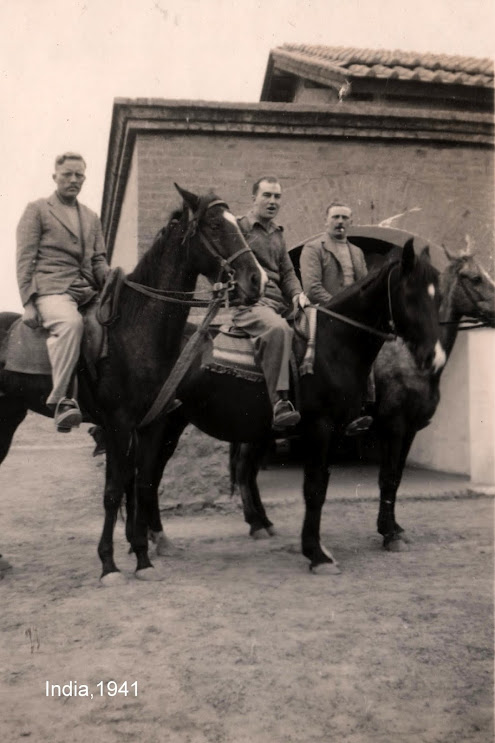
So formal! After completing his courses, he moved to India to work on a tea plantation around 1937. He remained in India during the second world war serving as a translator.
In a letter dated 7th May, 1946 from the India Office, Whitehall, it says:
Sir,
“Now that the time has come for your release from active military duty, I am to convey to you the thanks of the Secretary of State for India and of the Government of India for the valuable services which you have rendered to your country at a time of grave national emergency.
At the end of the emergency you will relinquish your commission, and at that time a notification will appear in the London Gazette (Supplement), granting you also the honorary rank of Captain. Meanwhile, you have permission to use that rank with effect from the date of your release.”
He returned to England in 1946 and shortly thereafter immigrated to Canada where he met and married my mother. Together they owned a pair of flower shops for a few years. My father later managed a nursery in my hometown of London, Ontario.
Lucky for me his hobbies included photography and the careful assembly of albums, like the one pictured here. I remain fascinated all these years later of his time in India and his work planting and propagating tea in the Darjeeling region. He died far too young. A smoker of pipes and unfiltered, hand-rolled cigarettes, he lost his life to cancer when I was just nine years old. He was 54.
Photos from Daddy’s time in India
Planting young tea, photo by Eric Milner
Tea Grows in India, 1939, photo by Eric Milner
There are so many things I would ask him if I could. What was it like to be a boy in England in the twenties? Who were his friends? What drew him to botany and landscaping? Dad’s treasured albums leave subtle clues, but each photo poses more questions. There are pictures of my namesake Aunt Alys and his parents, neither of whom I met, but pictures of others too. Who were they and why did their image make it into his photo albums? If Daddy had lived to a ripe old age, his own shared memories would be a part of our story, and perhaps most of them mundane. Instead they’re a mystery that I can’t quite solve, special moments from a life interrupted.
Daddy in uniform
One of his landscape designs
A lifetime lover of all animals
Detailed sketches
Landscape design
My Aunt Alys (Dad’s sister) far left as a Windsor Woolies model
Detailed sketch
Dad and June (who’s June?)
Landscape Design
Mom and Dad on their wedding day
Daddy’s model of The Golden Hind, two years in the making
Landscape design
Charcoal sketch
One of Dad’s photos
I feel connected to dad when I’m tending my garden or digging in the soil. He lives in my heart and at the end of my proverbial green thumb. If he were here to celebrate this birthday, I would thank him for the gift of my life, for his compassion and care and for passing on his love of the earth. I would wrap my arms around his slender frame, give him a hug, and tell him all the things we missed together.
New England states are known for stunning displays of fall color. My husband and I crossed the country by train one year so we could enjoy the spectacular (and fleeting) beauty.
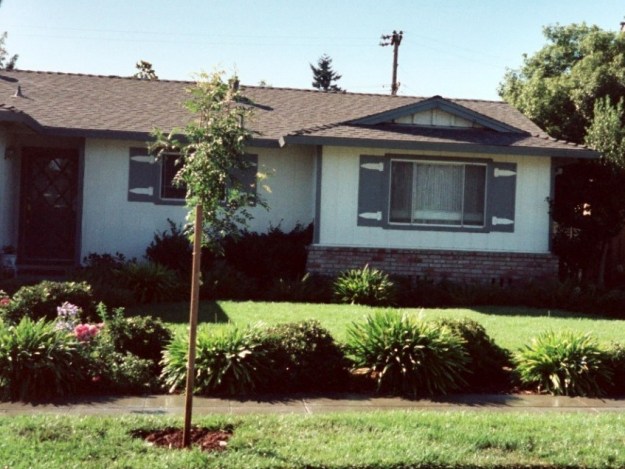
We also had the good sense to plant our own fall color in the strip of land between the street and the sidewalk. Though there were four beautiful trees growing in the back yard when we bought our house in 1996, we didn’t have a single tree out front.
Planting the tree August, 1996
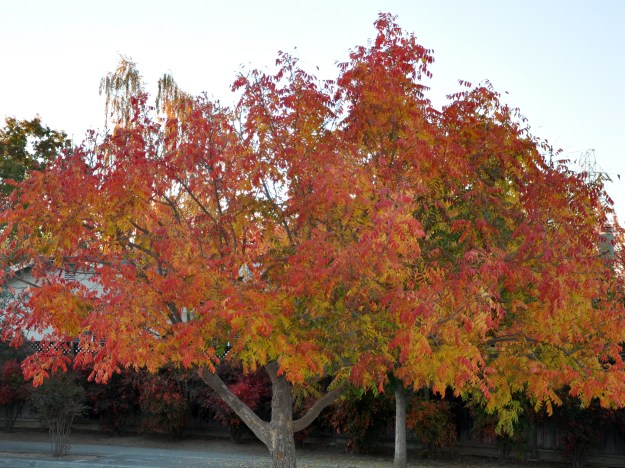
We planted two that first year, and have since planted a couple more. The Magnolia shows off in early spring with huge, snowy-white flowers but the fall belongs to the splendid Chinese Pistache.
The City of San Jose requires a permit before planting a tree in the sidewalk strip, the space between the sidewalk and the street. They provide a list of “approved” street trees. Approved trees must have non-invasive roots, non-staining fruit and other good-neighbor qualities. In the past, neighboring streets sported Liquidambar trees. They’re pretty but a nuisance when planted curbside. Invasive roots lift the sidewalks, causing myriad tripping hazards, and the seed pods are hard enough to twist an ankle when stepped on. I remember getting them caught in the wheels of the boys’ s stroller and later in the undercarriage of scooters. One by one, homeowners removed the Liquidambar, leaving neighborhoods bereft of trees.
A few years back the trend reversed, and once again families are planting trees.
Planting a tree is an act of hope and optimism. It also says “I’m here to stay!” My family moved a lot when I was a child, and I moved even more during college and my early working career. The same was true for my husband. Planting a tree outside our front window said “we plan to stay awhile.”
August, 1996
Spring, 2011
Now and again my husband grumbles that our tree is not as tall or as full as the one across the street. I immediately come to our trees’ defense and assure him that it’s just fine. BK (before kids) we used to measure the tree’s height each year. We settled into life raising two boys, and measured their growth each year instead.
Growing boys, sleeping tree
Now we have three strapping teenagers (two boys and one tree) and all three are taller than me. The colors of fall, and our beautiful tree, are an introspective time to reflect.
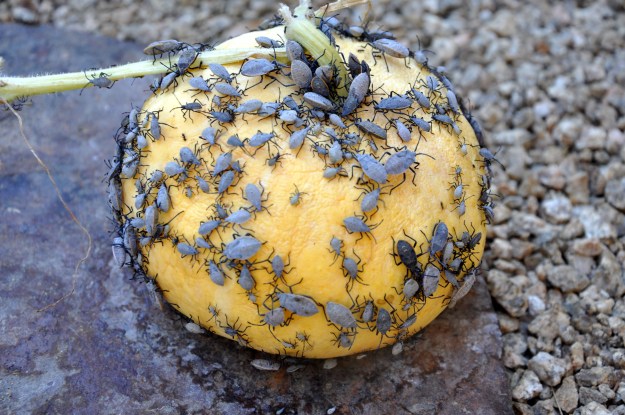
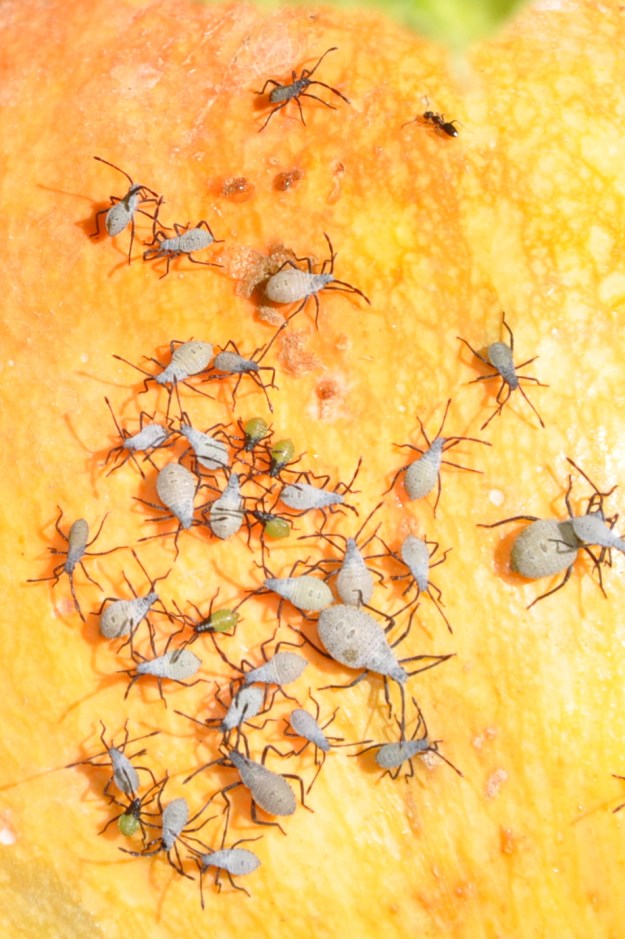
Things got a bit dicey in the pumpkin patch last month. Nearly a dozen pumpkins grew happily on the vine until disaster struck. A rapidly producing colony of squash bugs moved in and things turned ugly. If you have any doubt, take a look:
This pumpkin never stood a chance
Instead of leaving the orange pumpkins on the vine to harden, I harvested all but two and set them on the patio thinking I would wipe them off before bringing them indoors. The next day, the squash bugs found the harvest! Eek!
I brought the pumpkins inside one by one, wiping them down with the first thing I could get my hands on: my son’s lip balm. (Desperate times call for desperate measures). I didn’t want to bring garden pests indoors, so I figured the coating would put an end to anything I missed.
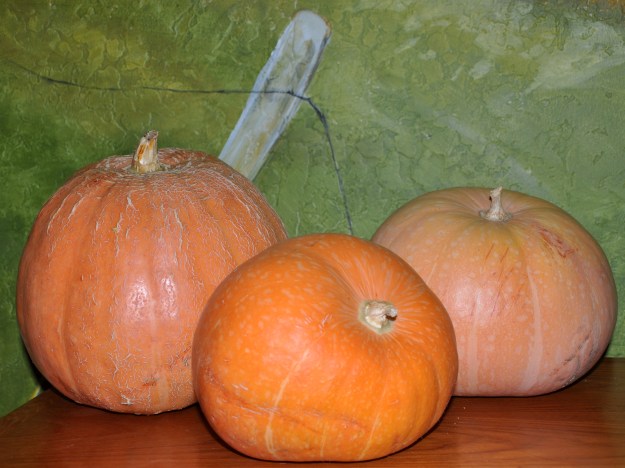
Polished pumpkins
We’re big on pumpkins around here: we grow, harvest, decorate and carve them. It’s been a family tradition for a decade. I also enjoy saving seeds for the next season. This year I gave a few starters to friends, and passed on some seeds to an adorable pair of three-year-old twins that walk by the house with their dad. They planted the seeds and grew pumpkins of their own. I’m delighted.
The pumpkins hung out in the living room for several weeks, but as October approaches, it’s time to bring them center stage. I created a display on my iron bench combining an eclectic mix of drying lavender, three pumpkins and a refurbished fairy garden. Check back next week for the fall upgrade.
I love October. It starts with my birthday, ends with Halloween with plenty of goodness in between. Just when I thought it couldn’t get any better, this Boo season brings a special visit from Boooooomdee. She told me to expect her on the whisper of a dandelion, but I think she was teasing. I’ll go to the airport to fetch her just in case.
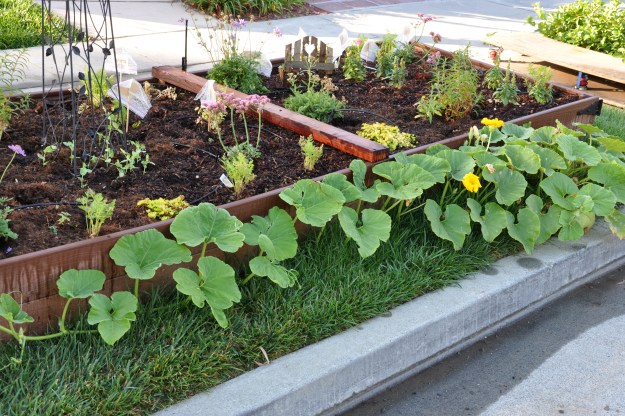
Okay, so squirrels aren’t always destructive. There’s a good chance that a squirrel buried one of last year’s pumpkin seeds at the edge of the lawn. That seed managed to survive all the activity around building the curb garden (twice), not to mention the proximity to the street. You couldn’t ask for a clearer example of ‘survival of the fittest.’
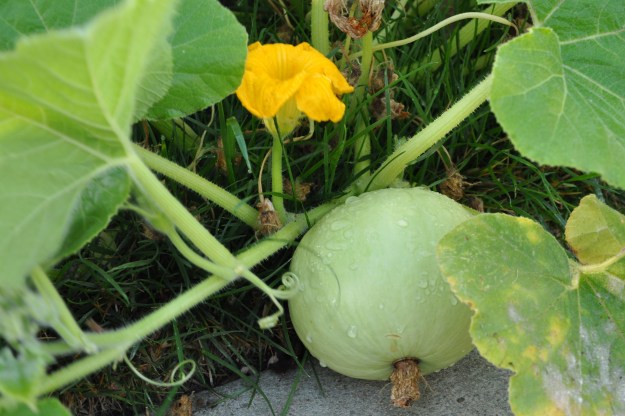
I spotted the tell-tale seedling early on, but didn’t expect it to survive. I let it be of course, and it gradually sent out true leaves and a few flowers. Given the dense root system of the lawn, I figured it would overtake the pumpkin. I removed chunks of lawn around the tiny plant without disturbing the pumpkin’s roots. That did the trick. Look at the progress of this plant in less than 30 days:
Curbside pumpkin plant, August 24th
Curbside pumpkin plant September 18th
I’m seeing the tell-tale signs of late season mold on the leaves, but the flowering continues. Hopefully we’ll have one more orange pumpkin to add to the mix before the vine retires for the season.
If you’ve been following along, you’ll know this is pumpkin harvest week at gardeningnirvana. The probable final count is ten, 12 if you count Frank and his cousin Shelley. I left a few late-season fruits on the vine since I’m nothing if not optimistic when it comes to pumpkins.
The squash bugs continue unabated, so I need to come up with a plan. I want to use the soon-to-be vacated planting bed for my cool season crops, but not until the bed is pest-free.
I’m soaking seeds on the kitchen counter as we speak for peas and beets. Broccoli seeds don’t require a good soak, but I need to get busy setting them out soon. The first day of autumn in our hemisphere is still a month away. The changes in the air say otherwise. I hate to miss a good planting opportunity.
In case you missed yesterday’s post, here’s another peak at Frank.
Frank aka a pumpkin casualty
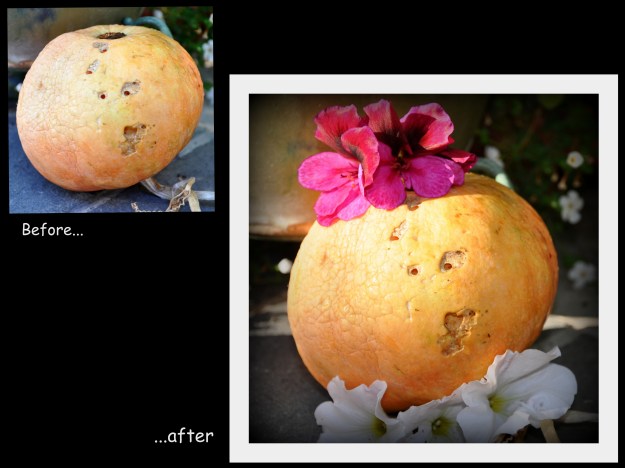
Frank wears his scars proudly, forgiving the gentle gardener for her blunder. Shelley on the other hand has piercing eyes and a lopsided grin, courtesy of an unknown pest. Since everyone loves a good ‘before and after’ shot, without further ado, here’s Shelley:





























 Gardening Nirvana