Complimenting the Sunflowers: The Color Purple

In color theory, yellow compliments purple. The colors are directly adjacent to one another on the color wheel, in the same way green is to red, and orange is to blue. Without consciously realizing it, I’ve complimented brilliant yellow sunflowers with purple Lavender, Ageratum and nearby Mexican Sage.

The sunflowers line the top of the deck, while the lavender shrubs grow in front. The fragrant flowers bump up against the steps, softening the hard edges. Lavender is one of my favorite plants. It blooms for months on end, with a distinctive scent, valued for its restorative and relaxing powers.  I dried a bunch of lavender in the garage, and used a few blossoms in my bath.  I’m dreaming up ways to share these powerful blooms this Christmas.

Lavender

Lavender Lines the Deck

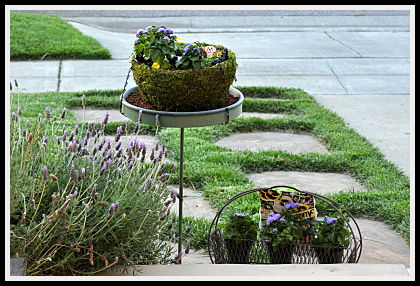
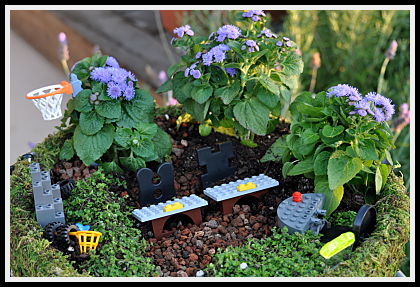
This week I planted Ageratum and Baby Tears in a moss bowl, added some LEGO® Brick furniture and called it a Fairy Garden. It wasn’t until I took a step back from the arrangement that I realized I had surrounded the sunflowers with purple goodness. I love the shape of the fluffy blooms, but I also delight in the little saucer shapes with the dotted edges just before.

Ageratum

Ageratum Graces the Fairy Garden

Dominated by tall grass, the Dwarf Plumbago is easy to miss. It resides in the lower garden and to the right of the steps leading to the deck. Don’t you just love the red burst of seed pods in the center?

Dwarf Plumbago

Dwarf Plumbago

The magnificent Mexican Sage grows at the curb, in an otherwise unremarkable section of the sidewalk strip. The sage goes dormant around December, when we give it a hard prune, then resumes its show of color, spring through fall. It’s a popular plant with children on the block due to its soft, velvet-like flowers. The hummingbirds are also big fans, frequently tussling over the right of territory.

Mexican sage

Mexican Sage
Drought-Tolerant and a Hummingbird Favorite

On the subject of territory, my sister Sharon “owns” the color purple. It’s been her favorite her entire life. Sharon, this one’s for you.

Blooming Thursday: Gardens Throughout My Day

It’s so easy to get caught up in our day, isn’t it?  Everyone’s busy.  We rush from here to there, and back again if you have kids.  Who has time to slow down?

In truth, we all do.  Everyone gets 24 hours in a day.  It’s up to us to spend them wisely.  When my mom was in hospice at the end of her life, I read some interesting comments from a hospice nurse.  Most of her end-of-life patients regretted the things they didn’t do.  I try to remember that.

Yesterday, though I had plenty to do, I consciously slowed down.  I attend a fitness camp three morning a week at a local middle school.  We complete our drills in the interior quad, working hard for 50 minutes.  Then we all race to our cars and continue on with our hectic days.  I took a moment to return back to the quad, to admire and photograph this beautiful rose.

Rose at John Muir School

Blushing Rose at Fitness Camp

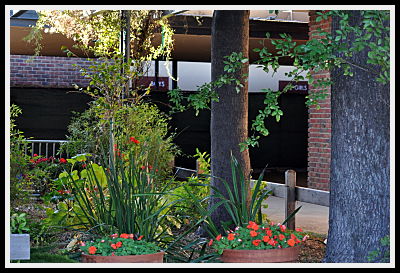
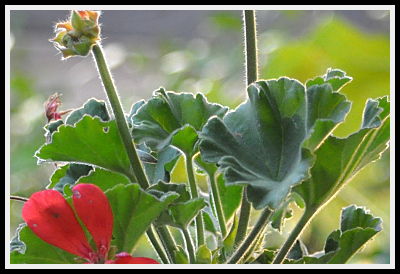
After driving my older son to school, I lurked in the parking lot till the coast was clear, then walked around to the front of the school and snapped a few shots. They have a lovely garden  just outside the office, with bright red geraniums, bushy ferns and a stand of magnificent trees. I never noticed the trees before yesterday. One of the small benefits of slowing down.

Red Geranium

Branham Geranium

Branham Office Garden

Branham Office Garden

On my drive home, I pulled over to admire the sunflowers growing a few blocks over. Kelly at Boomdeeada suggested I scout the neighborhood for similar flowers, since I seem to be growing a variety I didn’t plant. She might be on to something! It was a good excuse to finally get out of the car and see them up close.

Neighboring Yellow Sunflowers with Palm Tree

Down the block, our neighbor Robert plants a colorful selection of annuals along the border of his white picket fence. He suffered a stroke a few years ago, and had a long trip back to wellness. I enjoy driving by his house and seeing his flowers in bloom. If he’s  sunning himself in the driveway, I’ll wave. I realize as I write this that he has no idea how much I enjoy those flowers. I plan to share that with him today.

flowers at picket fence

Robert’s Summer Display

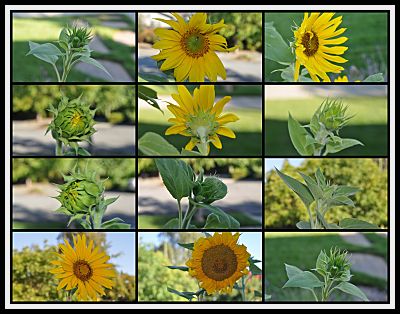
My own welcoming committee is a pleasure to behold: a wall of sunflowers just outside the kitchen window, and my recently planted fairy garden. The purples and yellows are vibrant and fresh, as if to say “summer will never end.” Sure, I know better, but I still enjoy the charade.

Sunflowers: The Sunny Dozen

Sunflowers: The Sunny Dozen
Photographed in order on deck

Wednesday is early out day in our school district so the boys return home in the early afternoon. My last stop was Office Max, for yet another round of school supplies. They have enormous clay pots planted in front of the store, brimming with colorful flowers. It’s challenging taking photographs under the mid day sun, but I still enjoyed the view. I appreciate strip malls that make the effort to bring beautiful gardens to an otherwise drab exterior.

Office Max Flowering Pots

Office Max Flowering Pots

I perhaps owe having become a painter to flowers. ~Claude Monet

Office Max Gernaiums

Cascading Geraniums

Guess what? I still accomplished what I planned for the day, climbed out from under a writers slump, made phone calls, booked a client and nurtured my husband, two boys and four cats.

I encourage you to take five minutes for yourself today. Look at something familiar with beginners eyes. Taste. Smell. Marvel. Rather than imagining you are the center of the universe, try to be centered in the universe. You’ll be a happier person for it.

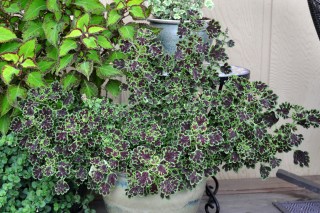
Winterizing the Double Wide Coleus

Inky Finger Coleus

Inky Finger Coleus
aka Double-Wide

My beautiful ‘Inky Fingers’ Coleus has been busy.  Unlike its tall neighbor, this Coleus is growing out instead of up. I’ve nicknamed it Double-Wide.

Double-Wide makes me smile when I walk up the patio steps. The colors are spectacular. I’ve grown fond of this plant and hope to winterize it if possible. I grew a spectacular Coleus in the same area last year.  It even garnered compliments from our landscape designer.  Sadly, as soon as the temperatures dropped, the leaves dropped too.  I thought it might come back the following year, but apparently when it’s done, it’s done.

Some brave souls bring their plants indoors for the winter, but I’m leery of what might move in with them.  After a summer dealing with aphids, scale, wasps and thrips, I’m reluctant to go that route.

This year I want to create a localized greenhouse for the two plants to see if they’ll make it through the winter.  I’ve done a bit of reading today, and learned that Coleuses grow as a perennial in Zone 10, an area quite a bit inland from our Zone 15.  I also learned that you can take multiple cuttings from the plant in late summer, and start next season’s plants indoors.  The challenge is lack of humidity in a dry, winter house.

Fall is still a few weeks away, so I will enjoy the plant outdoors for as long as I can.  I don’t have a green house so I would have to improvise with PVC pipe and heavy-gauge plastic.  Gardener’s Supply Company catalog sells garden quilt fabric and plant protection tents good to 24°F,  also possible options.

Do you plan to winter over some of your garden plants?  Have you had success in the past?  Tips welcome!  Please reply in the comments section below.

Back to School in the Fairy Garden


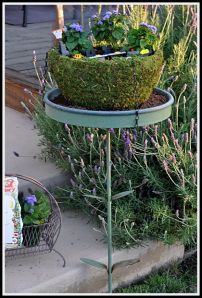
Fairy GardenOur local paper ran an article on fairy gardens recently with a few ideas I hadn’t thought of.  One suggestion was to plant a fairy garden in a pot up high for easy maintenance.  The other was to place it in a high-traffic area so others could enjoy it.

Today I did just that.  In honor of back-to-school month I planted a back-to-school themed fairy garden and placed it out front near the steps.  The bees found it immediately, then my son when he got home from school.  Can those ethereal garden fairies be far behind?

I used an old bird bath stand as a base, then added a fern-lined wire basket.  The fern-lined hanging basket came with three chains attached to a hook.  I pried the hook loose, then wrapped the chains under the bird feeder to secure it in place.

Lovely purple Ageratum line the back of the classroom, with Baby Tears serving as a walkway.  The classroom chairs are part of a stacking game.  I raided the LEGO® Brick bin for desks and playground equipment.  If you squint your eyes and employ your imagination, you might just see an apple on the teacher’s desk.

Fairy gardens were once the purview of small children, but they’ve enjoyed a resurgence among adults.  Blogs, books and websites abound with ideas and inspiration.  In the end, I think it’s fun to use your own imagination and if possible, items you have on hand.

This is a great project for the young and the young at heart.  Let me know how your garden turns out.  Be sure to report back…with pictures of course.  ♥

This slideshow requires JavaScript.

From Tonkadale Greenhouse:

For centuries, the world has been fascinated with the idea that “fairies and elves” live among us and have the power to spread magic and mischief throughout our homes and gardens.

While the existence of fairies is up to your own imagination, adding fairies to your garden is a way to participate in this centuries old tradition. It never hurts to please the fairies and sprites in order to gain their favor.


Changing Seasons: The Pumpkin Knows

Vegetable Garden April

Vegetable Garden April 25, 2012

According to the sun, summer doesn’t end for another four weeks. It draws to a close, today, however for the 12 year-old in the house.  He reluctantly returns to school tomorrow.

Autumnal Equinox arrives September 22nd at 10:49 am EDT. The changing of the seasons in our sunny state are easy to miss. My son will wear shorts to school for several more months, and the rain doesn’t arrive till late October.

The Pumpkin Knows

Back in April, a small pumpkin seed knew it was time to grow. Genetic information, stored in that tiny seed pronounced that the soil and sun were a go. The seed pushed a pair of tender leaves up through the earth while setting down roots below. True leaves followed, right on schedule and within weeks the small plant was a vine. Tendrils curled out, looking for support, knowing the vine would grow and grow. Magnificent yellow flowers appeared, first male than female. They had a short window of time to attract a bee before curling up for the night. The first few pumpkins formed on the vine, but shriveled and died within days. Eventually the vines set larger fruit, first green, then yellow and now orange.

As the fruit matures, the once tiny plant sends the last of its energy directly to the pumpkins. It’s time for the plant to wither and die with the genetic understanding of a job well done. Trickle-down economics doesn’t work in the real world, but boy does it work in the garden. One small seed produces numerous edible flowers, then goes on to produce several jaw-dropping gourd-like squash. Each pumpkin holds hundreds of seeds, enough to eat and plant the following season. Pumpkins produce sweet flesh for cooking and baking. Sturdy, colorful pumpkin shells line windows and porches on Halloween, carved to perfection.

August Vegetable Garden

Vegetable Garden, August 25, 2012

The season is changing
The pumpkin knows
tiny seeds become heavy gourds,
vines turn brown
their cycle complete;
Jack O’Lanterns grin
at Trick-or-Treater’s feet.

-A. Milner

Gifts from the Garden: Late Season Surprises

I love receiving gifts from the garden, little treasures and discoveries I didn’t expect. Here is what she offered up this week.

Turning Orange After All

Acorn shaped pumpkin turns orangeThis acorn-shaped pumpkin was doing well, when a scar on the skin opened into a small wound. With the fruit exposed to air, I assumed that was the end of it. How disappointing.

To my delight, it continued to turn orange.You can see right through to the inside of the pumpkin, so I’m surprised at this development.  It’s a gift!

Raspberry Redux

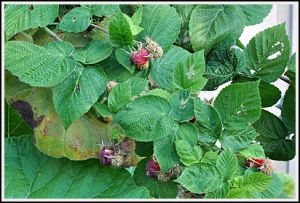
RaspberriesWe devoured raspberries for several weeks this summer, eating them straight off the vine. Eventually they stopped blooming and  I cut back the vine. This week, they are at it again. Fresh berries in August. Yum, yum, yum. Thank you berry vine for your generous gift. How sweet of you!

It’s a Whopper!

Large, still yellow, pumpkinOne of our pumpkin vines produced three large gourds in late July. They’ve put on weight daily, though the pumpkins to follow mostly shriveled and died on the vine. In what seemed like an overnight sensation, we now have a fourth still-yellow but equally large pumpkin on the vine. I hope it stays warm enough for the fruit to turn orange.  Occasionally the size of the gift is important.

Unexpected Sunflower

Sunflower with small centerI planted Evening Sun and Mammoth Russian Botanical Interests® sunflowers, so imagine my surprise when a third variety appeared this week. I love the shiny yellow flowers and their perfect little centers.  Who doesn’t love a gift out of the blue?

What’s up in your garden this week?

Blooming Thursday: Borrowed Landscaping

Pine Tree Reflecting SunThe concept of borrowed landscaping  incorporates the view beyond your garden.  It takes advantage of nearby elements like trees, architectural structures, and other natural views, so that your garden seems to extend beyond its borders.

Active borrowed landscaping requires planning.  The idea behind it is to blend trees and plants grown on your property into a cohesive flow, so that the landscaping out of your control becomes one with your garden.

Passive borrowed landscaping simply takes advantage of what is already there. You accept the challenges, and works within those parameters. We are grateful for our borrowed trees every time we head out to the yard.

We live on a small lot in the suburbs with narrow lot lines and small yards.  They built homes with fences surrounding the back yards to afford privacy.  I have friends on the east coast with two acres of land, and others out of country with farms.  We measure our puny lot size in feet.  With 1/8 of an acre, you want to make everything count.

Here is what we borrow every day:

Monterey Pine

This majestic tree grows at the back corner of our lot.  It towers over neighborhood homes.  The pine provides shade we wouldn’t otherwise have and drops an occasional pine cone.  It makes a suitable race track for energetic squirrels who go round and round, the tree.

Muskogee Crape Myrtle

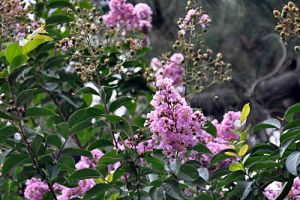
Muskogee Crape MyrtleOur neighbors Crape Myrtle is tall enough to branch out over our shared fence.  It’s covered in tiny lavender blossoms this time of year, giving a softness to an otherwise rigid fence.  Myrtle isn’t far from our dining patio, so our guests get to enjoy her lovely show.

Cactus

Flowering CactusThis prickly plant belongs to a prickly neighbor, so it seems appropriate to include it on the list.  It’s currently flowering behind the lattice.  In this case “good fences do make good neighbors” with a thorny plant thrown in for good measure.

Crepe Myrtle-Southern Belle

Crepe Myrtle Southern BelleI discovered alternate spellings for this lovely tree.   Our shared Crepe Myrtle sits on the property line in front of our homes.  It has lovely white flowers all summer long, then further entertains with its shedding bark.  The kitty from a few doors down love using it as a scratching post. This tree gets lots of “love” and attention.

Do you have a favorite borrowed landscape outside your window or door?  Let me know in the comments below.

Sunflowers: Better Luck Next Year?

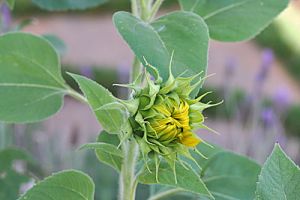
Budding Sunflower

Budding Sunflower

I tried something a little different with my sunflowers this year. I sowed the seeds in narrow planters and lined the front of the deck.  If all went according to plan, the seeds would produce tall, healthy specimens.  The towering wall of sunflowers would face the kitchen but could also be enjoyed by passersby.   I was jazzed!

My son helped me plant the first crop, which promptly disappeared.  Squirrels made off with the seeds.  A few went undetected, but once sprouted they ate those as well.  I managed to preserve three plants.  Moving on to plan B, I purchased more seeds, and started them indoors.  I also planted a few in the side yard hoping the critters wouldn’t notice the new location.  Last summer the flowers grew as tall as the house there.  Alas, those too disappeared.  Poof.

Indoors, the seeds sprouted quickly. I needed a plan to keep them safe.  The morning of Mother’s Day, my husband helped me assemble what I now refer to as “screen savers,” a system I created with left over screening and sliding window screens from the hardware store.  They worked!

I originally planned to remove the screens from the established plants, but the stalks remained on the thin side.  The soil dried out quickly, even after I added a thick layer of mulch.  Eventually the stalks cleared the top of the screens and started their accent.  The birds arrived, pecking away at the leaves, creating patterns as they chipped away.  Every few days, the plant added leaves and the birds came back for more.

SunflowerThis week, ninety days later and right on schedule, the sunflowers are in bloom.  The original three are the hardiest of the plants and the first to bloom.  They are taller and stronger than the others.  The transplants are fairly weak, with bent stalks and smaller stems.  But they too have buds.

What have I learned for next year?

  • The planters need to be at least twice the current depth
  • Sow directly into the soil, add lots of mulch, and screen
  • Plant a lot more seeds, then thin when necessary
  • Don’t give up hope!

Row fo Sunflowers

Sunflowers in a row

Sunflowers Line the Deck

Spring Bulbs: To Plant or not to Plant?

River of Hyacinth FlowerThat is the question. The answer: it’s complicated.  I’m perusing the Fall Netherland Bulb Company catalog this morning.  It arrived about a month ago, far too early to take it seriously.  Now that fall approaches, I’m giving it a second glance.  Years ago I planted several bulb varieties from Costco. Either I made the beginners mistake of planting them all upside down, or they didn’t like our soil.  Not a single one came up!  Perhaps a squirrel dug them up behind my back, but I never saw evidence of that.

I know many bulbs need frost first, then a proper thaw to get them going.  Was it foolish to assume that bulbs sold in our town would actually grow in our temperate climate?

One year a friend gave me a pot of paper white Narcissus.  Once the plant was spent indoors, I transplanted the bulbs outside.  Do you know what happened?  Nothing.

As I gaze lovingly at the ‘Tulip Fat Tuesday Blend,’ I can picture the purple and yellow blooms scattered all over my yard. Further on, they’ve dedicated a page to  ‘Darwin Hybrids’, including Tulip Beauty of Spring. The petals remind me of a fresh peach.

The most intoxicating of all bulbs are the Hyacinth. Their scent makes me giddy. I received my first Hyacinth as a Christmas present from Mom. I grew it indoors in a glass jar. I still remember the beginning of the transformation and that incredible smell when it bloomed. Planting something with evocative memories isn’t always a good thing. Tied up with the memory of that flowering bulb are things I would like to leave in the past.

So, to plant or not to plant? The icon on the cover says “Bulbs: dig, drop,done.™”  They don’t know the half of it.

Hyacinth orientalis ‘Blue Jacket’, exactly as I remember mine.

Yamagami’s Nursery

Purple Heliotrope

Purple Heliotrope

Yamagami’s Nursery, located in Cupertino California, has been around since 1948.  In a town known for tech behemoth Apple, inc. the nursery is a delightful throw back to a simpler time.  Taro Yamagami originally sold fruit from a stand on the same spot, gradually giving way to plants.  It became a full-fledged nursery by the early 1950s and it remains today in its original location.  If you ask any serious gardener in the Valley, chances are they’ve heard of and shopped at Yamagami’s.

Yamagami's glazing ball

Glazing Ball (I’m too clumsy to own one)

We actually left empty-handed on a recent trip, but not for lack of wanting.  We were in search of beneficial insects and eventually resorted to the web since our request was somewhat obscure.  They sell ladybugs, earthworms and Praying Mantis eggs but no Lacewings.

The nursery walkabout is always fun.  It’s a spacious two acres, with interesting plants tucked in with  gorgeous pots, garden ornaments and a help center.  I always feels at home.  When we were there in July they posted a sign alerting guests to the nesting bird in a nearby plant: “Shhh quiet please, bird nesting.  This plant is temporarily not for sale.”  I snapped a photo at a respectful distance.  Even the neighboring birds feel at home.

Yamagami's bird nesting sign

Quiet Please, Bird Nesting

In addition to the nursery, Yamagami’s has a helpful website and a monthly newsletter covering soup to nuts issues around gardening.  You can subscribe to their newsletter here.

If you’re planning a visit to Apple headquarters, be sure to visit the nursery as well.

In the meantime, here is a virtual tour of Apple, Inc. and a few more snapshots from Yamagami’s.

Yamagami's Nursery Collage

Yamagami’s Nursery Collage