Blooming Thursday: Bachelor’s Button

According to the Bachelor’s Button seed packet, this “care-free, drought tolerant annual, adds vertical interest and an array of colors to your garden.” Well.

Perhaps there was a single’s dance going on a few gardens over, because my Bachelor’s were largely a no-show. The ones that are in bloom were late to the party, blooming two days before Autumn officially arrives. Bachelor’s Button, also know as cornflower are drought tolerant and require “little pampering.”  So what gives?

Were they jealous of the cosmos getting all the attention this summer? Maybe they didn’t get enough sun. I offered them plenty to drink and lots of encouragement. There is always enough love to go around in my garden.

I’ll just chalk it up to “one of those things” and “you can’t win them all” and I’ll move on <sniff-sniff>.

Here are a couple of pics of the one or two that grew.

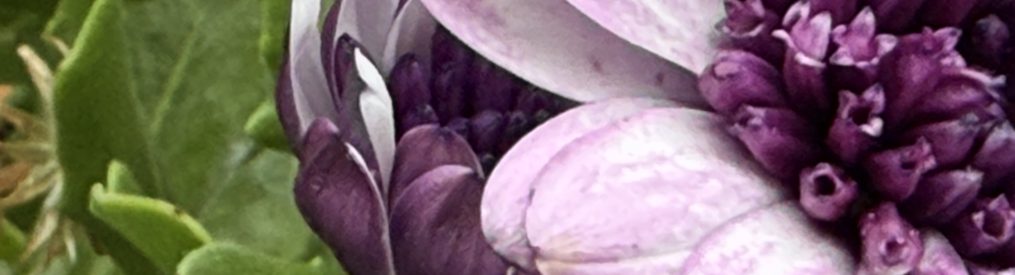
Bachelor's button bud

Flower or fish? I love those multicolored scales.

Bachelor's Button flower

Bachelor’s Button handsome profile

Bachelor's Button closeup

There’s the promise for next year.
Smiling in the Garden

Smiling is good for you. It reduces tension, helps you relax and promotes overall good health. There is always something to smile about in the garden; sometimes I’m lucky enough to catch it with my camera.

I hope these photos put a smile on your face, too.

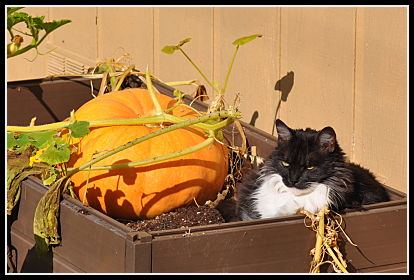
Kitty in the garden bed

Sure, the pumpkin is nice, but will you look at that cat I grew!?

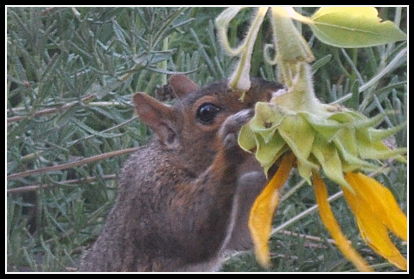
squirrel closeup

He’s a cheeky little fella

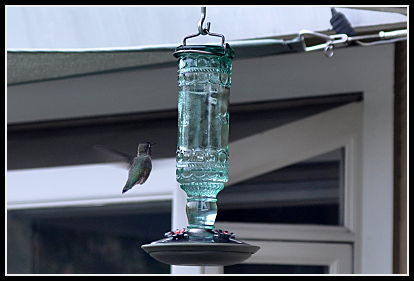
hummingbird at feeder

Look, Ma!!! I can fly with one wing!

dog like flowers

I think there’s a pooch hiding in the tree. Dogwood???

bottoms up

Bottoms up!

Are you smiling yet?

Tumbling Composter: Some Assembly Required


As I excitedly ordered my tumbling composter, I failed to read the inevitable fine print. You know…some assembly required. I kept a watchful eye for the UPS driver, ready to pounce on that box. My kitchen scraps were taking on an odoriferous scent and still the composter didn’t come.

I eventually dumped the scraps in a bucket in the garage, and covered them with potting soil. It’s funny but two weeks ago I would have tossed those scraps or ground them up in the garbage disposal.  Now the scraps had a real purpose. My garden was counting on me.

UPS At Last

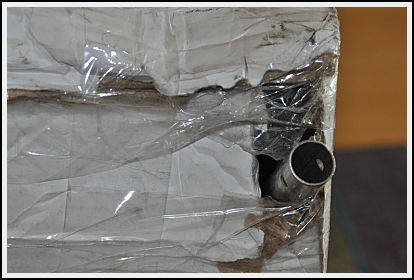
The day my husband, and resident handyman left for a business trip, the box arrived. I came home that afternoon to a damaged box on the porch, with one of the parts sticking out of the side. Oh-oh.  I was afraid to open it. The good news: no harm done. The bad news: so many parts. I was facing eight panels, two end pieces, six leg pieces and a bag with 56 washers and screws. I unpacked all the pieces, then left the room.

damaged box

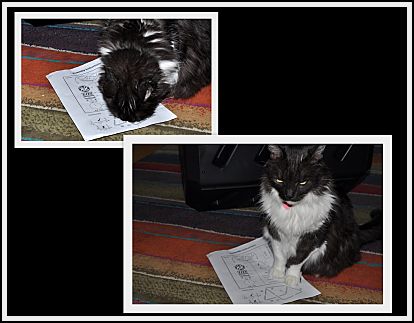
Lindy sits on the directions

Lindy didn’t think she could help, either.

My son, in his sweet and gentle way, asked me if I would be moving it as it was blocking his path to the living room. Okay. I can do this. I fumbled around with my husbands various tools, found what I hoped would work and got down to the business of building a composter.  It went together beautifully, and was over half done when I called it a day.  I finished assembling it with my son’s help on Thursday. At last the fun could begin.

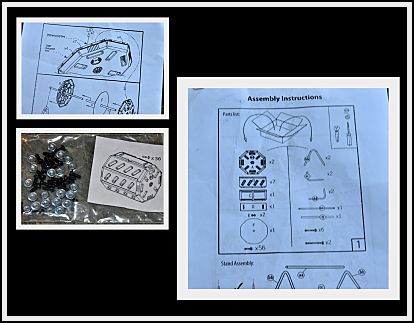
compost assembly instructions

Some assembly required

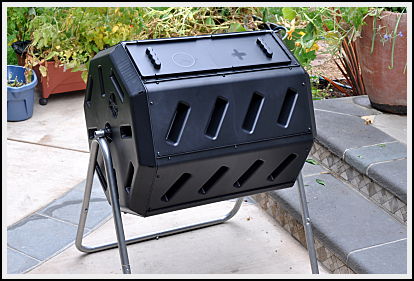
assembled tumbling composter

Ta-da!

I had a bucket of “brown” from the pumpkin patch ready to go and a decent sized bucket of “green” to go with it. Into the bin they went.  I closed the door, gave it a spin, and smiled. Who knew rotted apples and dead leaves could bring about such happiness?

Do you compost too?

The Compost Recipe

I’ve seen several variations on the mix, but here are the suggestions from tumblingcomposters.com:

The composting process works best by mixing moist greens (nitrogen rich) with dry browns (carbon rich) in a ratio of approximately 2 parts greens to 1 part browns.

Greens are:

  • kitchen scraps
  • grass clippings
  • garden and house plants

Browns are:

  • leaves
  • straw or hay
  • saw dust
  • twigs

Do not compost:

  • meats/fats/bones
  • dairy products
  • trash/plastic
  • wood ashes
  • invasive plants or weeds

Serves several plants.


Squirrels: They’re back!

In early June I planted a row of sunflower seeds along the front deck. Within a week they were gone, consumed by our neighborhood squirrels. I planted a second batch, this time indoors, but the transplants were leggy. Refusing to give up, I came up with a barrier, heretofore known as the screen saver, and planted one last time. They took!  Within 90 days we had a beautiful row of six-foot sunflowers.

Last year the flowers went completely to seed on the plant. I saved a handful of seeds, then placed the flower heads along the garden wall for the squirrels. It was fun watching them nibble away.  I love watching those cute little “hands” busy at work. They polished off the sunflower seeds in a matter of days.

This year the squirrels took matters into their own hands. Not known for their manners, they simply bent (or broke) the stems till they reached the deck and helped themselves.

I’m always amazed at their ingenuity. Wild bird centers are full of gadgets to deter squirrels from bird feeders, but those clever squirrels figure it out. When it involves nuts or seeds, squirrels are up for the challenge.

I finally caught two of them in the flower-bending act this week. Did I shoo them away?  Of course not! I grabbed the camera instead.

squirrel eating sunflower seeds

Mmmm…not half bad.

squirrel eating sunflowers

Hey!  I want some too.

squirrel standing tall

This buffet line is taller than I remember it last year.
squirrel hide and seek

Shhhh! Pretend I’m not here.

squirrel with stem

Let me just…break off…this annoying stem.

squirrel with sunflower

That’s more like it!

running squirrel

I’m out of here. I’ll be back once you’ve cleaned up this mess.

California tree squirrels are either Gray or Fox. Here is a side by side comparison.

Harvesting Pumpkins: Three to Get Ready


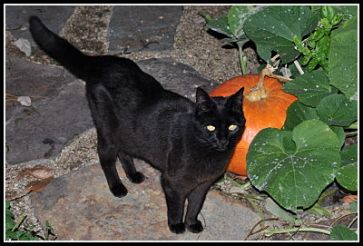
Black cat with pumpkin

Slinky is ready for Halloween

What a joyous day!  Fall is in the air and pumpkins are in my house.  We harvested three orange lovelies this morning, then brought them indoors for safe keeping.  Two have been ready for a while but I left them on the vine for up to the minute ripening.  The third pumpkin was a surprise, in more ways than one.

We still have four extra-large pumpkins on the vine, hoping they’ll turn a bit darker.  Currently they have a peach complexion.  I lifted one of these large pumpkins away from the beds to give it more sun, and discovered a smaller pumpkin had been growing just below.  It has multiple cracks in an interesting geometric pattern, but each of the cracks healed over.  I can’t wait to take a picture and share it with you.  We’ve never seen anything like it.  I’m wondering if the extraordinary weight of the pumpkin above caused it to slowly crack, giving it time to heal as it split.  My husband and resident carver is looking forward to hollowing it out.  He thinks it will look like a star burst.  We’ll restrain ourselves until Halloween.

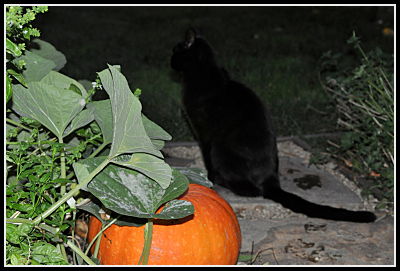
Slinky near the pumpkins

Do you think she’s waiting for The Great Pumpkin?

The plan is to give each of the larger pumpkins a name on our Wii Fit, so we can weigh them one by one.  Won’t that be fun?

Meanwhile, I’m practicing sitting on my hands.  Every time I go out there I want to harvest the fruit and make way for the winter garden.

Ò Ó Ò


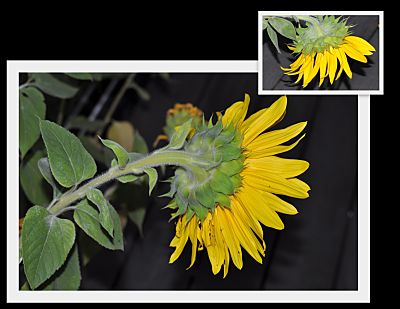
Sunflowers: Setting Sun on the Season

I knew this day would arrive, but oh how I’ll miss them.  The row of sunflowers lining the deck are starting to go to seed.

Impatient birds knocked over one of the lightweight planter boxes last week, smashing the largest flower head clean off the stalk and into a heap on the deck. My son helped me move the planters from the deck to the narrow space behind the lavender to stabilize the planters.  Now wedged in place, they won’t fall over, but they look like they shrunk two feet.  Hopefully the rest of the flowers will go to seed on the stalk. It’s a beautiful thing to behold.

Last year I placed the seed heads along our stone wall, just outside my office window.  There I could watch the squirrels pick them clean.  I don’t know why I find those cute little hands at work so appealing.  I’m annoyed when they chew off the pumpkin leaves, but delighted when they snack on the seeds.

For my readers living in different parts of the world:

Sunflower (Helianthus annus) is an annual plant native to the Americas. It possesses a large inflorescence (flowering head). The sunflower is named after its huge, fiery blooms, whose shape and image is often used to depict the sun. It has a rough, hairy stem, broad, coarsely toothed, rough leaves and circular heads of flowers. The heads consist of many individual flowers which mature into seeds, often in the hundreds, on a receptacle base. From the Americas, sunflower seeds were brought to Europe in the 16th century, where, along with sunflower oil, they became a widespread cooking ingredient. Leaves of the sunflower can be used as cattle feed, while the stems contain a fibre which may be used in paper production. – Wikipedia

Today I’m wearing my worn out but much-loved sunflower t-shirt with the saying “Love this Life” across the front.  It’s my own little sendoff to Helianthus annus, flower of the sun.

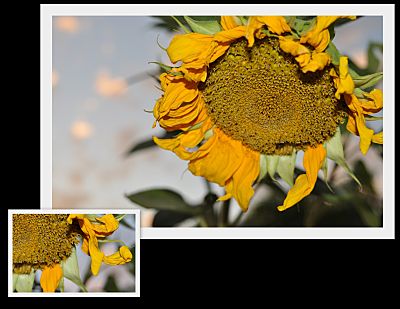
Here are the last of them, photographed at dusk.

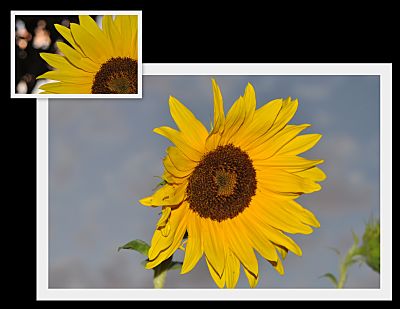
Sunflower
Sunflower at Dusk
End of Season Sunflower

Floating rafts of sunflowers are being used to clean up water contaminated as a result of the 1986 accident at the Chernobyl nuclear plant in the former Soviet Union. The roots of the sunflower plants remove 95% of the radioactivity in the water by pulling contaminants out of the water.”

Birdhouse Gourd: Racing the Biological Clock

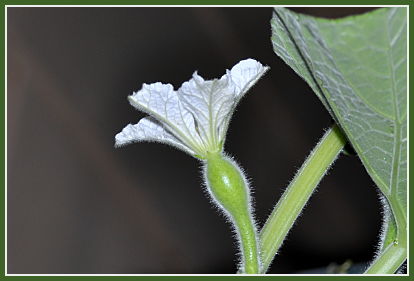
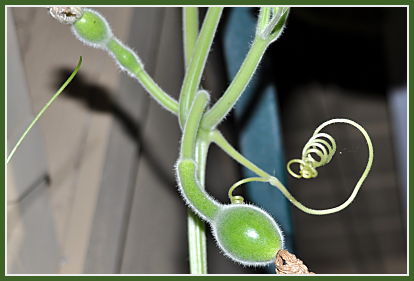
Our birdhouse gourd vines are sporting several small fruits, each one about two inches long. They’re the color of limes and about as large as an over-sized peanut. Aren’t they cute?

The question of the hour is will they grow up?

We found the seed packets on one of our nursery rounds, but not until after planting the rest of the garden. The idea of growing a birdhouse was irresistible so of course the packet made its way into my cart. I envisioned a garden full of birdhouses, just waiting for a feathered mama to claim them.

We have at least another month of warm weather, but will it be enough? Please send your happy-garden energy vibe. I’ll be sure to report back.

birdhouse gourd flower

Birdhouse gourd bloom

Birdhouse gourd bloom

birdhouse gourd fruit

Blooming Thursday: Garden Friendships

My friend Liz has been back in the States for several months, but it took her imminent departure for us to finally get together.  Our friendship is such that we can simply pick up where we left off, regardless of time passed.  Liz is also a gardener I admire and look up to.

Liz has the unique distinction of gardening through one spring and two summers.  She spends part of her year in California, the rest in beautiful New Zealand.  She taught me and some friends how to felt on one of her trips home.  I hope to learn how to eco-dye from her one day, too.

On her visit today, she came bearing gifts…and lunch!  So much for my hosting skills. We enjoyed delicious, home-made, vegetarian burritos while sitting on the patio talking shop.

You probably need to be a gardener to fully appreciate the first gift: a bag of worms and worm castings. I feel like a real gardener.  I have a worm bin, a kitchen scrap container, and soon my tumbling composter will arrive at my door.  I’ll be brewing garden goodness all winter long.

Worm Bin

Worm Bin

In addition to worms, I am also the lucky recipient of several eco-dyed pieces, one-of-a kind art made with natural dyes, leaves and flowers. The small pouch is made from reclaimed materials, printed with leaves, dyed, then hand-stitched.

Eco-dyed Pouch

Eco-dyed Pouch

The three pieces pictured below use a similar technique, but with paper. I love the artistry.

eco-dyed print

Eco-dyed Art Print

Eco-dyed paper

Eco-dyed Paper

My dear friend is not a fan of pictures, but she did let me take a closeup of her t-shirt. She bought the shirt at a thrift store, wrapped it around rose leaves, and dipped it in a natural dye. It’s exquisite.

Eco-dyed T-shirt


Eco-dyed T-shirt

You can learn more about eco-dying from India Flint.

Tumbling Composter: Waiting for UPS


Forest City Tumbling Composter

Forest City Tumbling Composter

It’s all coming together.  The Tumbling Composter I ordered online will arrive this week. My counter-top food scrap bin is almost full. There’s a bucket in the garage collecting spent flowers and the leaves on the Chinese Pistache are starting to turn!  I’ll have all the ingredients for my first batch of compost.

I looked at several varieties before settling on this model. My criterion was simple:  It had to be portable, affordable and resistant to rodents.  It’s constructed from recycled materials, also a plus, and the compact size is perfect for my small vegetable garden.

Why Compost?

  • Composting reduces the amount of waste you send to the landfill
  • Composting turns your waste into a useful product—and it does so without requiring additional resources.
  • Using compost in your garden reduces the need for water and fertilizers and helps eliminate the need for pesticides.
  • Composting provides you with a valuable experiential lesson in the cycles of nature and the folly of our throwaway culture that is likely to lead to other waste-saving measures as time goes by.   (Source: Sheryl Eisenberg, Natural Resources Defense  Council NRDC)

Additional Resources


Double Dentate: The Shape of Leaves to Come

Flowers and fruit are the garden darlings, but where would they be without leaves?  As a seed set roots, tiny leaves quickly follow, the building blocks of things to come.  Leaves are:

“a plant’s principal organ of photosynthesis, the process by which sunlight is used to form foods from carbon dioxide and water. Leaves also help in the process of transpiration, or the loss of water vapor from a plant.”

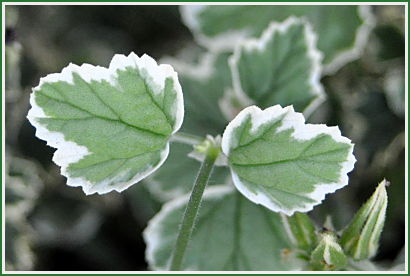
The shape of a leaf, known as the leaf margin, helps to determine the type of plant.  Leaf margins, or edges, include dentate, double dentate, crenate, ciliante, entire and lobate.  I traveled the garden with my camera this week, so I could get up close and personal with the powerhouse leaf.

The Shape of Leaves to Come

I enjoyed studying the different leaves in my garden, viewed with a more observant eye. Each plant has leaves that are fully formed, but it was also fun to observe the shape of leaves to come.  Some leaves stack in pairs, in alternating patterns, while others climb up the plants stem. My garden favorites:

Inky Leaf Coleus

Inky Leaf Coleus: Lobed

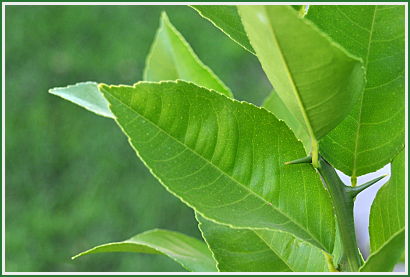
Lemon leaf

Dwarf Lemon: Entire Leaf

Scented Geranium Leaf

Scented Geranium Leaf: Dentate (or Serate)

Star Jasmin Leaf

Star Jasmin Leaf: Lobate

Clover Leaves

Clover Leaves: Entire

Resources: