As the azaleas drop the last of their flowers, it’s time for the Serbian bellflowers (Campanula poscharskyanato) to put on a show. The bellflowers started to flower last week, and now they’re producing color in earnest.
2021, Azaleas and my “Dr. Seuss” succulent2021, April, the same containers a month later
The plants are small, so I placed several under the azalea’s canopy. They took a few years to establish, but now the star-shaped flowers push their way through the azalea’s foliage when the azalea finishes blooming.
The bellflowers are a beautiful shade of purple to almost blue. We have several growing along the front of our living room window as well. They’re easy to grow, and unlike the azaleas, they bloom for some time.
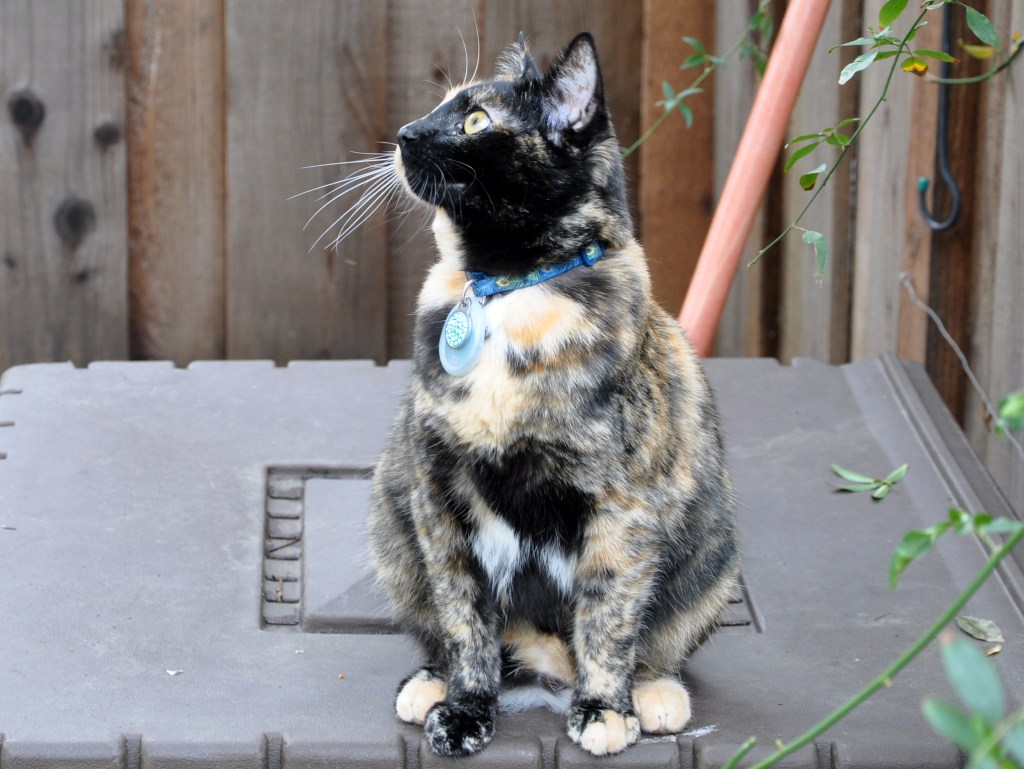
I tried to get Lindy to look up at the camera, but she wanted no part of it. I snapped the photo anyway. Lindy adds charm to any picture, face-on or otherwise. She’s a sweet cat with a lovely disposition.
Lindy-Lu, almost 19
It’s Friday evening as I write this with an eye on the weather. We’re forecast for a 70% chance of rain on Sunday. We’re all doing our version of a rain dance, hoping that the wet weather materializes. Here’s hoping my next post is full of rainy day garden pics.
I hope you enjoy your weekend ahead, rain or shine.
Weeds are imposters. They’re like a spy at a cocktail party, standing tall in their green suit, effortlessly blending in. To the untrained eye, they look like everyone else at the party.
They can’t fool this gardener. I’m a professional.
Not really, but as weeds go, I know things.
I’ve been uprooting the same half a dozen weed varieties in this garden for over twenty-five years. I know when they’ll appear in the garden, and I’ve learned ways to minimize them. Eradication, however, is futile. To garden is to weed.
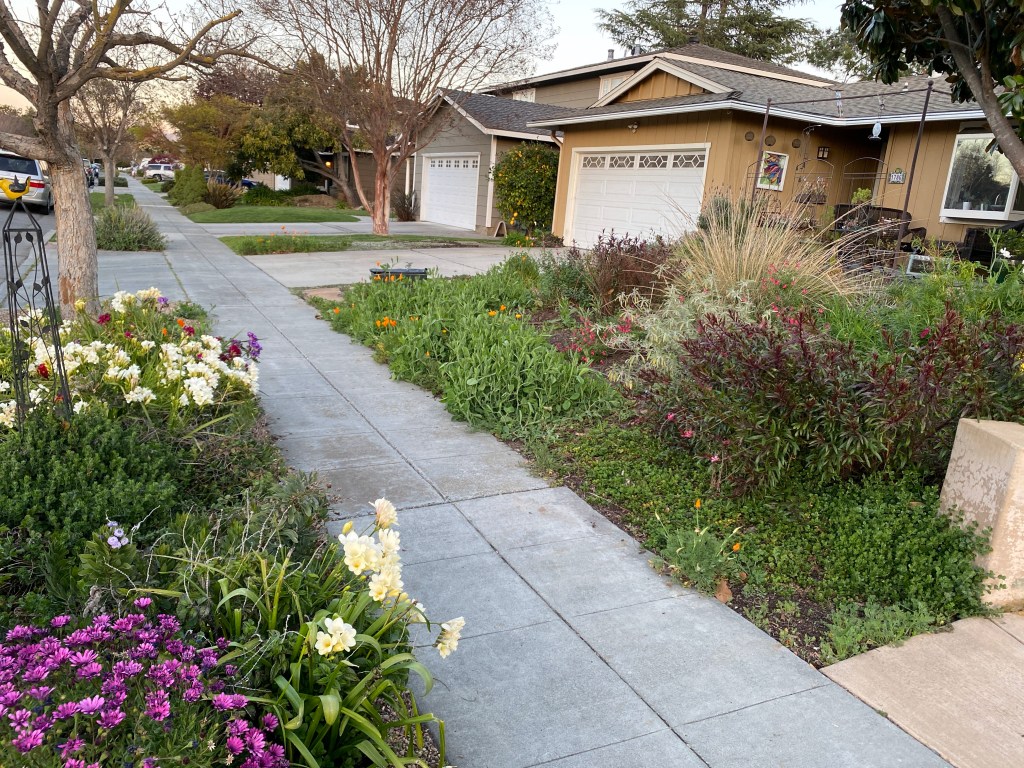
Walkway to the right of the driveway, weeds running amok
I don’t mind weeding for the most part. I do it mainly by hand and at times find it therapeutic.
Walkway to the left of the driveway, more weeds
Oxalis, however, is a scourge. Oxalis grows along the walkway on both sides of the driveway. Dymondia grows between the paving stones. It’s described as “a dense mat that over time will choke out weeds.” Ha! The oxalis mocks me. It spreads its roots under the paving stones, then grows up through the dense planting. If flowers quickly, so if I don’t nip it in the bud, it quickly produces more weeds.
Weed-free Dymondia
Oxalis hides in other parts of the garden, but it’s easier to pluck when you can get at the roots. I have to be in a reasonable frame of mind to weed the walkway, knowing that the oxalis will live another day before I start.
Oxalis growing through the Dymondia.
Even the origin of this weed’s name sounds sinister:
Early 17th century via Latin from Greek, from Oxus ‘sour’ (because of its sharp-tasting leaves).
Lexico.com
Oxalis is native to North America. It grows in poor soil and needs very little water to survive. It flowers eight months of the year. It’s sounds like a garden darling if you’re fooled by this sort of thing.
Oxalis is easy to spot and remove when it grows elsewhere.
I know better. Yes, it’s a lovely green, but the oxalis has to go.
April 22 is Earth Day, the anniversary of the start of the environmental movement in 1970. This year’s theme is #RestoreOurEarth.
Drought tolerant Salvia (Mexican Sage)
Over the past five years, we’ve made changes to our garden, adaptions that honor our fragile environment. We replaced our lawn with native and drought-tolerant plants. We installed a rain catchment system that diverts rain from storm drains, making it available for the garden. Unused rainwater can also be released to recharge depleted groundwater.
Rain catchment system (and Tessa)
I’ve always planted species that attract bees, but we make sure to have water available as well. It’s often the smallest things that create a big impact on the ecosystem around you.
I LOVE bees
I don’t have space for a large composting system, but I found a self-contained one that works wonders. Dried leaves and kitchen scraps, aided by billions of microbes and earthworms, compost scraps into rich nutrients for the soil.
Tessa likes to sit on the composter at dusk
By removing our lawn, we increased garden diversity. An expanse of lawn is a monoculture. It’s the use of land by one crop at a time. Monoculture farms can produce food in vast volumes at an affordable price but at great cost to the environment. Monocultures require heavy pesticide use. They degrade the soil, leading to erosion. Monocultures require more water, and they place a lot of stress on our pollinators. Without them, we couldn’t survive.
Bee pollinating wildflower
Earth Day is widely recognized as the largest secular observance in the world, marked by more than a billion people every year as a day of action to change human behavior and create global, national and local policy changes.
Earthday.org
I grew up embarrassed by my vegetarian mother, only to become a vegetarian myself at 18. I’ve always loved animals, and I no longer wanted to eat them. Dairy stops me from becoming a full-on vegan, but it’s a goal worth striving for. Eating lower on the food chain benefits everyone on the planet.
Growing strawberries in the VegTrug
There is so much more to do. I’m still using more water than I should. It’s a balancing act, one that I’ve yet to perfect. Our reliance on fossil fuels is of huge concern as well. One of the unexpected benefits of this pandemic is the reduction in commutes. I hope that trend continues.
I pledge to continue to reduce, reuse, and recycle.
My garden will remain pesticide-free.
I will continue to attract pollinators and beneficial insects to my garden.
I pledge to continue my education in best gardening practices. A healthy earth begins with me.
A basket of succulents outside my laundry room window
Our citrus trees are blooming again. The waxy flowers produce an intoxicating scent that invites you to linger below the tree.
Lemon tree budsOrange Blossom
We inherited an orange tree when we bought the house, along with a tall lemon tree and an almond. I never tasted the almonds, but the squirrels certainly approved. They remained well-fed during the tree’s tenure.
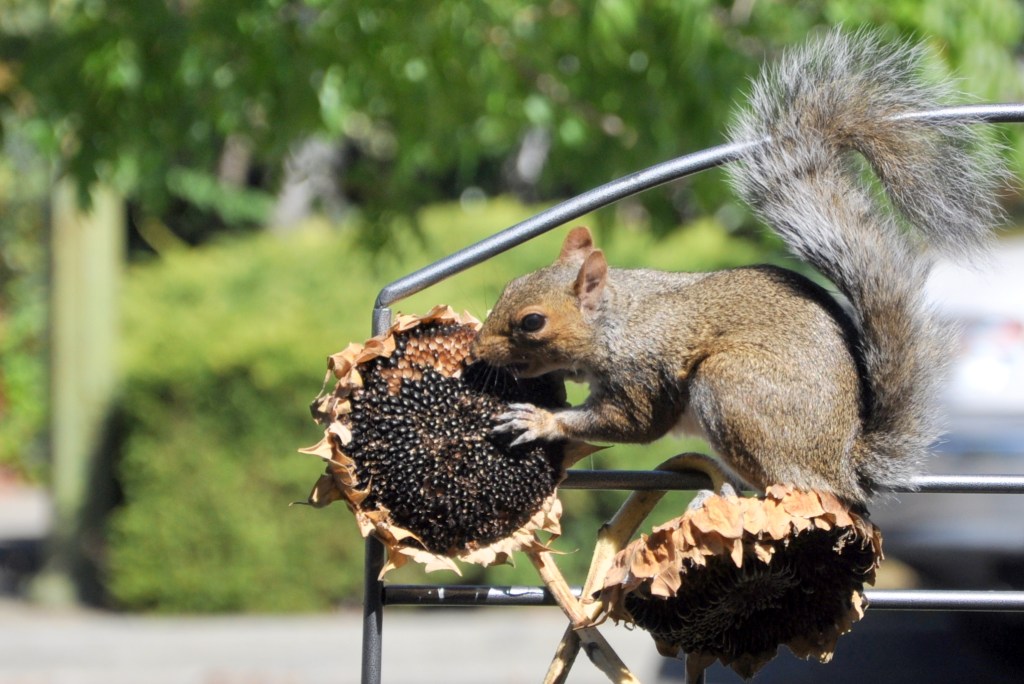
Squirrel eating sunflower seeds on our deck
Sadly, two of those three trees suffered from neglect. The lemon tree had been allowed to fork early. The tree grew two long trunks that started splitting the tree in half. We harvested the lemons as best we could and tied the two trunks together for support.
Alas, I arrived home one day, puzzled by the bright sun at the corner of the house. It took me a moment to realize that our lemon tree had split down the middle. Half the tree lay sprawled across the garden.
The almond tree suffered from a lethal fungus internal to the tree. The arborist recommended removing it before it fell down. Sadly, it had to go.
Only one established tree in the back garden remained: the orange.
Orange Tree
Anna’s hummingbird resting in the orange tree
We bought a Meyer lemon to replace the tree we lost and made sure it grew in an upright manner. I’ve also tried to prune it in such a way that it remains easy to harvest. The lemon started in a pot, but it didn’t take off until it went into the ground. It occupies a space in our side yard, where we share it with our neighbors.
Lemon tree, ivy, azalea, lily, and Jasmin vine
It’s easy to forget all these years later how far we’ve come with shipping and refrigeration. As a young girl in Canada, an orange was a special treat placed in the bottom of our Christmas stocking. Oranges weren’t readily available in Ontario at that time, or if they were, they were pricey.
I sometimes look back on a time when things weren’t plentiful. It’s good to keep one’s perspective. When I sit under the orange tree, fragrant blossoms inviting me to lift my head skyward, I’m reminded of the extraordinary gift of citrus in bloom.
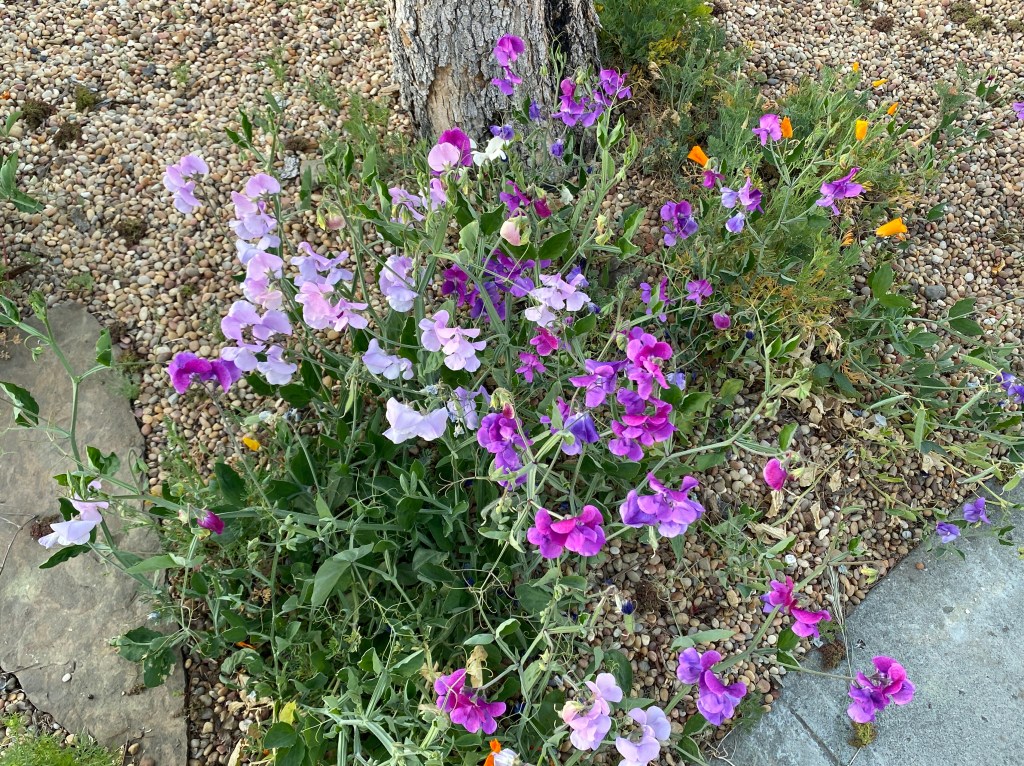
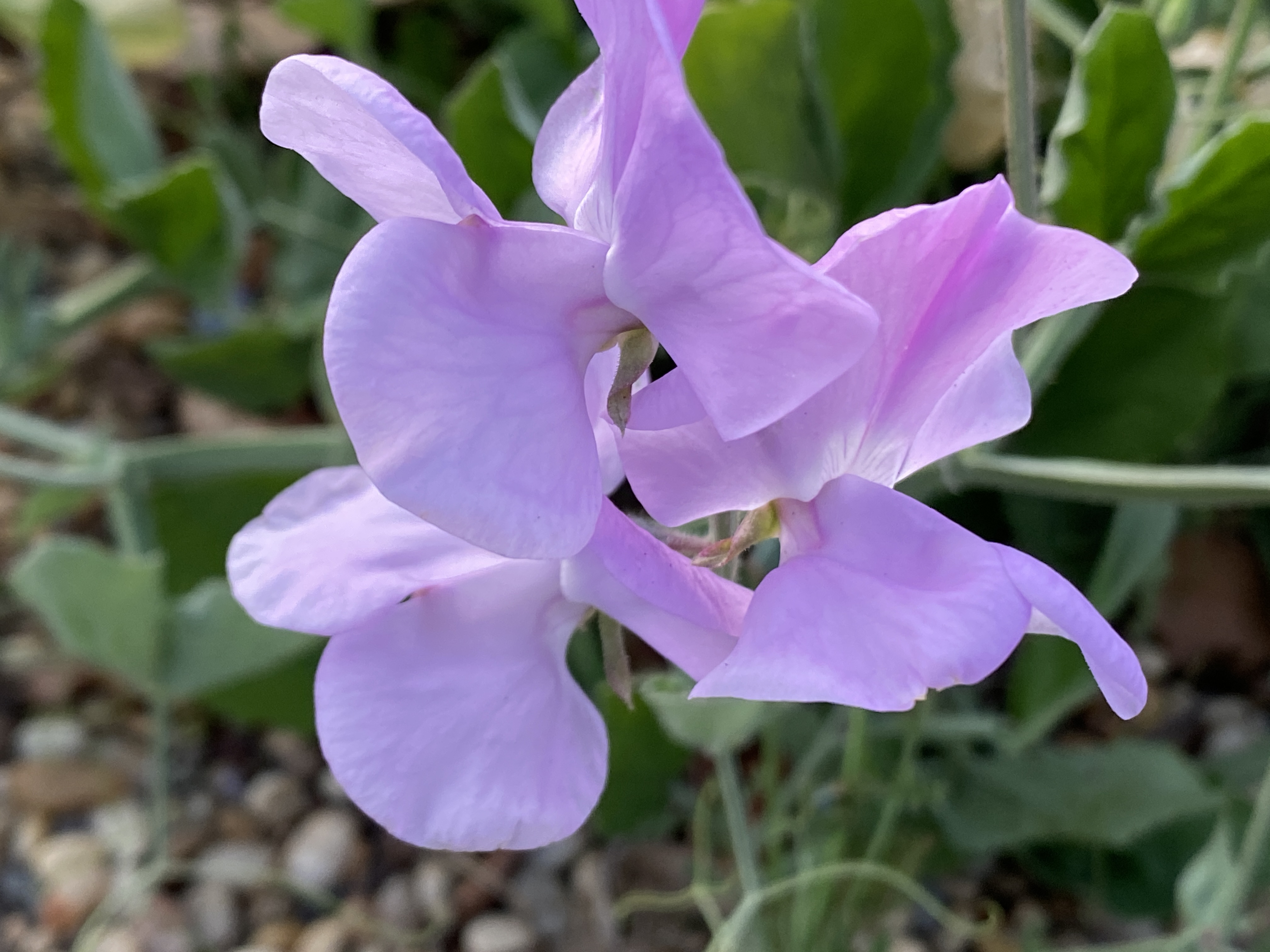
I’ll be the first to admit that I’m a bit obsessed with sweet peas. I look forward to them every year. These unassuming flowers have the ability to uplift. They’re sweetly scented and delicate, cast in soft colors and pale hues.
Here’s what the sweet peas looked like three weeks.
March 27, 2021
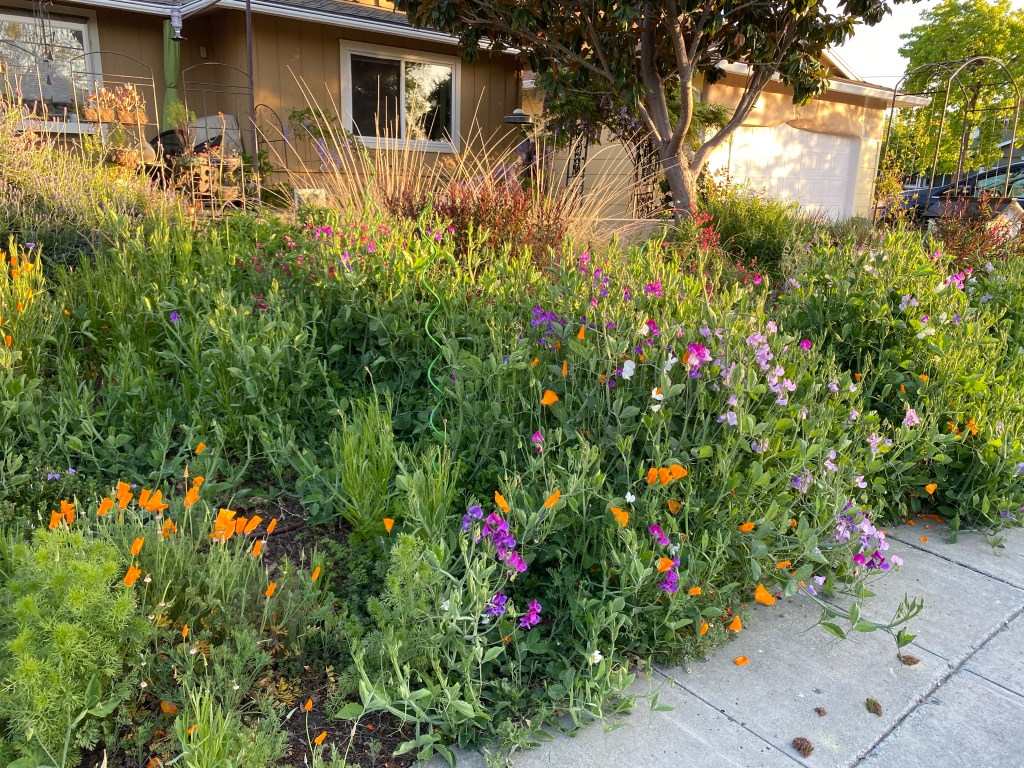
This is what they look like today. I’ve added stakes for climbing, just visible in this photo. In the past I’ve used a portable folding fence, but I prefer the look of these stakes. The stakes are designed for tomatoes, so they’re nice and sturdy.
April 19, 2021April 19, 2021
I let the sweet peas go to seed every summer. They replant themselves in the fall, impervious to the cooler weather or the ocassional frost. They start flowering in March and fill the garden through May. Our summer heat is no match for these shade-loving sensations, so I enjoy them while I can.
Because they self-seed, I’m intrigued that the color variations don’t change. The flowers come back, year over year, in white, lavender, fuchsia, purple, and soft pink. As the last of the freesias fade, the scent of sweet peas takes over. I’ve cut a few of the flowers here and there, but I’ll soon have enough to start cutting small bouquets. It’s such an enjoyable task filling a small jar with wisps of green and scented sweet peas. I look forward to it every year.
2015: This watering can vase is 27 years old
I didn’t expect to see the sweet peas growing in the gravel this year as they’ve done in the past. Last summer we hired a handyman to rebuild the deteriorating planter box and at the same time replace the weed cloth under the gravel. The sweet peas are back, rooted in the small amount of soil deposited by the wind.
I’ve put together some favorite garden photos from the week for another Sunday Snapshot. We’ve had temperatures ranging from 45 to 88 F here in San Jose. I’m hanging my hopes on the potential for rain by Friday, but the estimates are low.
I once told a friend that the best time to pull weeds is after the last rain of the season. The wet soil is happy to relinquish the weeds, roots, and all. I didn’t wait this year, and it’s just as well. Things are still looking fresh. I’ll continue to enjoy it while it lasts.
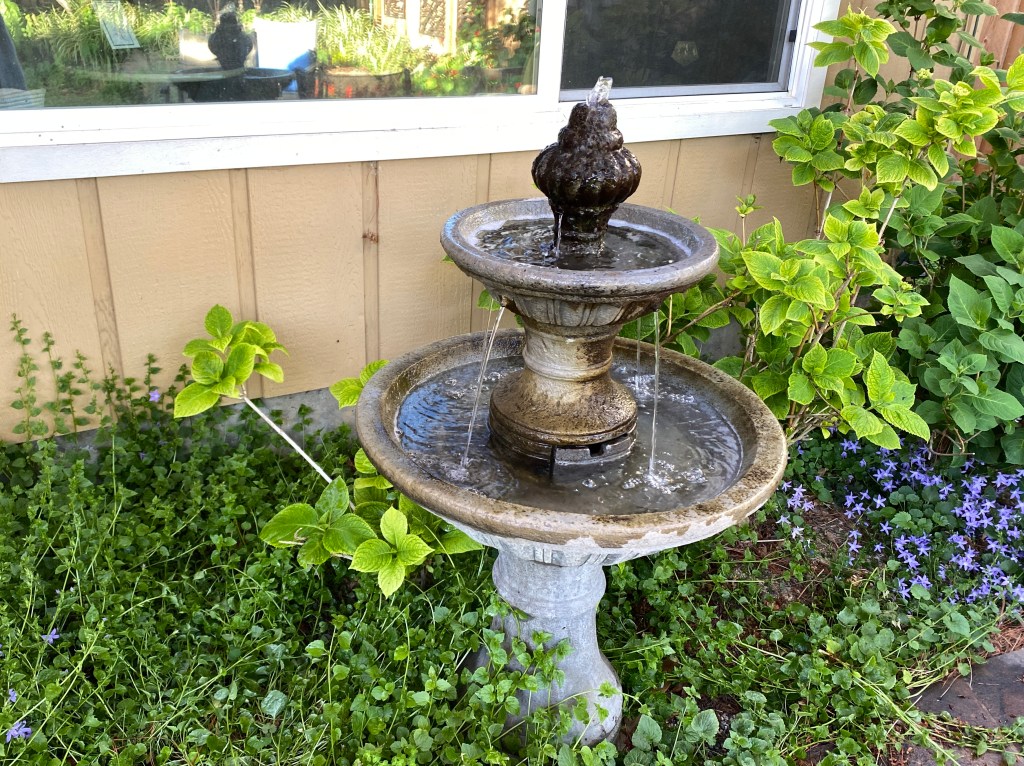
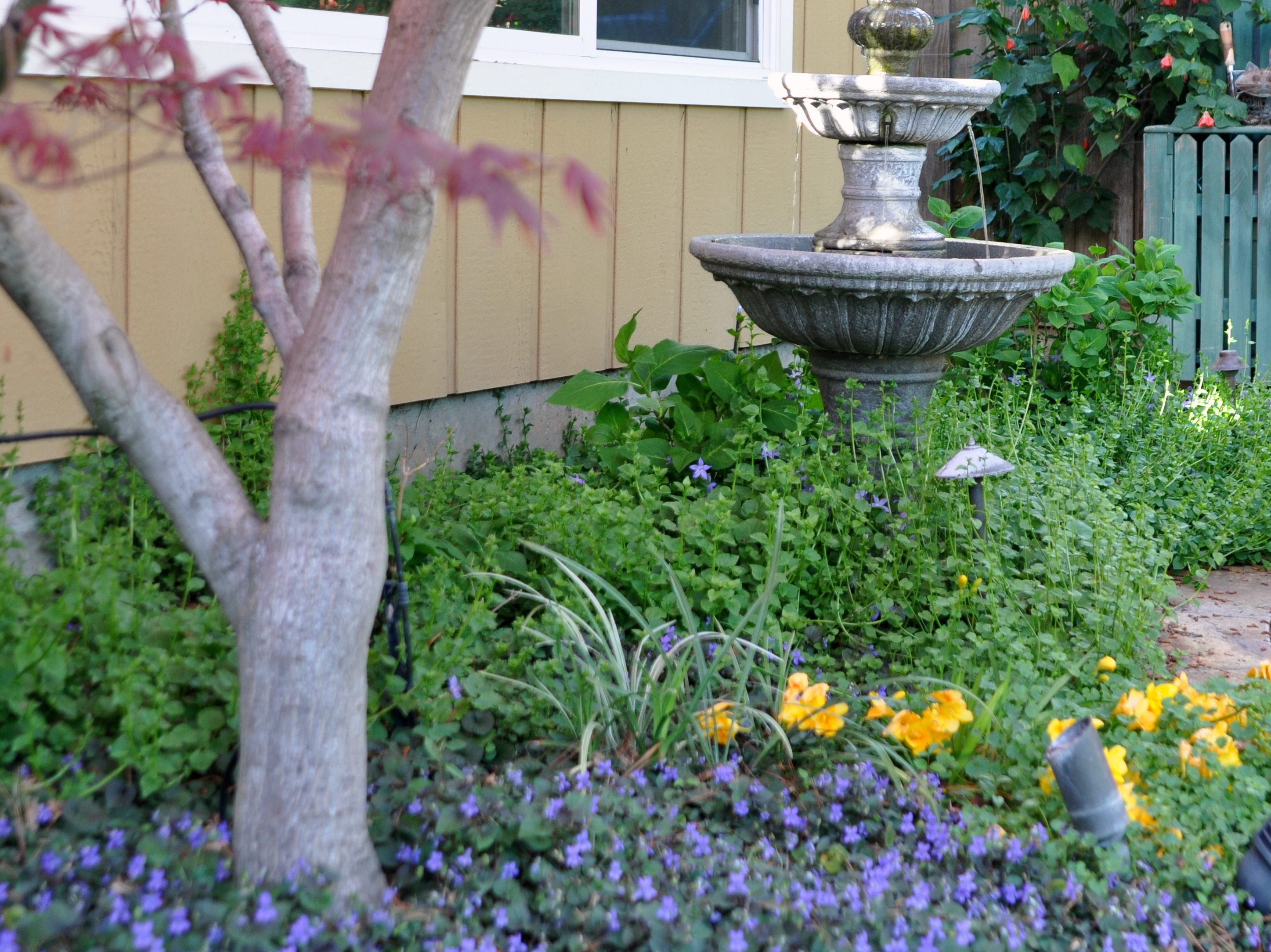
I’m not averse to most dirty jobs, but I always dread cleaning the fountain. It’s not so much the dirt and slime, but the challenge of getting it clean.
For the birds
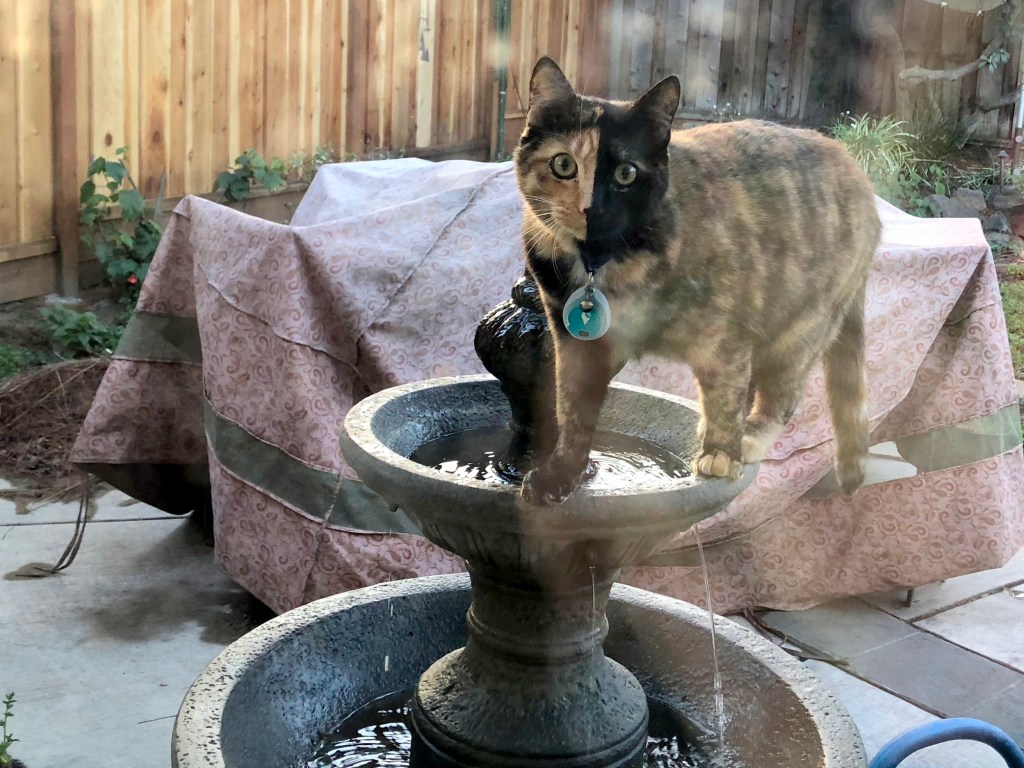
Before placing the fountain in front of our living room window, I researched the best location. Wet wings slow the bird down after they bathe, so they suggest a nearby tree. The fountain is in the shade, so it doesn’t get too hot. Surrounding shrubs discourage easy access by a certain feline.
Tessa as a kitten
Or so they say.
What keeps the birds safe is what makes this job a challenge. The fountain invariably collects plant debris in the water and around the pump. In between an extensive cleaning, I reach into the pump cavity and clear away debris. I use a stiff brush to clean the sides and then refill the fountain with fresh water.
The deep clean is more involved. I cut power to the pump, then tip the heavy fountain to empty the water. It’s a balancing act, sloshing out the dirty water while keeping the fountain from tipping over. I pour white vinegar into the emptied fountain, then top it up again with water and let it soak. Vinegar is non-toxic, so it’s harmless to the birds. It does a great job cleaning out the nooks and crannies.
On the other hand, white vinegar is not suitable for surrounding plants. I can’t blast out the vinegar water with the hose, and I have to be careful when I scrub not to splash the nearby foliage. I usually bail out the vinegar water and pour it down the drain. Only then do I feel comfortable rinsing and refilling the fountain.
It’s worth it, of course, when you spot birds taking a bath, sipping from the bubbler, or hopping in the branches in the nearby tree as they dry off.
Ana’s hummingbird on top of bubbler
On the subject of birds, we’re seeing more activity in the garden. Mike called me to the kitchen window earlier this week to see a male house finch on the railing. When I leaned over the sink to get a better look, I spotted a nest on the patio drapes. Squeal! That was unexpected.
Bird nest sitting on the fold of the drapes.
We use the drapes during the hot summer months to block the evening sun. Off-season, the drapes stack together under the eaves. A house finch built a nest on top of the folds.
After that first sighting, she didn’t return. I’ve been worried all week that either we scared them off with our regular activity or that she met with a different fate.
It turns out that female house finches build several nests, then decide which one they want to use. I hope she chooses the one outside our kitchen window. Only time will tell.
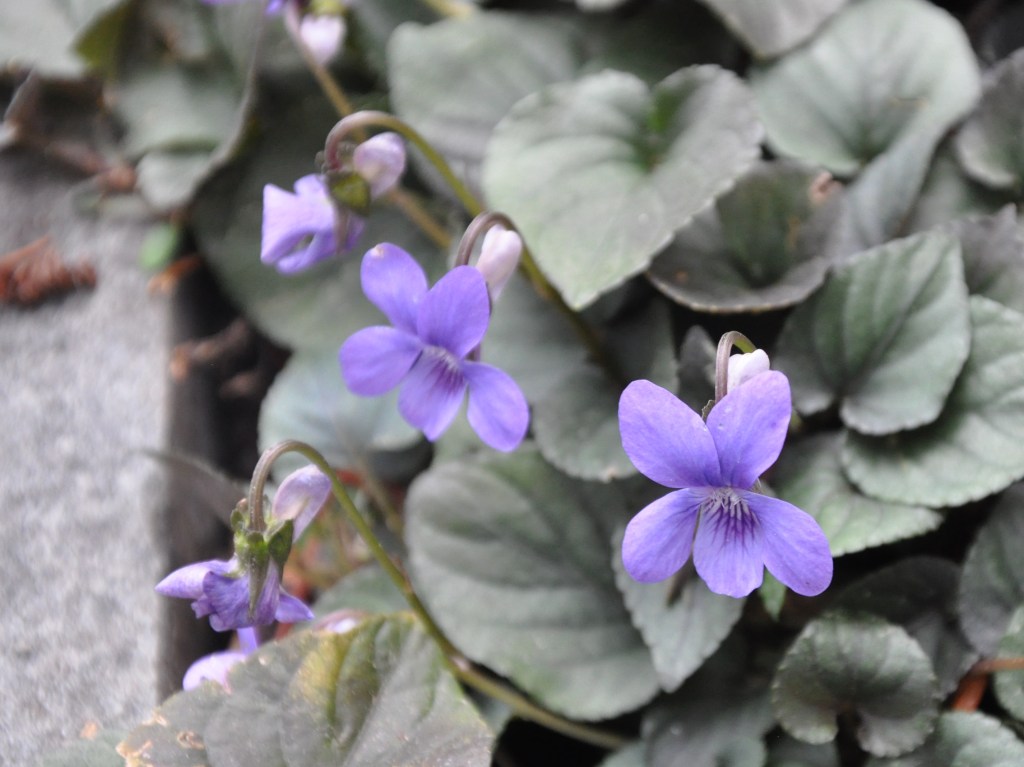
Wild Violets (Viola odorata) are easy to propagate or invasive, depending on your perspective. I think they’re charming. These purple gems come back year after year, adding a vintage vibe to the garden. I don’t remember planting violets, but it’s possible I bought one as an annual and they later seeded on their own.
Violets
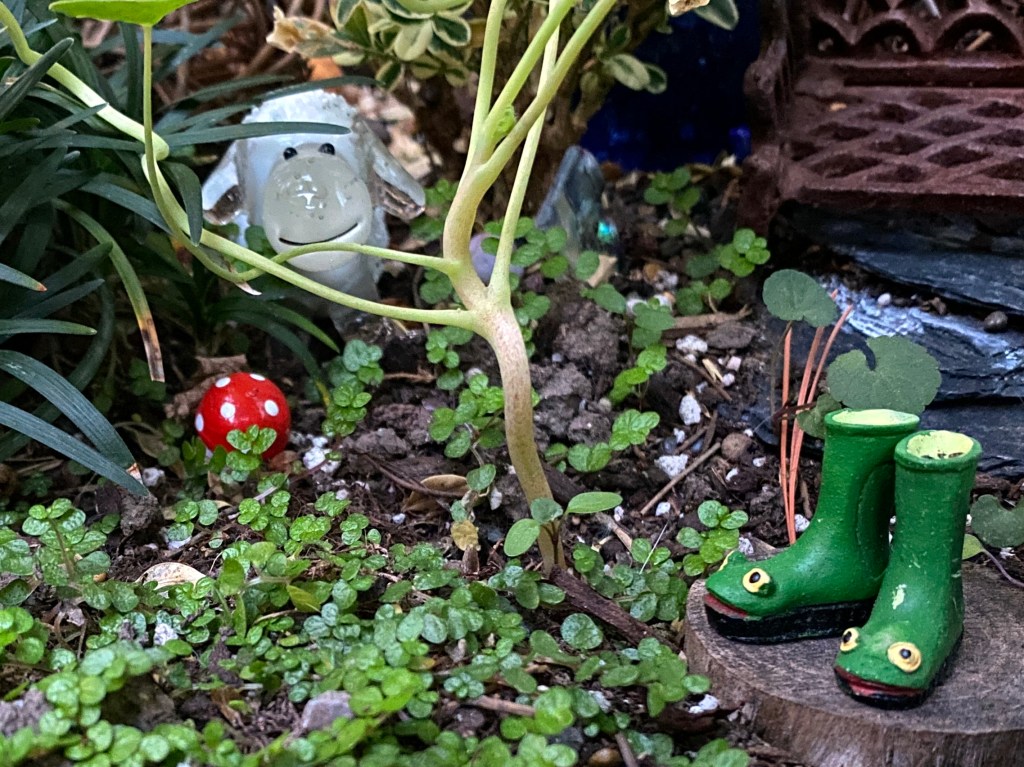
Tiny Violets fill in gaps between plants, giving the garden a filled-in look that I love. A few months ago, a violet flowered in the fairy garden. It’s remarkably to scale.
A self-seeded Violet grows behind the boots.
Next to the patio, we have an elongated ellipse between paving stones. The now-forgotten plants that grew there eventually died, but the violets have slowly filled in. A yellow freesia planted itself there, too, complementing the delicate purple flowers. Purple and yellow are among my favorite color combinations, so a hat tip to nature for planting these two together.
Ellipse filled with Violets and a yellow freesia.
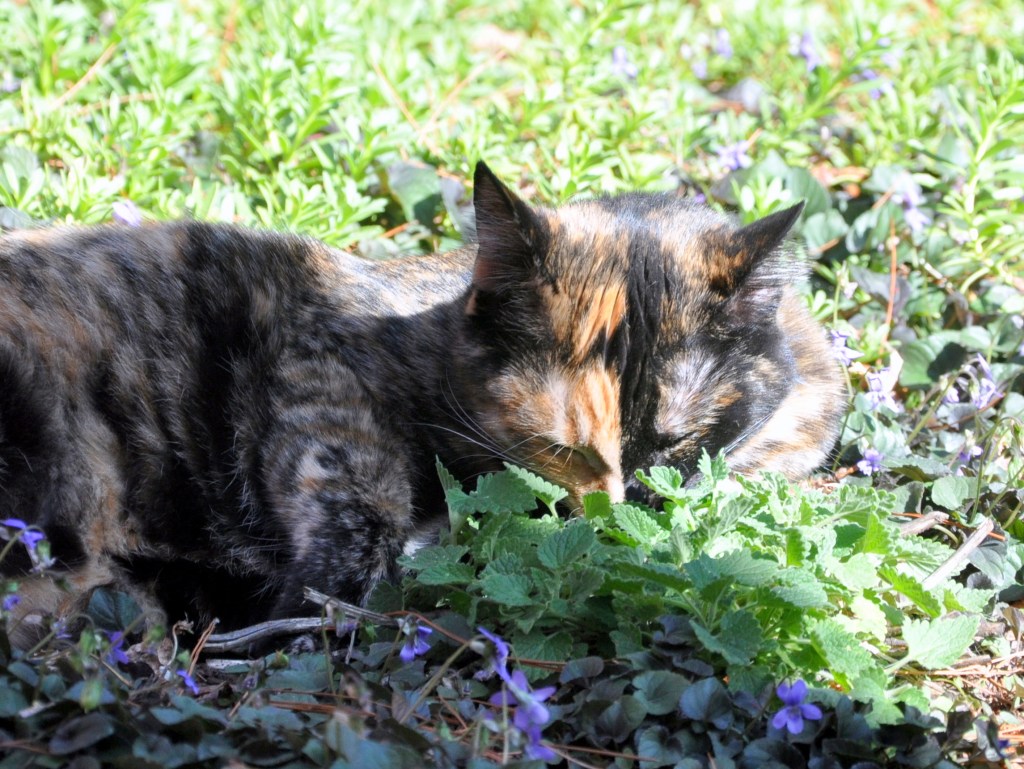
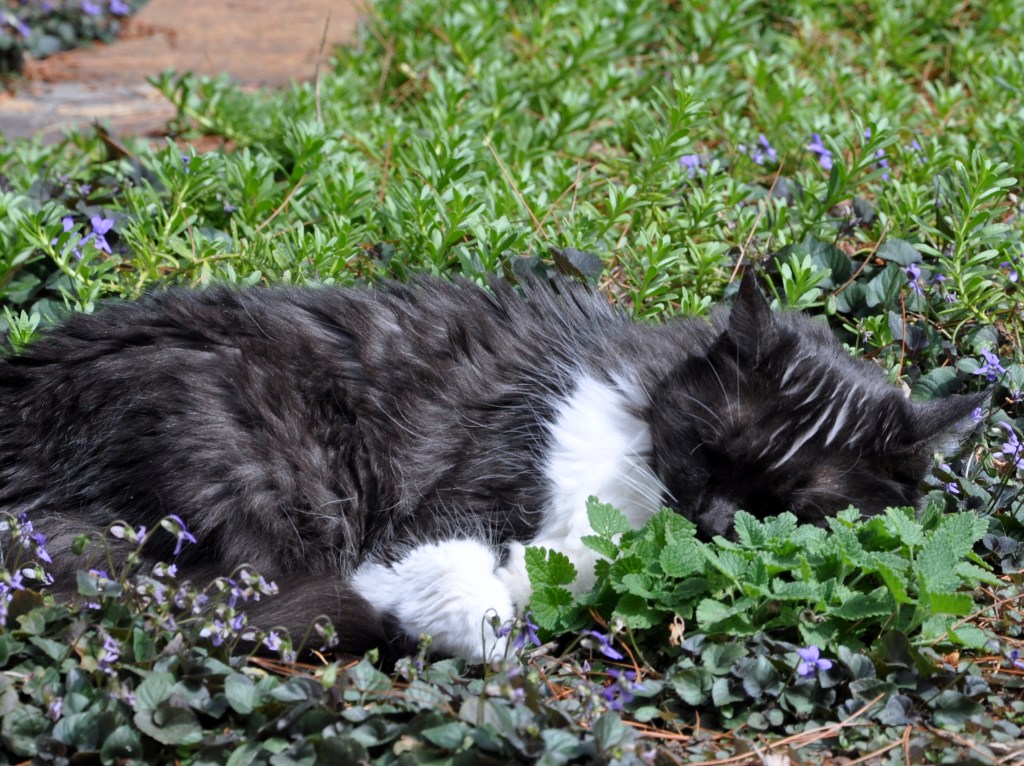
Violets make a terrific backdrop for cat portraits. They’re rugged, too, standing up to feline traffic. All three kitties enjoy lounging near the nepeta, but the Violets are none the worse for wear.
A mixture of Violets, Serbian bellflowers, freesia, and hydrangeasTessaMouse the CatLindy-Lu
If a kiss could be seen, it would look like a violet.
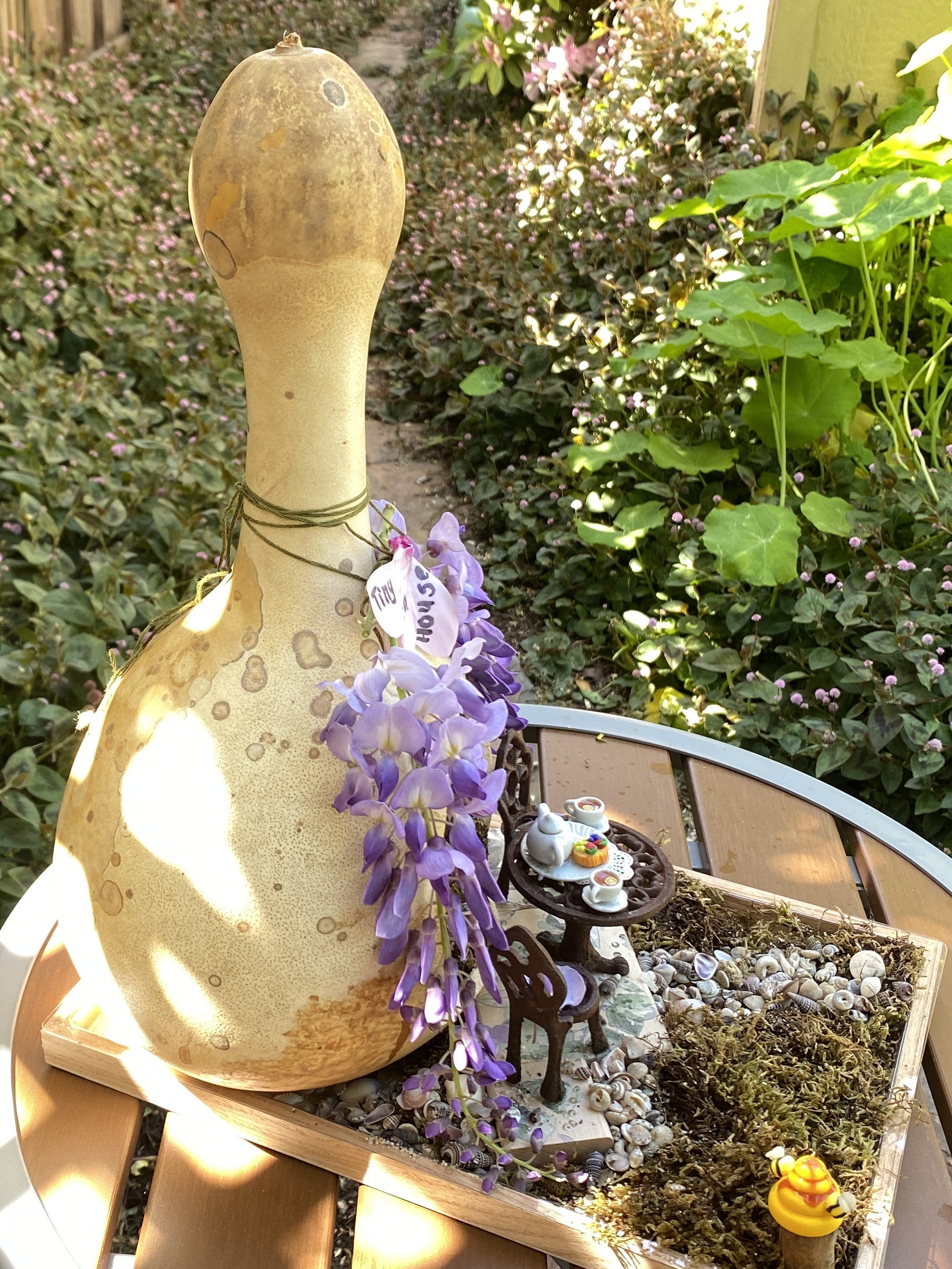
Have a look at my tiny tea house, made from a birdhouse gourd.
Birdhouse Gourd Tiny Tea House
Here’s a bit of history: Several years ago, when my boys were still young, we planted birdhouse gourds. They were fun to grow, but they need a lot of space. When all was said and done, we ended up with two gourds.
2015, Growing and harvesting birdhouse gourds
The gourds took a year to dry out. I knew they were ready when I could shake them like an oversized rattle. The color changed too, from bright green to a spotted brown.
Mike drilled a bird-sized hole in one of the gourds and a few pinholes in the bottom for drainage. Year after year I dreamed of a nest of birds, but alas, it wasn’t meant to be. One year I found the gourd filled with tiny pinecones, a discovery that made me laugh. Squirrels no doubt.
Today I turned the second gourd into a tiny tea house.
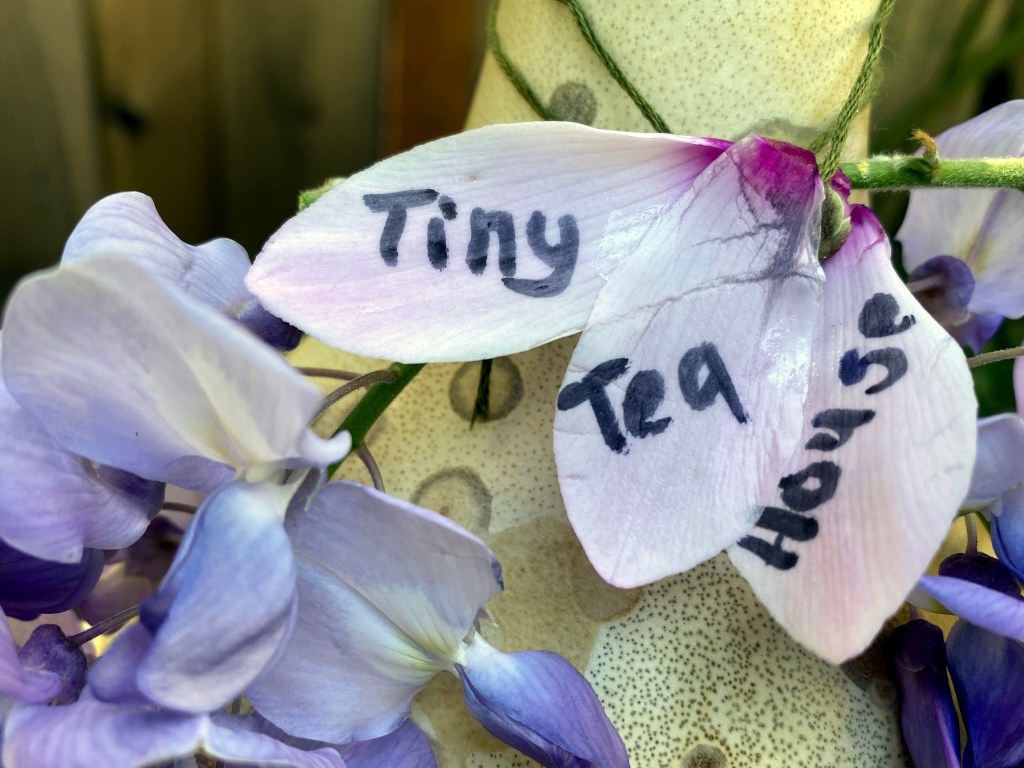
Tiny Tea House sign made from cyclamen petals
Like most of my miniature fairy gardens, the concept evolved. The gourd proved too small for the tea house, so I moved the furniture “outside” and created a patio instead.
Birdhouse gourd draped in Wisteria
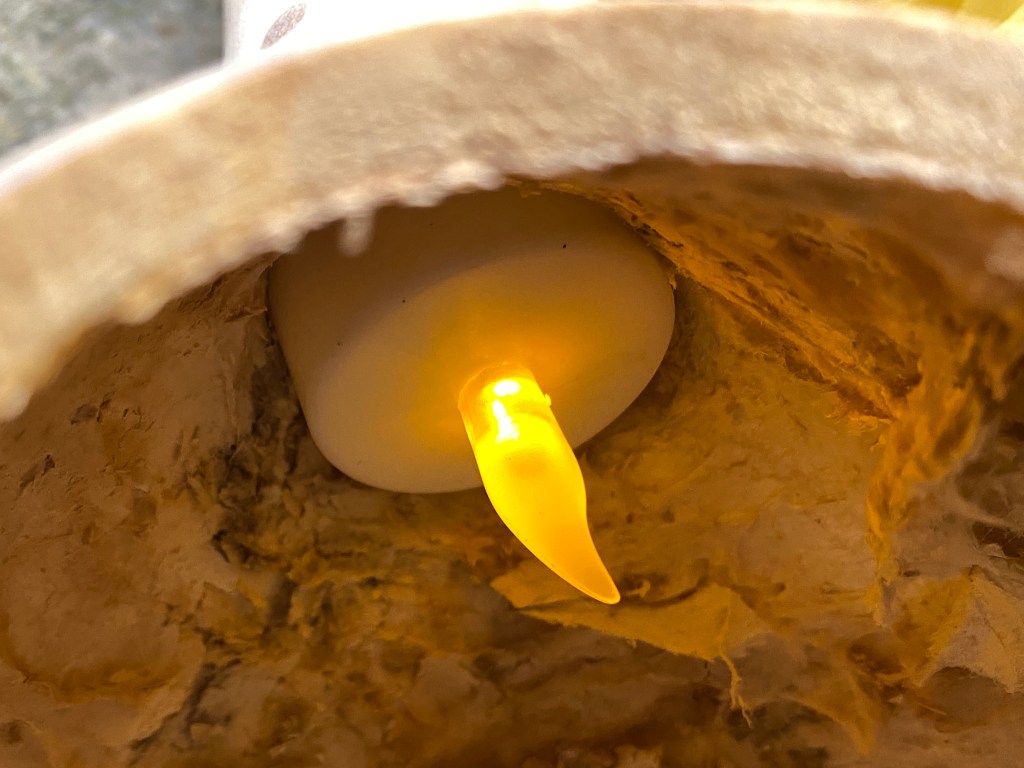
I placed a battery-operated tea light in the stem of the gourd for some ambiance. It’s a perfect fit!
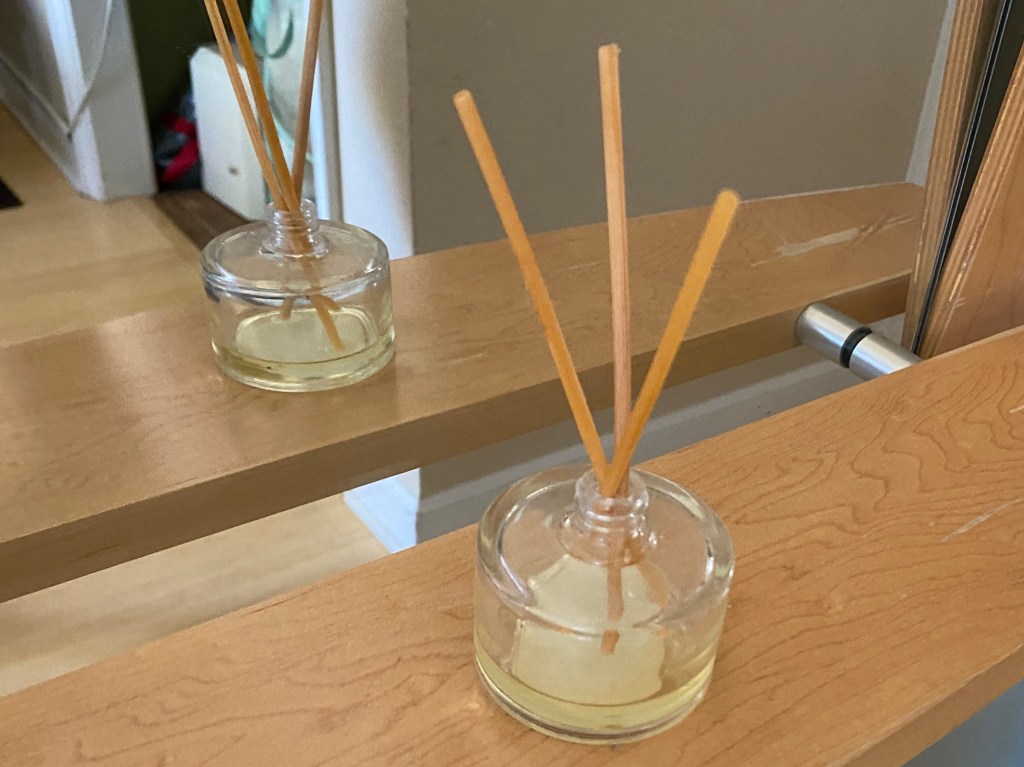
I fashioned a small curtain from a tattered silk scarf, then hung the curtain from a reed once used in a diffuser. Unlike full-sized drapes, it took me longer to thread the needle than to sew them.
Tealight wedged in gourd neck
Fairy lights behind the silk curtain
Reed infuser
Tattered silk scarf
Lavender silk curtain on a reed curtain rod
Top: tea light in gourd stem, light behind silk curtain, reed used for curtain rod, Bottom: tattered silk cloth, silk curtain
I put more fairy lights behind the silk, delighted with the soft, romantic effect.
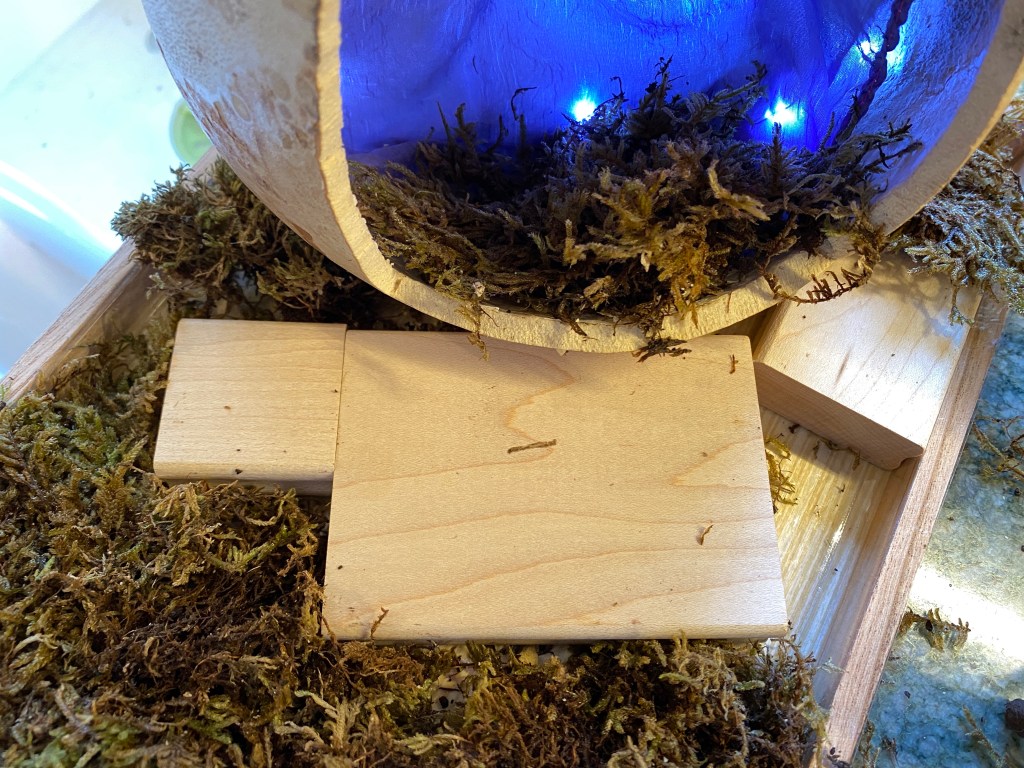
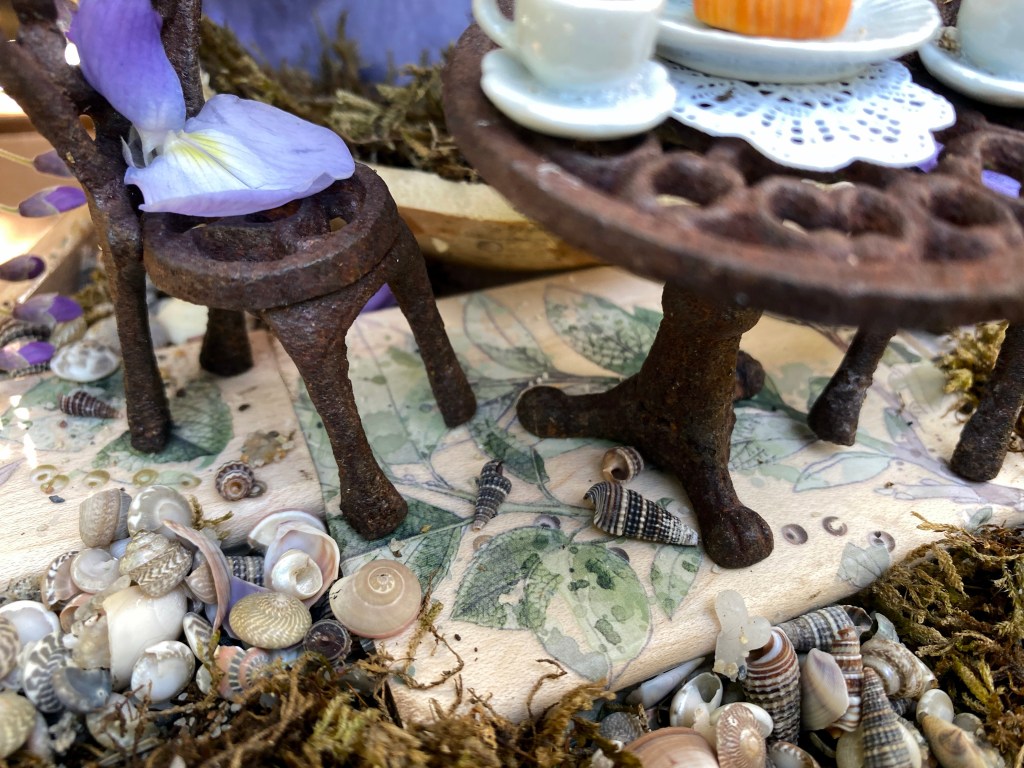
The gourd sits in the corner of a shallow wooden tray. The tray arrived at Christmas time, filled with delicious cheese and crackers. I knew I could put it to good use, and today was the day.
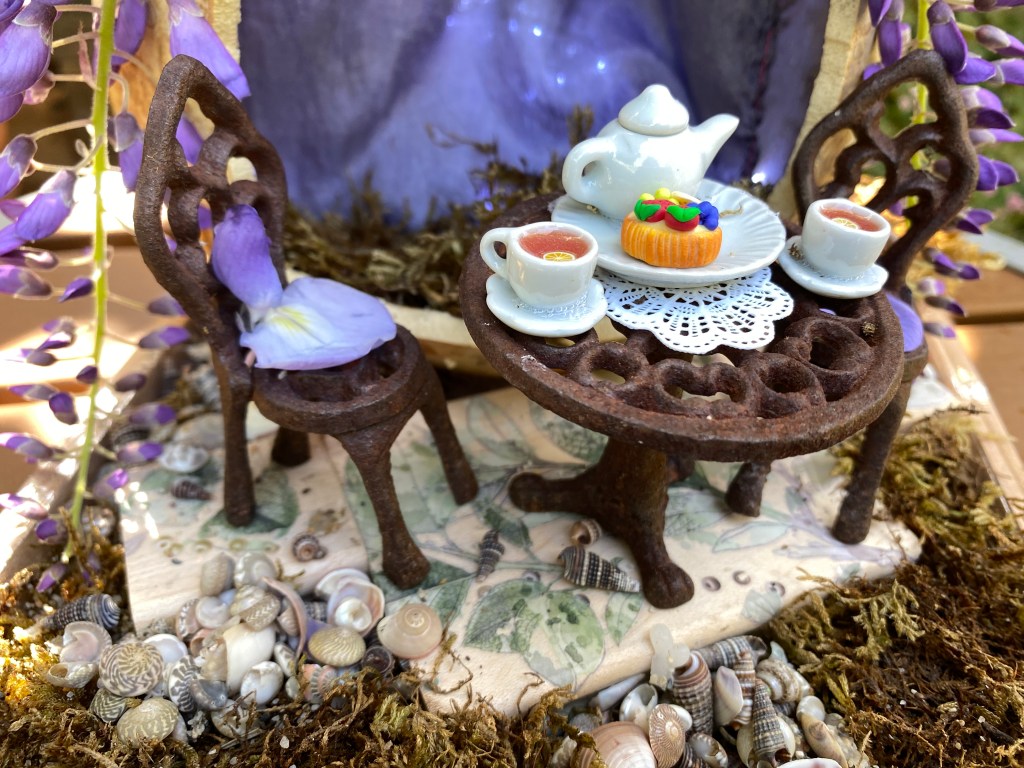
Tea service for two on the patio
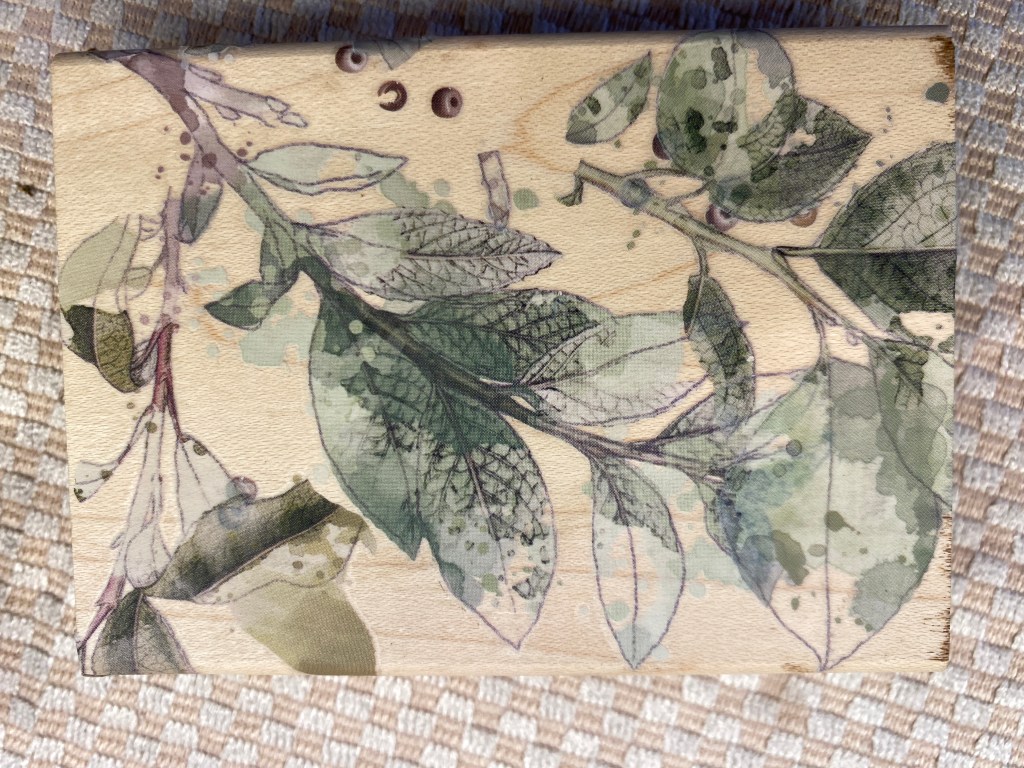
I lined the tray with moss and tiny shells from a broken necklace. I made the patio using three wooden blocks that were originally intended for rubber stamps. I applied rub-on transfers to make a leafy patio, then wedged them together on the tray. They keep the gourd in place, and they’re just the right size for the rusted furniture.
Wood blocks before leaf transfer
wood block with leaf transfer
Vintage Artistry rub-on transfers
Wood blocks with leaf transfers
Leafy patio
Small tea house patio made with wooden blocks with transferred images
The charming tea set and the beehive were a gift from my friend Kelly. We met through blogging many years ago, and we’ve become the best of friends. I got her hooked on fairy gardening as well.
Tiny tea house treasures from Kelly
I draped Wisteria across the opening and made a small sign using a Sharpie and a cyclamen flower.
What’s a ScrapHappy post? It’s an opportunity to create something new using scraps of paper, cloth, yarn, really anything. Our host, Kate, of Tall Tales from Chiconia, turns out gorgeous projects month after month. If you would like to join us, please let Kate know.
Pink geraniums
My dear friend Laura sent me a gift last year wrapped in beautiful blue paper, dotted with bumblebees. Bees have significance for her and her family, so she incorporates them in her art, cards, and other beautiful creations.
I gently unwrapped the gift to preserve the paper and set it aside to make her a card.
Gift wrap can be tricky to work with as it’s generally thinner and easier to tear. In this case, it worked beautifully.
Laura’s Bee Card among the succulents and nasturtiums
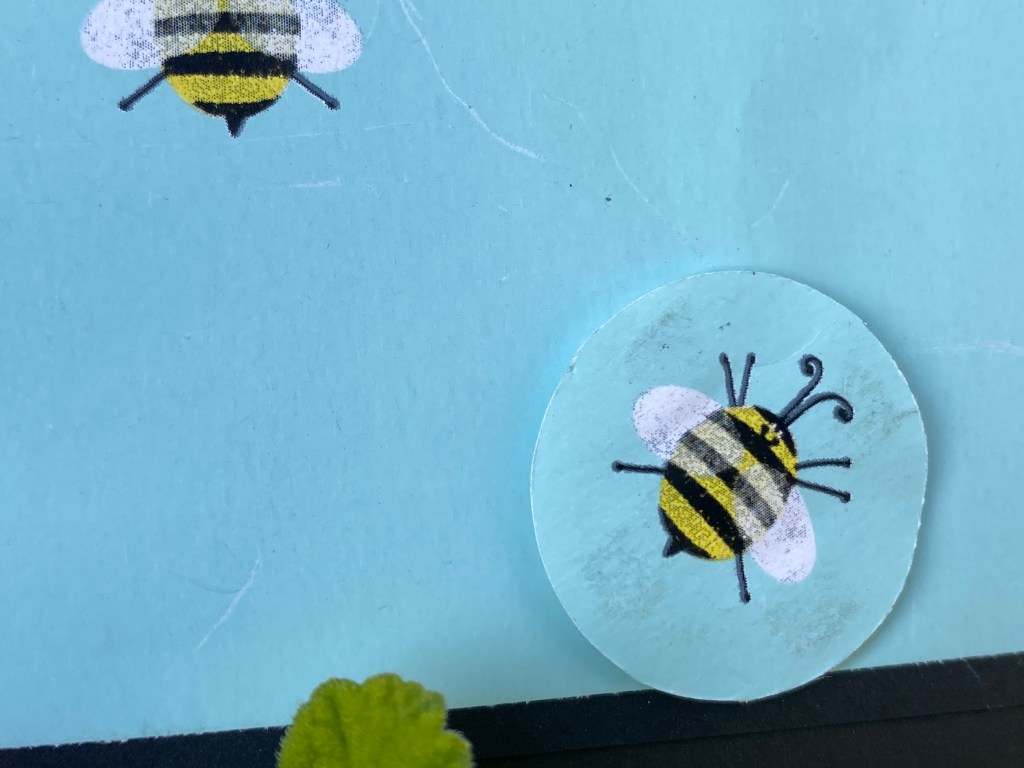
In addition to the gift wrap, I used a scrap of black card stock. I stamped the sentiment “You are Wonderful” on the upper left, then attached it to a 5 x 7 card. I used my die-cutting machine to cut circles around several of the bees.
Elevated bee
One of the bees sits on the front of the card, raised with a few foam dots.
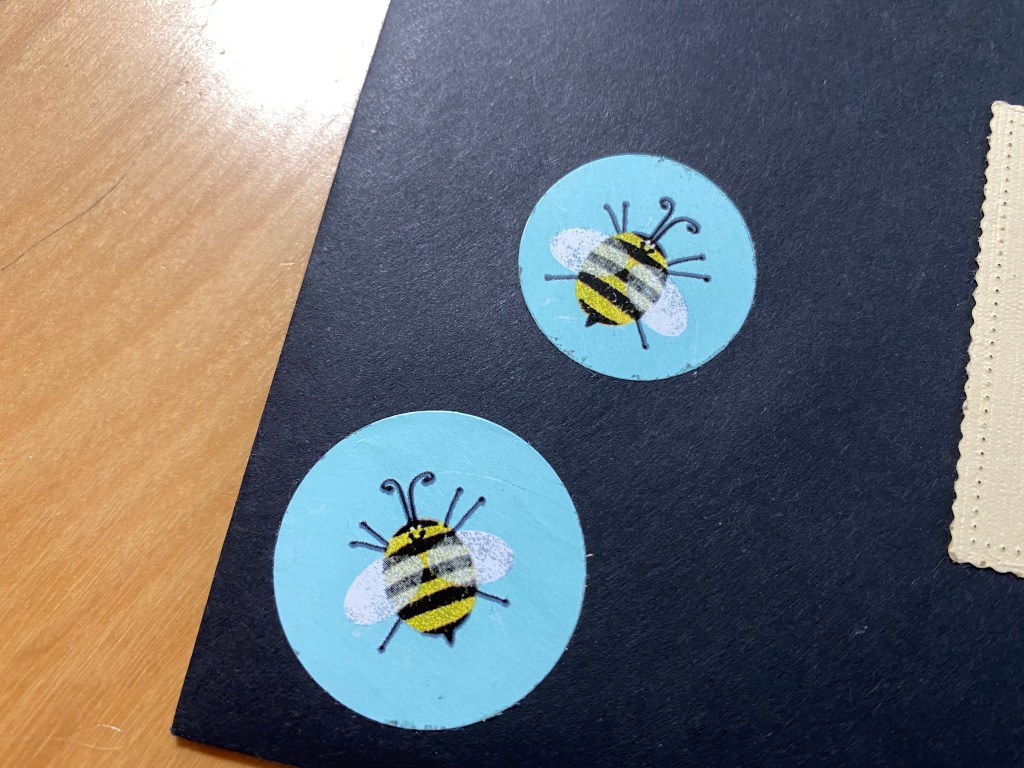
The bees take flight on the envelope
Two of the bees decorate the envelope, and a fourth one acts as a seal on the back.
I enjoy these monthly ScrapHappy posts. If you’re reading this and thinking of joining us, please do. Be sure to check out all the other scrappy posts this month linked below. Most of these blogs will be live on or just after April 15, 2021.




























 Gardening Nirvana