Art and Serendipity

My word of the year is serendipity,

the act of finding something valuable or delightful when you are not looking for it.

So joyous is this word in both sound and deed, that I may choose it again for next year.

2014 is also turning into my year of art. In January I won (yes, won!) this gorgeous Butterfly Sprite. The mixed media piece, created by the generous and talented Pauline of The Contented Crafter.  I smile at this carefree sprite every day, and every day she smiles back. Butterfly Sprite lives among soothing greens and flowers and texture that lifts my spirit. Art does that.
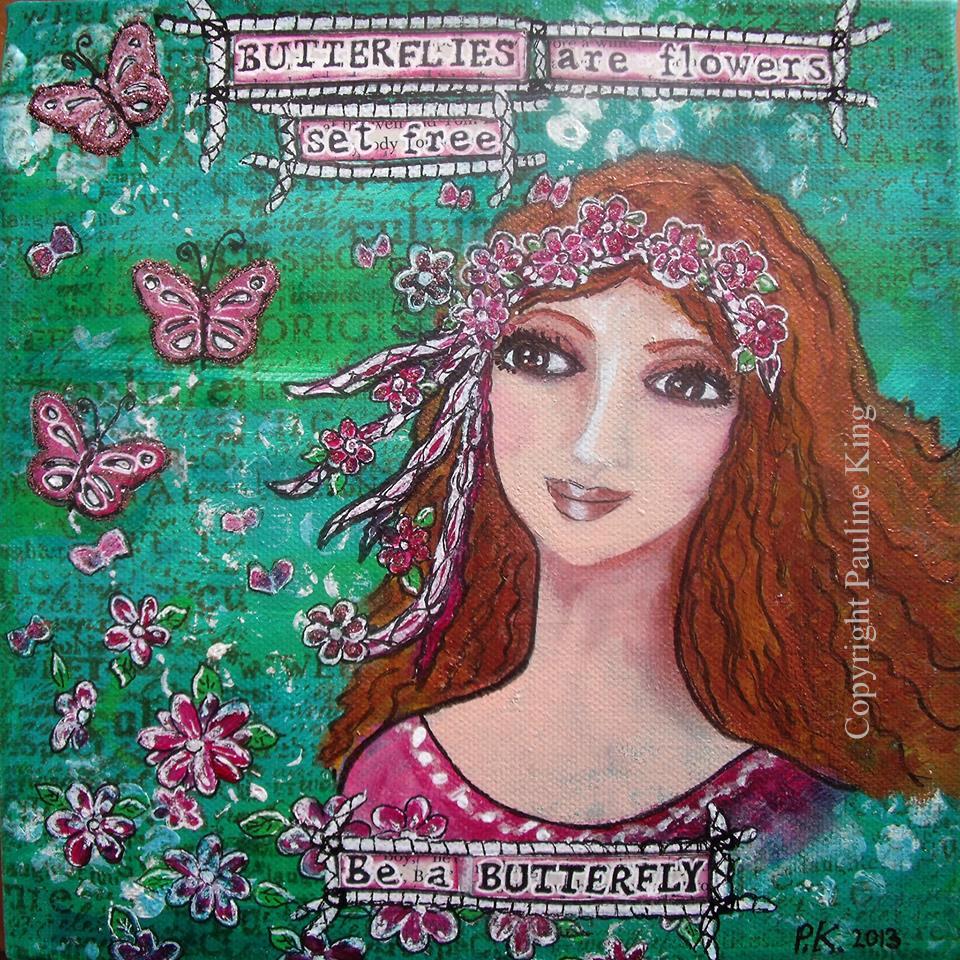
butterfly sprite

Butterfly Sprite by artist Pauline King

Also in January, I took a mixed media art class at A Work of Heart in Willow Glen and dabbled in my own little art project. I thought about Pauline the whole time.

Remarkably, I won another beautiful piece of art, a Bavarian textile knee blanket lovingly crafted by Dani of Teddy and Tottie. I guess this sort of thing happens when you choose a word like Serendipity.

Bavarian Knee Rug by Dani

Bavarian Knee Rug by Dani

I discovered another blogger via Dani and Pauline, and because you can’t make this stuff up, Fran blogs at The Road to Serendipity.

Last week my friend Whitney shared an album of photos for her upcoming art show in Gilroy, California. Whitney is a creative arts graduate of San Jose State. We met on Facebook via mutual friends. As I virtually thumbed my way through her online album, this sunflower rainbow stopped me in my lurking tracks. The piece celebrates three of my loves: old windows, brilliant colors and sunflowers. Seren-dipity-do-da!!!
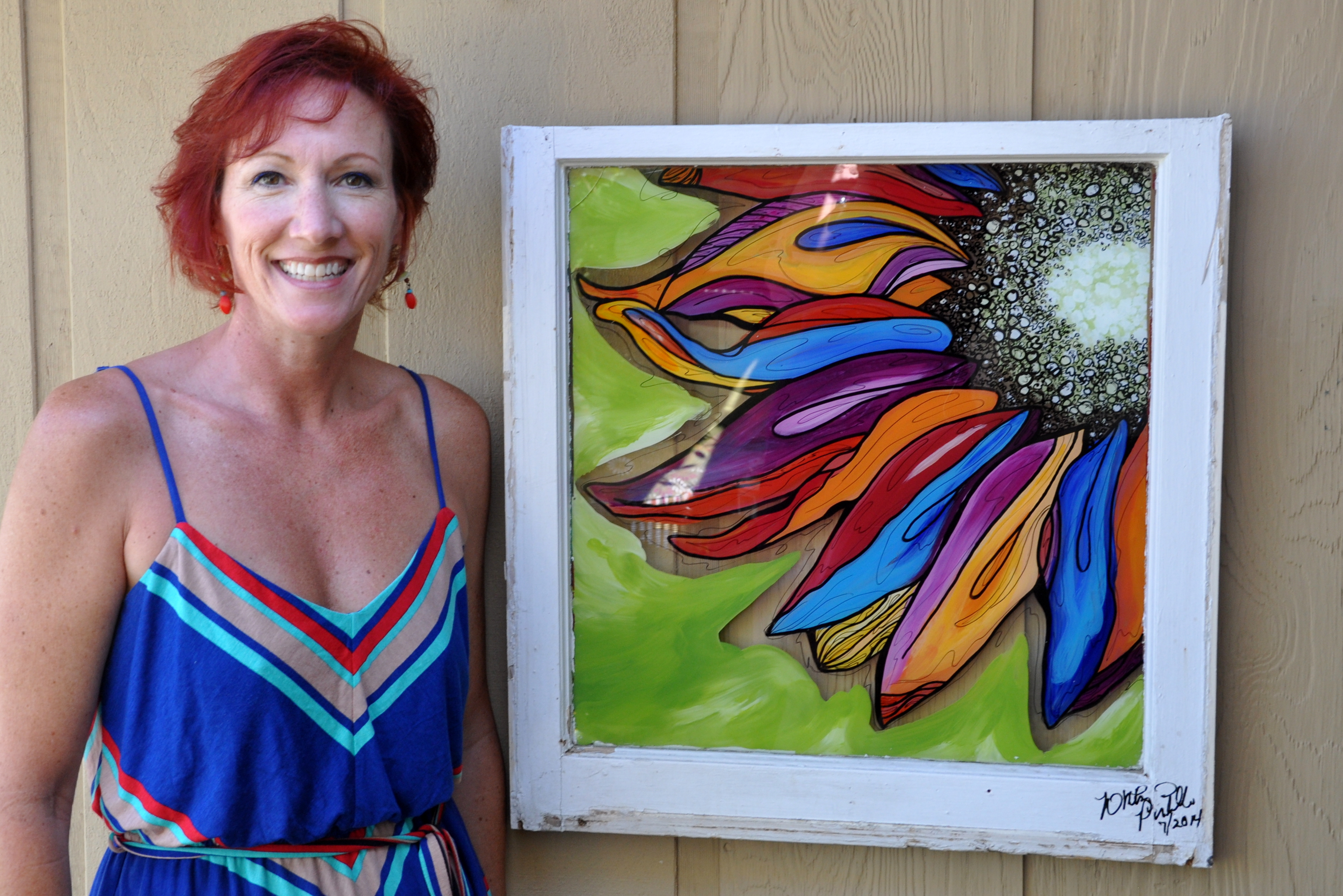
whitney with painting

Artist Whitney Pintello

I asked if it was still available, she said yes, and now it’s hanging in one of my garden seating areas.
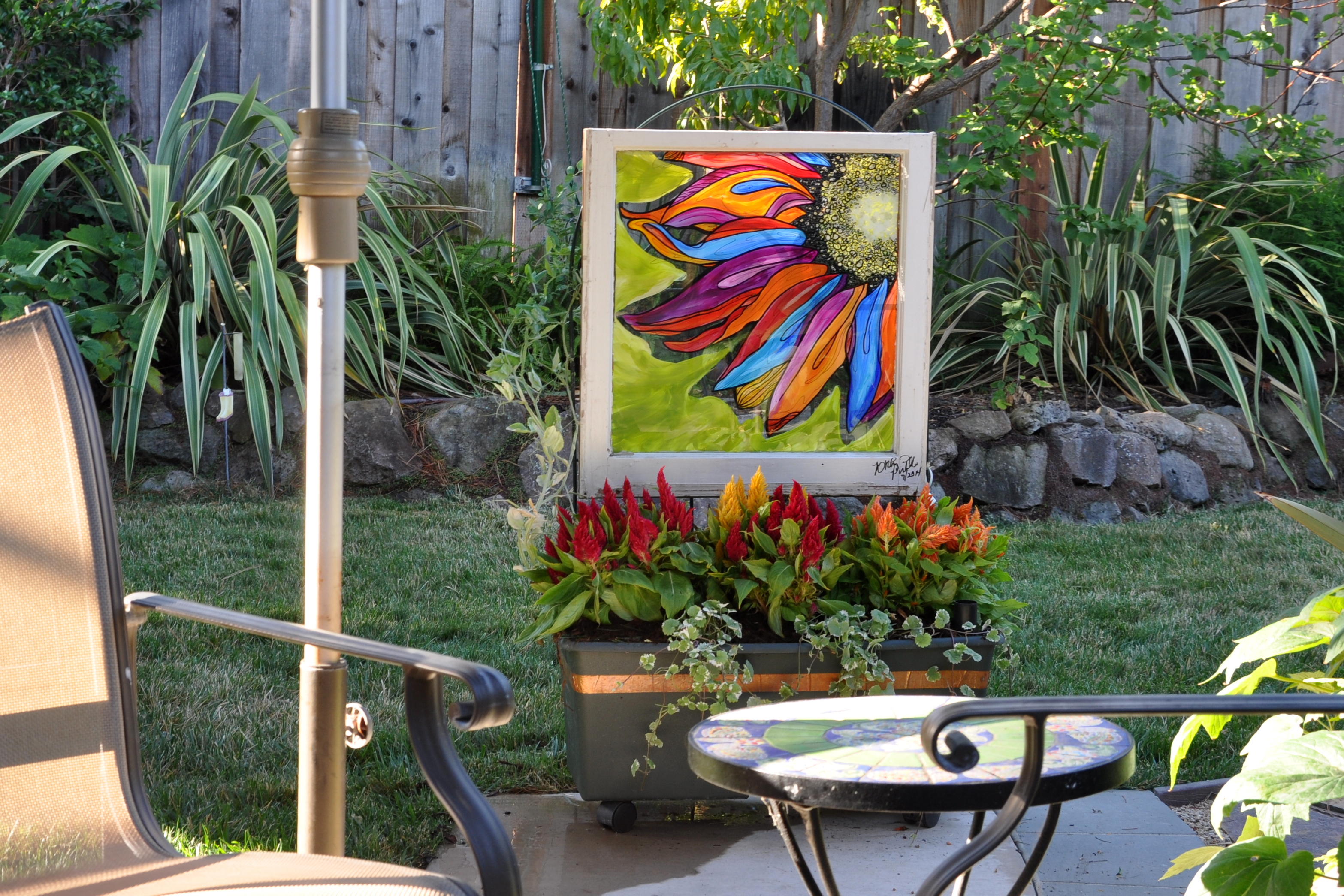
Sunflower room

We like to sit here in the evening to escape the heat

sunflower window front and back

Window painting, front and back

Whitney creates and sells vintage window paintings at a couple of local festivals each year. From her website:

Painting old windows is Whitney’s favorite medium, and came from exploring how to reuse old architectural elements. The process involves reverse painting: starting with the details of the painting first, then the subject, then the background, all on the back of the glass. Patrons like the casual, rustic quality the paintings have and the “found art” reuse of the vintage windows.

Who knew there was magic in a carefully chosen word?

Things With Wings

Lift, gravity and thrust. It’s not the latest dance craze, but a short list of what things-with-wings need to fly.

Wouldn’t it be thrilling to have wings?  I remember an episode of Gilligan’s Island years ago that always made me chuckle. In one attempt to get off the shipwrecked island, Gilligan donned wings and jumped off a cliff.  He momentarily flew until the Skipper shouted “You can’t fly!”  Gilligan replied, “Oh’, and only then did he drop to the ground.

I love watching things-with-wings flying in and out of my garden. They move with speed, efficiency and agility like a well-trained gymnast flying over the bars. What a thrill.

Birds

bird collage july 2014

Visiting birds

I worry about the birds as our drought drags on. They’re traveling in circles, searching for food, water and seed. Reservoirs are low and plants are under a lot of stress.

I keep our bird bath topped off so that our visitors can quench their thirst. The garden takes care of the rest. It’s satisfying watching birds sip nectar from a flower or pilfer seeds from the compost bin. They sing, trill, hum and yes shriek but it’s all a reminder of our garden diversity.

According to Discovery.com

{birds} can play any number of roles in a given ecosystem, most of which fall into four main categories: provisioning, regulating, cultural enhancement and supporting services. Supporting services, for example, include tasks such as predation, pollination and seed dispersal.

All that and they’re cute, too.

Bees

bee collage july 2014

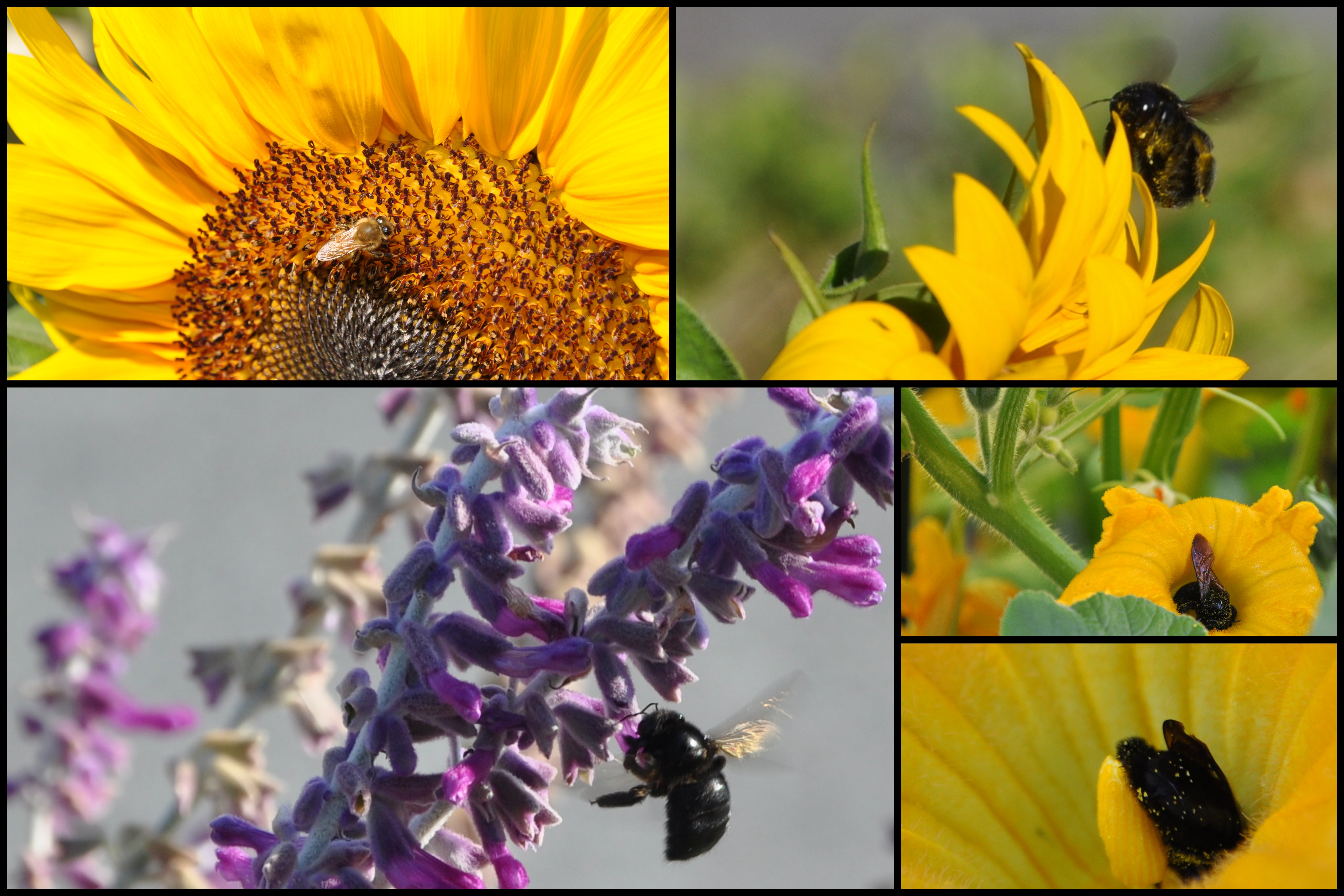
Bees pollinating sunflowers, pumpkins and Salvia

Through the camera lens, I’ve witnessed the extraordinary movement of bees gathering pollen. Shiny black bodies lift in and out of the pumpkin flowers, coating themselves a golden-yellow. The buzzing sound stops when they land, and within seconds they lift off again They are all business. If another bee is in the center of the flower, the second bee backs up and continues on. What they accomplish is extraordinary and relevant to our survival.

Butterflies

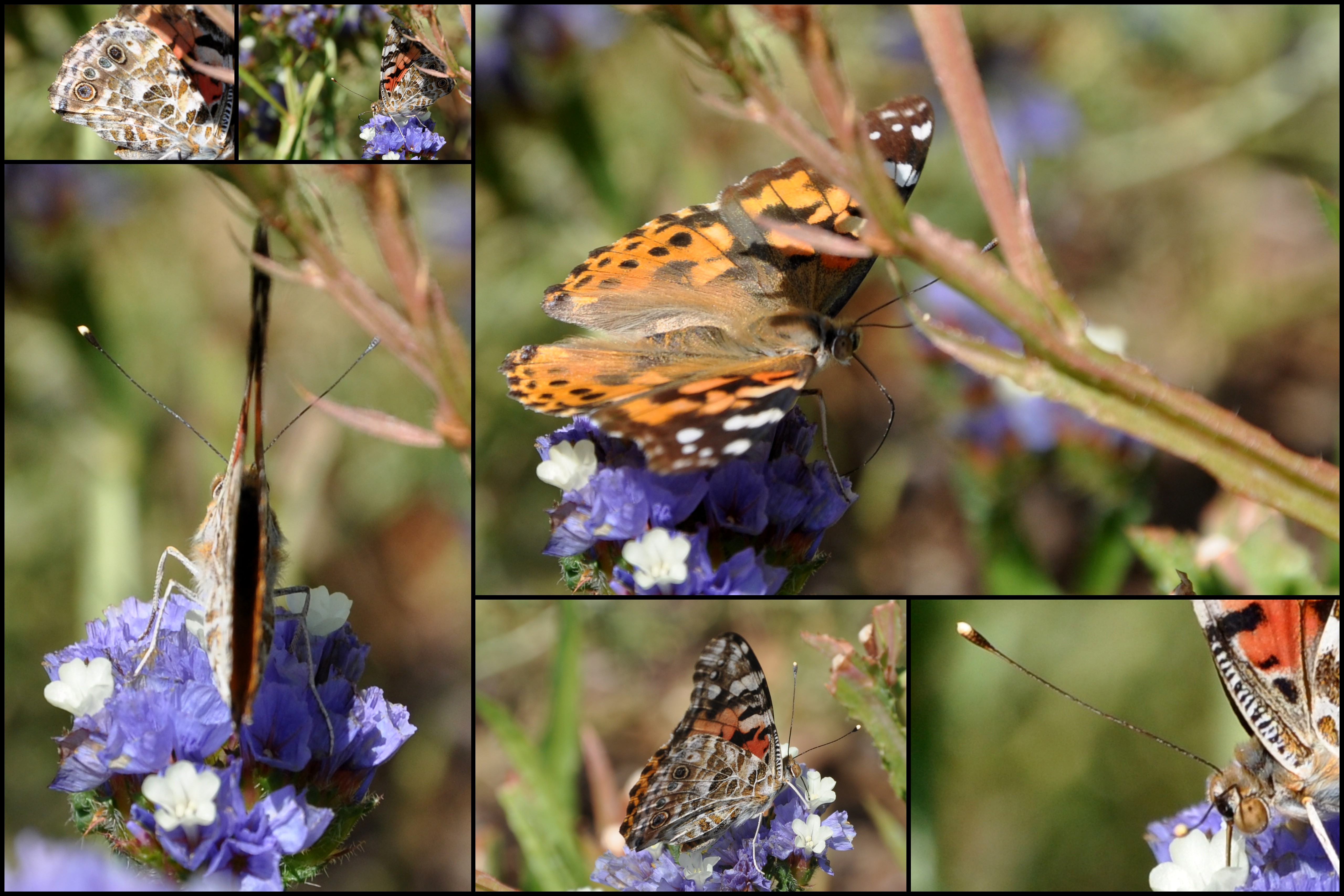
butterfly and statice

Butterfly and Statice

This beauty landed in the flower bed sending me racing indoors to grab my camera. Who doesn’t love a butterfly? When my boys were young, we visited the ‘caterpillar tree’ at our local park. One particular tree would be laden with cocoons. It was a yearly treat.  After a few years we stopped seeing them.

I’ve since learned that in the United States, Monarch butterflies have declined for the last twenty years. In the UK, certain species of butterflies are down by 50%. From an environmental perspective, butterflies are a bit like the canary in the coal mine. They’re extraordinarily sensitive to environmental changes around them and are apparently the most closely watched insect in the world.

I’m glad this special guest found something to eat in my garden.

Further Reading:

Declining Monarch Populations in the US

Habitat restoration efforts in the UK to combat butterfly decline

Nymph: Science vs Mythology

pumpkin turning orange

Pumpkin beginning to turn orange

A mythological nymph is:

a minor female nature deity typically associated with a particular location or land form. Different from goddesses, nymphs are generally regarded as divine spirits who animate nature, and are usually depicted as beautiful, young maidens who love to dance and sing; their amorous freedom sets them apart from the restricted and chaste wives and daughters of the Greek polis. They are believed to dwell in mountains and groves, by springs and rivers, and in trees and in valleys and cool grottoes.

Cool!

Unfortunately, I haven’t seen any of those in the garden. On the other hand, a biological nymph is:

the immature form of some invertebrates, particularly insects, which undergoes gradual metamorphosis (hemimetabolism) before reaching its adult stage.[ Unlike a typical larva, a nymph’s overall form already resembles that of the adult. In addition, while a nymph moults it never enters a pupal stage. Instead, the final moult results in an adult insect.

Oh-oh.

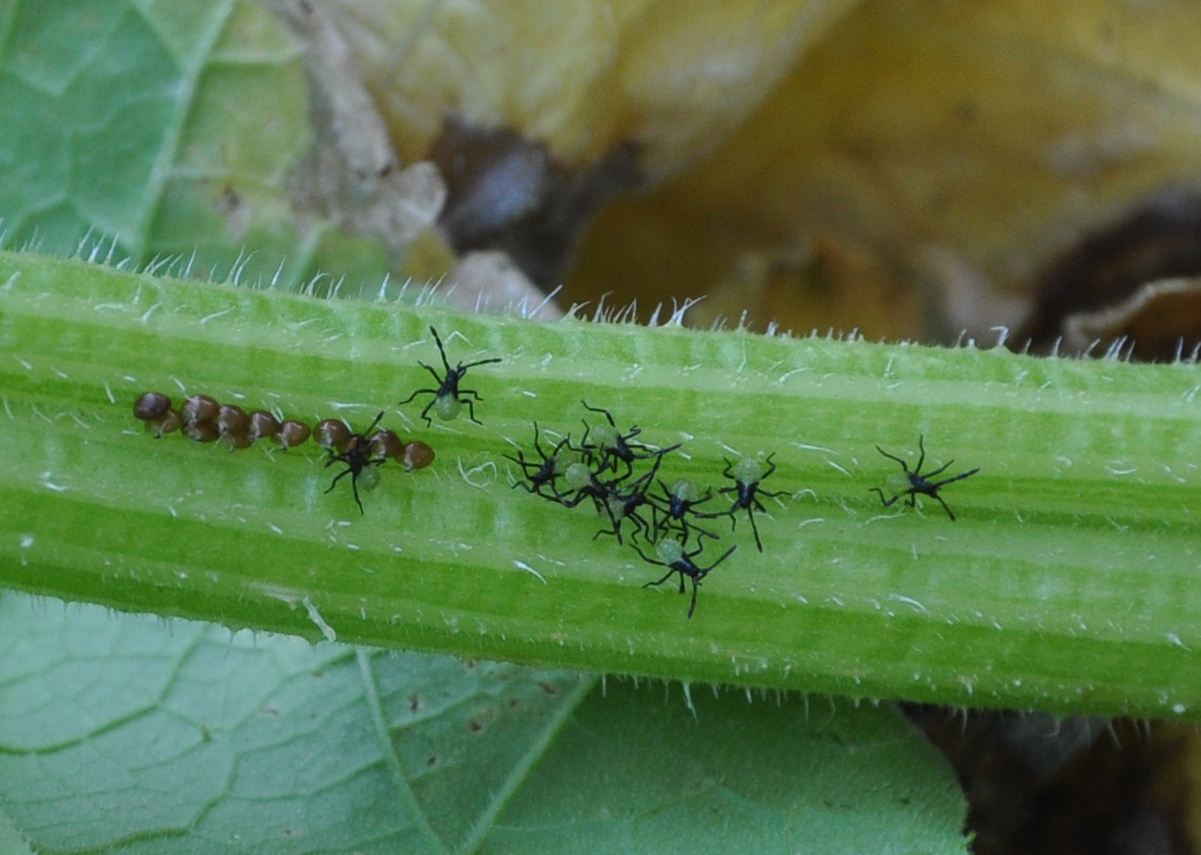
With all my due diligence, I missed a few of the squash bug eggs. The following video tells the rest of the story:

I removed the offending nymphs and even more eggs this morning, but it was impossible to get all of them. I’m going to figure out a way to create a barrier between the pumpkin and the bugs without harming the bees or the plant.  Stay tuned.

Freshly hatched squash nymphs

Freshly hatched squash nymphs

Squash bugs overrun a pumpkin leaf

Squash bugs overrun a pumpkin leaf

removing squash bugs

Squash bugs: off the vine and into the bucket

Mid-Summer Caretaker and the Mighty Seed

By the calendar, it’s mid-summer here in California. Our growing season is longer than most, given our mild climate and rich, agricultural soil. That said, pumpkins and sunflowers adhere to their own cycle and that cycle is coming to an end.

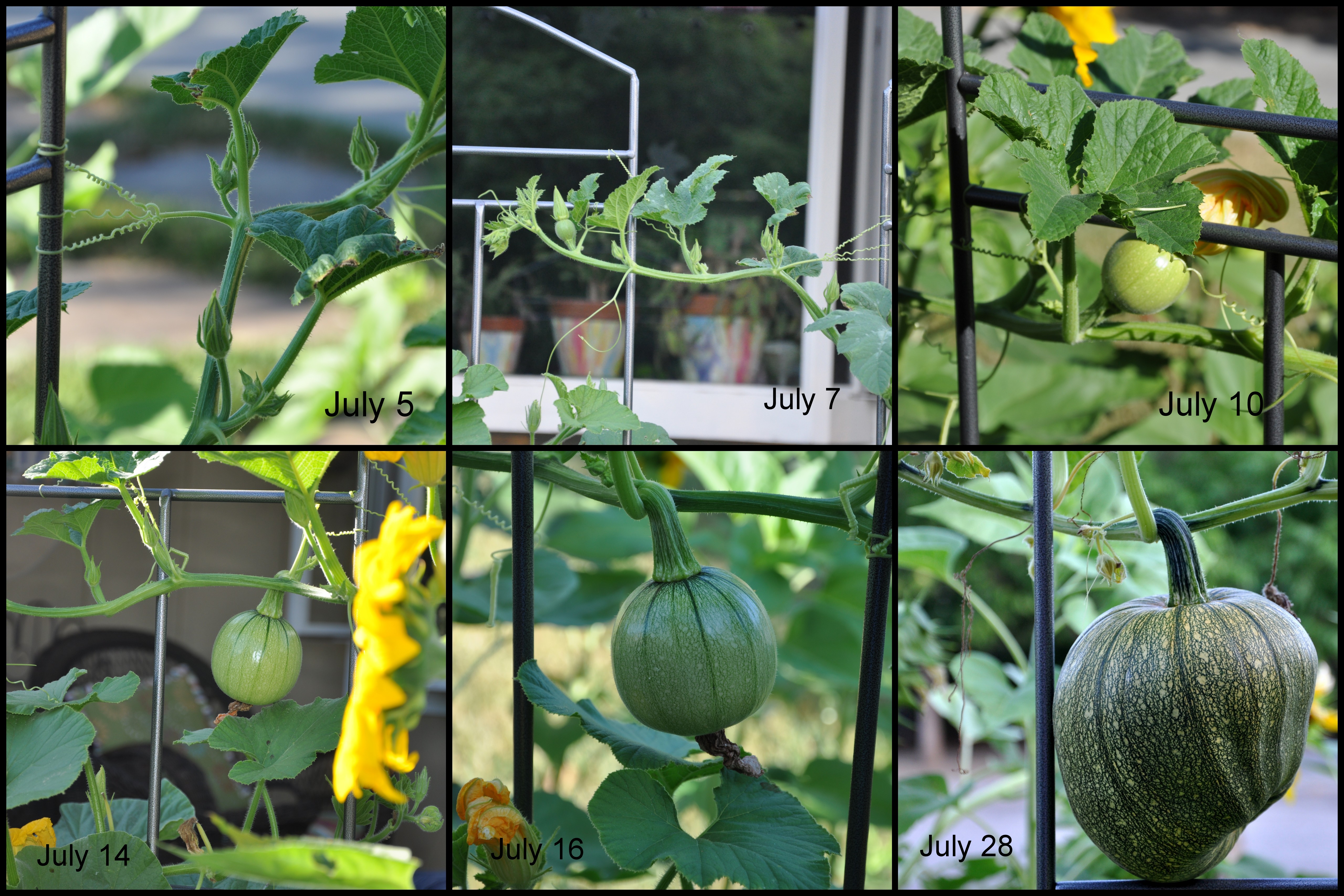
pumpkin progression july 2014

July growth

fading pumpkin vines

Fading vines as all the energy now goes to the fruit

Like many things in life, the anticipation often outranks the reward at the end. It’s the growing that brings so much pleasure. It’s also humbling to realize that much of what’s happening outside these four walls has nothing to do with me.  Nature knows what she’s doing.  While a bit of help from water, fertilizer and nutrient-rich soil is a must, once provided she can take it from there.

sunflowers setting seed

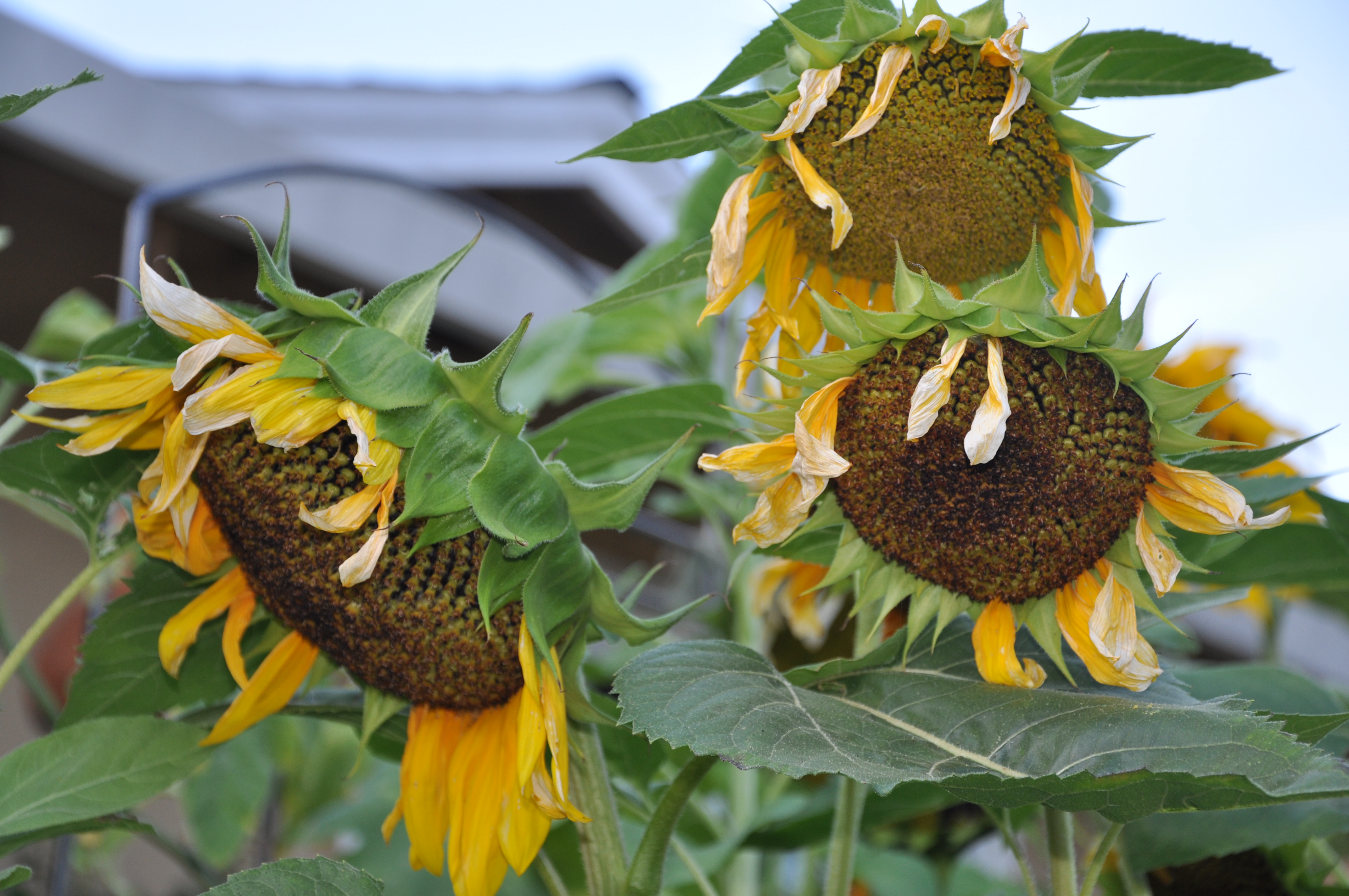
Sunflowers bowing from the weight of the seeds

water on a sunflower

A bit of water pools on the underside of a sunflower

I tend the garden anyway, battling drought conditions, air pollution, nasty bugs and the adorable menace, the western gray squirrel. I’m a caretaker more than anything else.

Squash bug hide and seek

Squash bug hide and seek (we’re still here)

Once you’ve gardened, it’s impossible to feel the same way about the fruits and vegetables that make it to your table.  Something as tiny and unassuming as a seed has all the DNA it needs to know when and where it should grow and for how long.  Helpers, in the form of pollinating bees or seed-scattering birds, also play a role.  I’ve gardened my entire life and I’m still in awe when a seed cracks the earth and a leafy green sprout appears.

According to Boundless Biology:

Seed plants are cultivated for their beauty and smells, as well as their importance in the development of medicines. Plants are also the foundation of human diets across the world . Many societies eat, almost exclusively, vegetarian fare and depend solely on seed plants for their nutritional needs. A few crops (rice, wheat, and potatoes) dominate the agricultural landscape. Many crops were developed during the agricultural revolution when human societies made the transition from nomadic hunter–gatherers to horticulture and agriculture. Cereals, rich in carbohydrates, provide the staple of many human diets. In addition, beans and nuts supply proteins. Fats are derived from crushed seeds, as is the case for peanut and rapeseed (canola) oils, or fruits such as olives.

We live in an amazing world.

The Plot Thickens: A Bit of Garden Humour

Here’s a little garden humour as you ease in to your weekend: My sister sent me this  story a few years ago. It always makes me smile. I don’t know the origins, so I’ll extend thanks to the universe and the anonymous writer of this tongue in cheek tale. Enjoy!

Plotting Tomatoes:

An older gentleman living alone in New Jersey looked forward to planting his annual tomato garden, but it was strenuous work. The ground was simply too hard. His only son Vincent would usually help him but Vincent was in prison. The man wrote a letter to his son describing his predicament.

Dear Vincent,

It looks like I won’t be able to plant my tomato garden this year. I’m just getting too old to be digging up a garden plot. I know if you were here my troubles would be over. I know you would be happy to dig it for me, like in the old days. I’m feeling a little sad. I hope you are well.

Love, Papa

A few days later he received a letter from his son.

Dear Papa,

Don’t dig up that garden. That’s where the bodies are buried.

Love, Vinnie

At 4 a.m. the next morning, FBI agents and local police arrived and dug up the entire area without finding any bodies. They apologized to the man and left. That same day the man received another letter from his son.

Dear Papa,

Go ahead and plant the tomatoes now. That’s the best I could do under the circumstances.

Love you, Vinnie

I hope you’re smiling, too.

DSC_0039

Heirloom Tomatoes: My Garden Darlings

If you’ve been following along, you know that I didn’t plant a single tomato plant this year.  Hard to believe, eh?

Self-seeded or Volunteer Tomatoes

Self-seeded or Volunteer Tomatoes

Last year my friend Doug gave me several varieties of Baker Creek Heirloom tomato seeds. I planted them in my City Picker but they were slow to grow. I hedged my bets with an organic nursery plant and finished off the summer with tomatoes to spare.

This year the heirloom tomatoes self-seeded one box over. Further, a variety of tiny cherry tomatoes flourished out of the bottom of the rotating compost bin.  Two additional plants showed up in the gravel walkway, a larger cherry tomato and another heirloom. What a bounty!

April 9, 2014

April 9, 2014

Tiny Cherry Tomatoes

mini cherry tomatoes

Mini cherry tomatoes

Since a speck of a tomato seed managed to sprout through a crack in the rotating composter, I felt compelled to let it grow. I staked the plant when it showed signs of surviving the season, and eventually it produced small, bright red fruit, just like you see in the grocery store. Of course the problem with most tomatoes from the store isn’t the appearance but the taste. These tiny tomatoes are flavorless. What a disappointment.

Cherry Tomatoes: The Sequel

cherry tomatoes

More cherry tomatoes

At the back of the garden, leaning up against the house, is another volunteer. This one produced larger cherry tomatoes, also a brilliant red. They’re a bit sweeter than the tiny cherry, but again bred for appearance and not flavor.

Baker Heirloom Tomatoes

heirloom tomatoes

Heirloom Tomatoes

Tomato gold! These are the sweetest, juiciest and most prolific tomatoes in the garden.  Honestly, there is no turning back once you’ve tasted them. What luck to have an entire crop of these delicious fruits.  I sliced open several today for seed saving, but plan to do all my vegetable seed purchasing from them in the future. In case you’re interested, check out Rare Seeds Baker Creek Heirloom Seeds.   

From there About page:

The family works extensively to supply free seeds to many of the world’s poorest countries, as well as here at home in school gardens and other educational projects. It is their goal to educate everyone about a better, safer food supply and fight gene-altered, Frankenfood and the companies that support it.

You can also follow them on Facebook.

What to do with all those tomatoes:

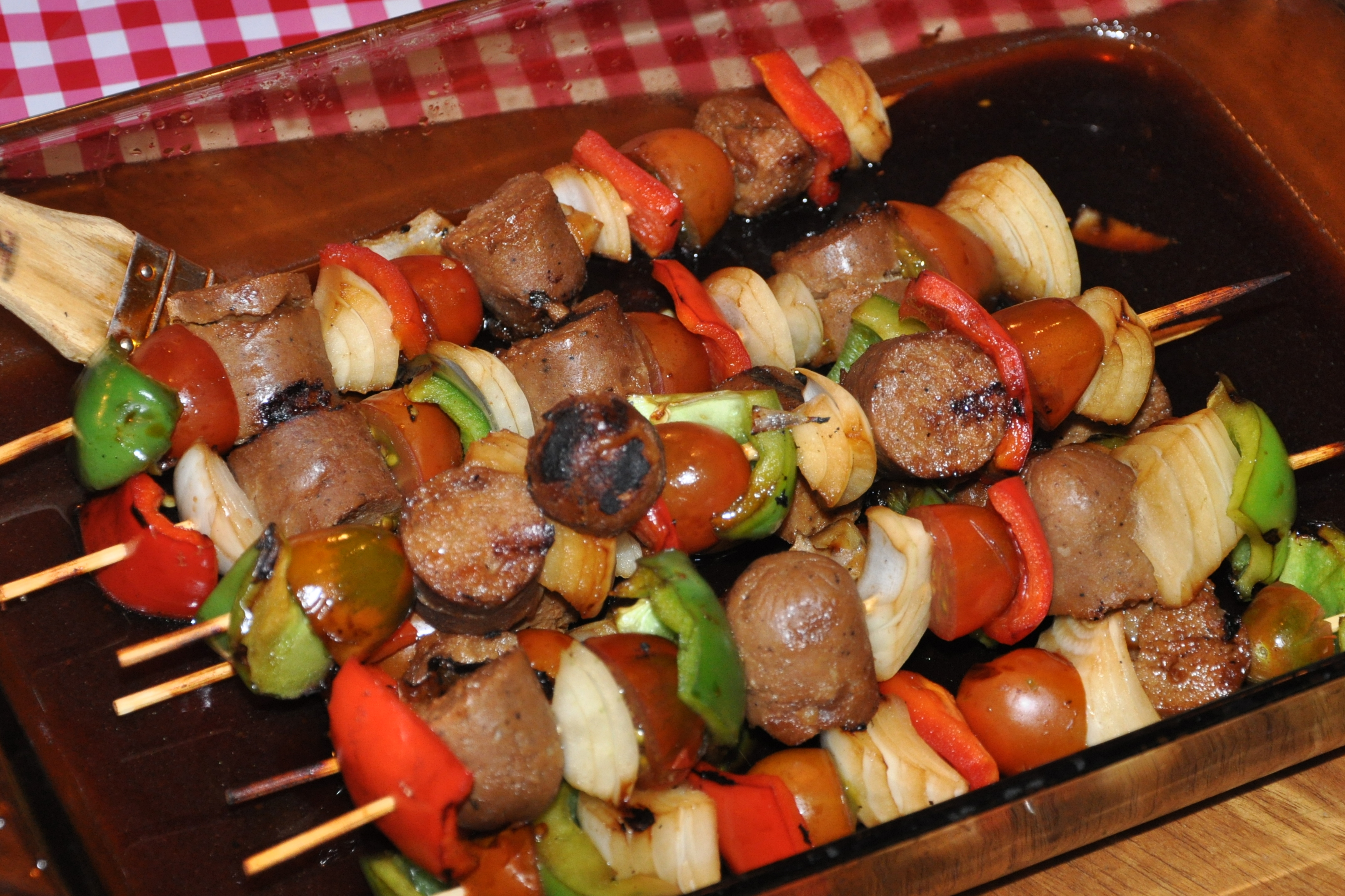
vegan kabobs

Vegan kabobs for the 4th of July

Made with tomatoes, onions, red peppers and vegan Field Roast ‘sausages‘.

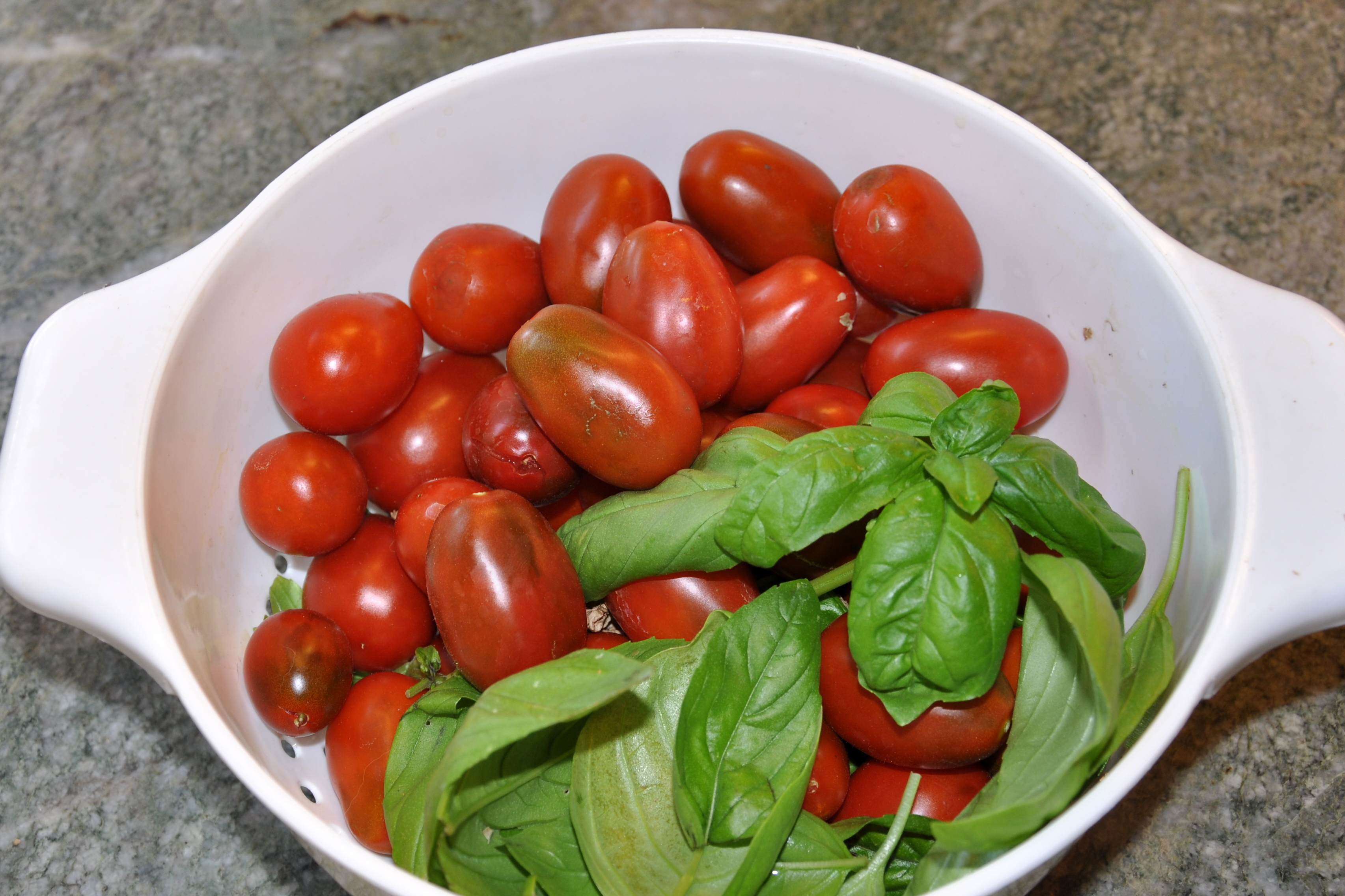
heirloom tomatoes and fresh basil

Fresh basil and tomatoes.

Eat them straight from the bowl.

frozen tomatoes

Freeze them, then turn them into salsa

Sarah the Gardener taught me that not only can you freeze tomatoes, but that the skin falls off of them when they’re thawed. Mike made several batches of tasty salsa. Here’s a similar recipe.

And of course share with anyone who’s interested.

How do you like your tomatoes?

tomato mozzarella basil salad

Tomato, basil mozzarella salad

To Blog, or Not to Blog?

What a silly question!

Today, however, I’ll be blogging in pictures. I’ll spend the time I save not writing, catching up on your thoughtful comments. I read them, love them, and have the best intentions of replying to all of them. Darn that busy life, eh?

I’ll see you shortly in BlogVille.  Meanwhile, here are a few pics from the garden.

It’s the birds…

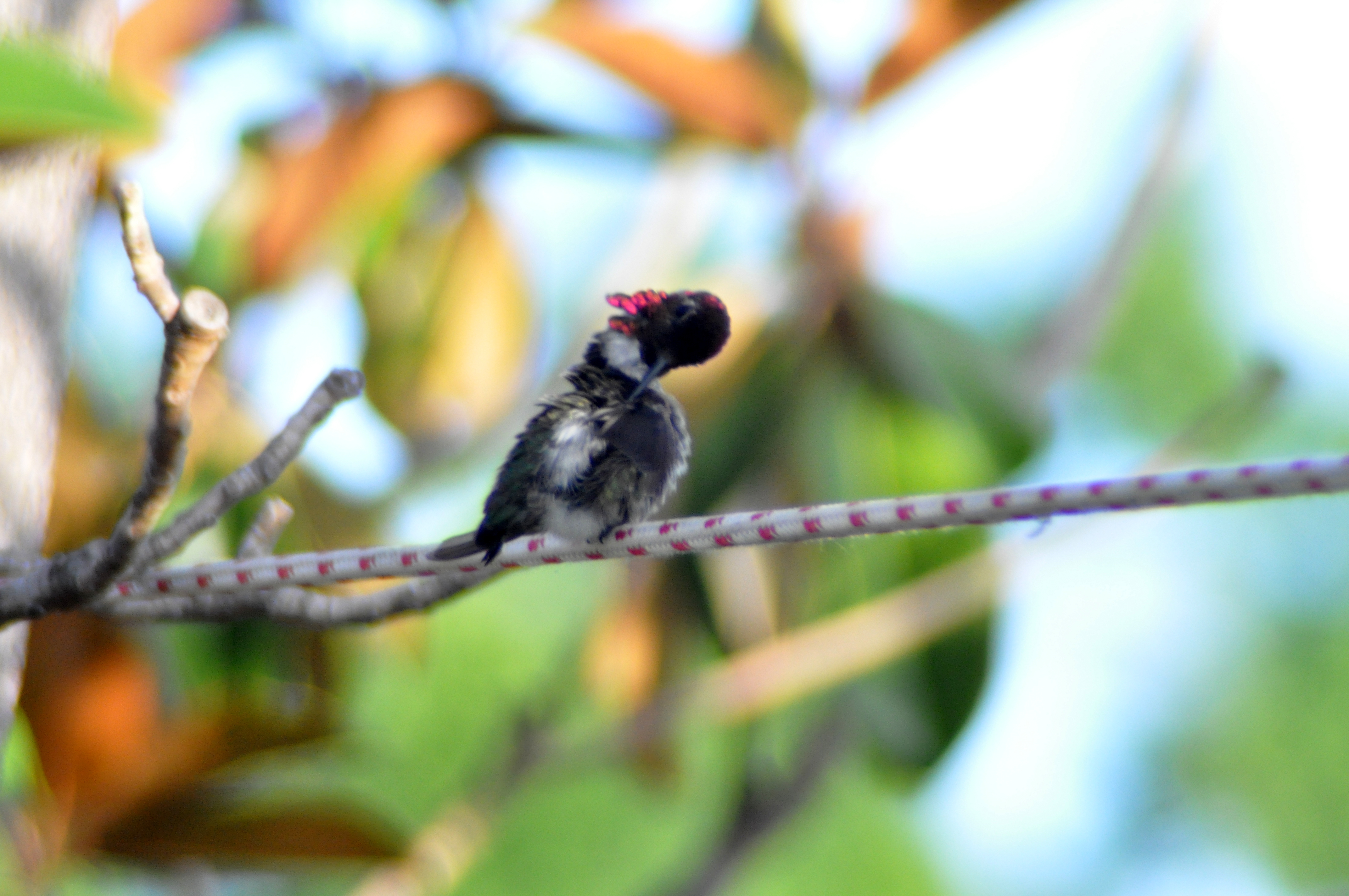
hummingbird grooming

Hummingbird grooming near the magnolia tree

and the bees…

california carpenter bee

California Carpenter Bee

and the flowers…

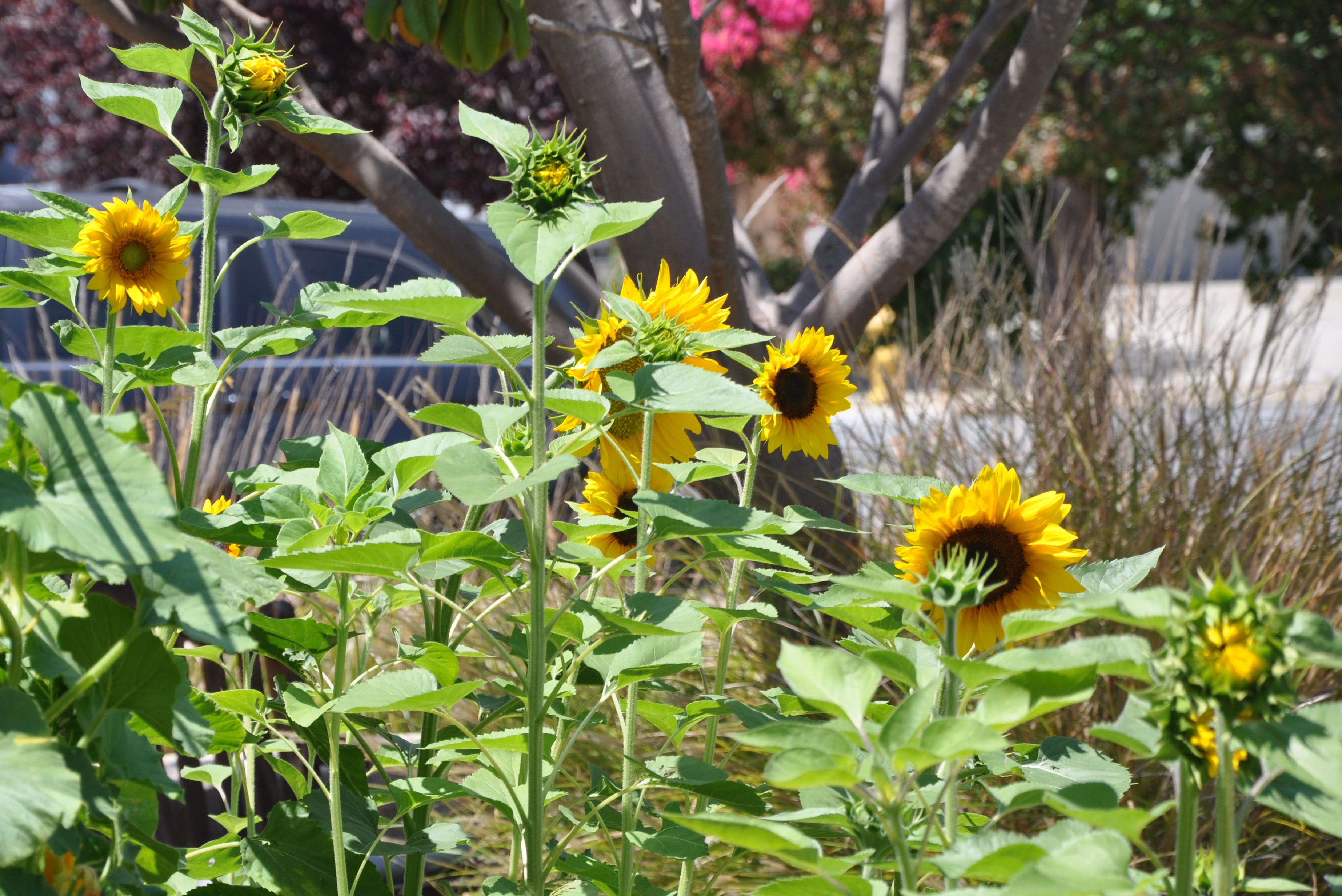
sunflowers

Sunflowers

and the trees.

magnolia with scale

Beautiful Magnolia (not so beautiful scale)

female pumpkin flower

Female Pumpkin Flower

cherry tomatoes, self-seeded

Cherry tomatoes, self-seeded

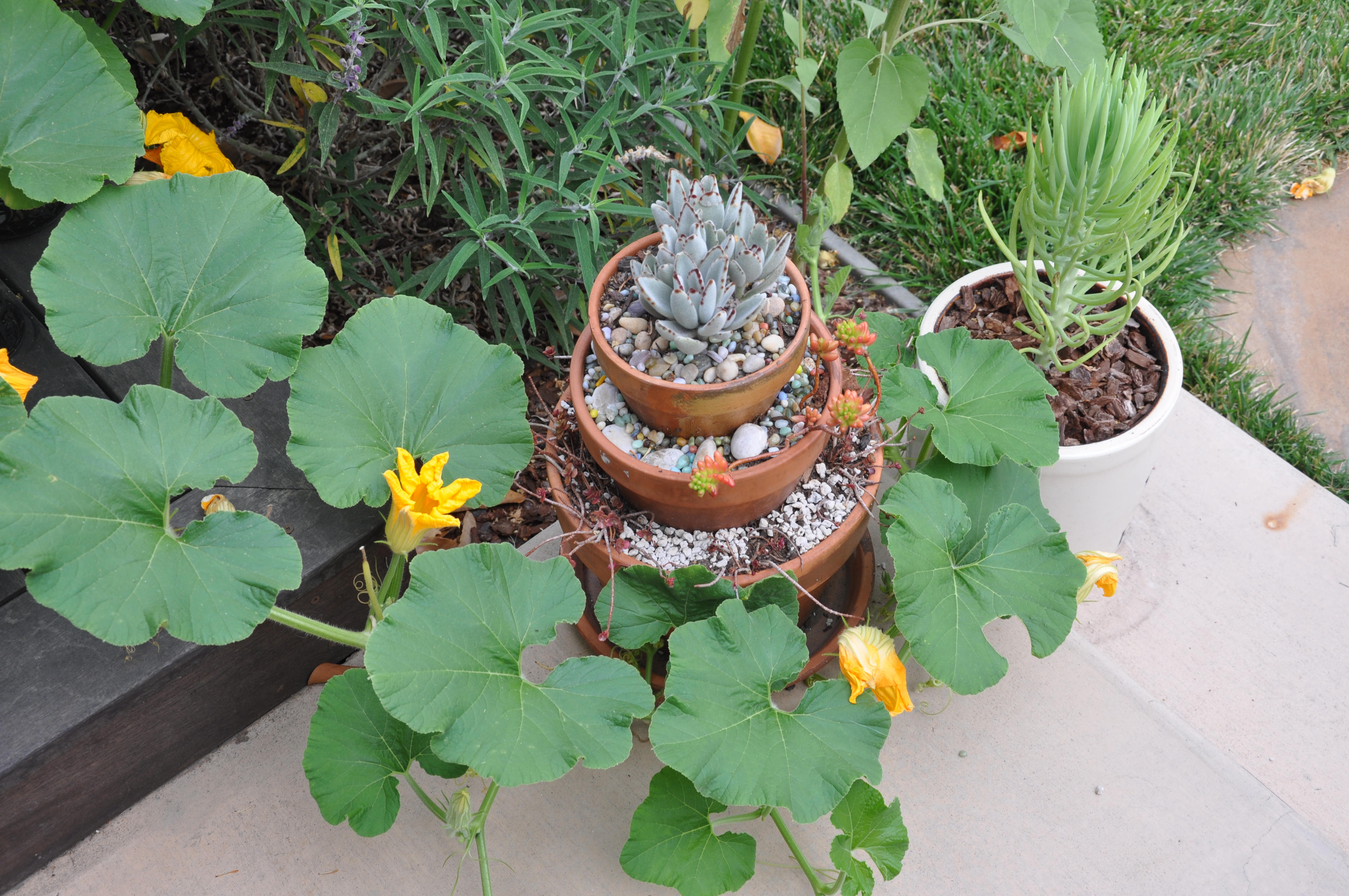
potted succulents and pumpkin vine

Pumpkin vines wrapped around potted succulents

and a thing called [gardening] love.

I Say Potato

harvesting potatoes

Harvesting potatoes

Every family has their cultural staple. We grew up eating potatoes.  My mom baked them, added them to her delicious stew and on the occasional Friday we had what the Brits and Canadians refer to as chips, aka French fries.  Potatoes were  tasty and filling and in my modest culinary repertoire, a fine addition to any meal

Potatoes remain a favorite, even though they’ve fallen from favor as a starch. Brown rice is tasty and so is couscous, but potatoes are my go-to comfort food. I love them.

Still, I didn’t set out to grow them.  For me, part of the fun of gardening is watching things grow. I love the wild trail of a pumpkin, the abundant tomatoes, and a myriad of flowers. Potatoes become potatoes under ground.

I tossed a few sorry-looking potatoes into the compost bin and nature took over. Who knew? Apparently they are pretty easy to grow. The industrious Fran at  The Road to Serendipity  advised me to leave them in place till they flowered.  The plants passed the flowering stage and started producing fruit, which, incidentally, is toxic.

I harvested the lot of them on Sunday and gave the harvest to my sister for her soup. She makes a big batch each week, then takes it for lunch. She’s a good cook with a small appetite so this will last her a week.

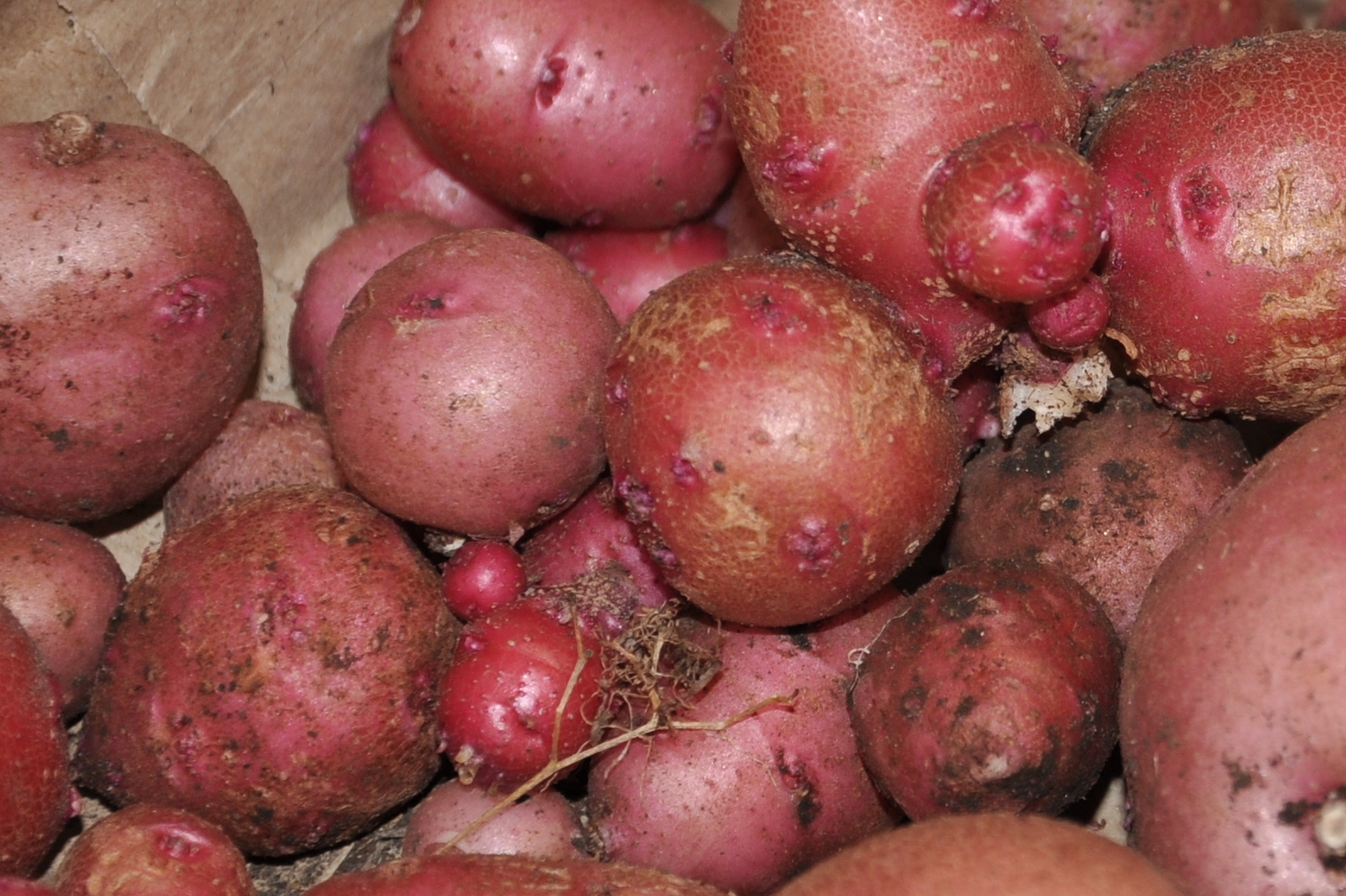
red potatoes

Small but plentiful

You can buy ‘new potatoes’ at the market, so hopefully the tiny potatoes I sent home are equally tender and tasty.  Unlike tomatoes, you can’t take a big bite and know right away if they’re good.

red potato harvest

Sharon’s Harvest

Do you have a favorite starch? Is it one you grew up with or something you discovered along the way?

What I say is that if a man really likes potatoes, he must be a pretty decent sort of fellow.
—A. A. Milne, English writer (1882–1956)

Computer Woes

My trusty laptop gave up the ghost today. It’s been sending subtle and not so subtle signs for weeks. My live in tech support, who also has a day job, tried his best. It seems my hard drive may be in park for good. I’m glad that all my photos automatically back up to Google. Here’s hoping the rest of the backups are in order.

With luck, I’ll be back in business next week. Have a restful, hassle free weekend.

🌱🌺🌺🌺🌺🌺🌺🌺🌺🌺🌺🌺🌱

Smiling Sunflowers

bee and sunflower

Incoming bee

Okay, technically sunflowers don’t smile. The effect is pretty much the same, though.  When I look out my window they’re waving in the breeze, nodding their sunny flower heads and vibrating with bees.  Maybe I’m the one smiling, but either way it’s contagious.

sunflower and yellow bee

Bees move between the sunflowers and the pumpkin vines

The tallest of the sunflowers is my height: 5’10” or 177 cm. It was the first on the scene.  I planted a variety of sunflowers this year, so each one is a bit different. One of the flowers just reaches my knee.

pair of sunflowers

Brothers and sisters

knee high sunflower

Knee high sunflower

Yesterday I gently untangled a few overzealous pumpkin vines, redirecting them back towards the deck. As soon as the sunflowers go to seed, they’ll be overrun by squirrels. I don’t want my furry visitors trampling the pumpkins in their quest. Sunflower stems are sturdy enough to support the heavy seeds. They are not, however meant to withstand the added weight of a squirrel running up and down at snack time.

A little history:

Sunflower (Helianthus annus) is an annual plant native to the Americas. It possesses a large inflorescence (flowering head). The sunflower is named after its huge, fiery blooms, whose shape and image is often used to depict the sun. It has a rough, hairy stem, broad, coarsely toothed, rough leaves and circular heads of flowers. The heads consist of many individual flowers which mature into seeds, often in the hundreds, on a receptacle base. From the Americas, sunflower seeds were brought to Europe in the 16th century, where, along with sunflower oil, they became a widespread cooking ingredient. Leaves of the sunflower can be used as cattle feed, while the stems contain a fibre which may be used in paper production. – Wikipedia

sunflower leaves and bud

Sunflower bud, about a week before it bloomed

opening sunflower

Ready to meet the world

sunflower

Bronze-centered flower

Here’s a story that will leave you smiling like a sunflower:

The Fukushima Sunflower project is now following the lead of Chernobyl, and fields of sunflowers are bursting into bloom across this contaminated area of Japan. Volunteers, farmers, and officials planted the flowers so that they can absorb the radiation that leaked into the soil from the region’s damaged nuclear power plant. There are concerns that the contamination is mainly in the topsoil and that the roots of the flowers are too deep to absorb it. Time will tell whether this project will be a success.

Officials are hoping that the local economy will benefit as much from the project as the environment. They are hoping tourists will come back to the region to admire the sunflower fields. Due to this magnificent flower’s ability to assist in getting rid of nuclear waste, it has become the international symbol of nuclear disarmament.

I’m smiling. How about you?

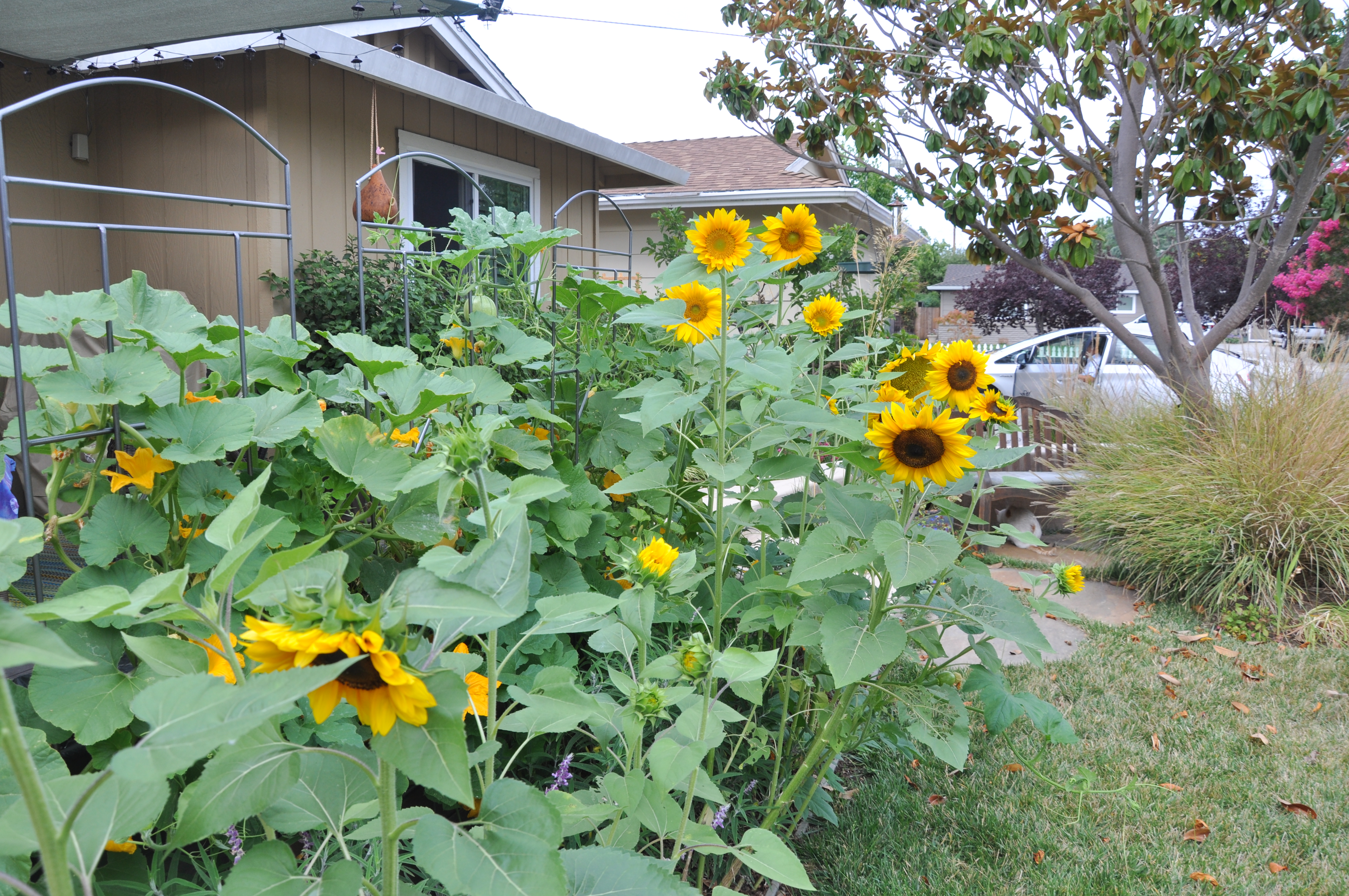
sunflowers near walkway

Sunflowers along the deck

DSC_0117