Cats in the Garden: The Cat Fence-in™ System

Over the years we’ve lost a number of cats to moving cars, Feline AIDS and wanderlust.  Others have endured abscesses from fights and other assorted injuries.  My cat Grant set the record for cats trapped in inappropriate places such as neighboring garages, attics and vacated townhouses.  I bailed him out of the Humane Society three times.   When we tried to convert him to an indoor kitty, he started (and continued) to spray the indoor perimeter of the house.  My husband constructed an outdoor cat run with a cat flap allowing him to come and go through a window, but he remained restless and bored.

One-eyed Estare

Then we discovered The Cat Fence-in System, developed by a company in Las Vegas.  I spent a weekend pruning vines and shrubs away from the fence line while my husband traveled out of country.  When he returned we added lattice to the fence to make it taller and installed the system. Sunday night we let the cats explore the yard so we could test for any flaws.  They tried climbing the fence a few times but were thwarted by the netting.  They quickly settled into a happier life as indoor/outdoor cats.

The system has been in place for nearly 15 years now, without a single escape.  The peace of mind has been such a gift:  No fights, no accidents, no communicable diseases.  It’s also a good-neighbor system:  if someone’s cat is digging up a flower bed or fighting at 2:00 am, I can rest assured it isn’t one of mine.

If you can keep your kitty happy indoors, go for it.  But if you love a rabble-rouser like Grant or a roamer like Estare, this CatFence-in System may by the perfect compromise.

Cat’s in the Garden

A Rare Moment of Togetherness

Sharing a Moment

Fluffy Incognito


Garden Log: August 9, 2011

The Autumnal Equinox is a mere six weeks away and our vegetables are showing signs of late-summer fatigue. We were excited to harvest our robust stalk of corn but knew it was best to harvest within two hours of eating for maximum sweetness.

Early August Harvest

I put a pot on to boil, but sadly we were about a week too late. The corn had already started to dry and was flavorless and tough. We’re hoping for better luck next year.

We love to plant tomatoes and pumpkins with corn as an afterthought.  Next year I think we’ll dedicate one-third of the planting beds to a block of corn to increase the likelihood of success.  This is a great primer on planting corn in small spaces: How to Grow Corn

Squirrel Food?

Tomatoes have been slow to ripen this year, due to moderate heat. We had late season rains, and cooler temps, neither of which seem conducive to their ripening. The plants are covered in green fruit, so we’ll hope for some hot days ahead.

Our sunflowers bloomed, but not before one of them reached the rooftop! It’s over nine feet tall. Magic!

Nine-Foot Sunflower

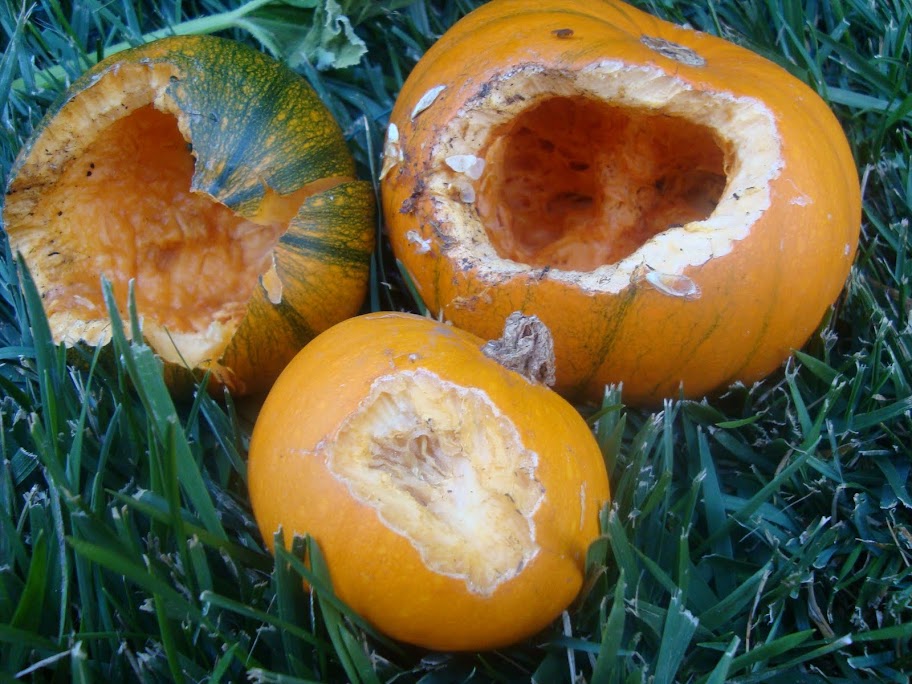
We’ve kept a close eye on our pumpkin crop, fencing off as best we could to discourage squirrels and rats. That said, we’ve noticed a recent onslaught. We harvested a few pumpkins this week after finding several partially eaten fruit. We have two exquisite white pumpkins,our first year planting the (Cotton Candy) variety and several smaller orange ones.

We also planted:

Batman Pumpkins

Dill Atlantic Giant Pumpkins (not!)

Full Moon Giant White Pumpkins

And a few leftover from last year’s carvings.

A handful of pumpkins were left to ripen on the vine. An offering of corn and partially eaten pumpkins rest on the grassy side of the fence to appease the late night snacking crowd.

Show Me Your Teeth

A gardener can dream, can’t she?

YouTube upload: A walk through our vegetable patch: Crunch, crunch, crunch…

Cotton Candy, Lumina or Full Moon Giant

Mr. Cat

Mr. Cat

We lost a feline friend this week, the seemingly immortal Mr. Cat. He was 22. He had a home one block over, but traveled the neighborhood and at some point, adopted us too. He was a scrapper in his youth, regularly picking fights with another male cat, but in his declining years he mellowed. He showed up daily this past year for affection and treats: spoonfuls of baby food chicken.

Mr. Cat slept in the rose bushes, soaking up the sun, and later spent time on the deck, leaning into the wall for support as he absorbed the last of the sun’s rays. He was in terrible shape these past few months, frail and weak.

He was social to the end. He still sought our company and when the petting was good he would purr a unique, rasping, motoring sound deep in his chest. We all knew his days were numbered, but I hoped he would slip away in his sleep, a peaceful end for this scrappy character.

Wishes often don’t come true and death can be unkind. He took a nap on the floor of a neighbor’s garage where she unwittingly ran over his leg. His owner gathered him up as gently as he could and we drove together to the emergency animal hospital. Kitty was in shock with a shattered femur and at 22, surgery was not an option. I watched the family agonize over the decision to peacefully euthanize him. Knowing my affection ran deep, they graciously included me in the process. He died with three pairs of hands holding him and loving him as he eased out of this world.

I’ve caught myself looking for him around corners all day. His “guest bed” remains as a sad reminder that he’s not coming back. Mr. Cat, we miss you. Rest well.

In Memory of Our Cat, Ralph
by Garrison Keillor

When we got home, it was almost dark.
Our neighbor waited on the walk.
“I’m sorry, I have bad news,” he said.
“Your cat, the gray-black one, is dead.
I found him by the garage an hour ago.”
“Thank you,” I said, “for letting us know.”

We dug a hole in the flower bed
With lilac bushes overhead,
Where this cat loved to lie in spring
And roll in dirt and eat the green
Delicious first spring bud,
And laid him down and covered him up,
Wrapped in a piece of tablecloth,
Our good old cat laid in the earth.

We quickly turned and went inside
The empty house and sat and cried
Softly in the dark some tears
For that familiar voice, that fur,
That soft weight missing from our laps,
That we had loved too well perhaps
And mourned from weakness of the heart.
A childish weakness, to regard
An animal whose life is brief
With such affection and such grief.

If such is weakness, so it be.
This modest elegy
Is only meant to note the death
Of one cat so we won’t forget
His face, his name, his gift
Of cat affection while he lived,
The sweet shy nature
Of this graceful creature,
The simple pleasure of himself,
The memory of our cat, Ralph.

Bagby Garden: How Does Your Garden Grow?

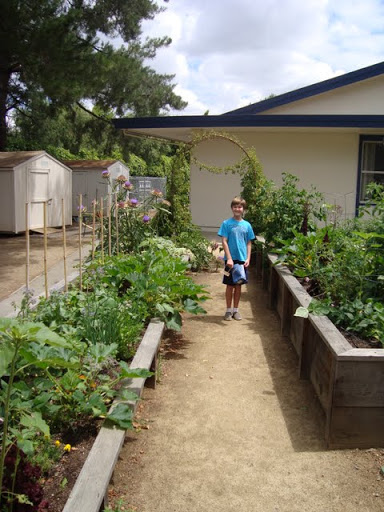
We lucked out with two weeks in the Bagby Garden this summer.  We harvested a few summer squashes but the berries weren’t quite ripe for picking. The greatest treasures, however, always lie in the unexpected: a lizard panting in the sun, bees among the petals of a flower and that earthy, damp smell after an uncommon summer rain.

Bee in the Borage

Latin name: Borago officinalis

Lounging Lizard

This little critter is probably a Western Side-blotched lizard, abundant in the warm, western areas of California.

“A thing is right when it tends to preserve the integrity, stability, and beauty of the biotic community. It is wrong when it tends otherwise.” -Aldo Leopold. A Sand County Almanac. Oxford University Press, 1949.

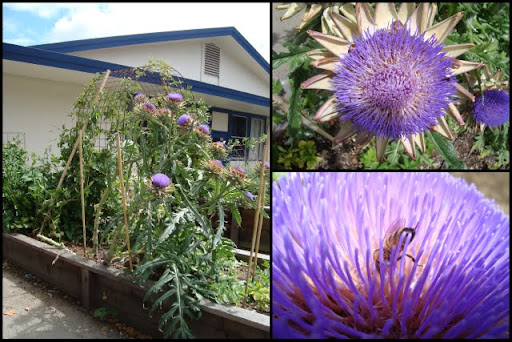
All Out Artichokes

Green Thumb Gardener

Guest Blog: 200 Pounds of Earth

Bob Jenkins

Special thanks to guest blogger and  friend Bob Jenkins, gardener, writer, and story-teller extraordinaire who wrote the inquisitive 200 Pounds of Earth.

Jean Baptista van Helmont (1577-1644) conducted one of the classic experiments in plant growth. Van Helmont describes his experiment:

I took an earthen pot and in it placed 200 pounds of earth which had been dried out in an oven. This I moistened with rain water, and in it planted a shoot of willow which weighed five pounds. When five years had passed the tree which grew from it weighed 169 pounds and about three ounces. The earthen pot was wetted whenever it was necessary with rain or distilled water only. It was very large, and was sunk in the ground, and had a tin-plated iron lid with many holes punched in it, which covered the edge of the pot to keep air-borne dust from mixing with the earth. I did not keep track of the weight of the leaves which fell in each of the four autumns. Finally, I dried out the earth in the pot once more, and found the same 200 pounds, less about 2 ounces. Thus, 164 pounds of wood, bark, and roots had arisen from water alone.”

I first learned about van Helmont’s experiment from Michael Pollan’s collection of essays, Second Nature: A Gardener’s Education. Let’s pause for a moment while you link up to your favorite on-line book vendor and order Second Nature.

OK? Book on order? Let’s get back to the magic.

So, van Helmont grows a 169 pound tree and depletes the soil by only 2 ounces in five years. Suppose he had composted the tree’s fallen leaves, certainly more than 2 ounces, back into the soil. He would have ended up with a 169 pound tree and more soil than he started with!

Doesn’t this violate certain thermodynamic laws, not to mention a couple of pithy sayings, such as “you can’t get something for nothing” or “there’s no such thing as a free tree.” Where did all that mass, that weight, that substance come from? Even if you could remove all the water from the tree, you would still have more stuff than you started with.

This is one of the real “miracles” of gardening. Year after year, you literally take more out of the garden than you put into it.

I actually know where all that extra “stuff” comes from. Do you?

Interested in joining this conversation? Be sure to subscribe to follow on comments, below.

Jail Time for…Gardening?

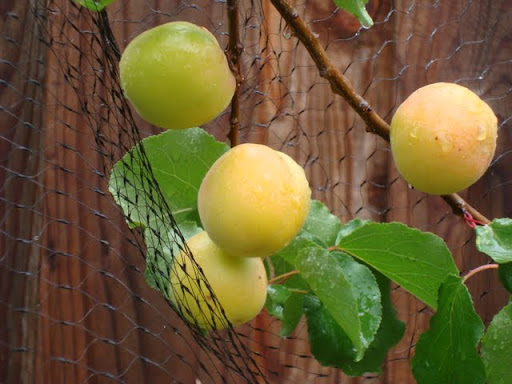
Our neighbors plowed their traditional suburban front yard in anticipation of what’s to come: an entirely edible front garden. Whenever I drive by I smile to myself and look forward to this unique and lovely approach. I learned about fruit cocktail trees from my neighbor, Gwyn, and then bought one last summer for my son’s 10th birthday. In just one year it is laden with four different fruits: plums, peaches, apricots and nectarines. These trees are a boon to folks with postage-stamp sized lots. You can grow a variety of fruits, all on one tree.

One summer we grew our own pumpkins in the front yard, along with sunflowers and a tomato plant. Our backyard is shaded by two neighboring pine trees, beautiful but impractical for growing sun-loving fruits and vegetables.

So imagine my shock when a friend shared this link today:

Michigan Woman Faces Jail Time for Garden

According to the website TakePart: Inspiration to act, “Michigan resident Julie Bass thought the price of organic food in her area was just too high. So she decided to plant a home vegetable garden.

And she thought she’d put it in the front of her house, “so the neighbors could see. The kids love it. The kids from the neighborhood all come and help,” she told MyFox Detroit.

Sounds great, right? Another homeowner trying to break away from the industrial food system by growing her own food? Well, clearly, you haven’t met the code enforcement folks for the city of Oak Park.

“That’s not what we want to see in a front yard,” Oak Park City Planner Kevin Rulkowski told the Fox station.

And so, they want to see this home gardener in court.”

Here is what happened when we planted our vegetable garden out front: Neighbors stopped to talk on a more frequent basis. They asked what we had planted, how the tomatoes were doing and what variety of sunflowers we had planted. The bees stopped by too, a hot commodity for any gardener and a welcome guest. Strangers walking their dogs slowed down to see the ever-changing “landscape” of the garden. Both pumpkins and sunflowers are 100 day crops. From seed to magnificent flower or fruit in three short months. You can almost see them grow day-to-day.

Vegetable gardening isn’t always neat and tidy. Neither, by the way, is life. Just before the pumpkins turn orange, the leaves turn brown, then grey and then and almost ash-white as the plant decays. All the plants energy is now diverted to the fruit. But there is beauty in that cycle, too. Seasons are cyclical and so is life. How is it that a city council can set down such restrictive and out of date guidelines, and worse, set out to enforce them in court.

These guidelines were likely put in place to discourage people from turning a front yard into an unsightly parking lot. For better or worse, what your neighbors do with their property can affect the value of yours. But to say that a vegetable garden, though atypical, creates a prosecutable offense, seems to border on the absurd. It discourages individuality and creativity while robbing the neighborhood of something equally valuable: a sense of community and belonging.

Helianthus: Flowers of the Sun

For Susan J.

There is something so happy and hopeful about sunflowers. We grew our first “crop” quite by accident when my then three-year-old spilled a bag of squirrel food. We scooped up most of it and brushed the rest into the dirt. Nature took over and by summer’s-end we had two tall sunflowers and a few pumpkins, all volunteers from the seed scatter.

I read today that “Campaigners in Japan are asking people to grow sunflowers said to help decontaminate radioactive soil, in response to the Fukushima nuclear disaster that followed March’s massive quake and tsunami.” What a hopeful, practical and wonderful gesture towards a happier, healthier Japan.

According to SunflowerGuide.com “The default direction of the sunflower head is to point east towards sunrise (the location of the sun when it rises over the horizon in the morning.) During the day motor cells in the sunflower stem tilt the flower bud to try to receive a maximum amount of sunlight. By evening, the sunflower head is pointing west, towards sunset (the location of the sun on the horizon just before it is no longer visible.) This causes the sunflower to basically trace a 180 degree arc, tracking the sun’s position throughout the day, from horizon to horizon, sunrise to sunset.

Overnight, the sunflower will reset to its original eastward positioning and wait for the morning, ready to follow the sun’s path once again.

Once blooming however, sunflowers no longer exhibit heliotropic behaviour, and the stem is generally frozen into an eastward-facing position.” Fascinating!

Space for the sunflower, bright with yellow glow, To court the sky. - Caroline Gilman, To the Ursulines

Green Thumbs are Genetic

Dad was a horticulturist by trade; a gardener by hobby. It recently struck me how much he loved both. Because I was so young when he died, I’ve had to work hard at separating the gentleman from the myth, the man versus the legend. I’ve coveted every detail our mother could share until her memory faded with age and dementia. In 1989 I met his sister and my name sake Aunt Alys at her home in Northwood, England, returning with a fistful of photos.

What I’ve learned is this: he was a beloved brother, a generous spouse and a dad who loved his kids. He involved us in his hobbies, took each of his daughters on individual “dates,” and regularly brought home small gifts that he would hide behind his back till you guessed “which hand.” He was also a big tease, finding ways to “steal” your desert when you weren’t looking. He enjoyed photography and home movies and filled them with images of his children, the cats and the garden. He painted with oils with our mother as his muse and taught us what it meant to have compassion and integrity.

One of the most precious gifts our mother gave us was to say “your father would be so proud of you girls.” Daddy, the feeling is mutual.

Eric Milner: Landscape Notebook

Eric Milner: Landscape Notebook

A Method of Growing Grass to Water's Edge

Carport Patio Design

Garden Steps

Planting Tomatoes: A Little Humor

My sister forwarded the following story. It made me smile.

An older gentleman living alone in New Jersey looked forward to planting his annual tomato garden, but it was very difficult work. The ground was simply too hard. His only son Vincent would usually help him but he was in prison. The old man wrote a letter to his son describing his predicament.

Dear Vincent,

It looks like I won’t be able to plant my tomato garden this year. I’m just getting too old to be digging up a garden plot. I know if you were here my troubles would be over. I know you would be happy to dig it for me, like in the old days. I’m feeling a little sad. I hope you are well.

Love, Papa

A Handful of Goodness

A few days later he received a letter from his son.

Dear Papa,

Don’t dig up that garden. That’s where the bodies are buried.

Love, Vinnie

At 4 a.m. the next morning, FBI agents and local police arrived and dug up the entire area without finding any bodies. They apologized to the old man and left. That same day the old man received another letter from his son.

Dear Papa,

Go ahead and plant the tomatoes now. That’s the best I could do under the circumstances.

Love you, Vinnie

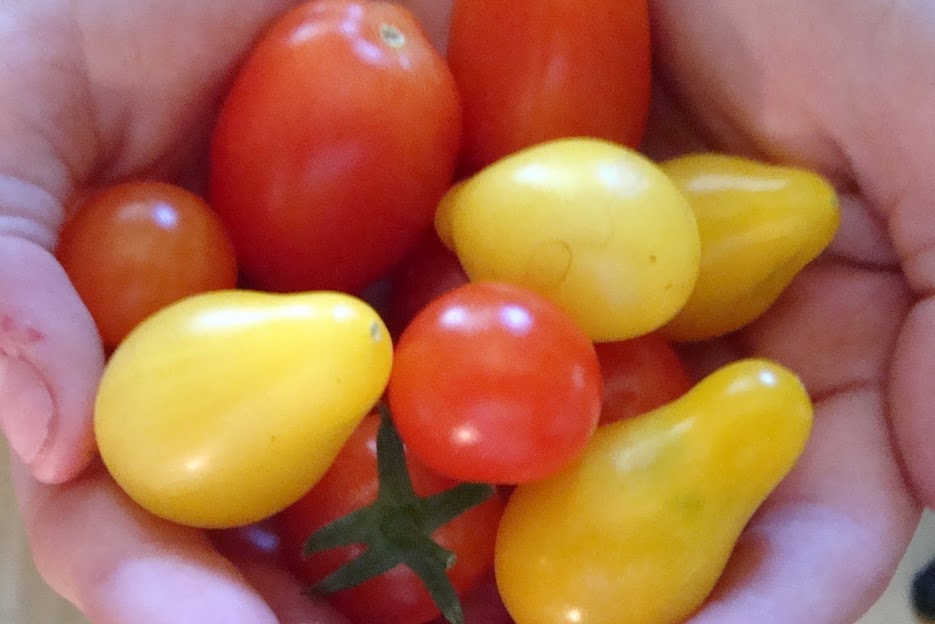
“A world without tomatoes is like a string quartet without violins.” – Laurie Colwin

A Crack in the Fence

Fine arts photographer, Paul Hood recently posted these stunning photos on Facebook entitled “Ten Minutes in the Backyard.”

I love taking photos in my own garden, but only dream of approaching the artistry of his work. With Paul’s permission, for your viewing pleasure:

Secret Garden

Lace

Blooms

Crack in the Fence

Fig Tree


Images used by permission (all rights reserved). Photographer, Writer and Spiritual Counselor, Paul Hood