Blooming Thursday: Around the Garden

Mary, Mary, Quite Contrary, How Does your Garden Grow?

Today’s garden surprise blooms in the side-yard: periwinkle. I bought a flat last summer and planted most of it in a pot on the deck with some annuals.  I envisioned beautiful trails of purple flowers cascading over the edge of the pot.    I stopped watering the pot when the annuals went to seed, assuming the rain would take over.  So much for assumptions; rain has been sparse all season. Then the squirrels began stashing peanuts in the planting mix, digging and scooping mounds of dirt on the deck. By February the neighbor’s cat was napping in the pot and I threw up my hands in defeat.

On my rounds today I discovered a handful of periwinkle plants survived the winter in the children’s garden.  Four tiny plants in bloom, each sporting one purple flower.  Also blooming today: The pink and white azalea, one of the camellias, and the broccoli now in bloom.  Against the backdrop of cool, gray skies I spotted one lone bee at work.  Perhaps tomorrow news will get back to the hive.

“For so work the honey-bees, creatures that by a rule in nature teach the act of order to a peopled kingdom. “~ William Shakespeare

From Benefits of Honey

Camellia Perfection
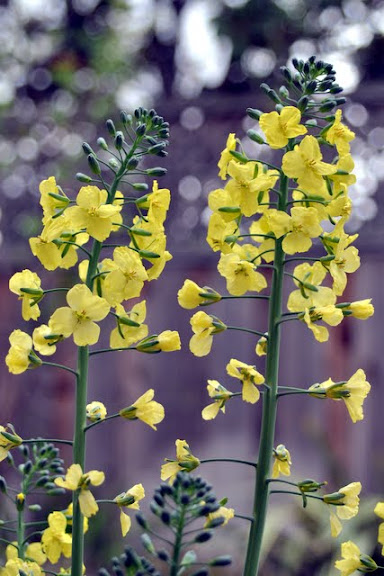
Broccoli Blooms
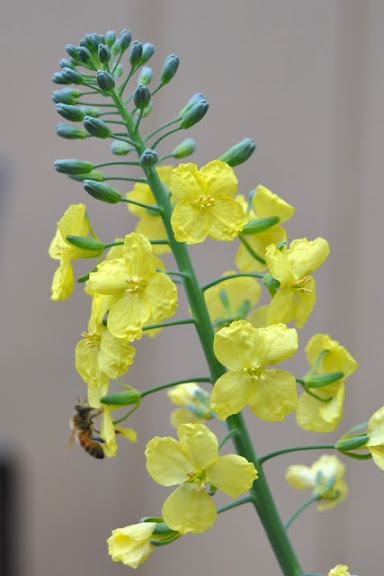
A Welcome Visitor

Periwinkle aka Vinca

Early Azalea
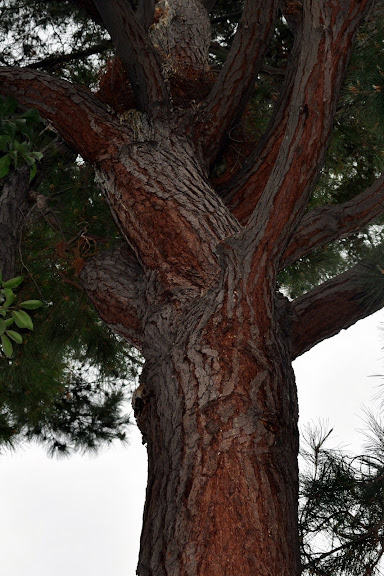
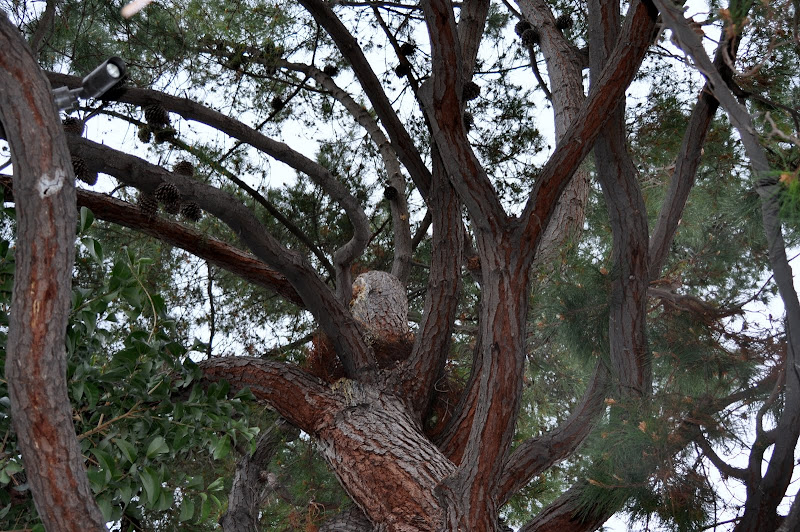
Monterey Pine: A Shave and a Haircut

If trees could talk...

As borrowed landscaping goes, you can’t beat the majesty and grace of a native Monterey Pine. This beauty lives at the fence line of our neighbor’s yard but we share the bounty year round. I’m humbled when I look at a tree this old and grateful that it continues to thrive in our urban setting.  The invasive pitch canker disease threatens to destroy 85% of the native Monterey pine forests by 2015.  According to this article by Linda Boston Franke:

In the last decade, this hearty pine tree species, which adorns west coast beaches, populates coastal mountain sides, accents both urban and rural neighborhoods, and flourishes in Christmas tree farms, has been threatened by a disease known as pitch canker, leaving beloved backyard monuments and entire forests alike scarred with scraggly decaying branches, gaping bare spots, and in many cases with the complete demise of the tree itself.

I’m so happy that “our” tree is still standing.

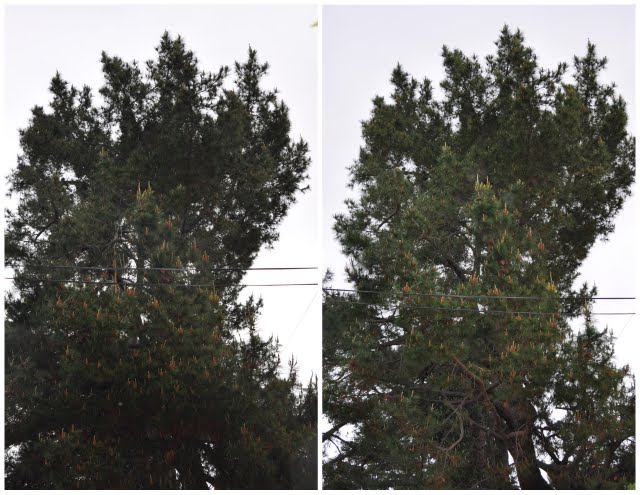
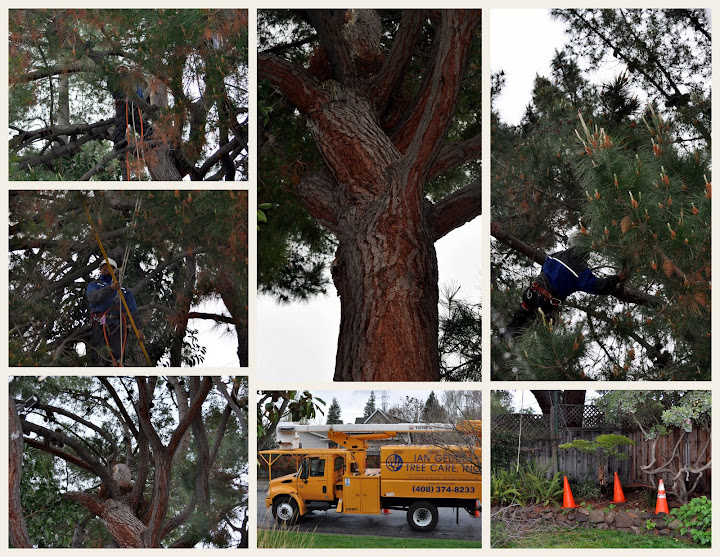
We’ve used the professional services of Ian Geddes Professional Arboriculture for 15 years.  They come out periodically to check on the health of our trees, pruning when necessary.  We were happy to learn last summer that the tree remains in good health.  Geddes team came out today to give the pine a “shave and a haircut” while the temperatures remain cool.  They thinned the inner branches to increase circulation, removed dead branches and tucked back some of the limbs to a safer distance from our homes.

PG&E sends out a crew every two years to trim the tree near the power lines, leaving it looking lopsided with a c-curve carved on one side.  Today’s prune was more aesthetic in nature, not to mention an amazing thing to watch.  Three men, tethered to one of the tallest limbs, scaled the tree and removed dead and crossing branches.  They were sure-footed and agile as they went about their work.  I heard singing from one of the branches, a clear sign in my book that at least one of the men tethered to the tree is doing something he loves.

As for our towering pine, I hope I’m still writing about the squirrel escapades as they circle the trunk, or the wonderful smell of the tree after a rainstorm in the years to come.  We’ve planted our own roots in this neighborhood, and this tree is part of what makes our house a home.

Ian Geddes Tree Crew

More Air Flow to the Tree

Before and After the Trim

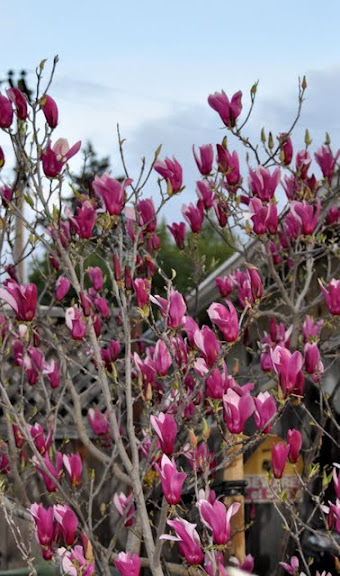
Magnolia Liliiflora, You Make my Heart Sing

Our Beloved Tree

We have two Magnolias in our yard, equally magnificent but unique. The more traditional tree, a grandiflora st. mary  towers over the house and provides shade and shelter for neighborhood birds. It’s also an evergreen so we tend to take if for granted since it’s covered in shiny green leaves year round. It produces huge white blooms, and lemon-sized seed pods.

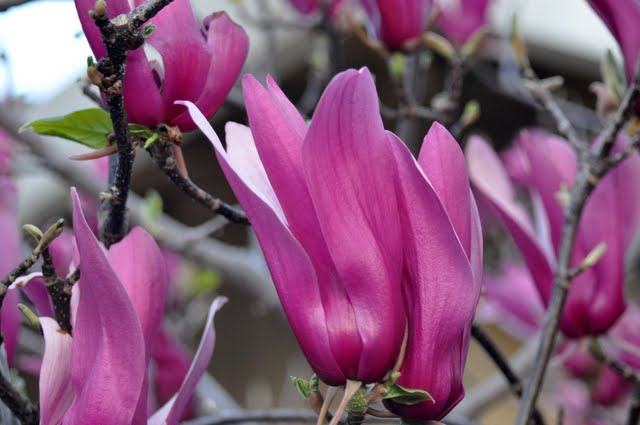
The smaller, more compact Magnolia is only about six feet tall.  It started out in the back yard, where it suffered from a fungus every spring. We transplanted the tree to our front yard where it now happily thrives.  The Tulip Magnolia (magnolia liliiflora) is deciduous.  It starts to wake up in early March with a show of pink and fuchsia, tulip-shaped blooms.

Ah, spring.  All kinds of goodies in store.

Magnolia Bloom

Magnolia Liliiflora

Maple Musings

Close Up

Rain is in the forecast again this week, but I’m trying not to get my hopes up. As we come to the end of this La Niña year, experts predict one of the lowest rainfall seasons recorded for San Jose. Other than a few cold days here and there, it’s been a surprisingly mild winter as well. All this adds up to confusion in the garden.

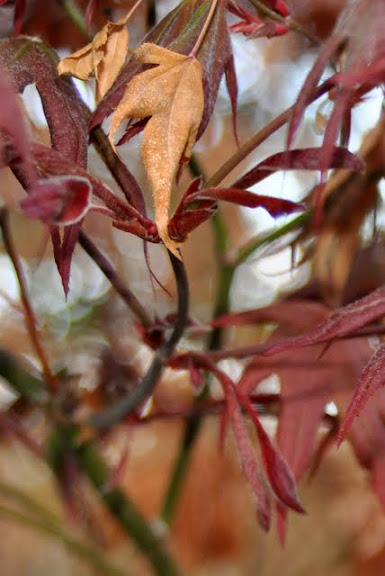
Our beautiful maple tree generally starts dropping leaves in the fall, and after a few good storms, the branches remain bare till spring. Around March, the maple’s internal clock knows to send out buds and shoots and little fruit known as winged samara. In a matter of days the tree dresses in rich, red leaves.

This year, only a few leaves dropped. They turned brown on schedule, but without the rain or wind, the leaves remained. A friend asked if the tree was dead and who could blame her: such odd behavior for a deciduous tree.

It’s been a rough season for allergy sufferers as well. Early blooms from over-stressed trees wreak havoc on sinuses. In my California backyard, one lone maple provides color and shade, but states like Vermont have cause for concern. Trees need cold nights followed by warm days to produce maple syrup.  According to Tim Perkins, director of the University of Vermont Proctor Maple Research Center:

“Sap flows best on warm, sunny days followed by nights that dip below freezing. The fluctuations are key: Cold nights contract air bubbles within the tree, producing suction that draws sap from the ground into the tree, where it mixes with sugar and freezes; warm days thaw the sap and expand the air bubbles, creating pressure that makes the sap flow into buckets or tubing, said Tim Perkins, director of the University of Vermont Proctor Maple Research Center, who has studied climate change’s impact on the maple industry.

Perkins predicts that climate change over roughly the next hundred years will result in the loss of maple trees across much of New England, according to congressional testimony he offered in 2007.”

As I muse on our lone maple tree within our suburban setting, I’m intrigued at the parallels on a grander scale, and what it means for us all. I’m worried.

The Old and the New

Scrapbooking Retreat: A Page from the Garden

Storybook Creator Garden Page

Twice a year I attend a weekend retreat not far from Apple headquarters, where I pursue my love of scrap-booking. Tucked into a cozy conference room with 16 like-minded, creative, and uniquely wonderful women, I pursue my craft. Pam and Staci, the Creative Memories consultants who put together this retreat, take care of all our basic needs: meals, snacks and caffeinated beverages. This is the first year I’ve left my clever tools and colorful papers at home so I could dedicate my energies to learning Storybook Creator 4.0, the latest in digital scrap-booking from CM.

I wish I could say it was all smooth sailing, but like most endeavors involving a computer, I did my share of hand wringing along the way. Of course the weekend isn’t just about crafting. Like a modern-day quilting bee, the women in Meeting Room “A” laugh and share stories of love and courage, strength and loss and the inevitable changes of life. I’ve learned Pixels2Pages and the spirit of camaraderie, the intricacies of 4.0 and the importance of a softly closed door. I marvel at the stereotype of the “weaker sex” as I’ve shared meals and space with this powerhouse group of “croppers,” a sharing, caring group of women who’ve got my back.

What does all this have to do with gardening? Just this: on the darkest of days, my life blooms with sisterhood. With gratitude to the female posse that helps me grow.

A (Laundry) Room with a View

Lindy-Lu Enjoys the View

For most of my adult life I lived in rented apartments. Dingy laundry rooms and laundromats were the norm. I once spent an hour with a police officer outside a Santa Rosa laundromat trying to reason with the woman who stole an entire dryer-full of my clothes. I managed to get everything back.

In 1996, my husband and I bought a house together with a washer and dryer hook-up in the garage. I figured life couldn’t get better than that.  Sure, we had rats and cockroaches out there, and it got pretty hot mid-July, but I didn’t have to leave home to make clothes clean. Life was good.

When we remodeled our house seven years ago, the architect suggested an indoor laundry room as part of the expansion and my heart did a little dance. It would be a laundry room with a view! Our small-lot house is a mere five feet from the neighbor’s fence, but oh the possibilities. The windowed door looks out on three glorious vines, Hardenbergia and two Star Jasmine. Cyclamen grow along the side of the house and Baby Tears have infiltrated the walkway, their tiny leaves tucked in close to the stone.  The greenery keeps me company as I wash, dry and fold for my family of four, an earthy reminder of the bounty of life’s gifts.

The Gardener: “I’ve tried to remember everything you taught me about beauty…”

The Gardener: by Sarah Stewart, Illustrated by David Small

We treasured books in the home I grew up in, and that tradition lives on in my home today.  One of the greatest joys when my boys were young was the time we spent snuggling and reading.  We punctuated our weeks with trips to the library, weekly storytelling at our local Barnes and Noble and the occasional author reading at the eclectic, one-of-a-kind Hicklebee’s children’s book store in Willow Glen.  I can say without exaggeration that I’ve read thousands of pages of kid lit: the good, the great and the regrettable.

From those piles of books, emerged one of  my all-time favorites: The Gardener by Sarah Stewart.

I remember the day I pulled it off the shelf, delighted to find a beautifully illustrated book that wasn’t about trains or bunnies.  I stood skimming it, then sat down on the floor so I could give it my full attention. I knew I was holding something special.  My little one was enjoying his own book selection, so I was free to savor every page. What I found was an incredibly moving, poignant, and hopeful book with joy on every page.  The illustrations, by award-winning artist David Small are lovingly rendered with charming details tucked into the corners of each page.  This review sums it up beautifully:

“A moving, wonderfully rich illustrated story. It is that rarity, a pictorial delight that in 20 double pages gives more and more of itself each time it’s read, and whose silent complexities reveal themselves with continuing pleasure.” —The New York Times Book Review

You needn’t be a child or a gardener to appreciate this gem.  Go flop down on some cushions somewhere and give it a read. You’ll be glad you did.

Blooming Thursday: Star Jasmine

Ready to Burst

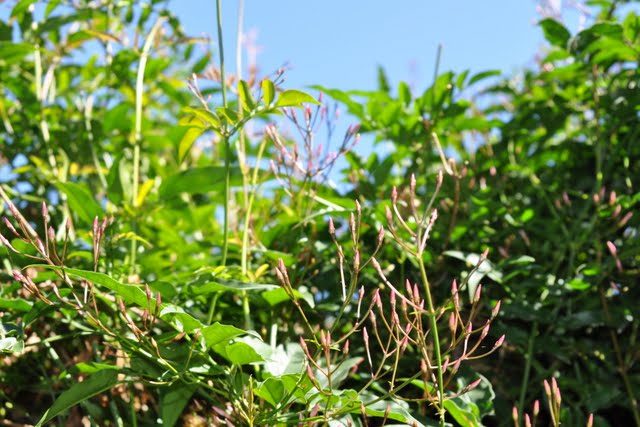
At the corner of our house, between two suburban lots lives the harbinger of spring: that heady, scented, intoxicating bloom star jasmine.

Against clear blue skies, the contrast of buds at the ready, the plant will burst into bloom any day. When it does, I’ll find myself lingering by the drive, taking in the scent and savoring it for as long as possible. Jasmine evokes the approach of summer. It puts a bounce in my step. I feel alive, connected and even amorous when it blooms.

Is it any wonder they’ve tried to bottle and sell it?

Beautiful Pinks against the Blue Sky

Tomorrow's Blooms

Lions and Tigers and Bears, Oh My!

March Haiku

March Winds

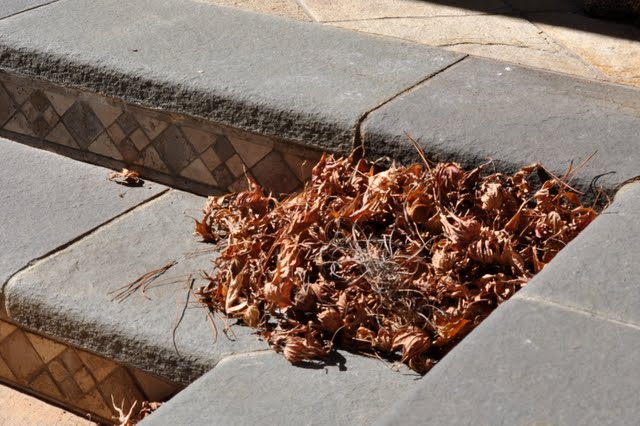
March winds fiercely blew.
Leaves gathered on the doorstep
I don’t need a rake!

Icy Water

Icy water flows,
fallen leaves how you vex me.
Mold in one hour.

Visiting Feline

Visiting feline
graces our garden each day.
Does your mama know?

Neighborhood Squirrel

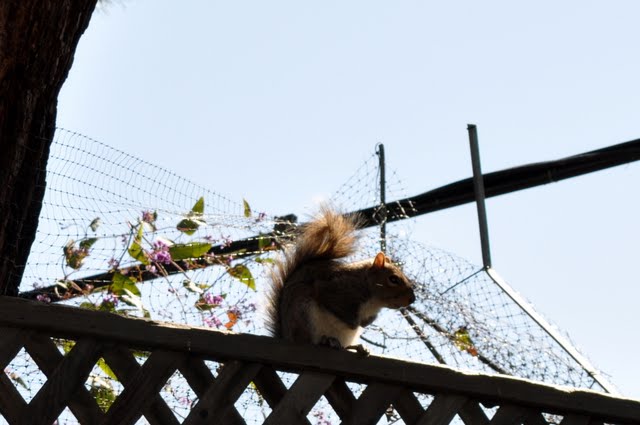
Neighborhood tree squirrel
amassing a trove of nuts,
please spare my new lawn.

Hardenbergia

Hardenbergia
Monosyllabic flower
you’re one-third haiku.

You can learn more about the origins of the ancient Japanese poetry style Haiku here.

How to write a Haiku poem from Creative Writing Now.

About the Haiku Master From Wikipedia:

Matsuo Bashō (松尾 芭蕉?, 1644 – November 28, 1694), born Matsuo Kinsaku (松尾 金作?), then Matsuo Chūemon Munafusa (松尾 忠右衛門 宗房?),[1][2] was the most famous poet of the Edo period in Japan. During his lifetime, Bashō was recognized for his works in the collaborative haikai no renga form; today, after centuries of commentary, he is recognized as a master of brief and clear haiku. His poetry is internationally renowned, and within Japan many of his poems are reproduced on monuments and traditional sites.

Spider Plant Sprawl

Spider Plant Sprawl

One by one, the root-bound spider plants relocated to the fence line.  We jokingly refer to that area of the garden as the back-forty.  It’s also where big, hairy spiders go, so they can do their garden business without scaring me on my daily rounds.

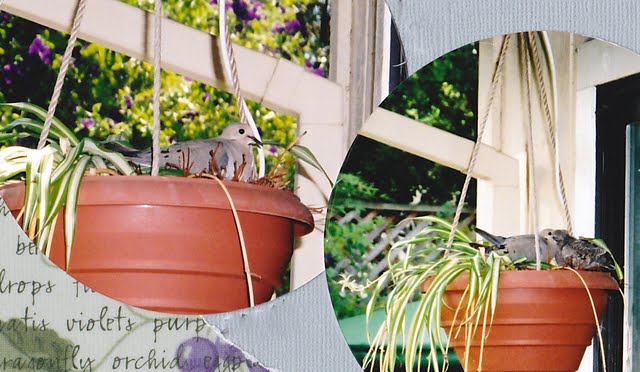
The back-forty is a transitional home for plants who’ve outgrown their pots but don’t currently have a good place to go.  One of the potted spider plants sheltered a nest of mourning doves one year.  Eventually the pot was too crowded for a nest or a plant. Time to visit the back-forty.  Sometimes I empty a bit of soil left in a pot, and a forgotten bulb rolls out.  I give it a toss into the mix  and carry on with my gardening chores.  It’s every plant for herself back there: find a place to put down your roots, or move over for the next plant.  Since nothing that we’ve purposefully planted under the pine tree lives for very long, I’m hoping my stealth plan takes root.

Two spider plants and an asparagus fern have been up to the challenge so far.  The acidic soil and shade agrees with them and they seem impervious to a steady shower of pine-needles.  At the rate they are multiplying, the back-forty relocation plan is looking like a success. Gardeners know that hope springs eternal or perhaps it’s spring that brings eternal hope.

Asparagus Fern Spider Plant Tango

Mourning Doves