Maple Musings

Close Up

Rain is in the forecast again this week, but I’m trying not to get my hopes up. As we come to the end of this La Niña year, experts predict one of the lowest rainfall seasons recorded for San Jose. Other than a few cold days here and there, it’s been a surprisingly mild winter as well. All this adds up to confusion in the garden.

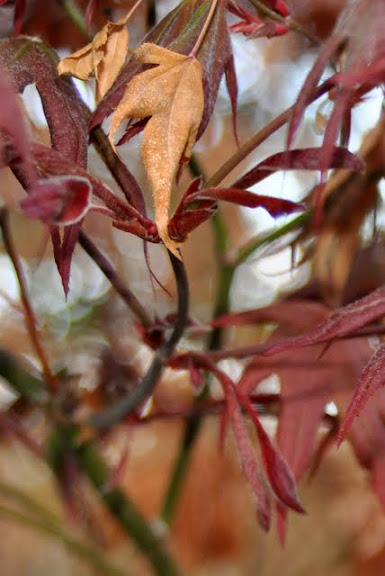
Our beautiful maple tree generally starts dropping leaves in the fall, and after a few good storms, the branches remain bare till spring. Around March, the maple’s internal clock knows to send out buds and shoots and little fruit known as winged samara. In a matter of days the tree dresses in rich, red leaves.

This year, only a few leaves dropped. They turned brown on schedule, but without the rain or wind, the leaves remained. A friend asked if the tree was dead and who could blame her: such odd behavior for a deciduous tree.

It’s been a rough season for allergy sufferers as well. Early blooms from over-stressed trees wreak havoc on sinuses. In my California backyard, one lone maple provides color and shade, but states like Vermont have cause for concern. Trees need cold nights followed by warm days to produce maple syrup.  According to Tim Perkins, director of the University of Vermont Proctor Maple Research Center:

“Sap flows best on warm, sunny days followed by nights that dip below freezing. The fluctuations are key: Cold nights contract air bubbles within the tree, producing suction that draws sap from the ground into the tree, where it mixes with sugar and freezes; warm days thaw the sap and expand the air bubbles, creating pressure that makes the sap flow into buckets or tubing, said Tim Perkins, director of the University of Vermont Proctor Maple Research Center, who has studied climate change’s impact on the maple industry.

Perkins predicts that climate change over roughly the next hundred years will result in the loss of maple trees across much of New England, according to congressional testimony he offered in 2007.”

As I muse on our lone maple tree within our suburban setting, I’m intrigued at the parallels on a grander scale, and what it means for us all. I’m worried.

The Old and the New

A (Laundry) Room with a View

Lindy-Lu Enjoys the View

For most of my adult life I lived in rented apartments. Dingy laundry rooms and laundromats were the norm. I once spent an hour with a police officer outside a Santa Rosa laundromat trying to reason with the woman who stole an entire dryer-full of my clothes. I managed to get everything back.

In 1996, my husband and I bought a house together with a washer and dryer hook-up in the garage. I figured life couldn’t get better than that.  Sure, we had rats and cockroaches out there, and it got pretty hot mid-July, but I didn’t have to leave home to make clothes clean. Life was good.

When we remodeled our house seven years ago, the architect suggested an indoor laundry room as part of the expansion and my heart did a little dance. It would be a laundry room with a view! Our small-lot house is a mere five feet from the neighbor’s fence, but oh the possibilities. The windowed door looks out on three glorious vines, Hardenbergia and two Star Jasmine. Cyclamen grow along the side of the house and Baby Tears have infiltrated the walkway, their tiny leaves tucked in close to the stone.  The greenery keeps me company as I wash, dry and fold for my family of four, an earthy reminder of the bounty of life’s gifts.

Blooming Thursday: Star Jasmine

Ready to Burst

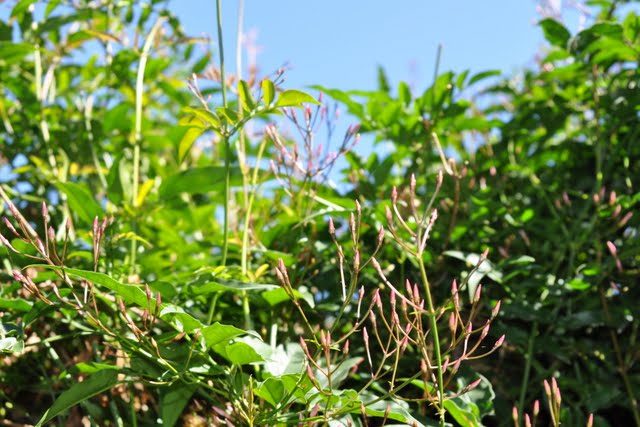
At the corner of our house, between two suburban lots lives the harbinger of spring: that heady, scented, intoxicating bloom star jasmine.

Against clear blue skies, the contrast of buds at the ready, the plant will burst into bloom any day. When it does, I’ll find myself lingering by the drive, taking in the scent and savoring it for as long as possible. Jasmine evokes the approach of summer. It puts a bounce in my step. I feel alive, connected and even amorous when it blooms.

Is it any wonder they’ve tried to bottle and sell it?

Beautiful Pinks against the Blue Sky

Tomorrow's Blooms

Lions and Tigers and Bears, Oh My!

March Haiku

March Winds

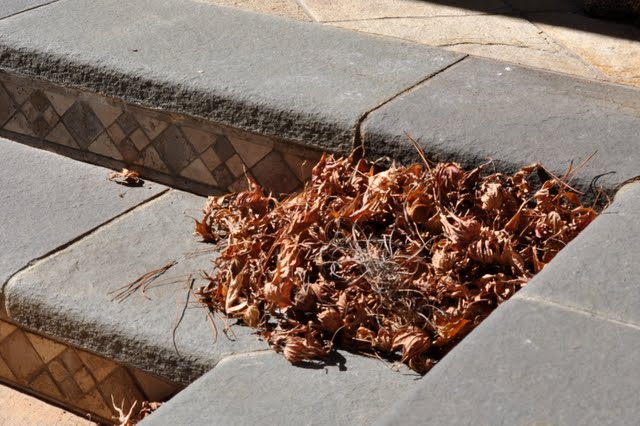
March winds fiercely blew.
Leaves gathered on the doorstep
I don’t need a rake!

Icy Water

Icy water flows,
fallen leaves how you vex me.
Mold in one hour.

Visiting Feline

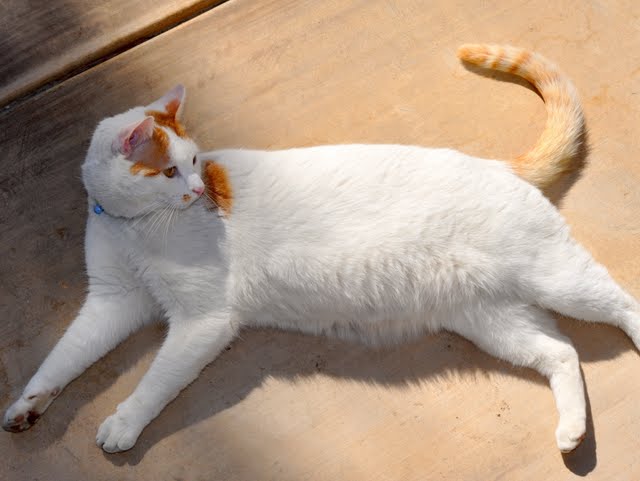
Visiting feline
graces our garden each day.
Does your mama know?

Neighborhood Squirrel

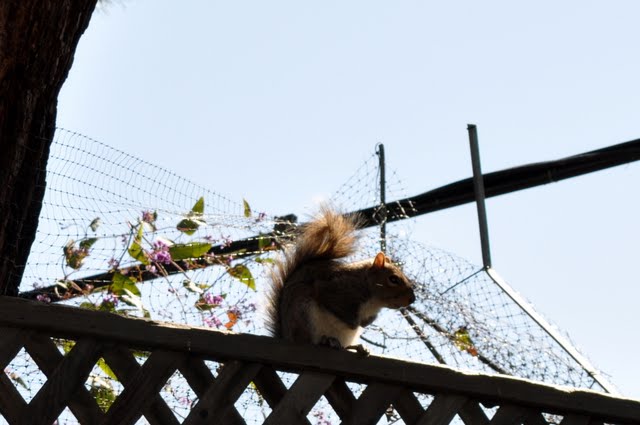
Neighborhood tree squirrel
amassing a trove of nuts,
please spare my new lawn.

Hardenbergia

Hardenbergia
Monosyllabic flower
you’re one-third haiku.

You can learn more about the origins of the ancient Japanese poetry style Haiku here.

How to write a Haiku poem from Creative Writing Now.

About the Haiku Master From Wikipedia:

Matsuo Bashō (松尾 芭蕉?, 1644 – November 28, 1694), born Matsuo Kinsaku (松尾 金作?), then Matsuo Chūemon Munafusa (松尾 忠右衛門 宗房?),[1][2] was the most famous poet of the Edo period in Japan. During his lifetime, Bashō was recognized for his works in the collaborative haikai no renga form; today, after centuries of commentary, he is recognized as a master of brief and clear haiku. His poetry is internationally renowned, and within Japan many of his poems are reproduced on monuments and traditional sites.

Spider Plant Sprawl

Spider Plant Sprawl

One by one, the root-bound spider plants relocated to the fence line.  We jokingly refer to that area of the garden as the back-forty.  It’s also where big, hairy spiders go, so they can do their garden business without scaring me on my daily rounds.

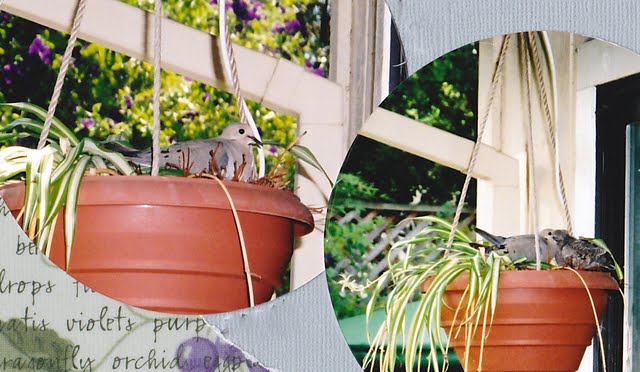
The back-forty is a transitional home for plants who’ve outgrown their pots but don’t currently have a good place to go.  One of the potted spider plants sheltered a nest of mourning doves one year.  Eventually the pot was too crowded for a nest or a plant. Time to visit the back-forty.  Sometimes I empty a bit of soil left in a pot, and a forgotten bulb rolls out.  I give it a toss into the mix  and carry on with my gardening chores.  It’s every plant for herself back there: find a place to put down your roots, or move over for the next plant.  Since nothing that we’ve purposefully planted under the pine tree lives for very long, I’m hoping my stealth plan takes root.

Two spider plants and an asparagus fern have been up to the challenge so far.  The acidic soil and shade agrees with them and they seem impervious to a steady shower of pine-needles.  At the rate they are multiplying, the back-forty relocation plan is looking like a success. Gardeners know that hope springs eternal or perhaps it’s spring that brings eternal hope.

Asparagus Fern Spider Plant Tango

Mourning Doves

Today’s Blog is Brought to you by the Number 9

Magic Fern Number 9

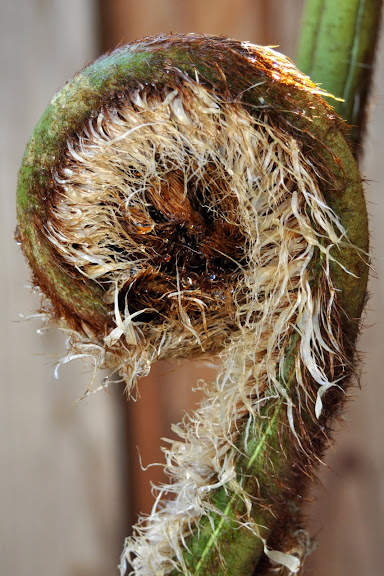
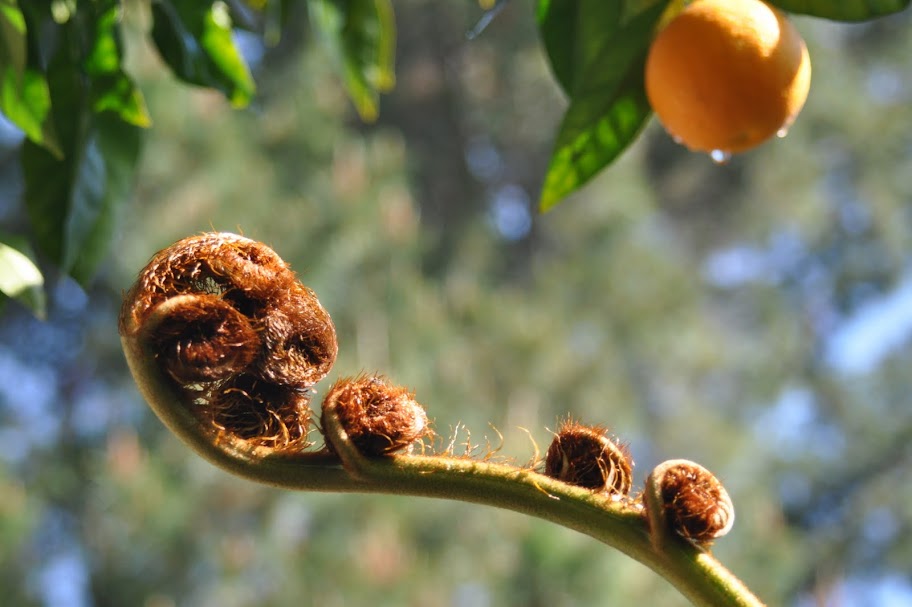
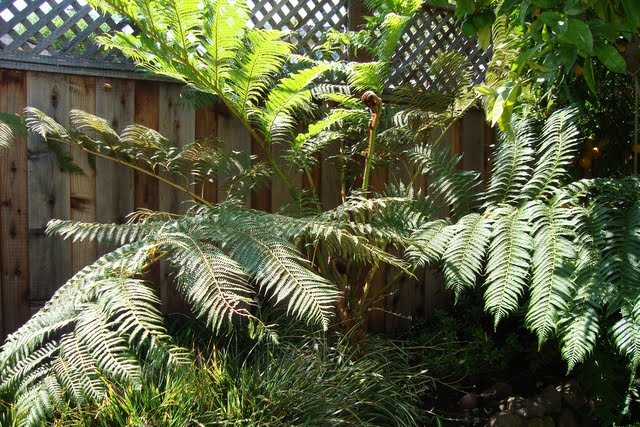
This glorious fern lives under the orange tree in our yard.  It fascinates me!  I’ve been searching Google images all morning, but I can’t seem to locate a similar one.  When I do I’ll post the botanical name.

From early March through late June or July, it unfurls these otherworldly fronds.  When I started photographing the process I expected it to take several days.  Two days later the tightly wound coils unfurled, leafing out into large, fan-like leaves.

I learned the hard way that the dusting of brown feathery scales is a skin irritant, no doubt a natural defense mechanism against foes and photographers alike.  I had to toss all clothes in the wash and shower-mid day to stop the infernal itch.  Beware!

Now that fern-unfurling has arrived in my backyard, I’ll be out there everyday, camera in hand.   I’ll keep a respectful distance of course.  Birding is fun but ferning is funnier!

Tightly Coiled

Happy Under the Orange Tree

Update:  This is a Woodwardia fimbriata, commonly known as a Giant Chain Fern

Catnip: Intoxicating Perennial

Catnip Seeds

Not all cats like catnip. (Not everyone likes chocolate either, to my dismay). In my own personal experience, however the vast majority of  felines take some pleasure from this fragrant herb.  My cat Estare literally drooled the first time I introduced it.  He rubbed his little chin through the crushed leaves, over and over again.   His brother liked it okay, but for Estare it was an experience.  Our current passel of kitties also enjoy it.  We have a few handmade cat toys, sewn by our local vet and  I buy loose-leaf nip as well. It seems to relax, intoxicate or invigorate, depending on the mood.

I planted catnip several years ago and  enjoyed watching it grow into a magnificent plant.  I didn’t know it would produce such pretty little flowers or that it would grow so large.  It filled most of the space below the lemon tree, supplying us with fresh leaves for a year.  Unfortunately the lemon tree split in two during a storm.  When we removed the damaged tree, the catnip went along with it.  I never got around to planting it again.

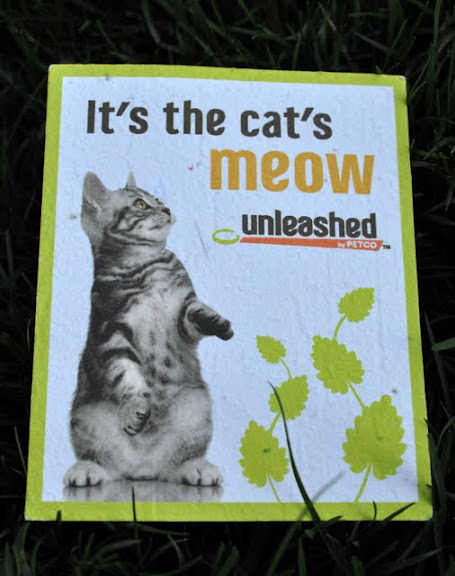
Earlier this year Unleashed by Petco passed out a catnip-embedded card as a thank you for supporting one of their programs.  Perhaps one of the cats slipped them a fiver to remind me to get back on track.  Catnip here we come!

Freebie from Unleashed by Petco

WindowAlert: Protect your Songbirds

We invite birds to our garden in a variety of ways using fragrant flowers, flowing fountains and feeders.  To that end, it was disheartening when the occasional feathered friend mistook our window for the sky.  That unmistakable thud left an indelible mark on our soul.

The good news: by applying WindowAlert™ Decals, collisions are largely a thing of the past. According to their site:

WindowAlert is a window decal that may be applied to home and office windows. The decals contain a component which brilliantly reflects ultraviolet sunlight. This ultraviolet light is invisible to humans, but glows like a stoplight for birds. Birds have vision that is up to 12 times better than that of humans. WindowAlert decals help birds see windows and avoid striking the glass.

The decals are removable and re-positionable.  The static cling variety can be cleaned by rinsing in warm water as necessary.  I purchased the Decorative Leaf Decal, but they are  available in a variety of shapes.

Support your local garden center or nursery if you can.  I shopped at Los Gatos Birdwatcher in our community.  You can also buy directly from the WindowAlert site.

Magic of Swing

I dreamed of a garden swing for years, but it seemed like such an extravagance. Stylish and pricey swings graced the pages of Grandin Road catalogs and the garden section of Sunset Magazine, teasing me with the seductive possibilities of life with a swing. When my youngest son was still small we would “test drive” all the display models at our local Home Depot garden center.

Then in 2009 I spotted a swing in town for under $200. Though it wasn’t a high-end model it looked sturdy and it was comfortable. The seats were cushioned and the back had built-in head rests and a canopy to fend off the sun. It was perfect! We snapped one up and my husband assembled it for me for Mother’s Day.

Had I known that swings had magical powers I would have splurged years ago! Whenever I wandered outside to sit on my swing, a kind of hypnotic trance took over. Suddenly, swinging was more important than answering email or tossing a load of laundry into the dryer. Invisible hands lulled me. I could barely move.

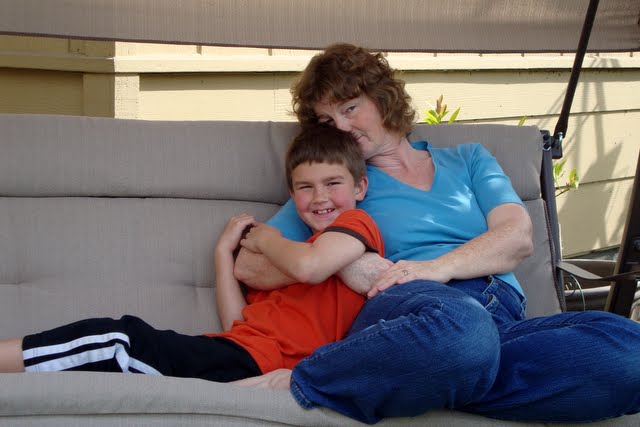
My boys were drawn to the swing, too. I would trek outdoors and before I knew it I had company on the swing. Back and forth we would go, swish-swish, swish-swish, swish-swish. Feuding cats set aside their differences and joined me on the magical swing, paws curled in as they settled into the deep cushions.

If I had to make a phone call, I figured I may as well do it from the swing. I pretended to read my book out there, but in short order the sun and swing led to slumber.

After three seasons under the noon day sun, my swing needs a little TLC.  I’ve got my eye on some new fabric, part revitalization, part disguise.  If the shopkeeper ever learned about the magical powers they would undoubtedly find a way to double the price.

Mother's Day Two-Fer

Reading the Fine Print

When my nine-year-old son discovered Fruit Cocktail trees, he could talk of nothing else. I’d never heard of them till our neighbor shared her plans to plant an edible garden. For the uninitiated, a “fruit cocktail” is a multi-grafted fruit tree; one tree, four varieties of fruit.

These trees are a boon for suburban gardeners with tiny lots. Another plus is the harvest season. The fruits mature at slightly different times extending the bounty gradually over the season.

Last spring we had beautiful fruit, but we were ill-prepared for nature’s scavengers. The squirrels and rats picked the tree clean in a day. We’re more prepared this year and will “net the tree” as soon as the flowers begin to fruit.

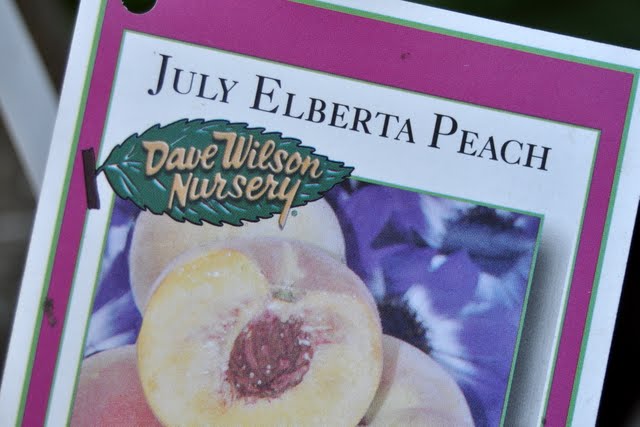
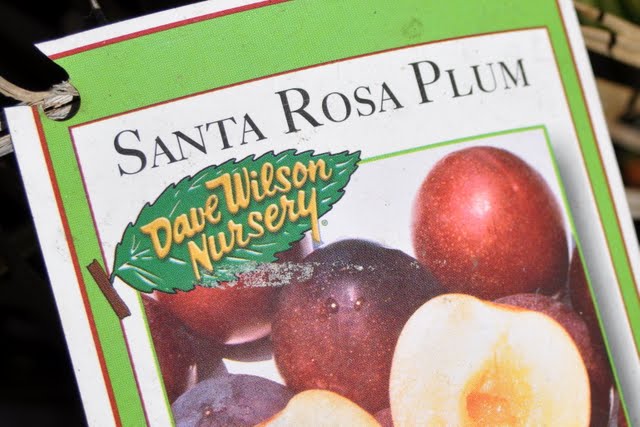
I photographed the beautiful blooms today, then removed the identifying tags. Reading the fine print on the back of each one made me smile.

A few gems:

“Self-fruitful in most climates.”
“Excellent pollenizer”
“…some tartness near the skin.”
“Tangy when firm-ripe, sweetest when soft-ripe.”
“Reliable, heavy-bearing tree.”

Blooming Apricot

Blenheim Apricot: Dave Wilson Nursery

July Elberta Peach Bloom

July Elberta Peach

Santa Rosa Plum Bloom

Santa Rosa Plum Bloom

Fantasia Nectarine Bloom

Fantasia Nectarine

Ah, fertility!

We purchased our Fruit Cocktail at Almaden Valley Nursery (thanks Doug!)
Wholesaler: Dave Wilson Nursery