The Fruits of My Labor

developing plums

Developing Plums

Gardens, like children, need nurturing to grow. Genetics certainly plays a role. Environment is significant too. A little TLC, however, goes a long way to ensure a happy, healthy garden. Today, I’m enjoying the fruits of my labor, literally and metaphorically.

This is the break-out year for our four-in-one fruit tree. We bought the grafted, stone-fruit tree as a gift for my son’s 10th birthday. I researched the guidelines for pruning the tree, and received additional tips from my nurseryman friend, Doug. Following that advice, I pruned the branches by 40-50% every year for the first three years. It seemed drastic to my young son who was pretty upset with me even though I was able to show him the research. One of the four grafts died, and I’ve never heard the end of it.

Where was I…oh yes, the fruits of my labor. Well guess what? This is year four and the tree is now covered in fruit. There is more fruit than we’ve had in the first three years combined.

future plums

Blushing fruit in the dappled sun

four in one fruit tree

Branches laden with fruit

Last year’s small bounty disappeared overnight. This year we have so much fruit that the rats and squirrels have only made a small foraging dent. We might actually be eating peaches, plums and nectarines this summer. Oh happy days!

Do you have a favorite fruit?

Blogging Nirvana

A few months ago, I updated my ‘About’ page to read:

I came for the writing and stayed for the friends. Who knew the blogging community was so rich and diverse?

On WordPress alone, bloggers produce over 44 million posts a month. My blog is a tiny minnow in a vast sea. Yet somewhere along the way, I’ve connected with a handful of remarkable people scattered across the globe. In many ways, blogging is the start of a conversation. Great things reside in the comments that follow. Like the oft-compared pen pals of our youth, we form relationships through the written word.

Without face-to-face exchanges, bloggers rely on words and pictures. When you’re first starting out, you hunger for comments. It’s a way to validate why you’re here and what you write about.  In a short time, however, relationships are born. They grow and strengthen and before you know it, you’re logging on every day to connect with like-minded and interesting people.

For me, it all started with ‘Boomdee’. I can still remember the first blog that caught my eye, a beautiful transformation of her front porch.  I love before-and-after pictures and I liked her style.  A little exploration told me she had two rescue cats, and that she lived in Canada, my country of origin.

The connection could have ended there, but before long, we were exchanging multiple comments back and forth every day. Unbelievably, someone I didn’t know just a few years ago, became one of my closest, dearest friends.

Through that connection, I found other bloggers.

  • Dani, at Teddy and Tottie. She writes a slice-of-life blog from a small town in Australia.
  • Julia, at Defeat Despair, writes inspirational posts from her homes in Washington D.C. and Virginia
  • Laurie, at Life on the Bike,  also lives in Virginia. She’s a fabulous photographer and a serious biker and she shares her experiences with both.
  • Pauline, at The Contented Crafter, blogs from New Zealand. Pauline blogs about her process of creating mixed-media art and crafts.

…and we all include our wonderful animals in our posts.

Yesterday, an amazing thing happened. Ms. Boomdee organized a global Skype Tea.She put together a schedule that accommodated five different time zones, then placed the call.  We had a series of technical issues, but it added to the fun.  Each of us read a pre-selected poem, wearing a hat and gloves of course. We enjoyed the novelty of hearing each other for the first time, and our diverse accents on the call. I can’t remember the last time I experienced something so unique and fun.

Special thanks, dear Boomdee, for making this all possible. Fellow bloggers, thank you for reading, writing, photo-sharing and commenting. My hat (and gloves) are off to you.

 Who Ya Gonna Call?

Skype Tea Selfies

Skype Tea Selfies

skype tea

Skype cast of characters

In a Vase on Monday

Cathy at Rambling in the Garden  posts a photo of a vase of flowers each Monday.  She includes flowers from her garden, a prop of some sort, and a variety of vessels.  Fun, right?

I think it’s a lovely tradition. I  found her blog via another Cathy at Words and Herbs.  If you love flowers and the art of arranging, these blogs are a treat.

Gathering flowers in to posies or bouquets is a time-honored tradition. Nothing brightens a home like fresh flowers.  The first year I grew cosmos, I had elegant blooms for months.  I enjoyed arranging them in a variety of ways, finding it creative and relaxing.

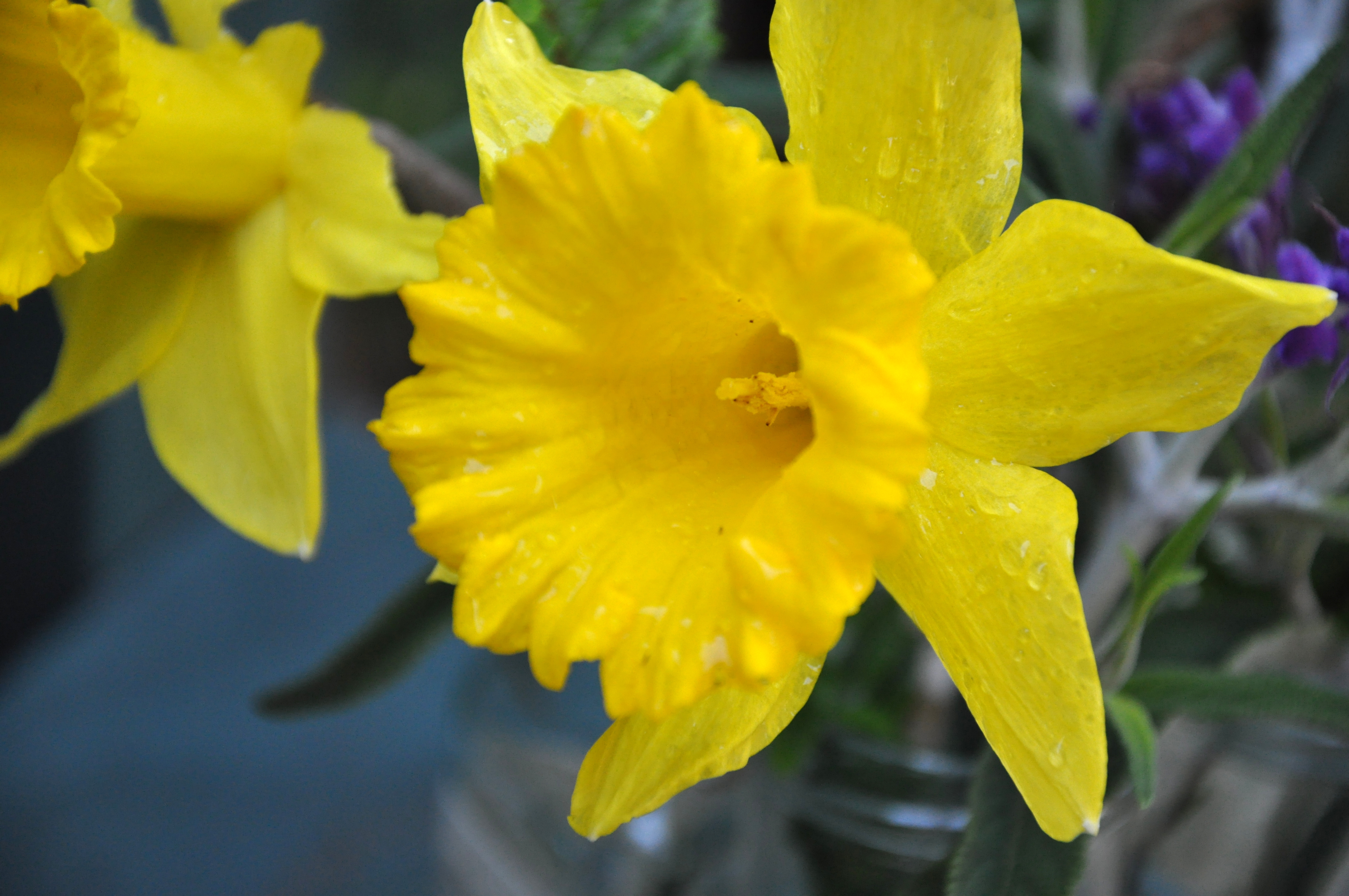
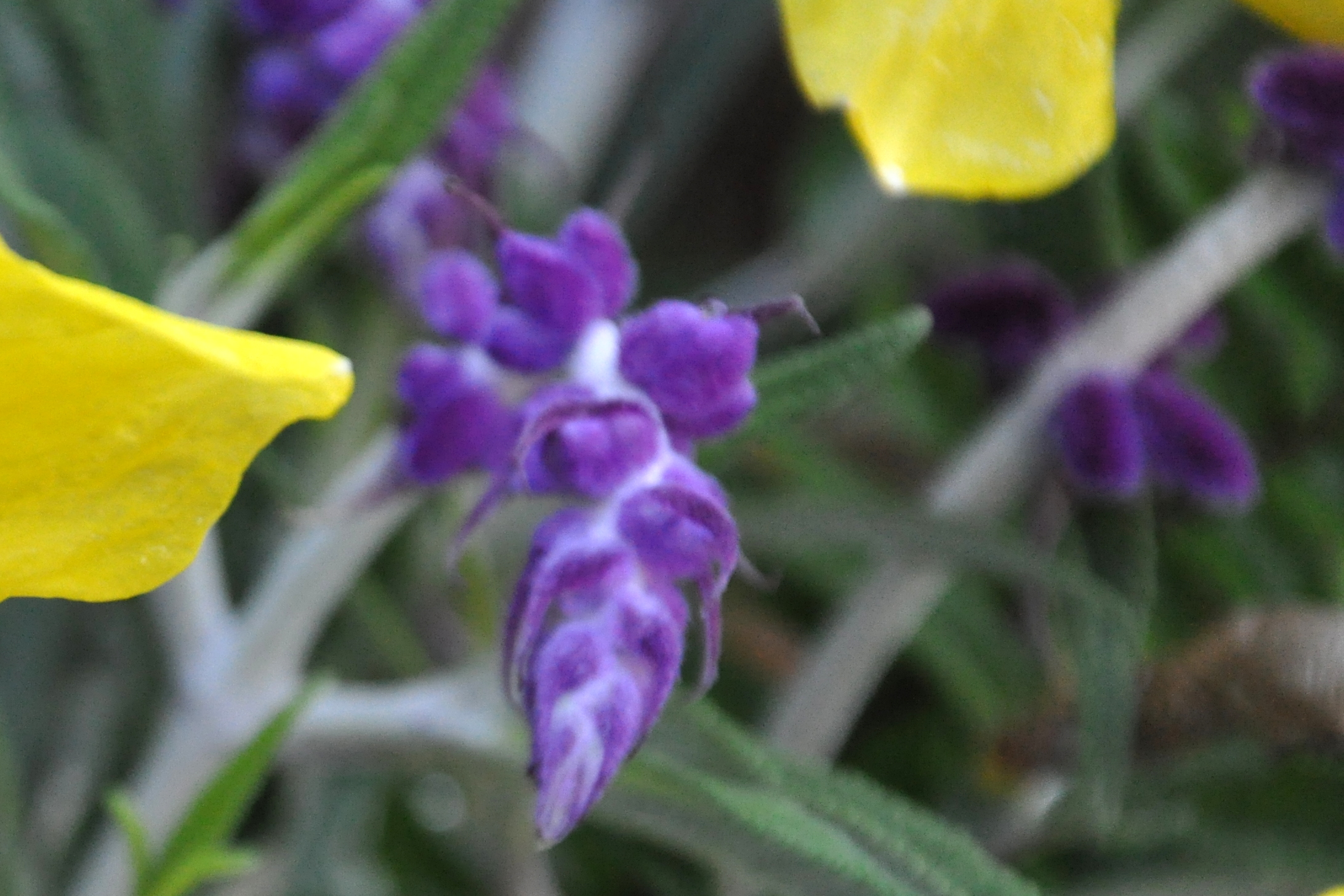
Today’s flowers in a vase includes Daffodils and Mexican Bush Sage with a few fronds of fern.   Starting with four empty Tamarind jars, I arranged them in a square.  I held the jars together with a piece of lace, a gift from my dear friend and fellow blogger, Boomdee.  A strip of washi tape over the lace added texture.

Here is the result.

flowers in a vase on monday

Flowers in a vase on Monday

Daffodils

Daffodils

Mexican Bush Sage

Mexican Bush Sage (soft as velvet)

tamarind jars

Tamarind jars gathered together with lace and washi tape

You’re welcome to join in, with a link back to the original blogger.

Cathy Lyon-Green writes: “I had not intended to write a blog, but was talking to a friend about how, now I had more time, I wanted amongst other things to keep a better record of the garden and nurture its spiritual aspects, as well as writing poetry more often. She suggested I do it online as a blog, and Rambling in the Garden was born.”

Cathy of Words and Herbs writes: “I’m an English trainer originally from the UK, but now living (and gardening!) in Bavaria. Two of my greatest passions are plants and books, which is what I write about here. I also love cooking delicious vegetarian food, a feature here too, and like to live in tune with the seasons.”

I hope you’ll join in one Monday, too.

Hummingbirds: Taking Turns

Our hummingbird feeders are draining quickly this week, with several birds taking turns at the feeder.  I hope this means one of the female hummingbirds is nesting nearby. The adults need to eat every twenty minutes. Once the female lays her eggs, she is in constant search of food.

Many birds work in pairs to ready the nest, but not in this case. The male of the species doesn’t stay around to help. A flyby exchange of fluids lasting seconds is all it takes to fertilize the eggs. Then the promiscuous male hummingbird is off.

The female hummingbird lays a pair of eggs at a time. She nests five or six times a season. Tiny eggs are the size of  tic tacs®, laid in a golf-ball-sized nest.  She uses soft grasses and twigs, then wraps the nest with silk from a spider’s web to keep it together.

In addition to eating nectar, hummingbirds consume soft-bodied insects for protein.

While I consider putting my feet up over the weekend, she’ll be hunting and gathering, building and nesting and finally rearing a pair of infants till they fledge.

Head slap: so *that* is how she maintains that svelte figure.

What are your plans this weekend?

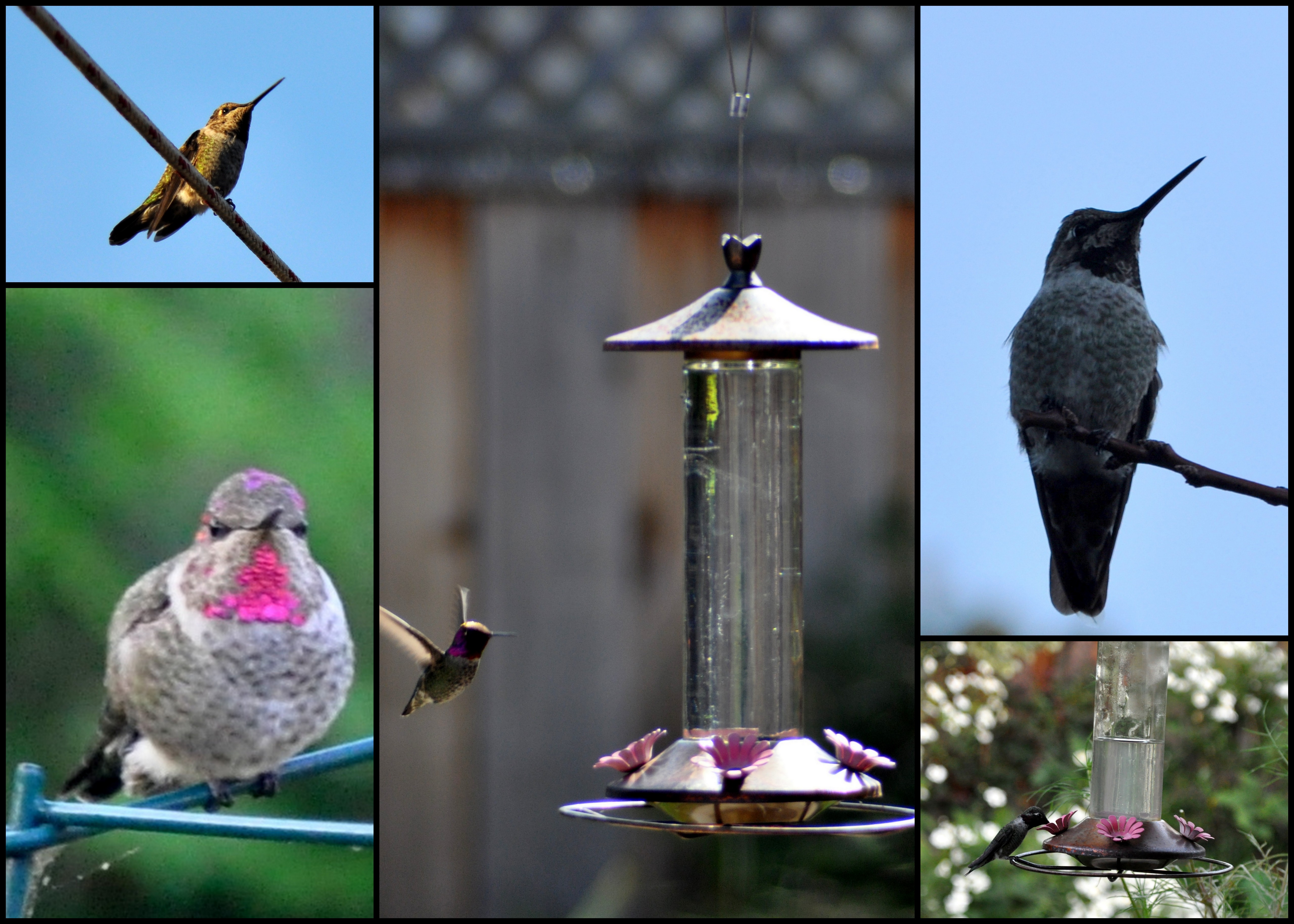
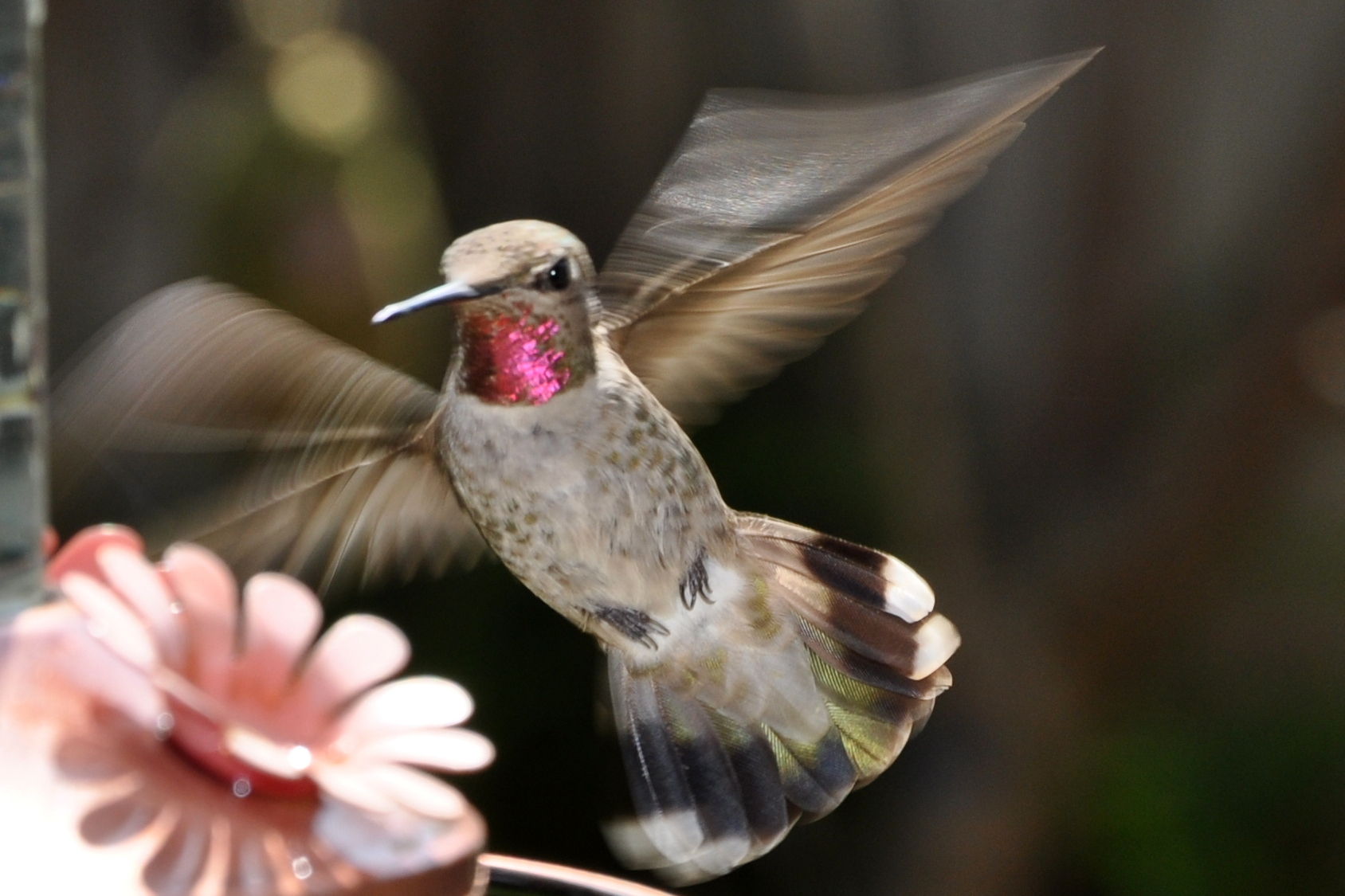
Female Anna's Hummingbird

Female Anna’s Hummingbird

Male Anna's Hummingbird

Male Anna’s Hummingbird

What’s in the feeder?

Sugar water. Mix one part white sugar with four parts water and your done. Food coloring is unnecessary and harmful to these tiny birds.

Living Scrapbook: My Little Side Yard Garden

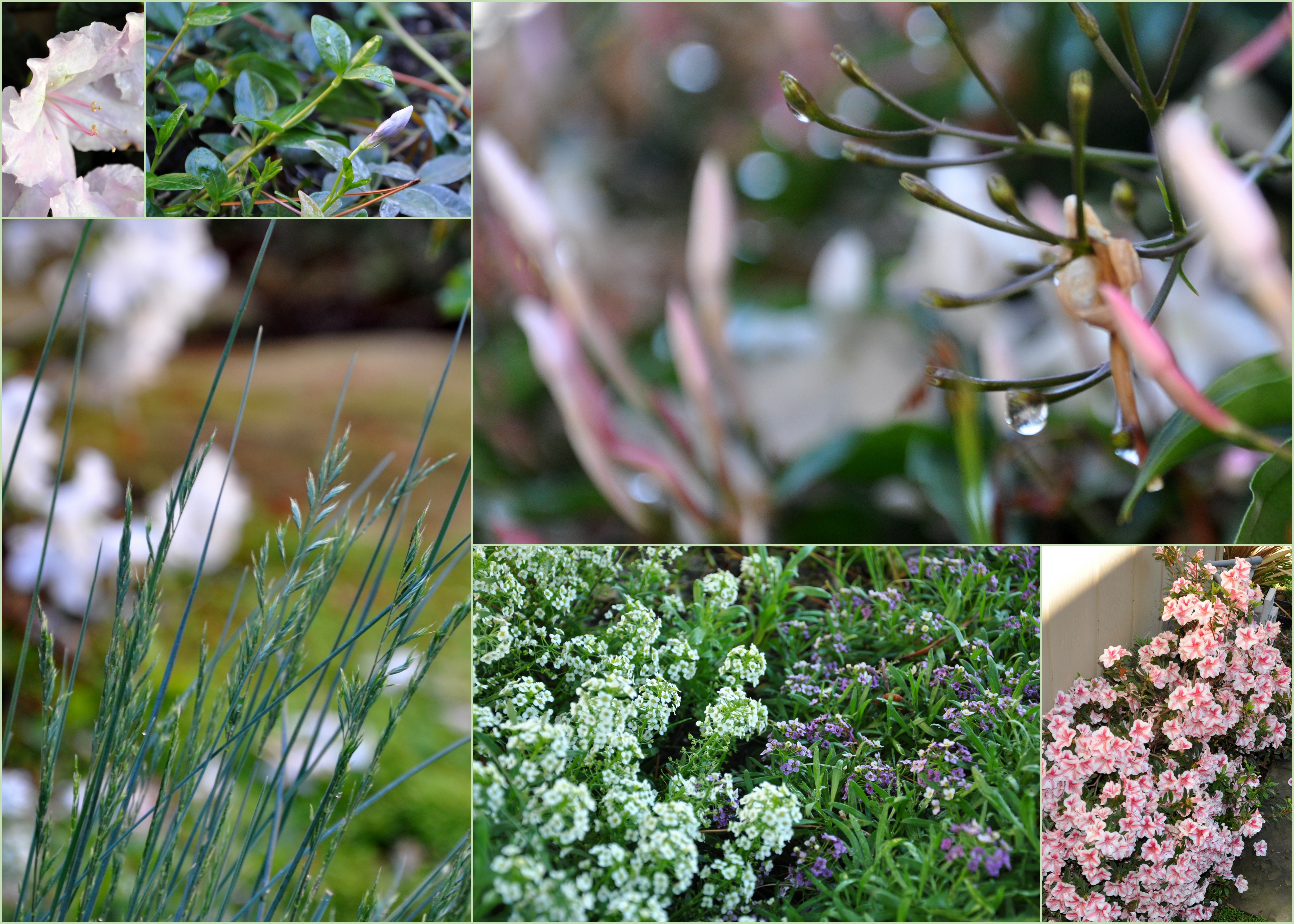
This seems to be a banner year for my little side garden.  Virtually everything is in bloom or promises to in short order. The tiny plot is small and shady, but full of wonderful memories.

side yard garden

Side yard garden darlings: petal pink azalea, budding Jasmin, blue fescue, white and purple alyssum, pink azaleas camouflage the meter

When we bought the house 18 years ago, the narrow space between our house and the neighbors was in sad neglect.  A ragged shrub divided the property line, creating a dark, narrow opening between the garage and the gate to the back yard.  In short, it was a pass through

The side yard was low on the list of household projects since we didn’t spend any time there. Of course, if you garden, every bit of available soil eventually meets the wandering eye.  What if we…

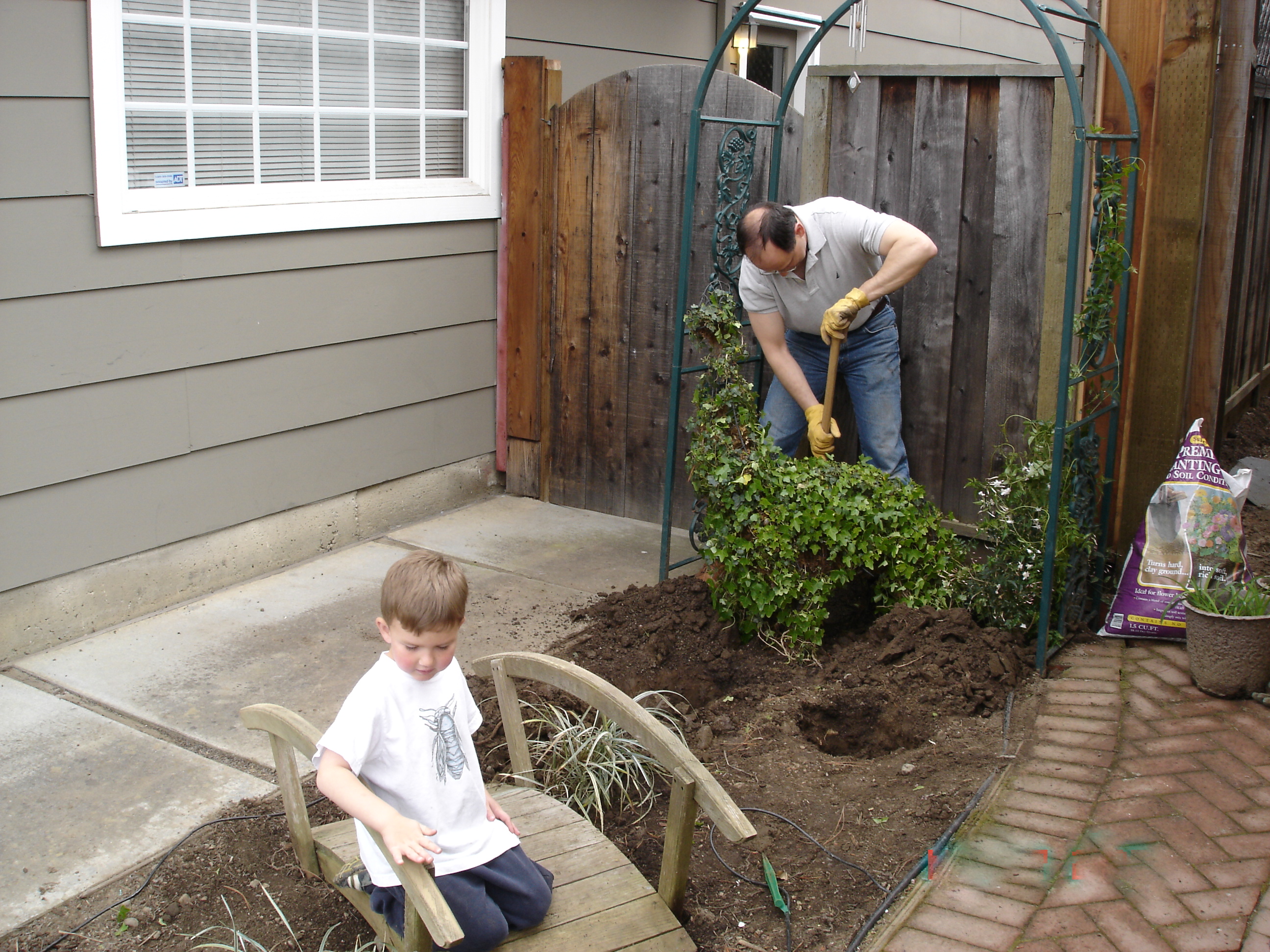
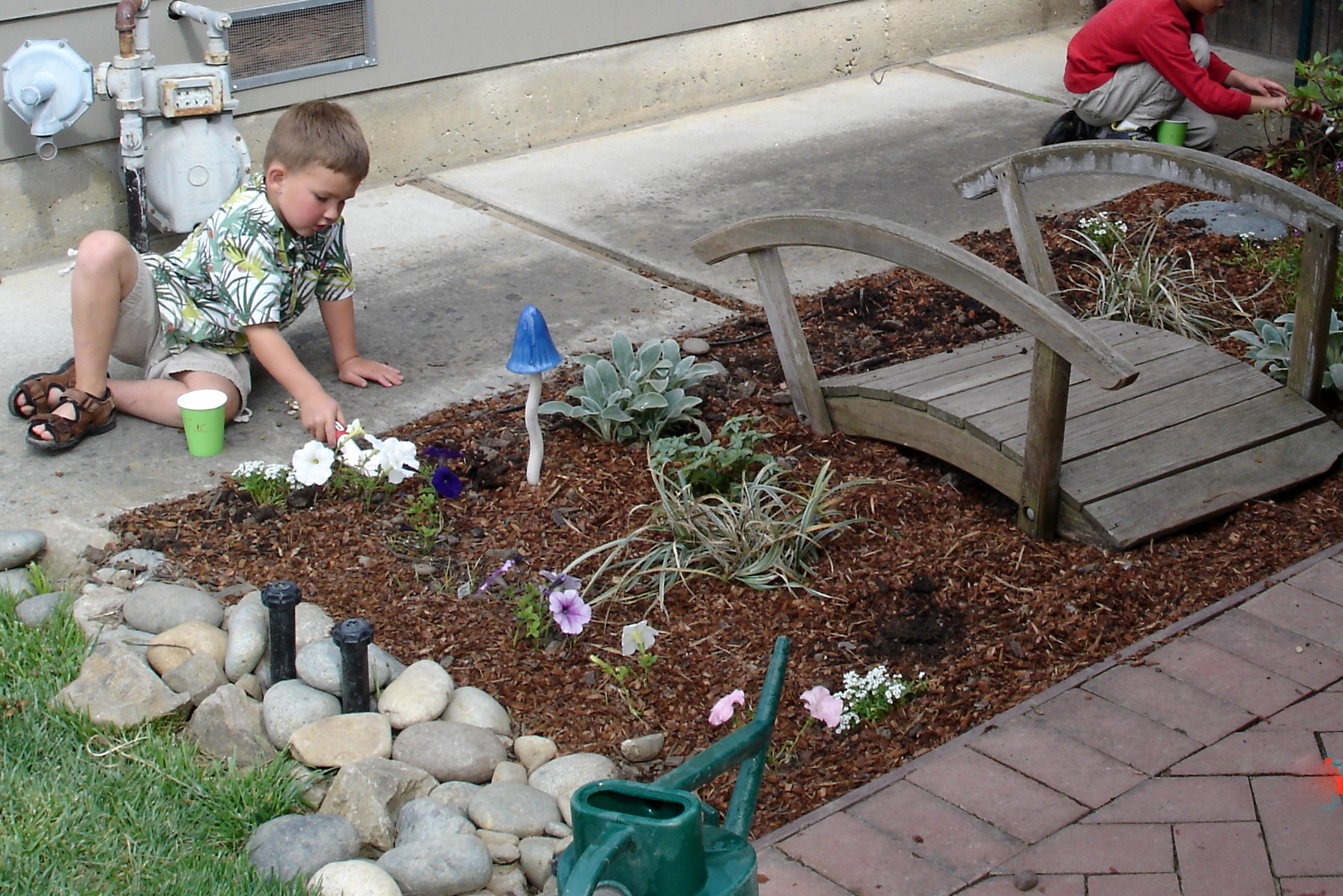
So when the neighbor asked if the shrub could go, the answer was a resounding yes!  Between households, there were five children, all under the age of ten so I suggested a ‘children’s garden.’  It would be a place for them to play, plant and experiment. A small wooden bridge, once in the backyard, spanned the tiny space and unified the area.  I relocated my dinosaur topiary and Mike transplanted a pair of azaleas from the back yard. The kids loved it. At one point my six-year-old decided to dig a ‘hot tub’ in the middle of the garden.  Shavings of sidewalk chalk turned into magic dust, as long as you believed. I miss those days of wild imaginings.

planting the children's garden

Planting the children’s garden

digging in the dirt

Digging in the dirt

Within a few years, the neighbors moved away.  Our boys got older, the bridge began to rot, and the garden morphed again.

As it turned out, the little bridge proved to be an excellent hiding place for snails.  I’ve never seen so many of them congregated in one place. Out it went.

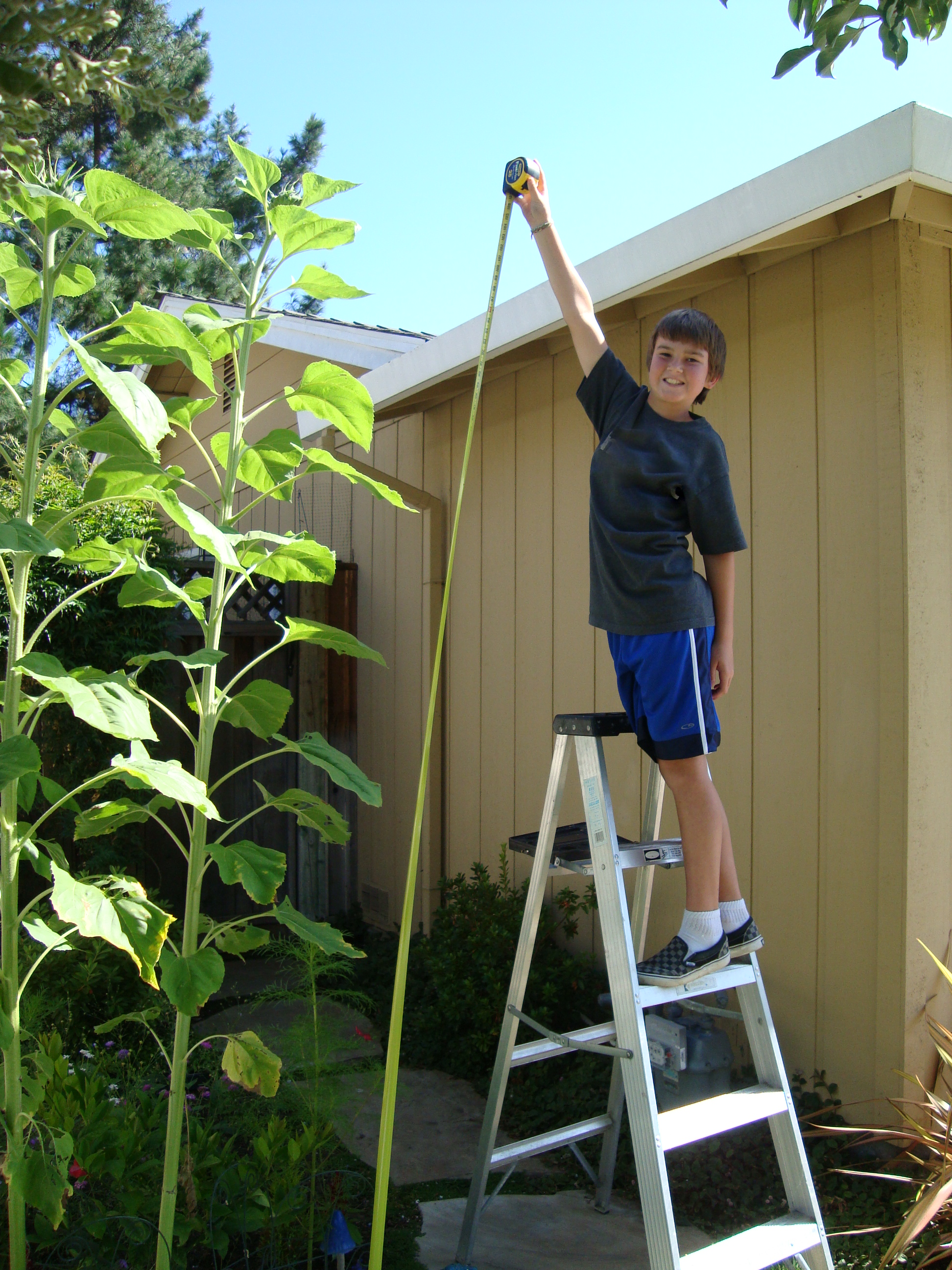
We planted sunflowers in front of the lemon tree, but it eventually took over.

I planted Alyssum from starters and a bag of wildflowers.  Just enough came up to fill the garden that summer, but just as quickly, they died off in late fall.  I added a few begonias, transplanted overgrown fescue from the fairy garden, and eventually the baby tears meandered over the exposed dirt and made themselves at home.  Our dwarf lemon tree moved in at the edge of the garden and agreed to stay.

sunflowers take off

Sunflowers take off

measuring the sunflowers

Measuring the sunflowers

Our little patch of garden makes me smile. It feels like a living scrapbook of our years in this home. It mirrors the ebb and flow of life.  It’s also a reminder of the joy to be found in a tiny patch of dirt.

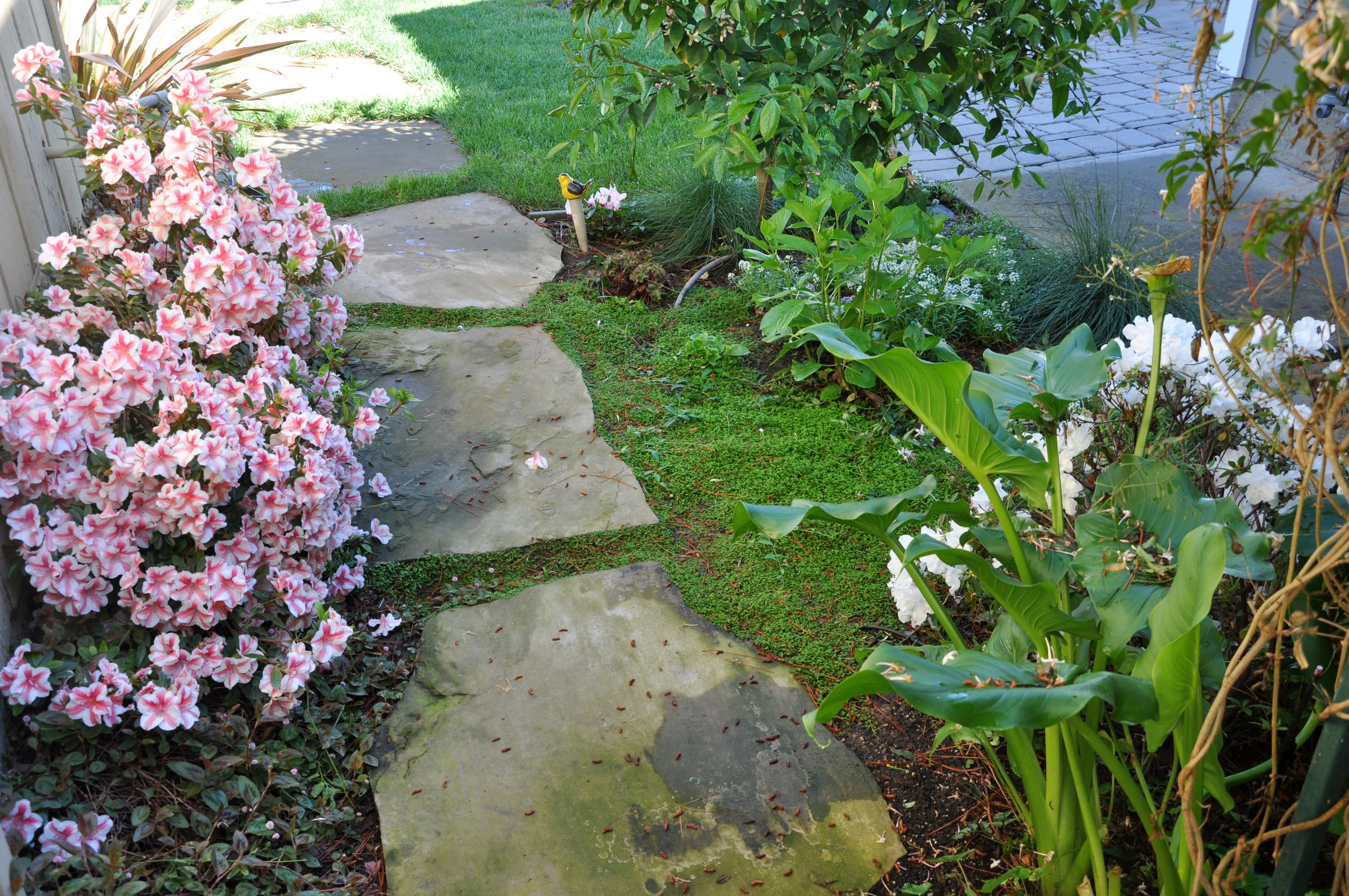
view from the gate

View from the gate

view form the neighbors side

View from the neighbors side

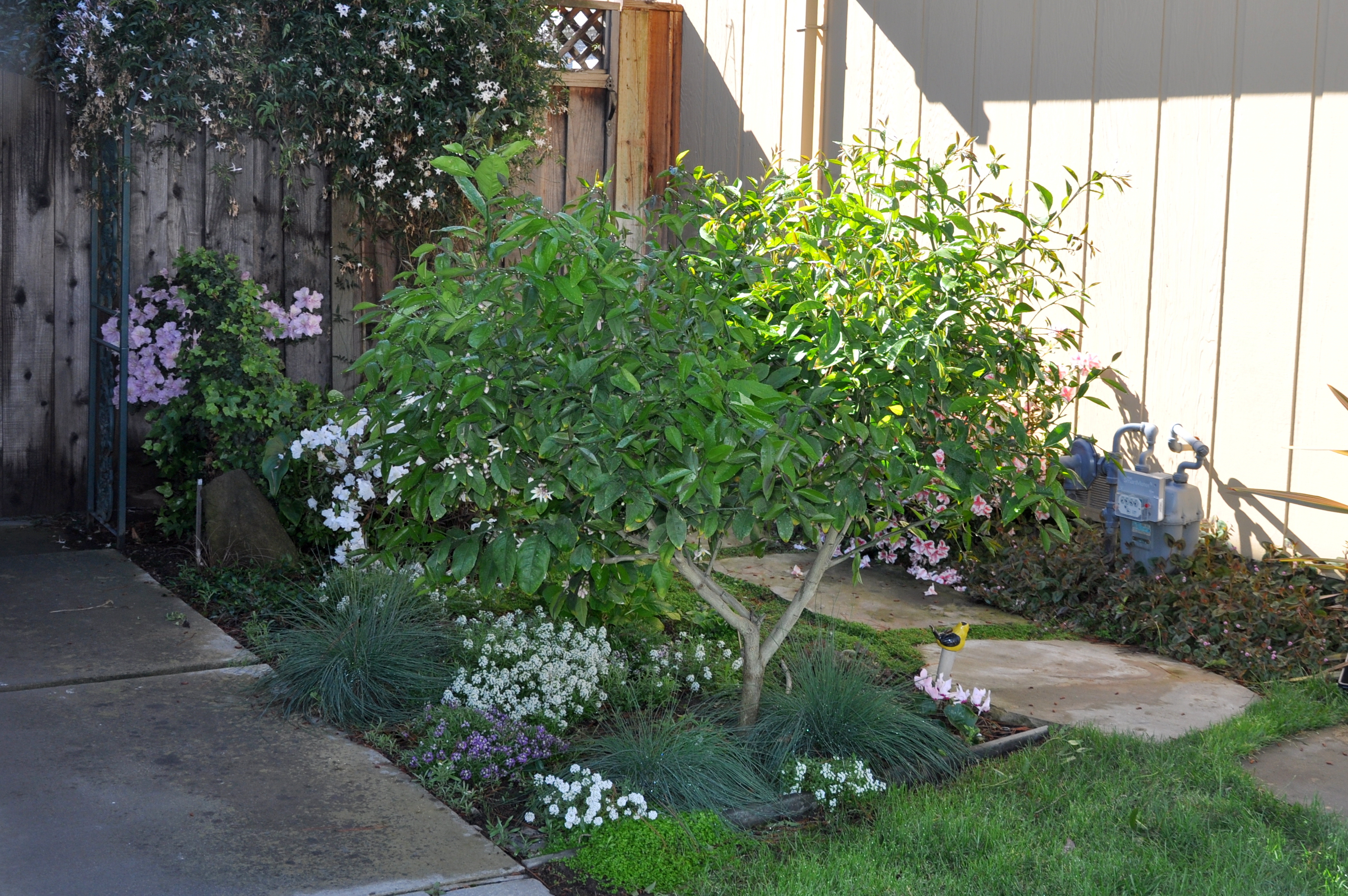
Fescue, Alyssum, vinca, and the trunk of the lemon tree

Fescue, Alyssum, Vinca, and the trunk of the lemon tree

The Tale of Two Lemon Trees

Prologue

Yes, I know it’s three chapters, but they’re short, and sweet, like the blossom on a lemon tree.

Chapter One

When we first bought our house, there was an ancient lemon tree growing in the back yard.  The lemons were as big as small grapefruits, but alas never juicy. We enjoyed the tree for its beauty and used the lemons for other things.

The sweet smell of citrus blossoms is crisp and inviting.  A tree laden with bright yellow fruit brought cheer to the garden year round. One year I found a nest in the dense foliage of the tree which confirmed what a special tree it was.  There was, however, one challenge.  The trunk of the tree was low to the ground. At knee-height, the lemon tree forked into two large branches.  The weight of the fruit started pulling the branches apart.  After wrapping the tree with rope, we called an arborist.  They suggested keeping the fruit to a minimum to reduce the weight and to harvest as often as we could.

lemon tree party

Garden birthday party, 2003

It was all for not.  I arrived home one afternoon to find the tree split in two.  Part of it was standing, but the rest lay sprawled across the lawn.  I was so grateful that my children weren’t playing in the yard at the time.  Once I knew the cats were also safe I was able to relax. I knew they weren’t trapped under the limbs of the fallen tree.

The tree had to go.

With the tree gone, we realized how much we enjoyed the extra light and the space to plant sun-worshiping vegetables.  We bought a dwarf lemon instead and put it in a pot on the front deck.

Chapter Two

Dwarf lemon trees produce full-sized fruit on a smaller tree. My mom had good luck growing a potted lemon tree, so I reasoned we could too. For whatever reason our Myer lemon didn’t take off.

We moved our dwarf lemon to the front, side yard and hoped it would get plenty of sun.

lemon tree 2011

Dwarf Myer Lemon Newly transplanted, 2011

dwarf lemon in side yard

Dwarf Myer Lemon today April, 2014

That first year the tree doubled in size but didn’t produce any fruit.  It increased in size again but got hit with a hard frost and  decided to sit it out for another year.  Last year the tree sent out thorns.  Surely fruit would follow.  By early fall, a fungus or some kind of pest, deformed all the new growth, wrapping it in a light powder.

What is a gardener to do?  I pulled out the shears, and removed the damage, taking a little extra for good measure.  Winter came (sort of) followed in typical fashion by spring.

Chapter Three

It’s spring!  The birds are singing, the bulbs are popping and we finally got a bit of rain.  Could this be the banner year for our little lemon tree? A recent trip to the side yard renewed my hope.  A single flower bud, fresh from the rain sent out a cheerful welcome.  New growth covered the tree and not a single pest in sight.

lemon buds

Lemon tree buds

A couple of rainy days later and all was right with the world.  Tiny flower buds cover the tree. Sweet, pink, intoxicating, might-one-day-be-a-lemon buds.

lemon tree flowers

Lemon tree flower and buds

To be continued…

 Epilogue

When life gives you lemons…

  • Collect them in a large bowl for a pretty display. Your entire house will smell like citrus.
  • Lemon juice and salt are great for cleaning copper.
  • Grinding a chopped lemon with some ice freshens the sink and the garbage disposal.
  • Use lemon juice instead of bleach to remove stains. Soak your delicate clothing in a mixture of lemon juice and baking soda for at least half an hour before washing. We did this with costumes in my theater days, so we didn’t harm the delicate fabric.

Birdwatching Fieldtrip: Fun in the Rain

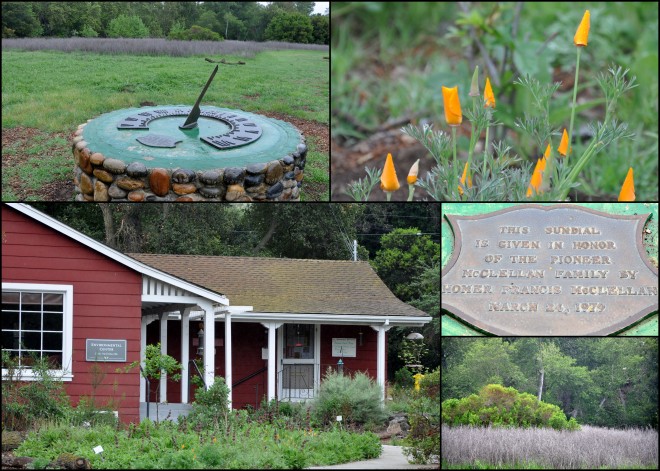
We took a hummingbird class at  Los Gatos Birdwatcher last week, then met for a birdwatching field trip over the weekend.  Lead by Lisa Myers of Let’s Go Birding, we drove to the  Santa Clara Valley Audubon Society.  Located at the tip of McClellan Ranch in Cupertino, trees, native shrubs and a number of feeders attract resident and migrating birds.  We stood under the awning with a light rain falling, and made like a tree.  Trees with binoculars, that is, and a few cameras, too.

Lisa pointed out that some people ‘bird’, some people photograph and some (raising my hand) try to do both. You can’t do both well, but I tried, knowing I wanted to share as much as I could with you.

Like so many things in life, once you tune in to something, the world opens up.  Lisa called out several species, pointing out gender, mating patterns, feeding habits and other bits of wisdom.  She has a dry sense of humour along with a vast knowledge of native birds, making for an interesting and entertaining morning.

She jokingly pointed out that serious birders will sneer if you mention seeing Canadian Geese and Seagulls.  The correct terms: Canada Geese and Gulls. Conversely, she has to bite her tongue when customers come into the store and swear they saw a canary or an eagle in their back yard.

Although we did see hummingbirds, they were fairly shy.  They didn’t approach the feeder until we were well out-of-the-way.  At home the resident hummers are quite bold, and will buzz up to us on the deck in the summer.  They definitely know the hand that feeds them.

No matter.  We saw plenty of other birds and I came away with even more appreciation of the songbirds in our area.
McClellan Ranch

McClellan Ranch

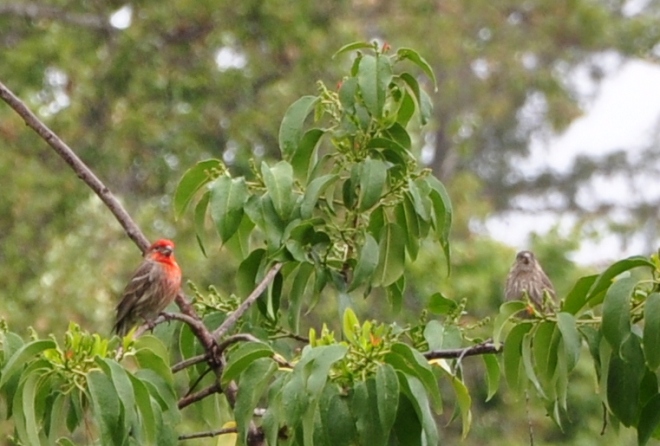
Male birds flaunt their colorful plumage in order to attract a mate. The female, on the other hand, is nondescript. Since she’s the one sitting on the nest incubating the young, it makes sense that she blends in, keeping her and the nest safe from predators. When I took the picture, below, I didn’t even know that the female of the pair was there.
Male and Female House Finch

Male and Female House Finch

Some of the pictures, below, are clearer than others, but I wanted to give you an idea of the variety on view Saturday morning.
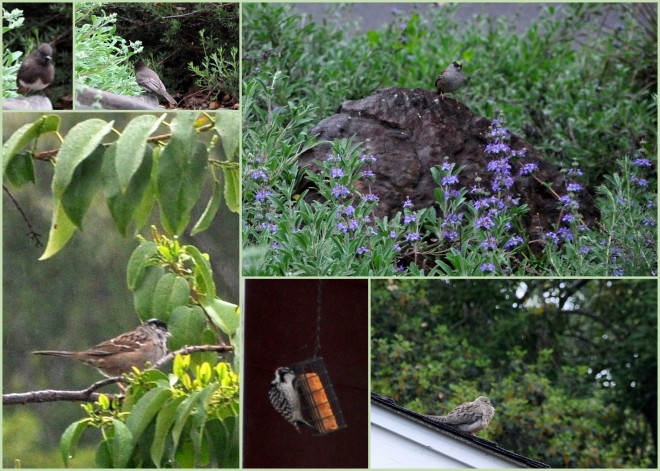
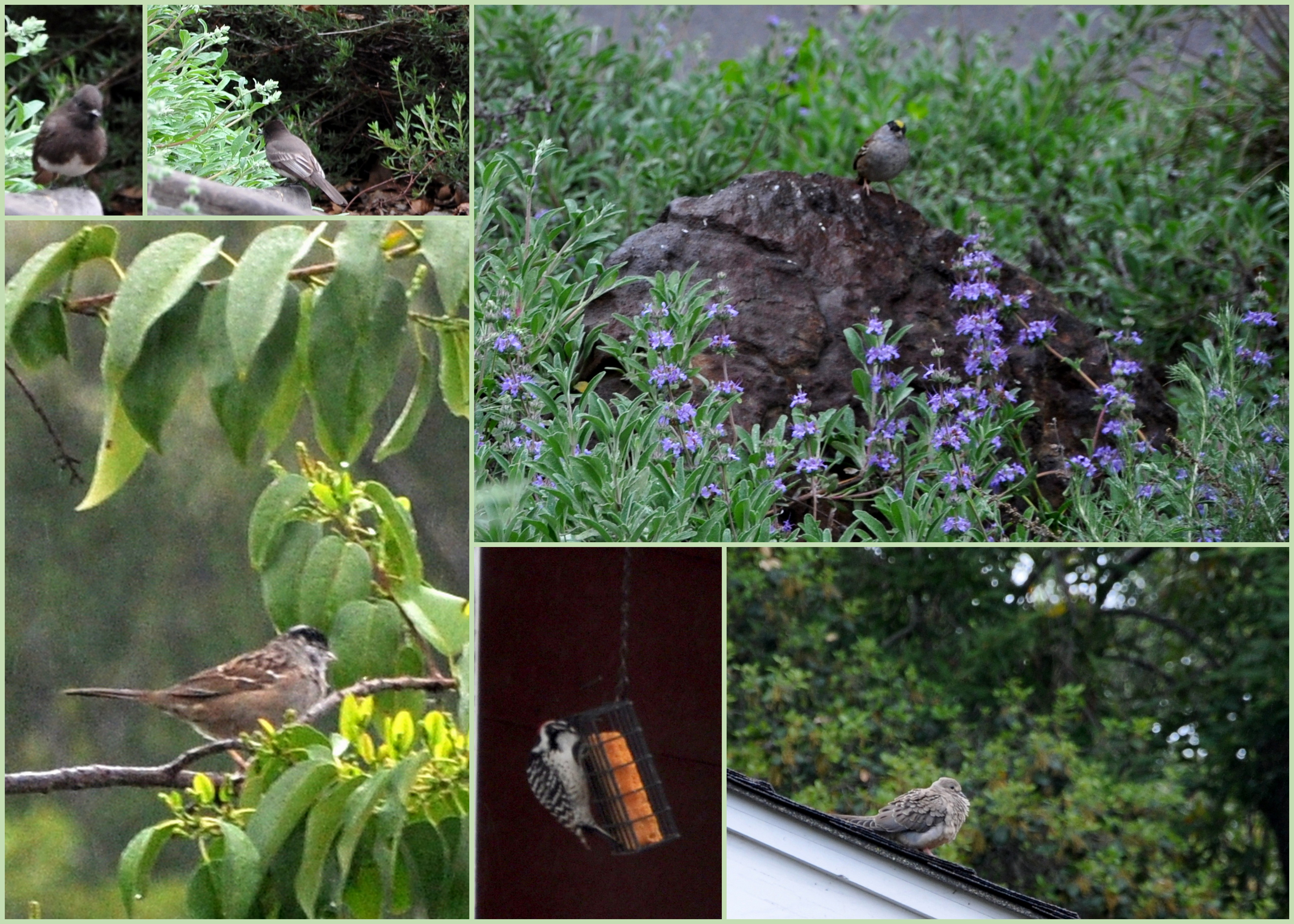
A variety of song birds

A variety of song birds

Upper Left: Black Phoebe, Song Sparrow (?) Woodpecker and Mourning Dove.

I’ve been working from memory and my trusty Local Birds of the San Francisco Bay Area Quick Guide to identify the birds pictured below. I’m going to have to check with Lisa to see if I got it right.
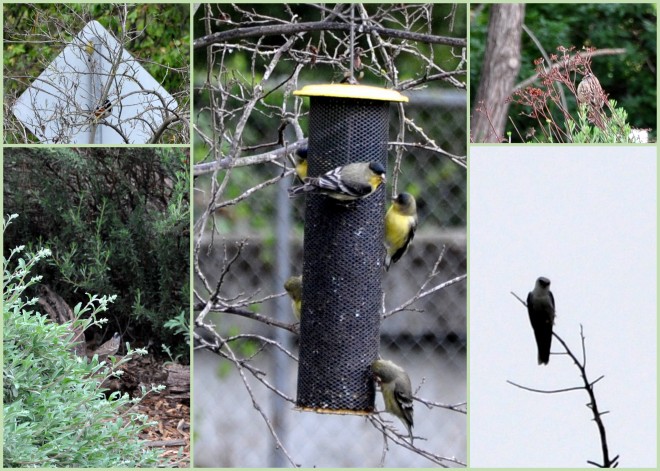
More song birds

More song birds

I’m more confident about identifying this crowd: Behind the stop sign, a House Finch and a Lesser Goldfinch, at the feeder, Lesser Goldfinch, two White-crowned sparrows, and at the top of the tree, a White-tailed Kite.

Do you have a favorite songbird in your neighborhood? Please let me know in the comments below. Sharing of photos encouraged.

Fabulous resources in Silicon Valley:
Beginning Birding: Hummingbird Class

Don’t you just love learning new things?  It’s especially fun when it’s something your passionate about.  We took a hummingbird class at the spectacular Los Gatos Birdwatcher.  This locally owned store describes themselves as

the nature lover’s general store, specializing in everything to do with bird feeding and bird watching.

If you’re local, or planning a visit to the area, it’s a must see. The owners and staff are wonderful people, knowledgeable and helpful in every way.  Their current dog in residence is a chocolate Cocker spaniel named Marley.

Lisa Myers of Let’s Go Birding presented the hummingbird class, then lead us on a two-hour field trip Saturday morning.  We had so much fun.  Lisa leads a variety of birding trips throughout the bay area.  She’s incredibly knowledgeable with a wonderful sense of humour.

Lisa Myers and Freddy Howell

Lisa Myers and Freddy Howell

We’ve been feeding hummingbirds in our garden for as long as I can remember. We have several feeders and hummingbird-attracting plants.

2014, 03-20

Hummingbirds in our garden

I’ve read a number of books and articles over the years, but still found much to learn.  It’s also nice spending time with a group of  like-minded folks.

Here are a few things I didn’t know:

  • There are over 300 species of hummingbirds, but only six or seven in the Bay Area.
  • Hummingbirds are native to the Americas.  They’re not found anywhere else in the world.
  • Yellow attracts bees, red attracts hummingbirds.  Therefore a hummingbird feeder with yellow plastic ‘flowers’ sends out mixed messages.
  • Anna’s Hummingbirds, native to our area, live here year round. There is no need to remove feeders during the colder months.
  • Hummingbirds are the only bird that can hover in the air, as well as fly forward and backward.
Anna's hummingbird

Anna’s Hummingbird

It was fascinating learning about torpor. Hummingbirds enter this state of hibernation nightly to conserve energy.  I found the following explanation at ScienceBlogs™

Even sleeping hummingbirds have huge metabolic demands that must be met simply to survive the night when they cannot forage. To meet this energetic challenge, hummingbirds save enough energy to survive cold nights by lowering their internal thermostat at night, becoming hypothermic. This reduced physiological state is an evolutionary adaptation that is referred to as torpor.

Torpor is a type of deep sleep where an animal lowers its metabolic rate by as much as 95%. By doing so, a torpid hummingbird consumes up to 50 times less energy when torpid than when awake. This lowered metabolic rate also causes a cooled body temperature. A hummingbird’s night time body temperature is maintained at a hypothermic threshold that is barely sufficient to maintain life. This threshold is known as their set point and it is far below the normal daytime body temperature of 104°F or 40°C recorded for other similarly sized birds.

Isn’t that interesting?

Please be sure to check back tomorrow for news and pictures from our two-hour field trip to the Santa Clara Valley Audubon Society.

Fabulous resources in Silicon Valley:

Garden Triangle

Around this time last year, I removed a wedge of lawn near the sidewalk to make room for some flowers.  That nifty little triangle of dirt proved to be a lot of fun.  Through spring, summer and early fall, an assortment of flowers bloomed. By late November, most of it had gone to seed.  All that remained was the Statice, relocated from the curb garden earlier in the year.

My reward for letting the plants go to seed: a host of spring ‘volunteers.’

Here is a photo from February 25th:

wedge garden

Wedge garden: February 25th

Here it is today:

wedge garden march 26th

Wedge garden: March 26th
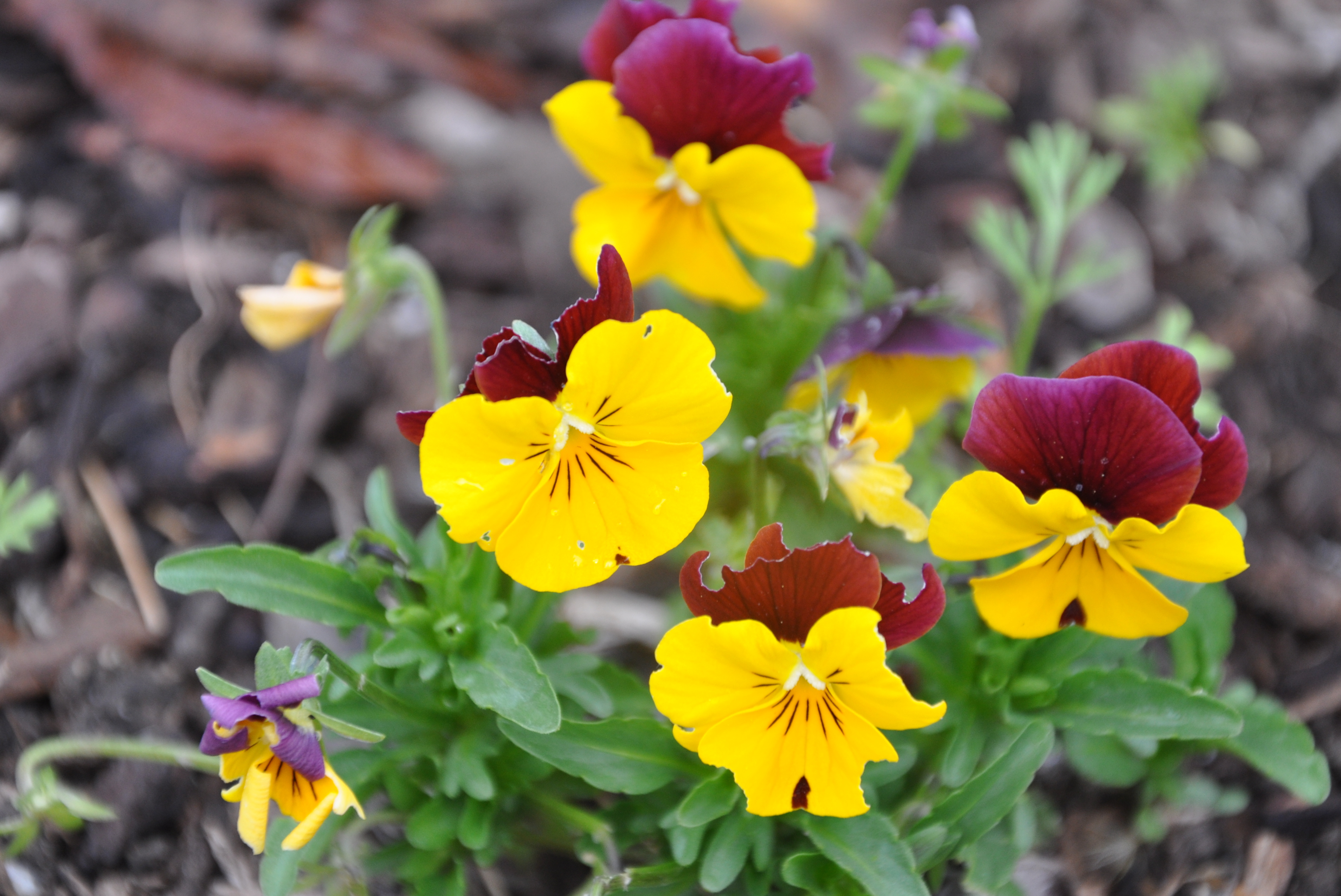
The Statice really filled out. It’s also about to bloom. The purple and yellow pansies are blooming for the second time and the seedlings have doubled or tripled in size. Now that the growing pattern is taking shape, I transplanted a few volunteer seedlings heavily concentrated at the curb. Spade in hand, I held my breath and took the plunge. They drooped for half a day, then bounced right back. Now I’ll have a nice mix throughout the triangle.

congregating at the curb

Congregating at the curb

garden pansies

Garden pansies spring back to life

purple statice

Purple Statice

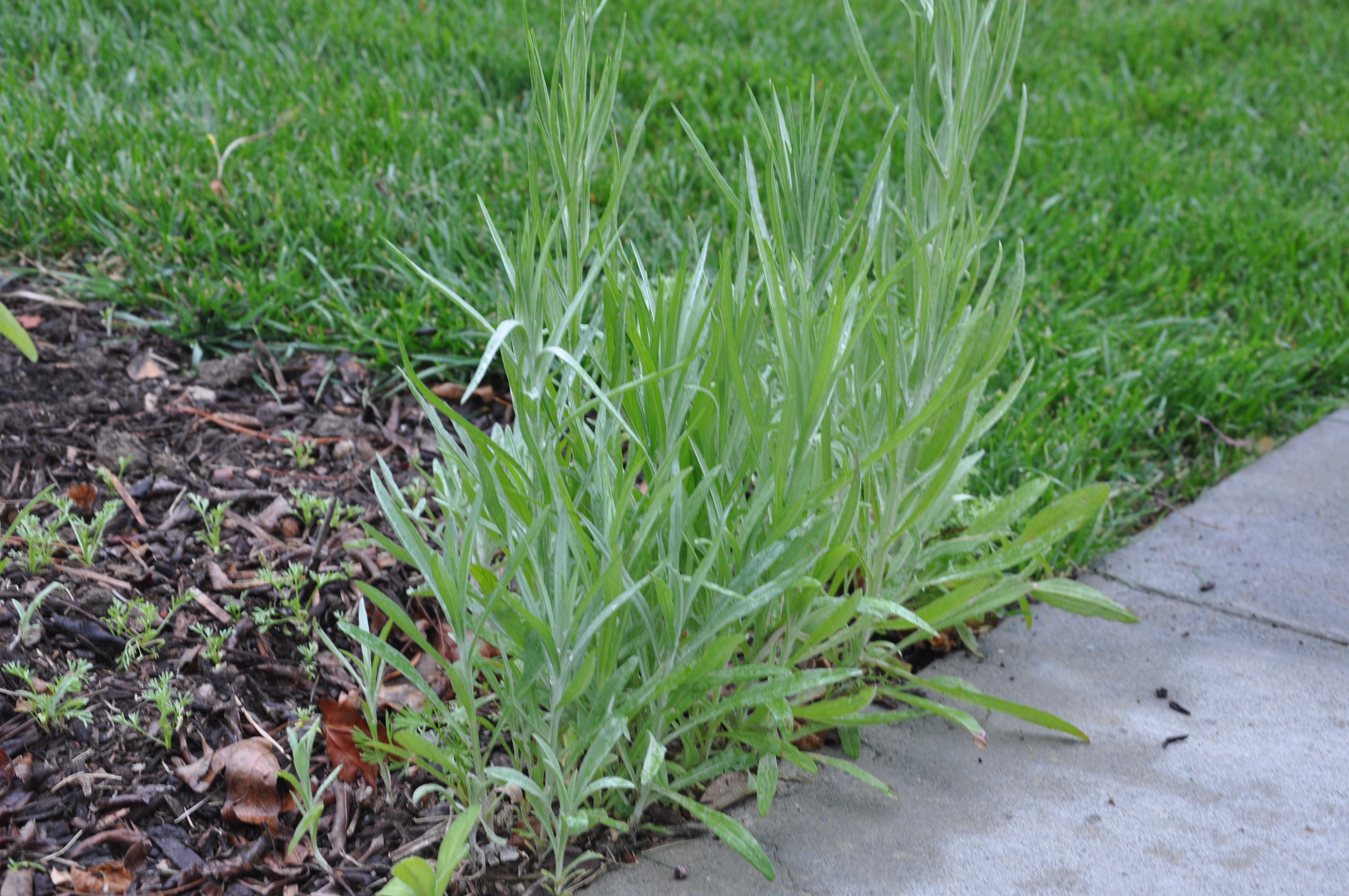
any guesses

Still a mystery. Any guesses?

I collected a lot of seeds last year, including Cosmos, Bachelor Buttons, Four O’clock’s and Zinnias.  Between the collected seeds, the volunteers and the bag of wildflowers (intended for last year but lost, then found) the garden should bloom all season.

Do you have a favorite spring flower?  Is there something you’ve always wanted to grow?  Let me know in the comments below.

Daffodil Dance

Shortly after planting my daffodil bulbs, I saw signs of digging everywhere. Little pockmarks appeared in the same random pattern as the naturalized bulbs. Foiled again!

I fluffed up the soil and hoped for the best. Surely the anonymous foragers left a few behind.

All that worry was for not. (Which is almost always true, but that is for another day). Apparently daffodils (narcissus) aren’t that tasty. I’ve since learned that it’s one of the few bulbs that even bunnies will leave alone.

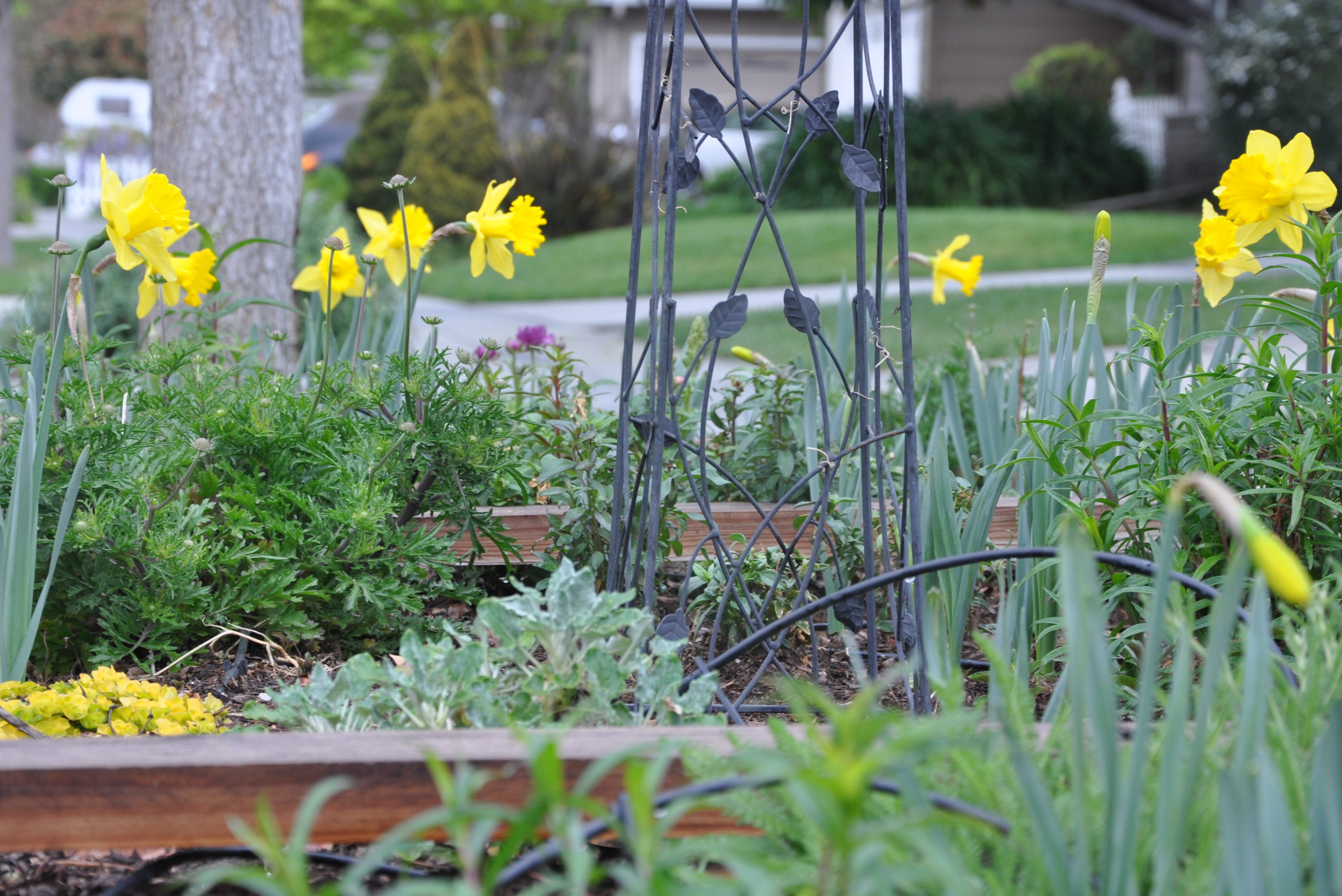
All fifty bulbs came up! Ten are in bloom, with several more about to bud. I’m so cheered by these flowers.

It’s easy to see the inspiration for William Wordsworth’s poem Daffodil:

“Ten thousand saw I at a glance,
Tossing their heads in sprightly dance.”

curb garden daffodils

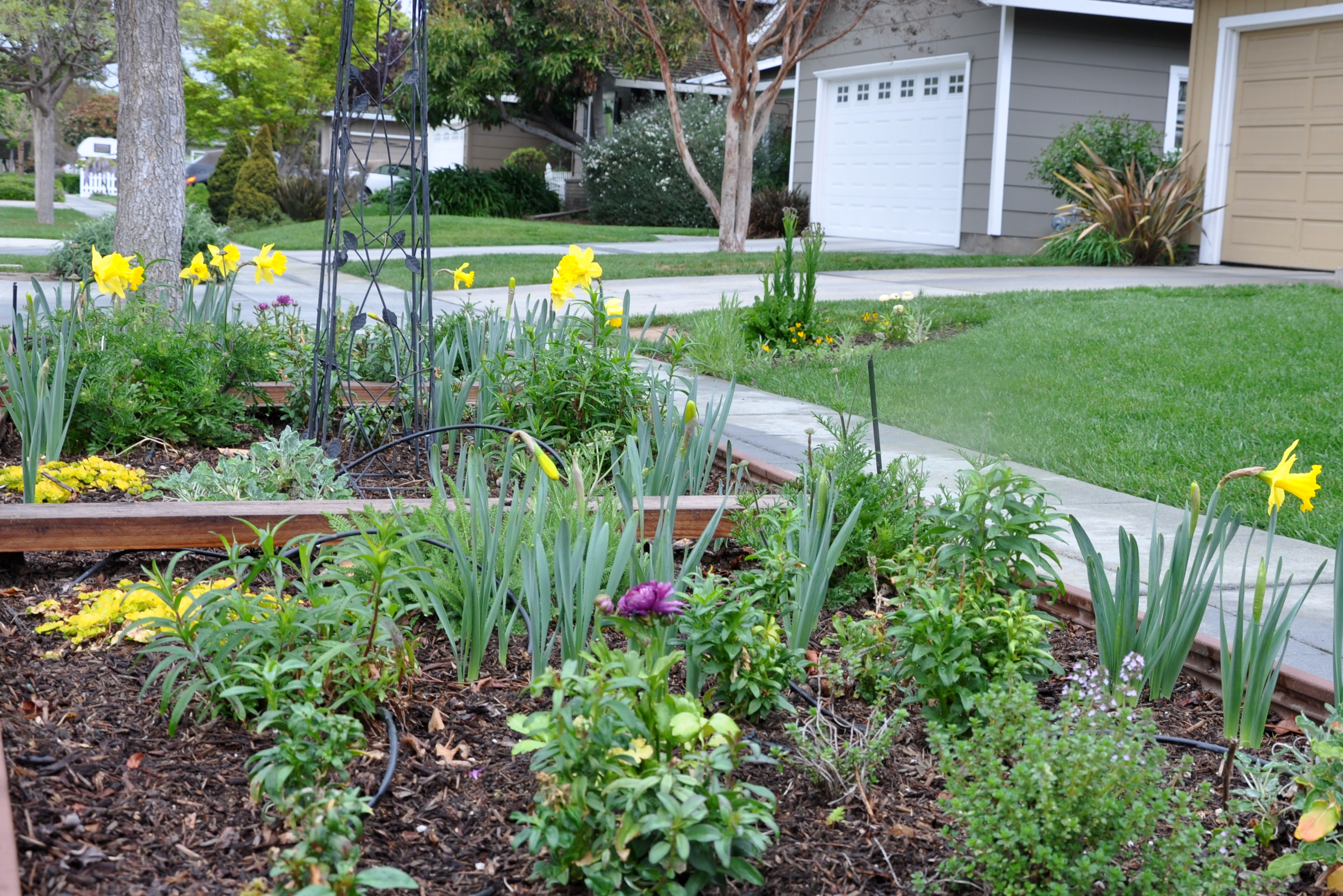
Curb garden daffodils

the long view

The long view

spreading cheer

Spreading cheer

A lovely rendition of William Wordsworth’s Daffodil: