Saving the Rain for a Hot Summer Day

San Jose summers are hot and dry. Even without the drought, rainfall plunges by April and remains mostly dry through September. When we’re not in a drought, we average 15 inches (38 cm) of rain a year, half of the US average.

13.5 inches (34 cm) of that rain falls between November and April. The following six months averages a *total* of an inch and a half or about four centimeters.

When you hear me squeal with delight at the end of this short video, you’ll understand why. We’re back to doing what our ancestors did: saving rain water.

A local company called Rainsavers installed a rain catchment system along the side of our house. The tanks are just around the corner from my vegetable garden.

Lot sizes are small in Silicon Valley, so big tanks aren’t feasible. We looked into gray water systems, but they have  limitations. Further, they are largely promoted for watering a lawn which we no longer have, or other non-edible plants. A friend showed me her patio cisterns, and described how they worked. The pair of cisterns keep her vegetable garden watered all summer. In the end we opted for Bushman Slimline tanks. They have a small footprint so worked well in our narrow side-yard. They connected three tanks, allowing us to collect and store 390 gallons (1,476 liters) of rainwater.

rainsavers collage

Rain Catchment System: view approaching side-yard, vines camouflage tanks, tanks installed along side of house, Brad from Rainsavers

Nearly two years after my water audit, and several stops and starts later, Rainsavers installed our new system. Within two weeks, we had a series of storms. One good soaking filled all three tanks to capacity.

The other cool thing about these tanks is the overflow. Most rainwater becomes run-off, further jeopardizing our diminishing ground water. Any overflow from these tanks helps replenish the county aquifers instead.

Here’s the timeline for reducing our outdoor water usage:

June, 2013: Removed lawn in sidewalk strip, replaced with gravel and raised planting bed

May, 2014: San Jose Water Company Audit

December, 2014: Sheet mulch half of the lawn in the back garden

May, 2015: The Fairy Garden Goes Native

Summer, 2015: We stop watering the lawn

November, 2015: The last of the lawn is history. California natives move in.

February, 2016: Rain water catchment system installed.

A Restorative Weekend at Carmel-by-the-Sea

We’ve just returned from a relaxing and restorative weekend in Carmel-by-the-Sea. Getting away like this is rare for us. We’ve focused on raising our boys who are now teens. Once a year we do an overnight stay at a local hotel for our anniversary, but otherwise we’re close to home.  With our oldest son away at college and the younger one away for the weekend with friends, we pounced on the opportunity to get away.

carmel collage

Enjoying the weekend with my sweetie. On the coast, enjoying an iced tea at Basil’s, posing with gardenerd, wrapped up against the wind

The city website describes Carmel as

A city in the forest. A one-mile long pure white sandy beach.
A cultural mecca for the performing and visual arts.  Superb dining and shopping experiences. A storybook setting!

We stayed at La Playa Carmel, a boutique hotel originally built as a mansion by an artist as a gift to his wife. Most of the talented artists I know can only dream of making that kind of money.

When I shared holiday photos on Facebook, I learned that one of my friends honeymooned there 35 years ago. Another couple we know married at La Playa Carmel. I’m tickled to no end by this. Mike made all the arrangements, so I had no idea that we were staying at this charming place.

[Click on individual photos in the gallery to enlarge]

We enjoyed lunch and dinner in the historic city center, visited the cute little shops, and admired the beautiful landscape nestled among the Monterey Pines. Flowers bloomed in front of every home and shop in the area. It’s a gardener’s dream.


Sunday we awoke to a musical downpour. It cleared after breakfast, allowing us to go for a long walk. As we walked the beach trail we imagined ourselves living in one of the beach-side homes to our left as the waves crashed against the rocks to our right. They build these homes for maximum viewing of the sea. The average list price of a home in Carmel is north of $3 million dollars US. Gulp. It’s fun to dream, though, right?

It started raining again while we lunched at a fabulous Green-certified restaurant called Basil.

carmel the last straw

This gave us the chance to walk arm in arm under our new umbrella for one last stroll before heading home.

Ahhhhhhh….

Gardening From The Ground Up

After my forced break from the garden, I’m making up for lost time. I’ve been outdoors pulling weeds, sorting compost, preparing planting beds and doing general cleanup every day for weeks.

freesia collage

The freesia are in bloom all over the garden

I’m in the garden for a few minutes in the morning after returning from school drop-off. If I’m working with clients or have other appointments, then I put in my time at the end of the day.

lemon tree buds and leaves in the rain

Meyer’s Lemon Tree Enjoying the Rain

The weekend affords the luxury of a few hours in a row, even with our recent and welcome rain.

Chronic neck pain, a wonky hip and my tender ankle tend to dictate the duration. I enjoy working in the cooler weather and even the rain but once my various ailments begin to act up, it’s time to pack it in for the day.

About a year ago I bought a garden kneeler with handles. I’ve seen pictures of them in catalogs for years. I once used a foam pad for shifting around the garden, but it’s become increasingly harder to get back up without pain.

The pictures generally feature a “mature” woman using the kneeler. Only recently did it occur to me that I’m a mature woman. In my mind I’m perpetually thirty. How disconcerting.

I got over myself and bought the kneeler.

gardenease kneeling bench

Kneeling in the garden

Word of the Year

I chose “health” as my word this year. It’s interesting how much of life’s enjoyment comes down to our personal well-being.  I’ve reduced my consumption of sugar, with some slip ups here and there. I’ve kept a food and exercise diary through MyFitnessPal for the past 66 days. Now that I’ve been on such a long streak, I find that I don’t want to miss a day. Logging what I eat is also eye-opening. It feels good to be back to Pilates classes two days a week, and I’m back to long walks as well. The weight is coming off slowly though, which seems so unfair [insert pouting face here].  I’m not giving up, but find it disappointing when week after week the scale doesn’t budge and the pants remain snug. I think we’re conditioned to think that if we do everything “right” we should see the results. Does this happen to you?

The first day of spring in California is March 20th this year. I’ll be planting heirloom tomatoes, basil and maybe, just maybe, a few pumpkins. I have a new and improved watering system which I will share in another post.

When autumn rolls around, I say it’s my favorite time of year. Then spring unfolds and I’m in love with the color, the birdsong and the freshness of it all.

I think I’ve made up my mind: I can’t possibly choose sides.

Have Carrot, Will Travel or Where’s Gardenerd?

Have you seen or heard from Gardenerd?

alys with gardenerdWell technically *I am* a gardening nerd and you’re hearing from me now, but this is different. Gardenerd is the brain child and mascot of Christy Wilhelmi, in Los Angeles, California. Here’s a snippet from Gardenerd: The Ultimate Resource for Garden Nerds.

Are you obsessed with organic gardening, have a thirst for knowledge and a healthy sense of humor? Whether you’re a novice or garden nerd veteran, there’s a place for you here.

At least a year ago my PR assistant, Mel, gave me a carrot plush toy. It’s the cutest thing ever. It also spawned an idea we couldn’t pass up. What if we sent this plush toy around the world so people could photograph it in their gardens? What if gardenerds all over the planet could then post their photos to Twitter or Instagram for all of us to share?

I’m like a child in a candy shop with this sort of thing. After meeting the traveling carrot via Sarah’s video, I quickly added my name to the list of garden hosts.

Gardenerd arrived in San Jose, California last week. He traveled thousands of miles from Waiuku, New Zealand via Sarah The Gardener. Sarah enclosed a few Kiwi treasures with her package as well. What fun!

Thank you, Sarah!!!

Gardenerd arrived with the first of several storms, bringing much-needed rain to our drought-parched state. What a weekend!

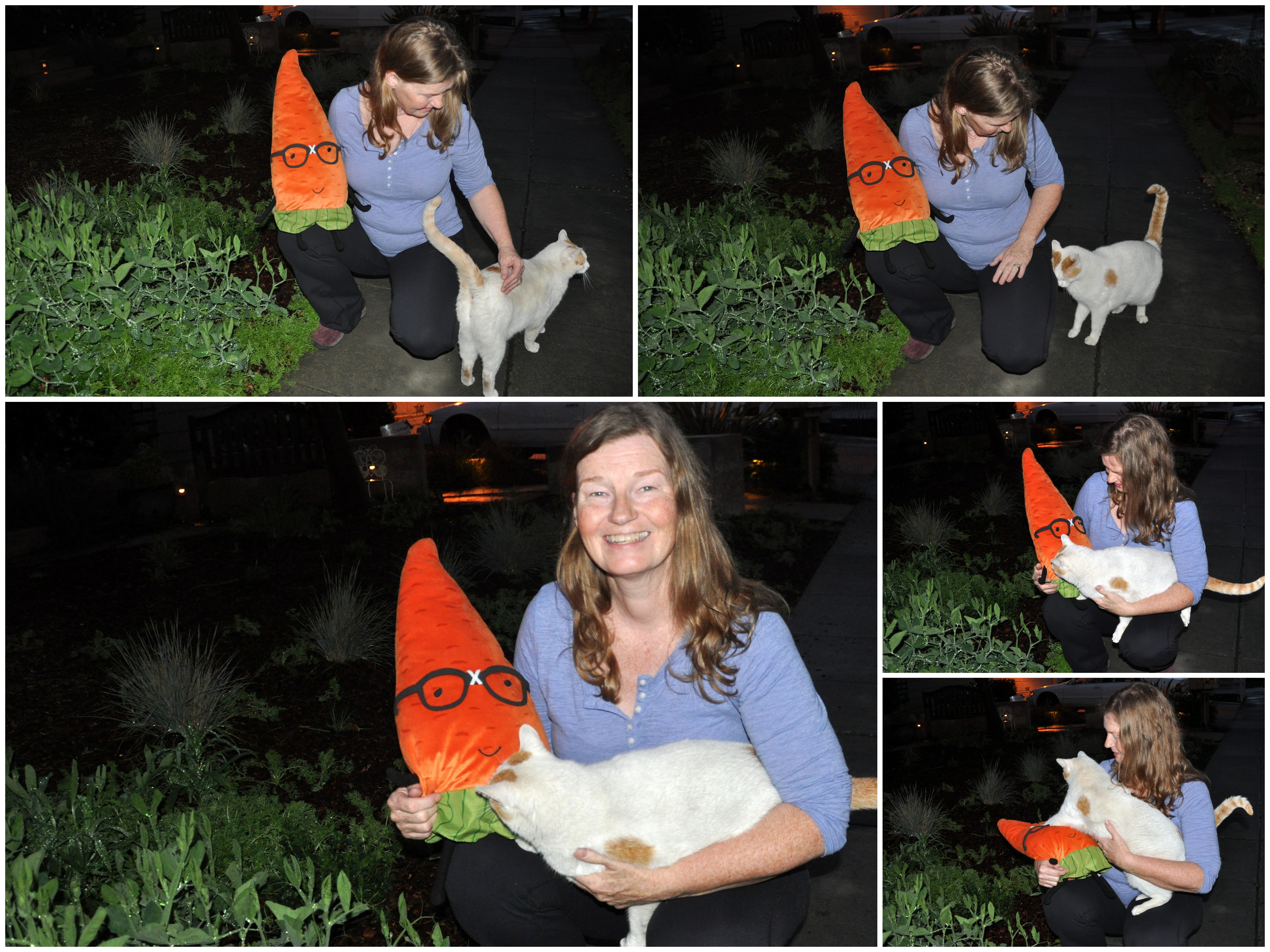
My first order of business was to take a quick pic in the garden with our guest. Mouse the Cat insisted on meeting him as well. As you can see, Mouse doesn’t have a shy bone in his body.

Gardenerd and mouse

By Saturday the rain was really coming down, so some quick rain gear was in order.

gardenerd in the garden

Gardenerd checks out the California native plants #wheresgardenerd

A produce bag, a newspaper cover and some scotch tape did the trick and he was ready to spend some time in the garden.

gardenerd on the garden trug

Gardenerd in his rain gear. He’s resting on my new planting Trug.

It’s been a busy time in the garden with the first day of spring less than two weeks away. I’ve been rotating compost bins, preparing gardening beds and assembling an elevated gardening bed called a Trug. More about that later. With the recent rain, the weeds are having a second go at garden domination. Sadly, they’re in for a disappointment. I’ve been plucking weeds and renegade lawn on a daily basis, keeping the garden in good shape.

Stay tuned for updates as I show my visitor around my garden and the nearby community.

If you’re interested in hosting Gardenerd, you can grab the details here.

You can follow Gardenerd’s adventures on Instagram or Twitter by using the hashtag #wheresgardenerd (with one ‘n’)

International Women’s Day

Today is International Women’s Day. I’m sharing this from my friend Laurie’s blog, Life on the Bike. Laurie recently ran for state delegate in an effort to balance the disparity of women in office. She’s also a health care practitioner, serving the needs of women every day. Let’s spread the word.

LB's avatarLife on the Bike and other Fab Things

Tomorrow is International Women’s Day and the 2016 Campaign Theme is Pledge for Parity.

https_proxy

“Worldwide, women continue to contribute to social, economic, cultural and political achievement, and while there is much to celebrate, progress towards gender parity has slowed in many places”.

Let’s all do our part to take concrete steps to help achieve gender parity more quickly – whether by

  • helping women and girls achieve their ambitions,
  • calling for gender-balanced leadership,
  • respecting and valuing difference,
  • developing more inclusive and flexible cultures, and
  • rooting out workplace bias.

Each of us can be a leader within our own spheres of influence and commit to take pragmatic action to accelerate gender parity.

Please share through your social networks, using #pledgeforparity and #IWD2016

In the meantime, check out this Timeline of Women’s Footprints in History

Thanks for helping to spread the word!

IWD2016

* Much of the verbage in this post was taken from the…

View original post 5 more words

The Rewards of Letting Nature Take Its Course

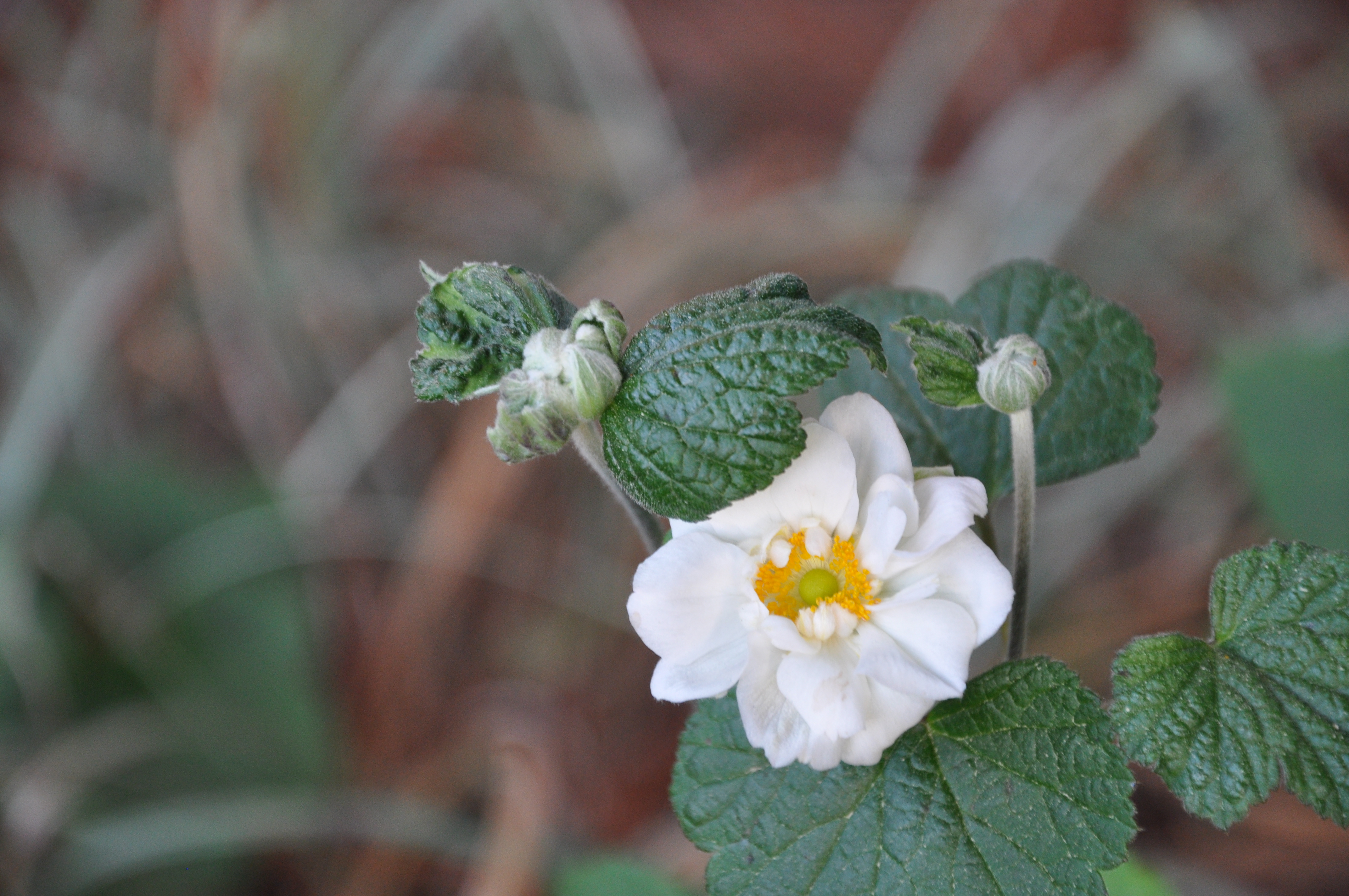
By early to mid August, our white Japanese anemone are in full bloom. They line the rock wall, taking on more and more real estate with each passing year. They’re considered non-invasive, but prolific bloomers. I’ll say.

Anemones

September, 2012 Japanese Anemones Line the Rock Wall

The blooms are generally spent by November and the flower stocks dry up and turn brittle. The entire stem pulls up easily, no pruning required.

Last year we had some late bloomers so I didn’t get around to “trimming” them back.

Then I had surgery.

And the wonderful consequence is this:

hummingbird collecting fluff

Female Anna’s Hummingbird Gathering Nesting Material

I wish the photos were clearer but I had to share. That’s a female Anna’s hummingbird gathering Anemone “fluff” for her nest. She’s been back several times to gather more, along with others nesting mammas in the neighborhood. She plucked at the fluff over and over till her mouth was full, then flew back to the nest. One of the Anna’s appears to be nesting in the orange tree. That’s the direction she goes once her beak is full. Another one gathers, then heads to the neighboring pine tree.
Fluffy Anemone Seed Heads

Fluffy Anemone Seed Heads

Earlier in the week I sat still in a chair for half an hour hoping to capture this wonderful event on video. I forgot to close the back door, however, and within minutes, one of the kitties was asleep in my lap.

I could have taken him back inside, but once I was resting there in the warm sun, I found myself “in the zone.” Sitting in my wicker chair in the garden, warm kitty in my lap, watching nature unfold was mesmerizing. Alas, the mama hummingbird didn’t return for her closeups so I had to make do with these blurred pics and the happy memory to go with them.

Oh, and remember what I said about anemones flowering in the fall? Check out this one, flowering away in late February.

anemone bloom february

Anemone Blooming in February

I wonder if the lack of rain along with weeks of unseasonably warm weather is playing tricks on the flower’s programming?

The Economics of Going Native

California Native Plants Replace the Lawn

California Native Plants Replace the Lawn

There are a number of things to consider when converting lawn to native plants. Economics is one of them. Up front costs are costly if you are unable to do the work yourself. If you live in the Bay Area/Silicon Valley as we do, labor is expensive.

When we bought this house in our thirties, my husband and I did most of the work ourselves. We spent hours removing ivy, digging a faux creek, planting and hauling stones from a quarry in the back of my hatchback. I mowed the lawn with a push-mower, and reluctantly got down on my hands and knees every few weeks to trim the blades of grass away from the curb.

Then life became more complex. I had two boys, three years apart, one requiring a number of early interventions. My husband traveled for one or two weeks each month and often worked long hours beyond a typical day. It made more sense to pay for big jobs then to attempt to do them ourselves. We’re both pretty handy, but we knew our limits.

Now that life is simpler again, I turned my back for five minutes and  I’m now in my fifties.

What?

So while we now have more time, we lack the strength and the energy. Between the two of us we have problems with our backs, feet and knees. We used some of our savings instead.

Here’s the math:

Professional landscape design and installation: $7,658

This included labor for hauling of old sod and other debris, site prep, laying of irrigation, planting and mulch. A crew of three worked for five days to complete the project.

collage native plant installation

RJ Landscape Crew Installation

Material costs included irrigation pipe and emitters, edging, pea gravel, paving stones for the swing area and plants.

The Santa Clara Water District offered a handsome rebate incentive for converting your lawn. After submitting all the paper work, I received a $2,530 rebate.

landscape rebate application

Santa Clara Valley Water District Landscape Rebate Program

This reduced the overall cost by a third, bringing the price down to $5,128.

I am no longer paying a lawn service, saving $1,800 a year in maintenance alone this year or $3,600 over the next 24 months. There will be additional savings in our water bill as well.

Between the rebate and the savings on lawn maintenance, the overall out-of-pocket cost of the conversion is about $1,528. In three years, the project will have paid for itself.

Why replace your lawn? Here’s a handy list published by Green Town Los Altos:

1. Healthier Creeks. Fertilizers, herbicides and pesticides are top polluters in our creeks, killing aquatic life and spreading disease.

2. Less Storm Water Runoff. Deep roots of native plants and trees surrounded by mulch retain more water on site.

3. More Free Time. Native plants don’t require fertilizer, herbicides, pesticides and benefit only from annual or semiannual pruning.

4. Save Water. Lawns require more water than our climate can provide.  Reducing our draw of water from the Delta and the Sierras helps maintain their ecosystems.

5. Save Money. All the mowing, fertilizer, herbicides and irrigation of lawns cost a lot of money. Native plants need substantially less effort and money to maintain.

6. Cash for Grass. Santa Clara Valley Water District will pay you up to $2000 to replace your lawn. Note: Sadly, this program is currently out of money, but  local citizens can put their name on the waiting list.

7. Good Bugs, Not Bad Bugs. Mosquitoes in our dry summer? There must be a lawn nearby. Frequent watering creates tiny pools just right for mosquitoes to breed. Native plants attract good bugs and birds, ones that eat mosquitoes and other pests.

8. Biodiversity. Other than hardscape, there isn’t a more inhospitable surface to biodiversity than the mono-culture of lawns.

9. Less Greenhouse Gases. Manufacture and transportation of fertilizers, herbicides, pesticides, and mowers has a substantial carbon footprint. Transportation, pumping and treatment of water requires energy. When you save water, you also save energy!

10. Smart Choice. Landscaping with plants that are native to our climate is a smart choice. If you want soft areas for kiddies to roll in, native grasses come in all three flavors: seeds, plugs and sod.

You can read the full article at Green Town Los Altos.

One last thing: An amazing thing has happened since removing the lawn. Now that I’m taking care of the entire garden once again, I feel more connected to my little patch of earth. It’s been a welcome and unexpected gift.

To Prune or Not to Prune?

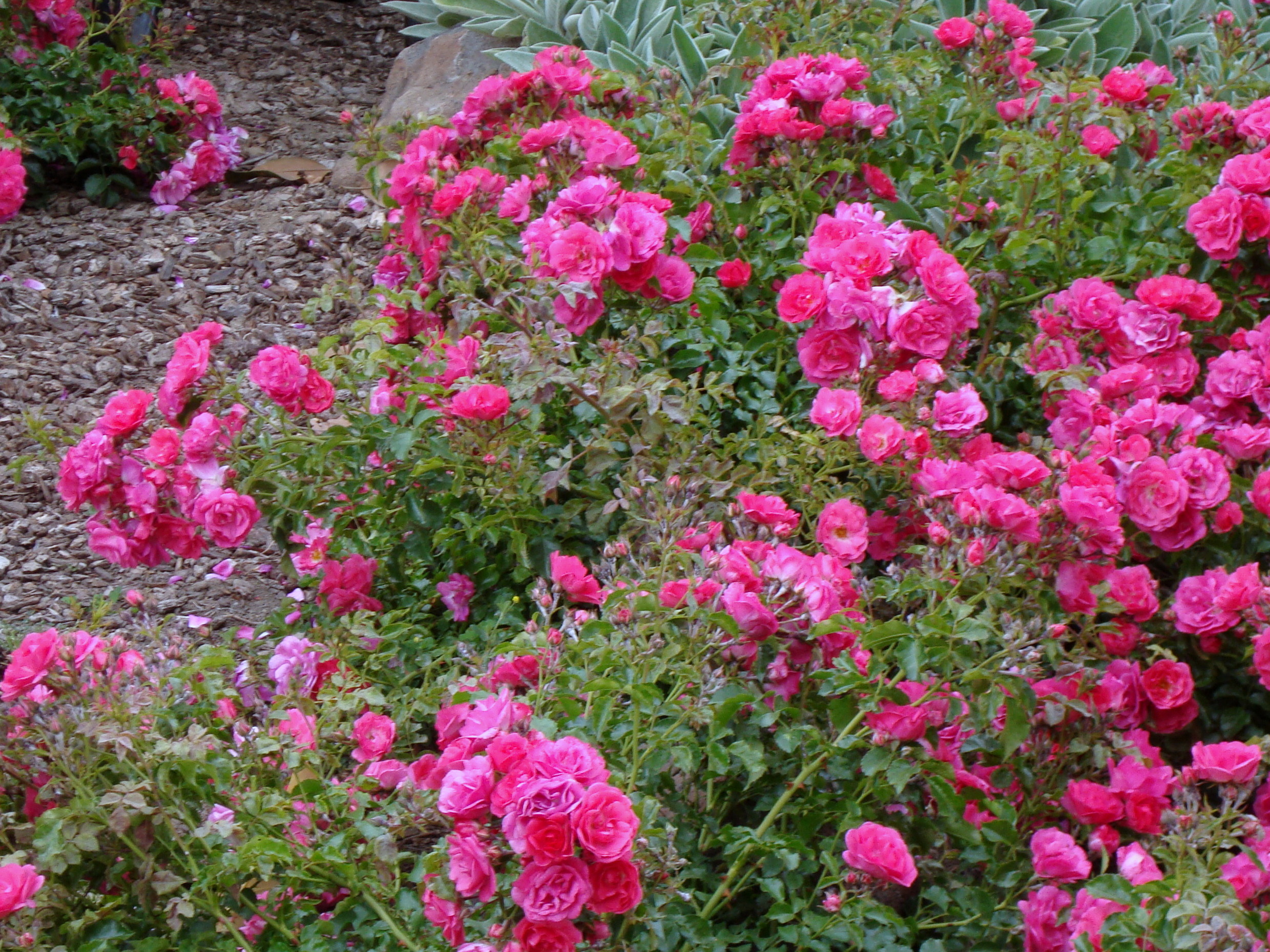
pink roses
There are different theories on the proper time to prune a plant.  When we bought this house twenty years ago there were dozens of rose bushes, front and back. I “hard” pruned them once a year in January, removing crossing branches and dead limbs and leaving little more that a few inches of stem. My neighbor looked on aghast, but I assured him all was well. Sure enough, the flowers bloomed year after year.

I’m not a big fan of roses, so we gradually replaced them with other plants. One of our neighbors took all of the pink roses and transplanted them in the garden of her rental property. It was nice to see them go to a good home.

rose bushes 2010

2010: Rose bushes on their way out.

About five years ago we added some hydrangeas in a few shady garden spots. The first year I pruned the plants in the fall after the blooms turned to a crumbly brown. A few of them came back looking good, but some of the others looked so-so. When I researched the proper time to prune them I got mixed answers. Some of the articles said to prune in the fall if the flowers bloomed on new wood. Others suggested pruning in the spring. I got up close to each plant and honestly couldn’t tell which was which

Last fall I decided to split the difference. I left a few of the plants untouched, while pruning the others just above the buds.

Now I know.

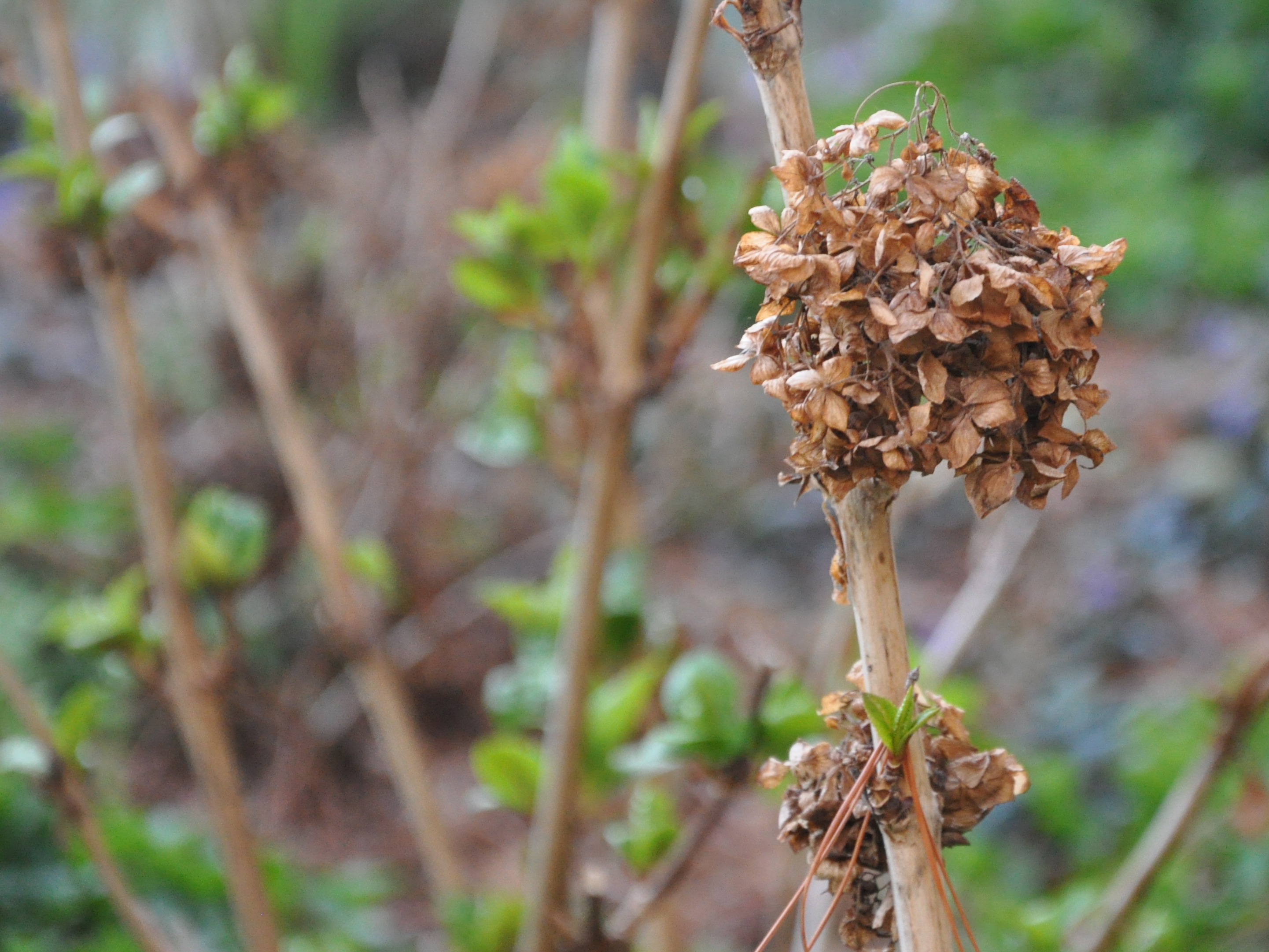
All of the hydrangeas are showing new growth, but the ones I left untouched look healthier. The growth appeared just below last year’s spent bloom. It was a wonderful experience cutting off the dead blooms and exposing the lovely lime green of new growth below. Don’t you just love that color?

Hydrangea: Spent blooms and new growth

Hydrangea: Spent blooms and new growth

hydrangea new growth

Hydrangea: New growth on old wood?

pink hydrangea

Hydrangea: A small bloom…in February.

hydrangea leaves

Hydrangea: New life underway

According to this first article in Fine Gardening, “knowing if your shrub blooms on old or new wood will help you make timely cuts.”

The same site shared this video, saying it depends on when your hydrangea blooms, spring or fall. Since ours bloom in the spring but continue to bloom through the fall, it seems that I should have pruned last fall after all.

I’m back to being confused.

I’ll report back in a few months when the plants are in bloom. Life in the garden is never dull.

My Garden at Dusk

garden at dusk as viewed from back door

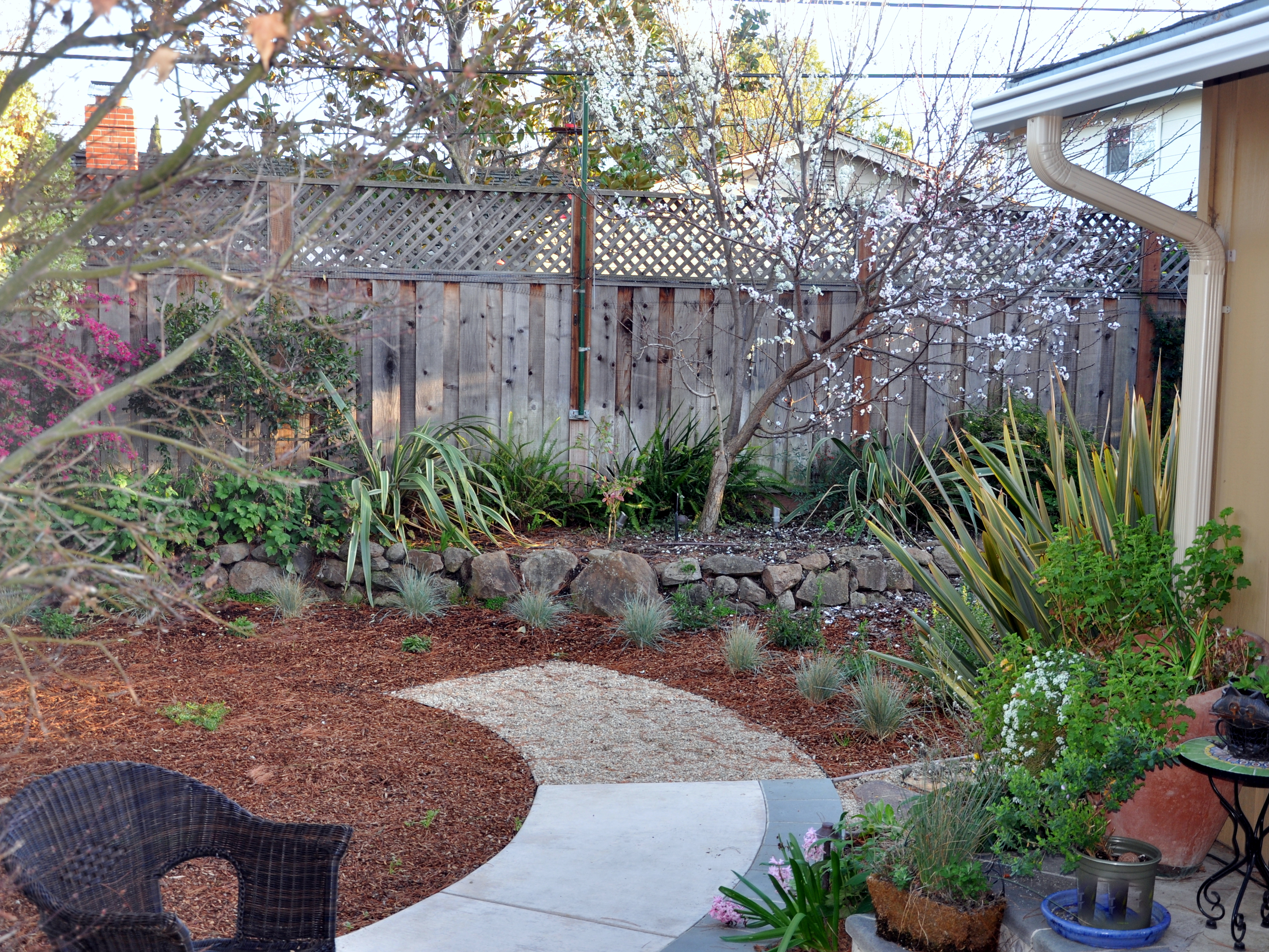
View from my back door at dusk

Though our temperatures are unseasonably warm, the sun tells a different story.  The angle of the sun reminds me that it’s still winter. Dusk comes early in the garden.

It rained last night, a welcome bit of moisture in this otherwise dry month. It smells wonderful.

I’m spending half an hour a day in the garden, pulling tiny weeds and bits of leftover lawn. When we converted the lawn to native plants last fall, they offered to put a chemical in the soil to kill any remaining grass. I’m an organic gardener, so I declined. I’m only finding shoots of grass here and there so it’s been quite manageable. I sheet-mulched most of the back garden beforehand, eliminating most of the grass organically.

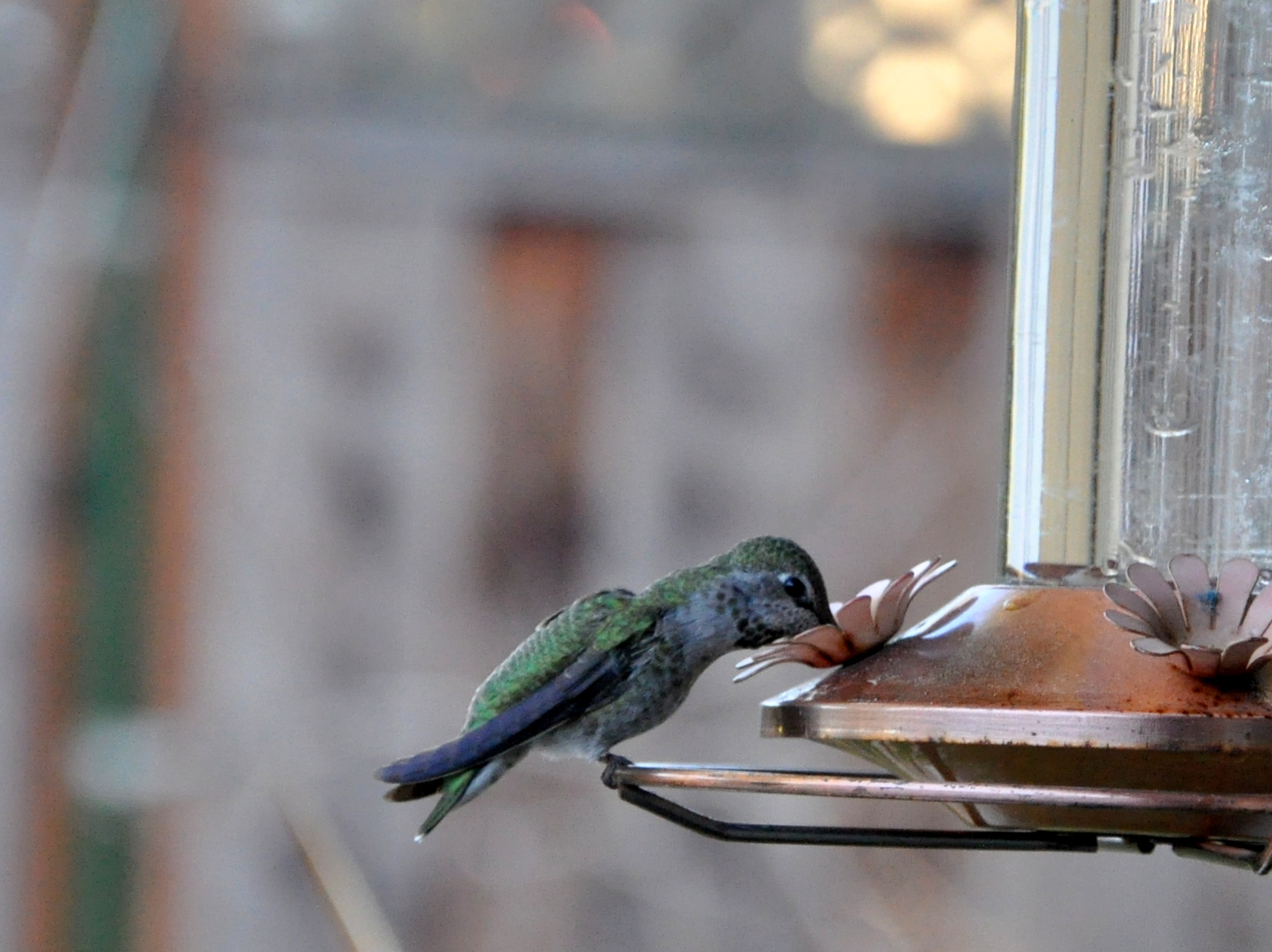
It feels great spending time in the garden. I’ve been sweeping up pine needles, dead-heading the Camellia and enjoying the clean air. I bring in half a dozen lemons each week for our morning lemon water, a wonderful new habit. The female Anna’s Hummingbirds are nesting nearby, which means long drinks at the feeder.  I love hearing them overhead as I work.

female anna's hummingbird at feeder

Female Anna’s Hummingbird at the Feeder

african iris

African Iris

fuschia plant

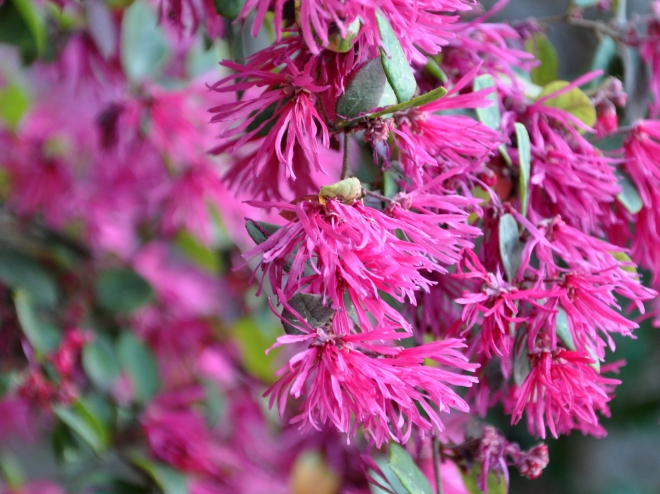
Loropetalum ‘Burgundy Fringe Flower’

new zealand flax with yellow flowers

These yellow flowers self-seeded under the New Zealand Flax.

plum blossums

Plum blossoms on the four-in-one fruit tree

pink William and Kate hyacinth

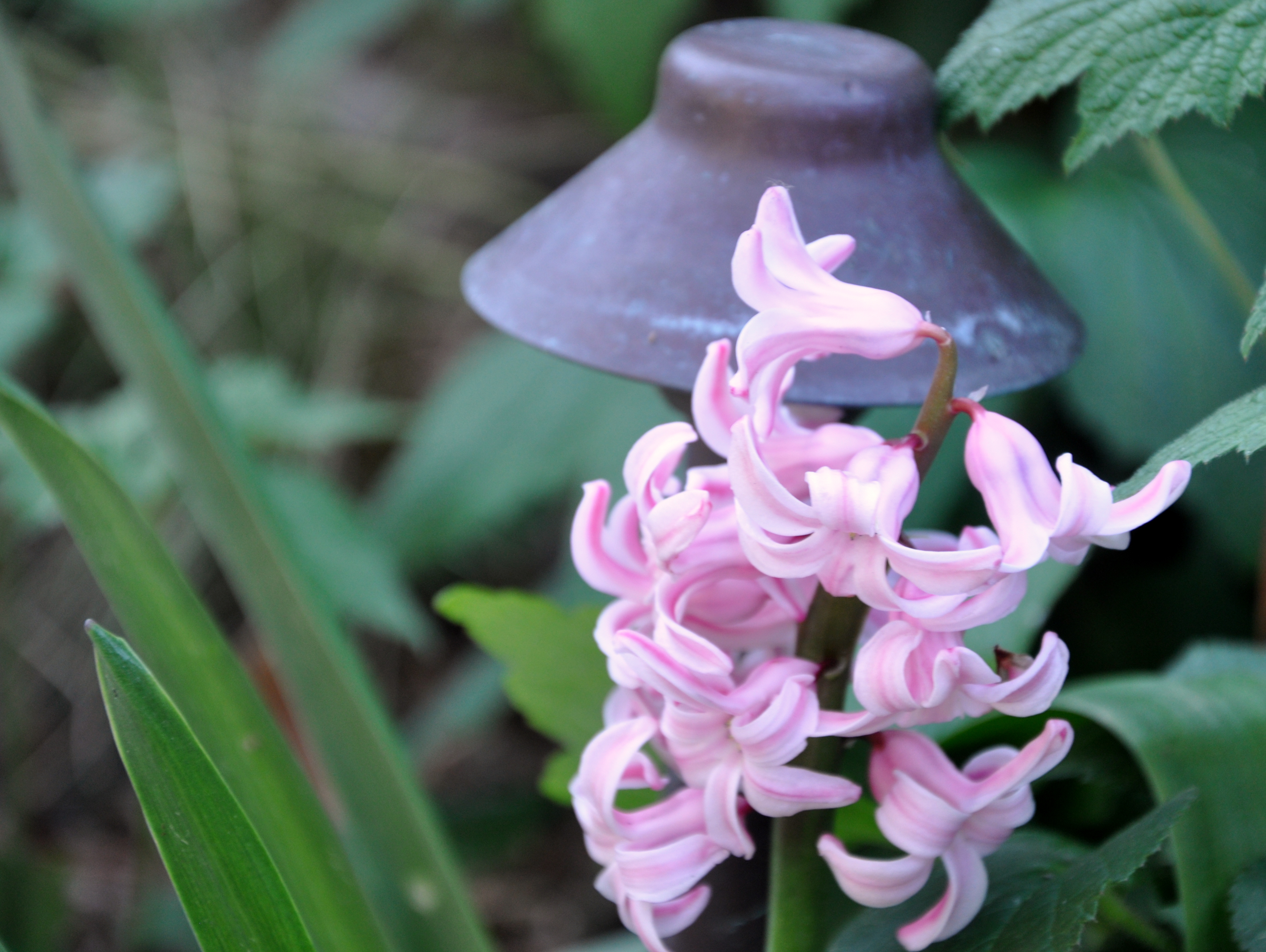
Pink Hyacinth ‘William and Kate’

Life is busy again now that I’m back to working with clients, so a lot of my garden time is catch as catch can. The time among the flowers and weeds feel like stolen moments but I don’t mind. Time in the garden is always a joy.

Robins and Daffodils and The Case of the Missing Rain

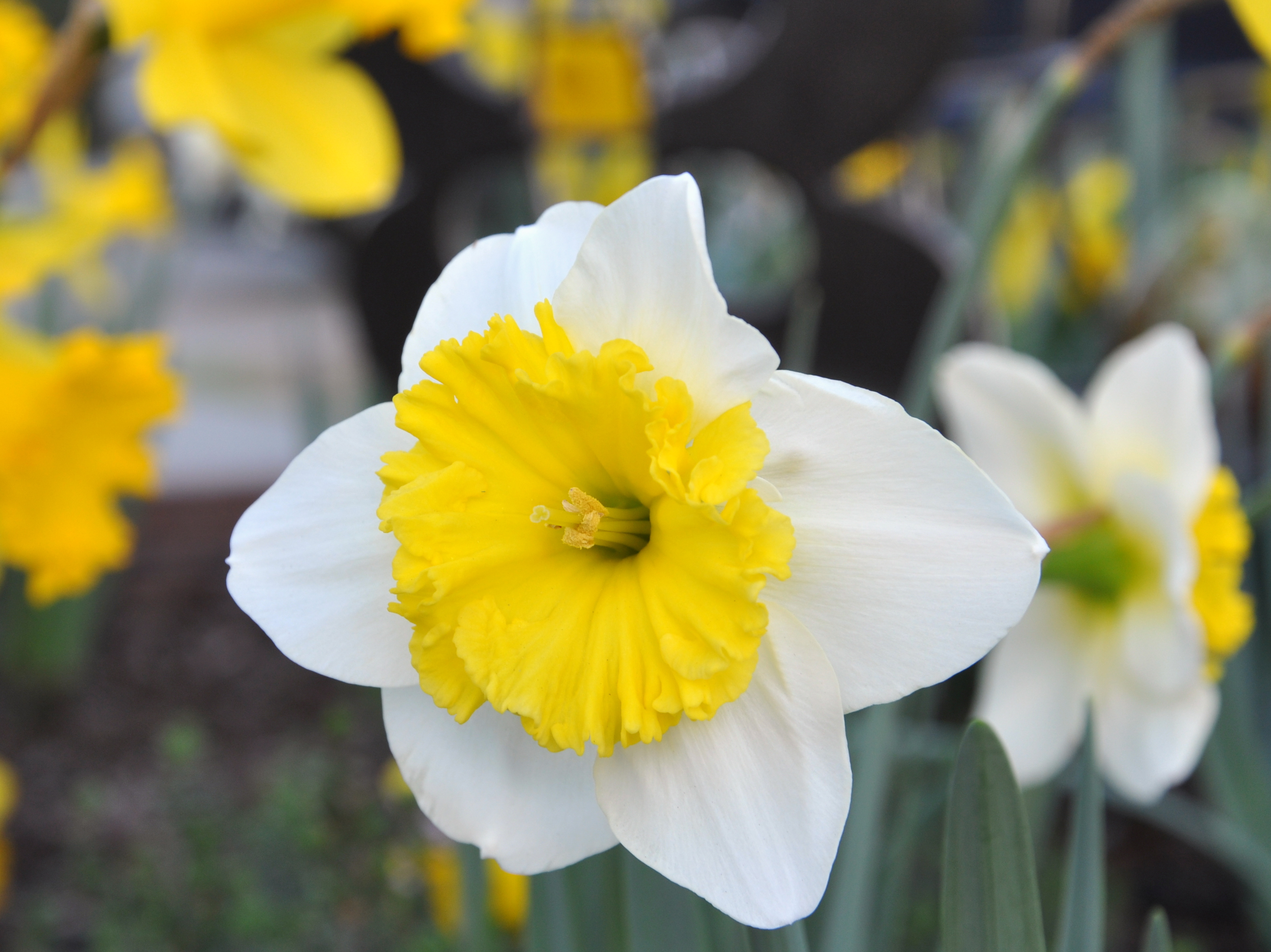
If the Daffodils are up, it must be February. Who needs a calendar when you can look out your front window and see this:

daffodil closeup

Daffodils: Just the Beginning

I’m amazed year after year that those tiny, brown orbs buried beneath the soil know exactly what to do and when.

For years I drooled over the Holland Bulb catalogs, but so many of the flowers need a really cold winter to do well. I tried tulips, refrigerating them first for six weeks in the crisper. Time in the cold environment simulates winter. The first year nothing came up. I wondered if I planted them too deeply or perhaps upside down. Maybe they rotted in the ground? There was no evidence that they’d been devoured by a critter.  I tried again about a decade later, once again lulled by the promise of beautiful tulips in my garden. About half of the bulbs produced beautiful blooms, but by the following year I was down to one.

After a bit of research I learned that Daffodil bulbs (narcissus) are toxic to squirrels so they leave them alone. They don’t require a cold winter and they can stay in the ground year round. Now that’s my kind of bulb.

Using the broadcast method where you toss the bulbs to the ground, then plant them where they land, I filled the curb garden box with 50 bulbs.  Every last one of them bloomed!

daffodil collage feb 5 and 10

Daffodils: February 5th and 10th

daffodil trio

Daffodil Trio

Emboldened, I bought 25 more bulbs the following year, this time the two-toned variety. They’re coming into bloom about a week after the original planting.

pair of two toned daffodil

What’s Up, Buttercup: A Two-toned Daffodil

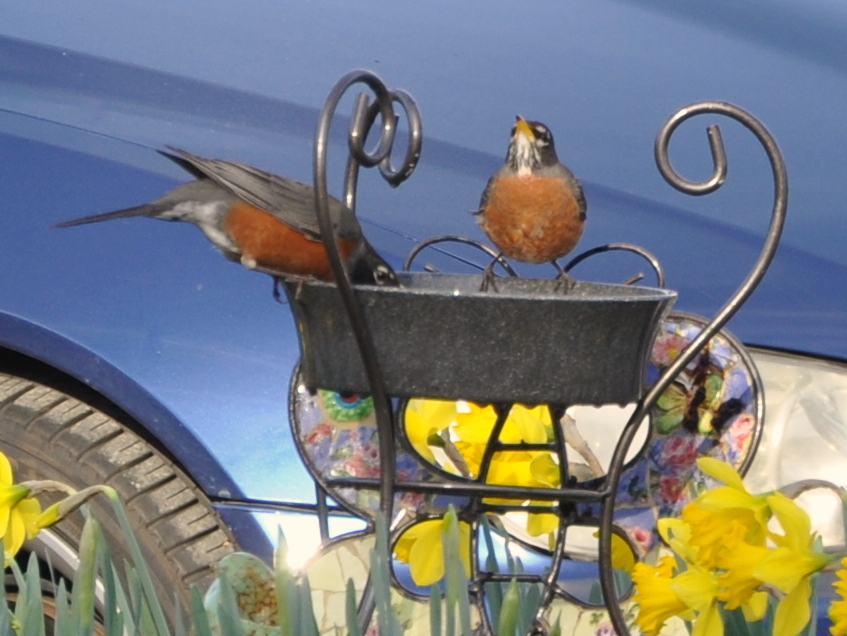
Also outside my kitchen window this past week: A thirsty flock of Robins.

three red robins

Trio of Robins

Though the American Robin is common throughout the States, we don’t usually see them flock in our neighborhood. Over the past two weeks, no doubt prompted by our strangely warm, spring-like weather, they’ve been gathering in nearby trees and drinking at our watering hole. Robins are handsome birds with an equally delightful song.

They prefer a meal of worms, but once the ground is frozen, they’ll migrate and then feast on berries. All that flying back and forth between trees means they’ve left quite a mess in their wake. You take the good with the bad, right?

I made myself late to Pilates last Thursday as I went into the kitchen for some water and fled for my camera instead. There were at least a dozen robins, one sitting in the water fountain, and the rest taking turns for a drink. By the time I put the microchip in the camera, then found a place to take pictures hiding around the corner of the garage several had moved on. I still got a few shots in and around my MacGyvered watering hole and garden.

robins drinking from the fountain

Robins taking turns at the watering hole

The garden is coming alive with color.  We’ve had ten days of unseasonably high temperatures but only a trace of rain. Today, San Jose may tie a record high set in 1943. February is traditionally our rainiest month. In a state that counts its rainfall in fractions, February is the star with an average of 3.31 inches (8.41 cm) of rain. Our annual rain fall is only about 15 inches. It’s February 15th and we’ve only recorded 0.05 inches! So while it sounds uncharitable to complain about blue skies and warm weather…well, I’m complaining.  We desperately need more rain.

If your swimming in surplus precipitation, please send it our way.