
“Sprucing” up the drapes

A fairy jungle of succulents

Succulent flowers going to seed

Tiny reindeer on the roof

A Merry Christmas sign from Boomdee

Stars shining brighlty, tiny deer overhead
I’ve started a new Christmas tradition. It’s called patience.
I’ve learned to wait patiently in line at the post office. I peel of all my layers before going inside so that I don’t pass out from the heat. I know all the post office regulars, and look forward to a brief yet satisfying chat when it’s my turn at the window. I use the time in line to people watch. Sometimes I make productive use of the wait by addressing a card or filling out custom forms.
Patience is a gift you give others, but it’s also a gift to yourself. I feel better about myself when I’m patient.
I’m patient with my husband’s annual fretting over the lights. He once spent four hours on the floor of the garage trouble shooting strands of Christmas tree lights. Our boys were young at the time, and I grew frustrated with what seemed like such a waste of family time. I’ve mellowed. And I’ve come to understand that it’s his thing. He hangs lights on the tree, strings lights on the house, and replaces all the lights in my son’s Christmas inflatables. He makes multiple trips to the hardware store to find replacements. Small packages arrive in the mail containing fuses and bulbs. Mike is a fixer and that’s what makes him happy, so with patience comes an understanding. Everybody wins.
I’m patient with Lindy’s demands for more and more (and more) attention, but I’m patient with myself, too. When I know I need to buckle down and get some work done, I relocate her to a sunny spot in the house and close the door. Prior to that she gets pets, cuddles, treats and a roll in the catnip, but after repeated demands for ear-scratching, I finally remove her from the room so I can get things done.
I have two remarkable teenage boys requiring no patience. I guess all that earlier guidance and patience eventually paid off. They’re both delightful young men. Perhaps this tradition of patience isn’t so new at all. That said, it takes patience to cultivate any good habit, so I’m learning to be patiently patient with myself.
Go figure?
I’m sticking with a few favorite traditions this year, too.

I use tiny silver clothes pins to attach cards to the tool skirt
I’m adorning my dress-maker selfie with Christmas cards once again. I love putting her to use sporting all the beautiful cards we receive by mail. It’s a dwindling tradition, but we continue to send our own cards each year and love the ones we receive.
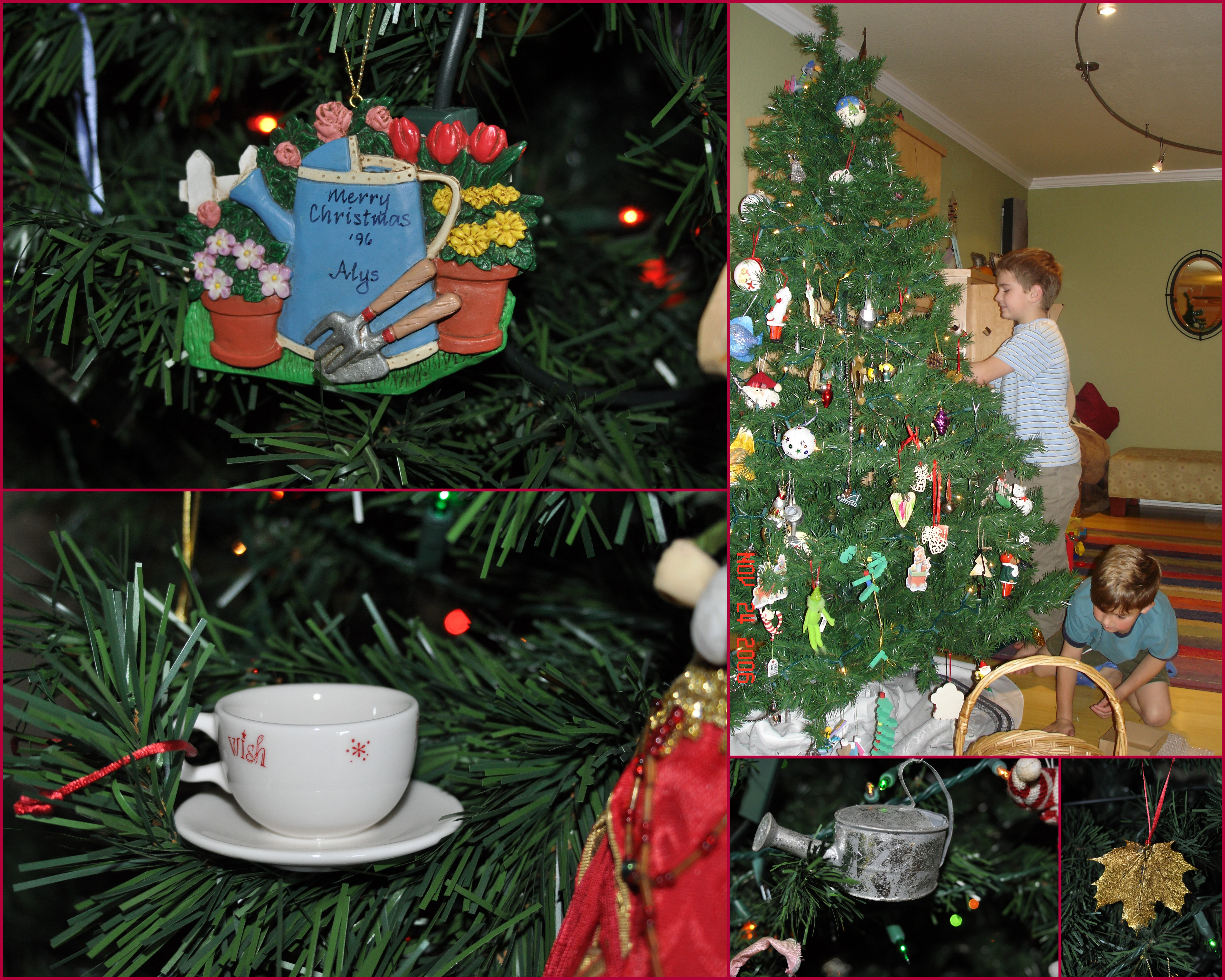
The boys decorating the tree a decade ago. Gifted ornaments over the years reflecting my love of gardening and hot tea.
We pull out our artificial tree the day after Thanksgiving and decorate it with the ornaments we’ve collected over the years. Every ornament has a story and that’s what makes it fun. We hang hand-made school ornaments from the boys early days along with ornaments we’ve received as gifts. We like to pick up an ornament when we travel, each one a fun reminder of a different holiday. Thomas the Tank Engine sits among the branches along with a hand-painted Christmas ball from Cannes France. It will come as no surprise that fellow bloggers Julia, Kelly and Marlene also contribute to the history and diversity of our tree. In the few days leading up to Christmas, I enjoy sitting in the dark, tree illuminated, grateful for the love in my life.
Our acrylic globe, a gift from my friend Marcia, becomes a “snow globe” this time of year. Each year is a little different from the last. Here’s the latest: I made a path using Petra paper left over from a holiday plant and some artificial snow. I added a few tiny trees from prior years and a twenty year old wooden snow man. I can squint my eyes and pretend that it’s snowing in San Jose.

Snow + Globe
Tomorrow I’ll start one more tradition. I’m volunteering for a toy distribution shift at Sacred Heart Community Services. Sacred Heart will distribute over 18,000 toys and books to 6,200 children in need in our community. This is a big step for me, as I used to get mired in depression when working so closely with the disadvantaged in my community. I retreated to a “safer” form of volunteering, either hosting drives, or serving on committees or board of directors. Since the election, I’ve been motivated to get up close again. The goal is to remain open, while at the same time protecting my tender heart. Wish me luck.
‘Tis the season…of Hanukkah, Christmas, Kwanzaa and Solstice; a time to share of ourselves.
What are your special traditions this time of year?
On a cool winter day, long before its scheduled appearance, a tiny pumpkin seed broke ground. How quaint, I thought, but how could it last? It was still cold at night.
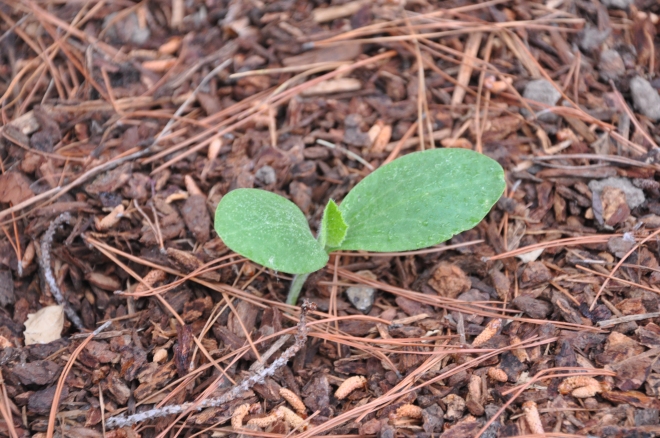
Pumpkin Sprout * March 4th, 2016
According to my seed packet, pumpkin seeds should go in the ground in May after “danger of frost has passed.” It was early March after all.

The start of something special

Pumpkin Vines (foreground). My crop grown from seeds in the Earth Box. RIP my failed little crop. * May, 2016

Pumpkin Vines and a Strolling Mouse the Cat * May 26th, 2016
As weeds appear, they are unceremoniously tugged from the earth, but I let other tiny seedlings grow. When it comes to my garden I’m part dictator (off with their weedy heads) and part socialist (everyone deserves a fair chance). I didn’t pamper the pumpkin, but I didn’t discourage it either. Before long, we were checking on the plant every day. In the heat of summer, pumpkin vines grow like weeds. Curly tendrils grab hold of nearby plants and meander across the garden. The Giving Pumpkin took off before spring!
If you’re new to planting pumpkins, it goes like this: the seed sprouts and a small plant appears. Several leaves form and the vine trails. Male flowers start to grow on the vine, opening by day, closing at night, and dropping from the vine within a day or two.

Male Pumpkin Flower * May 7th, 2016
Then the female flowers appear and the bees are on the job. The bees travel between blooms, cross-pollinating as they gather nectar for the hive.

Female Pumpkin Flower
Presto! Tiny green pumpkins begin to form on the vine. It’s not a done deal by any means. Those tiny pumpkins might last a day or two before shriveling and dropping to the ground. Sooner or later though, a glorious pumpkin takes hold and off it grows. If you’re lucky, the fabulously forming fruit goes undetected by rats, squirrels and the dreaded squash bugs.
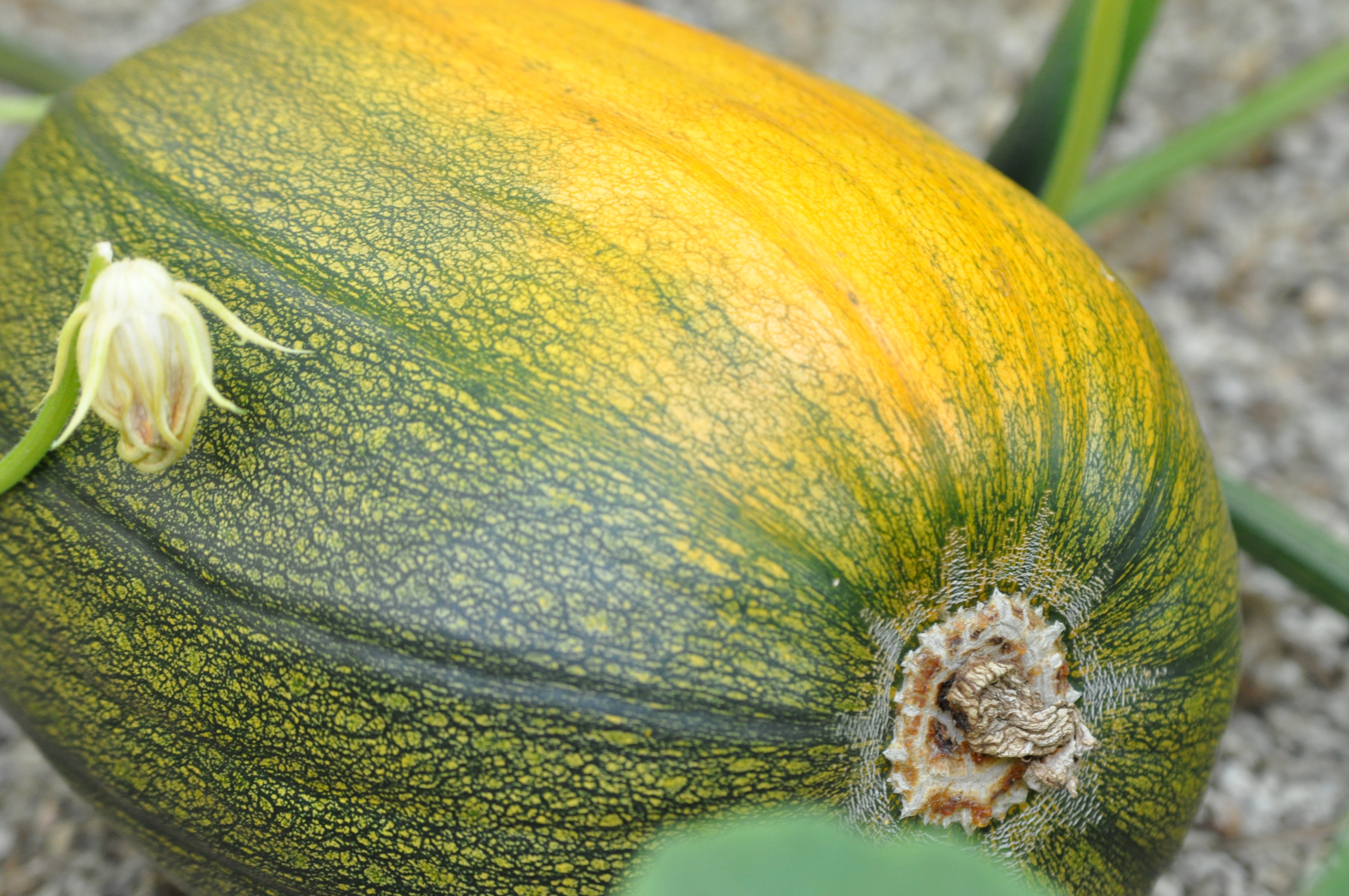
Turning Orange in the Sun * June, 2016
The size of the mature leaves closely determines the size of the pumpkin.

Pumpkin leaf correlates to the size of the fruit
Here’s what’s new this year with this fabulous giving pumpkin. As the fruit forms, the energy diverts from the plant to the fruit. In the past, once that happened there was no turning back. In rapid succession, the leaves turned ashy, literally crumbling to dust in your hands.
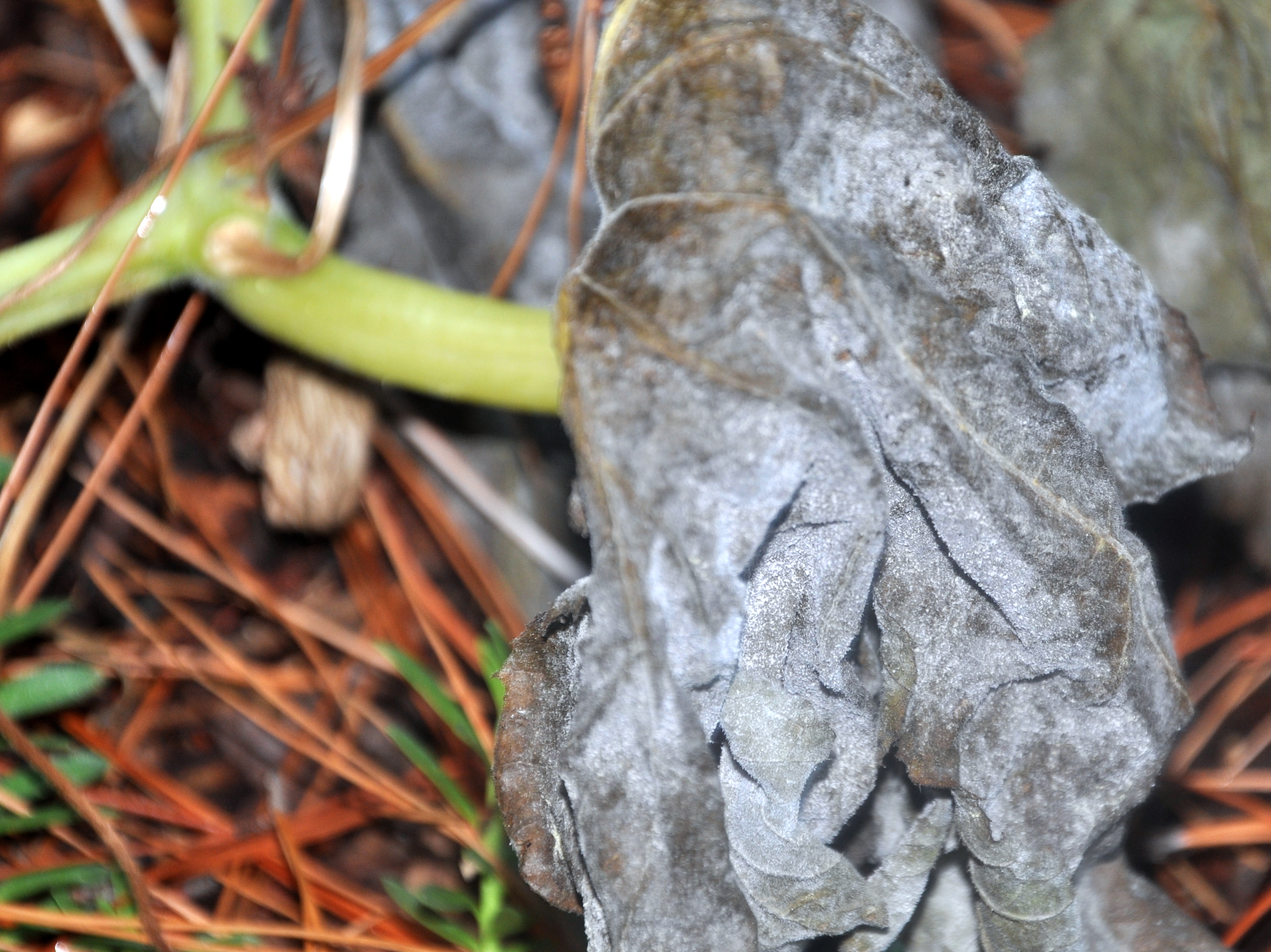
Pumpkin leaves turn to ash
I removed the dead leaves, harvested all three pumpkins, and figured that was that. My son asked it we could leave the vine a little longer, as we spotted a tiny budding pumpkin. So we did. To my delight, several new leaves formed at the joints and the vine took on a second life: more leaves, more flowers, more fruit. I’ve never “grown” such a prolific pumpkin.

Pumpkin Vine at Dusk * June 10th, 2016

New growth on the self seeded pumpkin
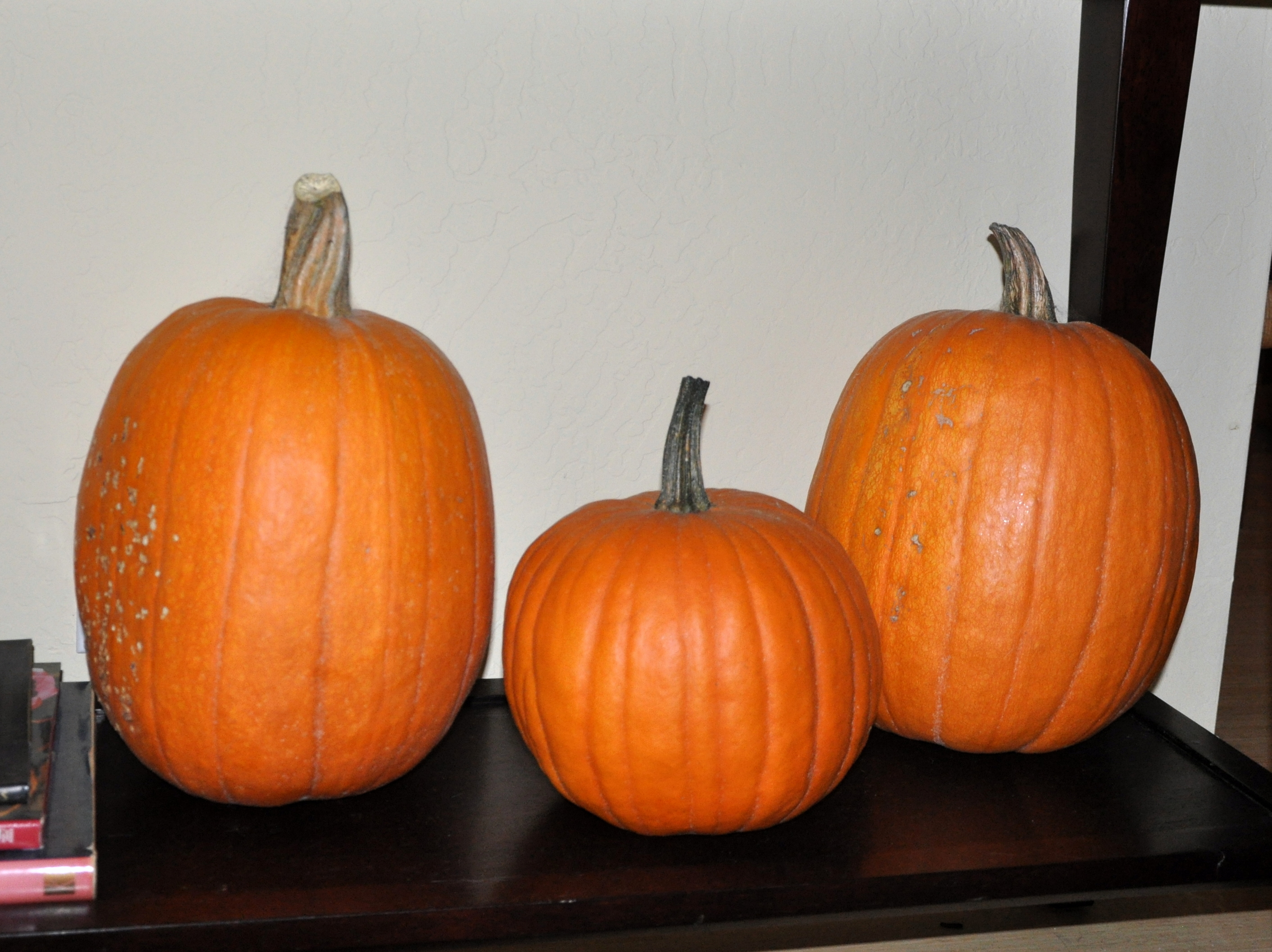
Tall twins and a cousin * August 9th, 2016

A Second Pair of Pumpkins * August 9th, 2016
The average life of a pumpkin plant is 90 to 125 days from seed to maturity. When I harvested the last pumpkin we were well into October.

The last of the pumpkins. Not quite orange, but full of teeth marks.
What a fabulous crop! I may start following Pauline’s advice. I’ll just toss a bunch of seeds over my shoulder and let nature do the rest. This season was great fun.
*With a tip of my hat to Shel Silverstein, author of The Giving Tree.
Note: On October 31st, my husband carves the pumpkins and we display them on the deck. We average 300 costumed children at our door each year. It’s a festive night. Here are some of his carvings from prior years.


I’ve said it before: creating a fairy garden is a shortcut to our inner child. That’s why I jumped at the chance to make one for Elizabeth.

This way to the fairy garden
Elizabeth Cassidy is my Pilates instructor. I’ve been taking classes at her studio for nearly a decade. We’re a close-knit group of women, who regularly offer bounty from our gardens, clothes or shoes in search of a new home, references and referrals and the like.
At the end of class one day, she asked if any of us wanted this empty concrete planter.

Elizabeth’s grey planter
Since no one else wanted it, I offered to make it into a fairy garden for her studio. Oh my gosh I had fun!
I wanted to bring a bit of warmth to the grey pot, so I added a single coat of rust-colored spray paint along the top, bottom and sides.

I used a single coat of rust-colored spray pain to add warmth
I added recycled packing pellets to the bottom of the pot to reduce its weight and to provide drainage. Then I filled it to the top with plants and soil.

Recycled foam pellets lighten the load
I bought assorted succulents at Yamagami’s Nursery one of my favorite garden centers. They’ve been in business since 1948.
Elizabeth has a pink corner in her studio, so the “fire-stick” succulents were the perfect addition. I found the sweetest little ceramic house and copper fence, also at Yamagami’s to round out the garden.

Sticks on fire ‘euphorbia’ succulent
I made a fairy cot or lounging bed using a small wooden block from a rubber stamp collection. I added a curved twig for a headboard, covered the bed with moss, and added a wine cork for a pillow. A bit of moss from my garden stash made a nice accent cushion. For an added bit of serendipity, the chocolate wine cork is from a gift Elizabeth gave me a few years ago. It was in my fairy garden stash, waiting for its debut.

Assembling the fairy cot

A resting cot for the fairies
Once the plants were in the “ground” I laid a cinnamon stick path to the door, then added gravel and other bits of moss here and there.

Succulents and a cinnamon stick pathway

The long view
There is good news on the wildfire front!
The Loma Fire I mentioned in An Ominous Autumn Beginning should be fully contained by today. According to the San Jose Mercury News, the 2-week-old wildfire remains 95 percent contained after burning 4,474 acres, destroying 12 homes and 16 outbuildings, and damaging but not destroying one other home. The blaze, which began Sept. 26, is the area’s third largest in the past 15 years, and the latest damage estimate is $15 million.
The Soberanes Fire, mentioned in my post August Doldrums, is 99 percent contained, with full containment expected by Saturday, October 15. The fire started July 22nd from an illegal, unattended campfire. It’s burned 132,127 acres, and destroyed 57 homes and 11 outbuildings. A total of 682 personnel and nine engines remain fighting the fire. The cost of fighting the fire is currently $236 million, making it the most expensive fire in California history.
Needless to say, I’m glad our rainy season is on the way.
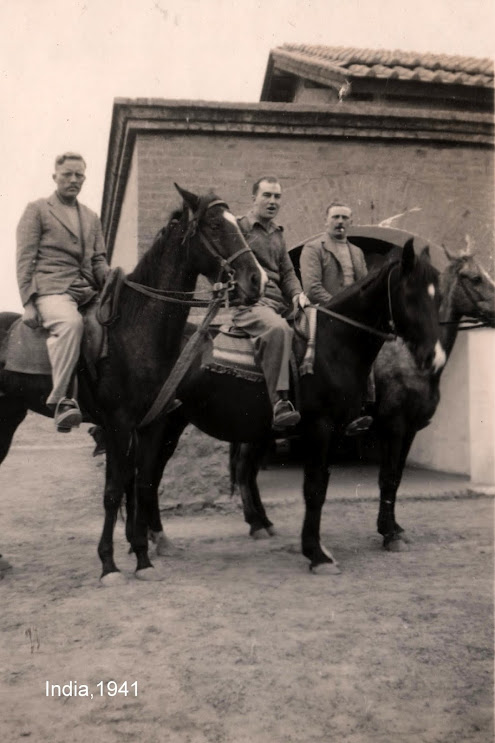
Eric Milner, center
My father traversed an interesting path, one of travel, adventure and creativity. Born in England on October 6th, 1915, today would have been his 101st birthday. Daddy studied botany and horticultural science at Wimbledon Technical College. He worked as a student gardener at the John Innes Horticultural Institution in London. Now you know where I got my love of gardening.
In a letter he saved dated October 1st, 1937, it says:
“Mr. E. Milner came to us on Sept. 16th 1935 as a Student Gardener. Since that time he has spent 4 months in the Fruit Department, 2 months in the Rock Garden, 8 months on general outdoor work and 10 months under glass. His experience with us has included the propagation and maintenance of stove, glasshouse and herbaceous plants, all of which we grow in considerable variety.”
So formal! After completing his courses, he moved to India to work on a tea plantation around 1937. He remained in India during the second world war serving as a translator.
In a letter dated 7th May, 1946 from the India Office, Whitehall, it says:
Sir,
“Now that the time has come for your release from active military duty, I am to convey to you the thanks of the Secretary of State for India and of the Government of India for the valuable services which you have rendered to your country at a time of grave national emergency.
At the end of the emergency you will relinquish your commission, and at that time a notification will appear in the London Gazette (Supplement), granting you also the honorary rank of Captain. Meanwhile, you have permission to use that rank with effect from the date of your release.”
He returned to England in 1946 and shortly thereafter immigrated to Canada where he met and married my mother. Together they owned a pair of flower shops for a few years. My father later managed a nursery in my hometown of London, Ontario.
Lucky for me his hobbies included photography and the careful assembly of albums, like the one pictured here. I remain fascinated all these years later of his time in India and his work planting and propagating tea in the Darjeeling region. He died far too young. A smoker of pipes and unfiltered, hand-rolled cigarettes, he lost his life to cancer when I was just nine years old. He was 54.
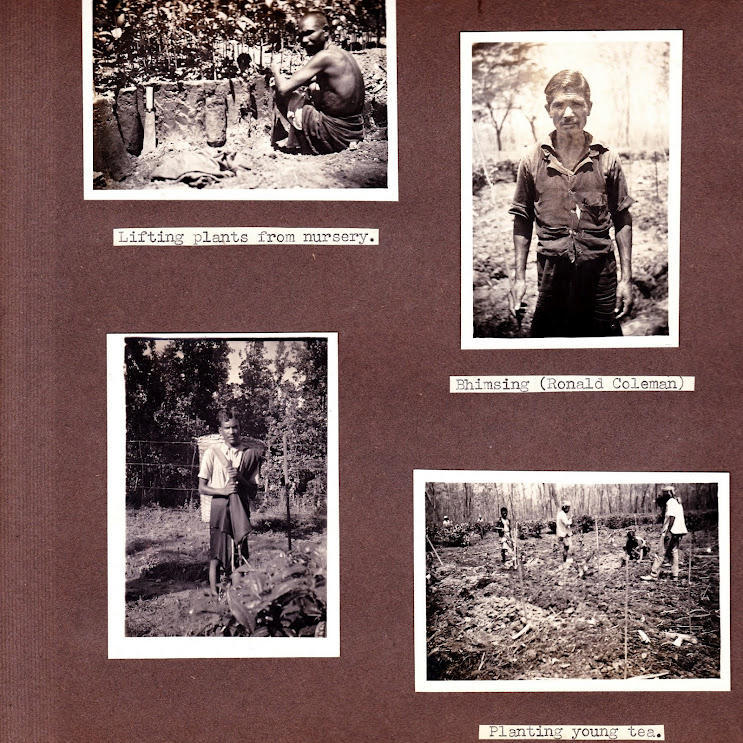
Photos from Daddy’s time in India

Planting young tea, photo by Eric Milner

Tea Grows in India, 1939, photo by Eric Milner
There are so many things I would ask him if I could. What was it like to be a boy in England in the twenties? Who were his friends? What drew him to botany and landscaping? Dad’s treasured albums leave subtle clues, but each photo poses more questions. There are pictures of my namesake Aunt Alys and his parents, neither of whom I met, but pictures of others too. Who were they and why did their image make it into his photo albums? If Daddy had lived to a ripe old age, his own shared memories would be a part of our story, and perhaps most of them mundane. Instead they’re a mystery that I can’t quite solve, special moments from a life interrupted.


I feel connected to dad when I’m tending my garden or digging in the soil. He lives in my heart and at the end of my proverbial green thumb. If he were here to celebrate this birthday, I would thank him for the gift of my life, for his compassion and care and for passing on his love of the earth. I would wrap my arms around his slender frame, give him a hug, and tell him all the things we missed together.
October is my favorite month. I’m not alone. October ranks in the top three in a number of surveys, vying with May for the top spot.
Here is my personal, unscientific top ten reasons to love October.
Okay, so not everyone is born in October, but if you love cooler weather, falling leaves and crisp air, this is the birthday month for you. If you’re mad for Halloween, also like me, you have 31 days of fun in store.

Mike finds beautiful Halloween cards for my birthday
I’ve learned a lot about the southern hemisphere in my years of blogging. Most of us complain about the bitter winter months, but October is the start of spring for my friends in New Zealand and Australia, and the beginning of autumn here in San Jose. Everybody wins!
Finally! The earth tilts on its axis as we head toward winter and cooler weather prevails. I can water the plants, pull weeds and put the garden in order without risking heat stroke.
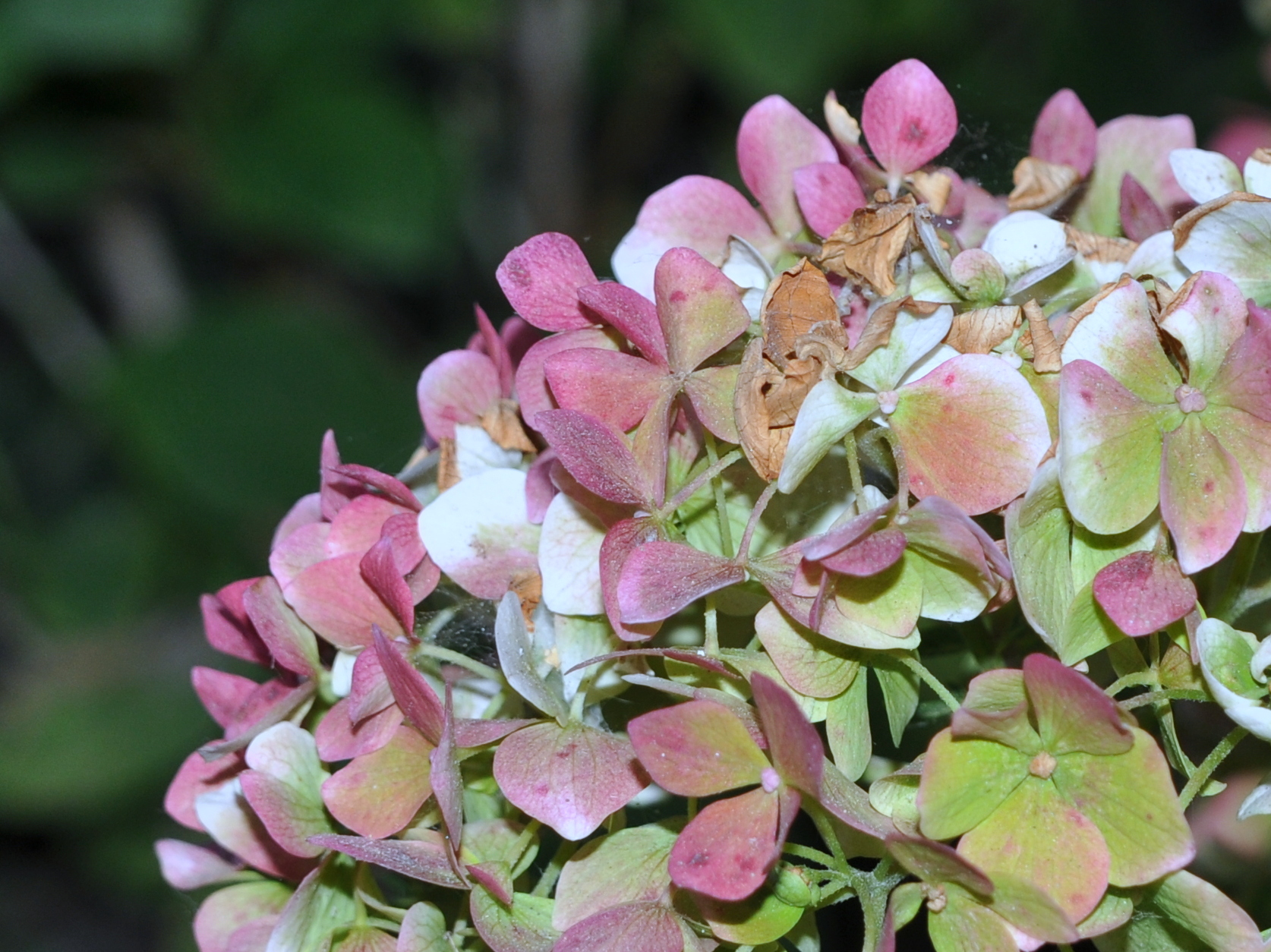
Hydrangea’s fall colors
If you’ve been following along for a while, you’ll know that I dedicate a lot of blog “real estate” to growing, care-taking, harvesting and decorating with pumpkins. My husband takes over on Halloween, carving the pumpkins we grow into lovely works of art. We save some of the seeds to plant the following year. We offer the pulp and a generous helping of seeds to the squirrels to who are busy foraging for the winter. The neighborhood squirrels planted their extra seeds this year, turning out all the lovely pumpkins in this photo. I’ve even dedicated a page to our love of pumpkins. Can you see it at the top of the blog?

Growing and harvesting pumpkins
My love of theater and sewing merge in October. I get to plan and create a costume for a couple of parties and if I’m not too tired, I’ll wear it on Halloween night. My sister Sharon and I have always had fun dressing up. I gave it up for many years, turning my attention to the boy’s costumes instead. In recent years, I’m back in the swing of things and I always have fun. This year I’m actually renting my costume, but sewing one for my husband. Stay tuned for the silly details.
It should come as no surprise that the National Confectioners Associate designated October 28th as National Chocolate Day. As a lifetime chocolate lover working hard to keep sugar at bay, I’m thinking this might be just the day for me. I can choose to indulge in this delectable treat once a year, banishing it from my daily diet and making it a special treat. As always, I’m a work in progress.

This chocolate pumpkin was a gift from a friend one year
Every day is cat day in this household. That said, I appreciate the intentions of this charitable organization. They seek to:
” help the public recognize the number of cats that need to be rescued. The day also encourages cat lovers to celebrate the cats in their lives for the unconditional love and companionship that they bestow upon them.
This day is sponsored by the Animal Miracle Foundation and was created by Pet Lifestyle Expert and Animal Welfare Advocate, Colleen Paige, in 2005. Since its inception, it has helped save the lives of more than one million cats.” Source: National Day Calendar
My son’s larger-than-life, inflatable cat. Mouse the cat is the real deal.
After months of dry weather, October kicks off our rainy season. I love the rain as much as I love pumpkins. You know that is saying a lot.
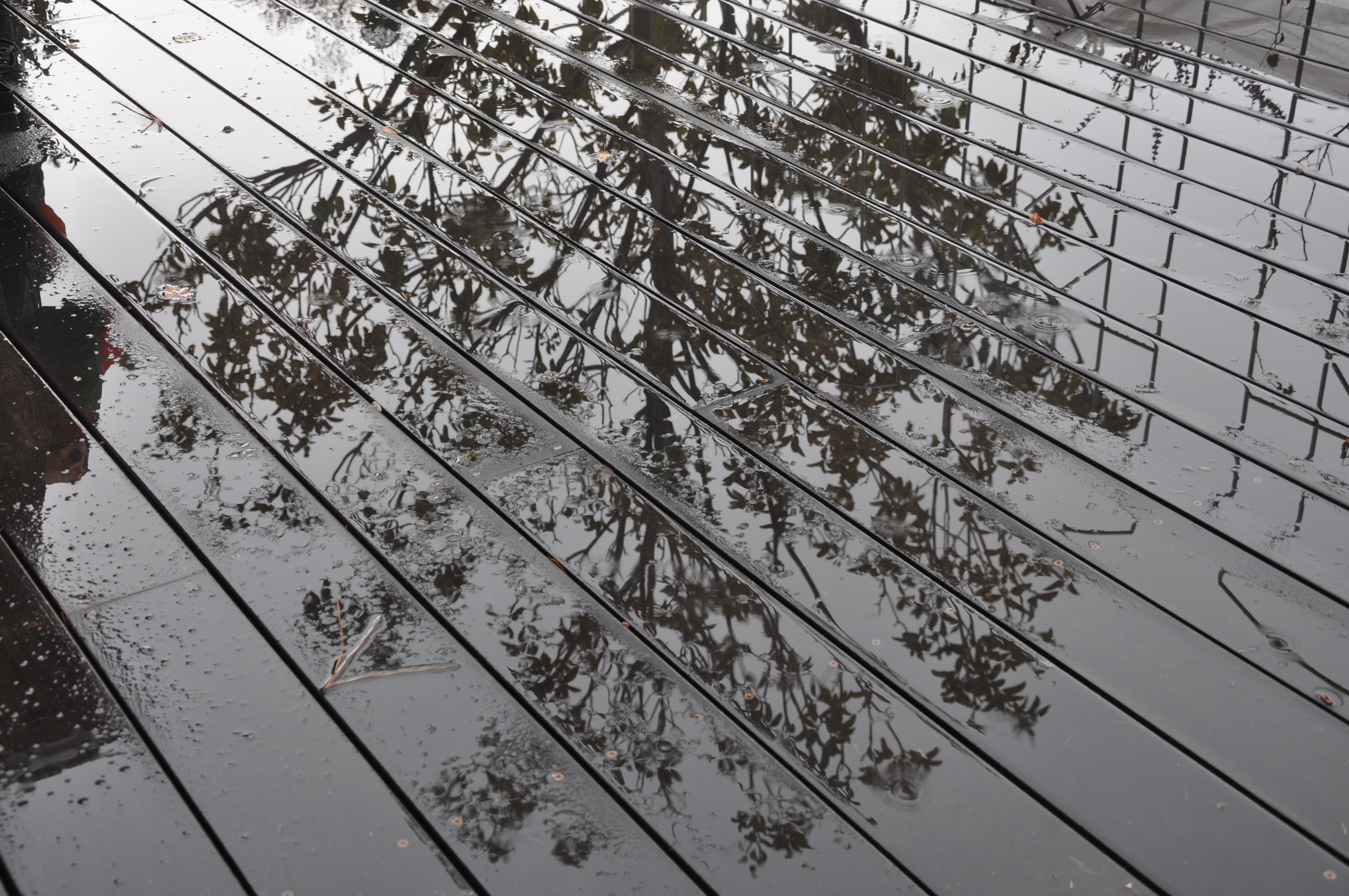
Once upon a time it rained in San Jose
After months of hot, dry days, it’s a delight to curl up under a warm blanket with a hot mug of tea at hand. Longer evenings give themselves over to more indoor leisure like assembling a puzzle, reading a thick book (or more blogs!) and making crafts.
Halloween is the second most popular holiday in America, behind Christmas. It evolved over the years “from Medieval rituals to the 1950’s kid-centered activity it is today.” You can follow this link to history.com to watch a two-minute video on the origins of the day. My youngest son, now 16, still enjoys the festivities. He and a friend create a “haunted deck” each year, using black plastic sheeting and an assortment of props. We live in a neighborhood populated with young children and words gets around. Last year we handed out candy to nearly 400 trick-or-treating children. There are knocks at the door for nearly three hours. It’s festive and fun. Everyone’s exhausted by November 1st, ready to settle in to cooler days, but until then, Halloween is great fun.
Is October your favorite month?
It’s the start of American football season, so please forgive the metaphor. As far as the Viburnum tinus is concerned, the score is not in my favor. It’s time to take one for the team. Though I feel personally defeated, it’s not all bleak. I don’t have a brain concussion from brutal tackles and I’m not benched for bad behavior.
It’s time to throw in the towel. Yet who wants to admit they’ve been bamboozled by a bug, tricked by a thrip, or outmaneuvered by aphids? Certainly not me.
I garden organically which means no pesticides or poisons. This limits my options, but I’m okay with that.
For the past seven years (yes years) I’ve been doing battle with thrips. Until last week, Viburnum Tinus filled the space between our home office window and the walkway to our deck. When healthy, it’s quite lovely. You can see the plants looking their best here. Shiny, dense green leaves give way to flowers and dark purple berries. It provided cover for the lizards and made a nice green hedge under the window.
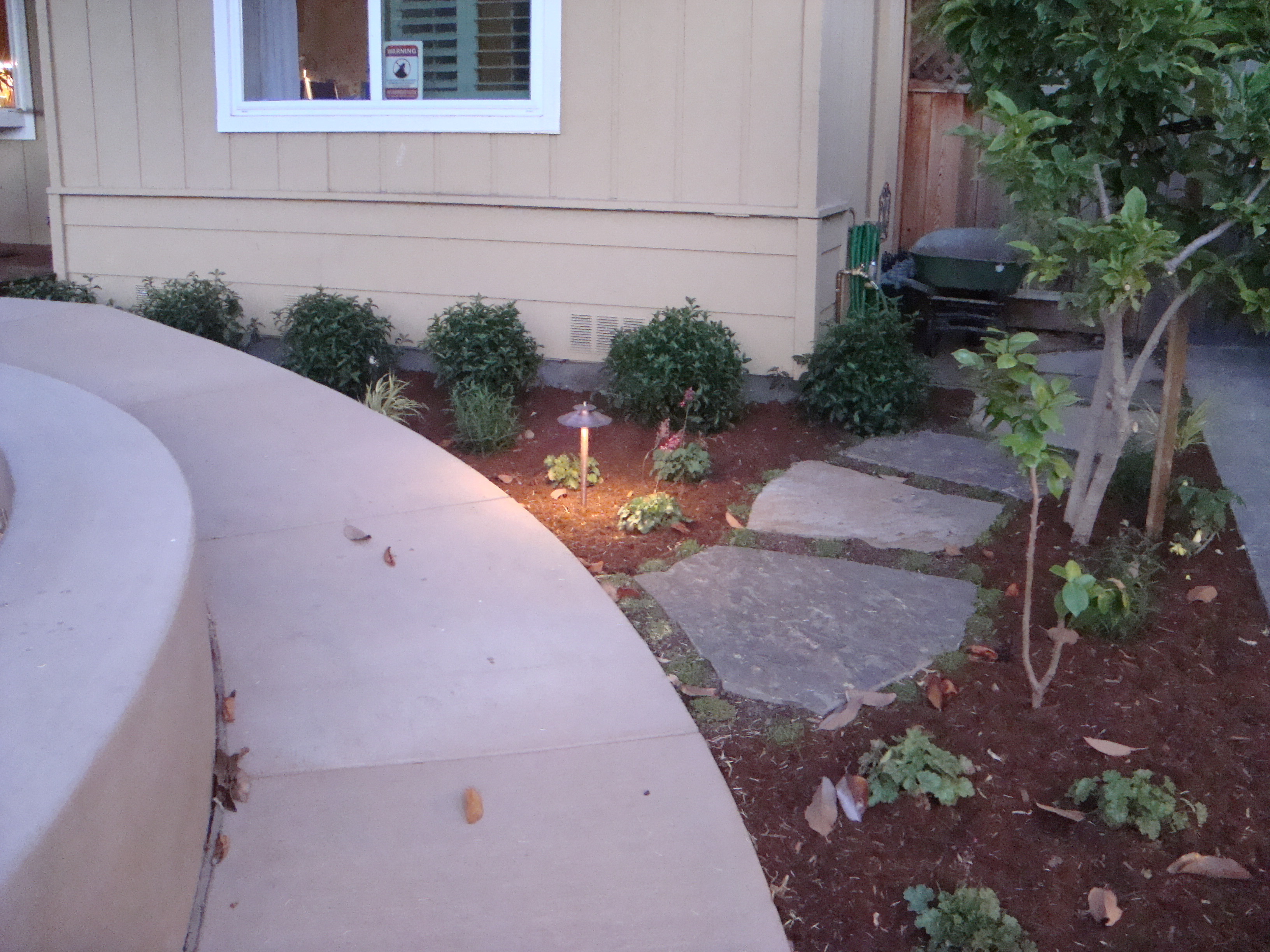
June, 2010
Yet year after year, the thrips return and the problem seems to get worse. This year they invited aphids to the party and things looked grim.
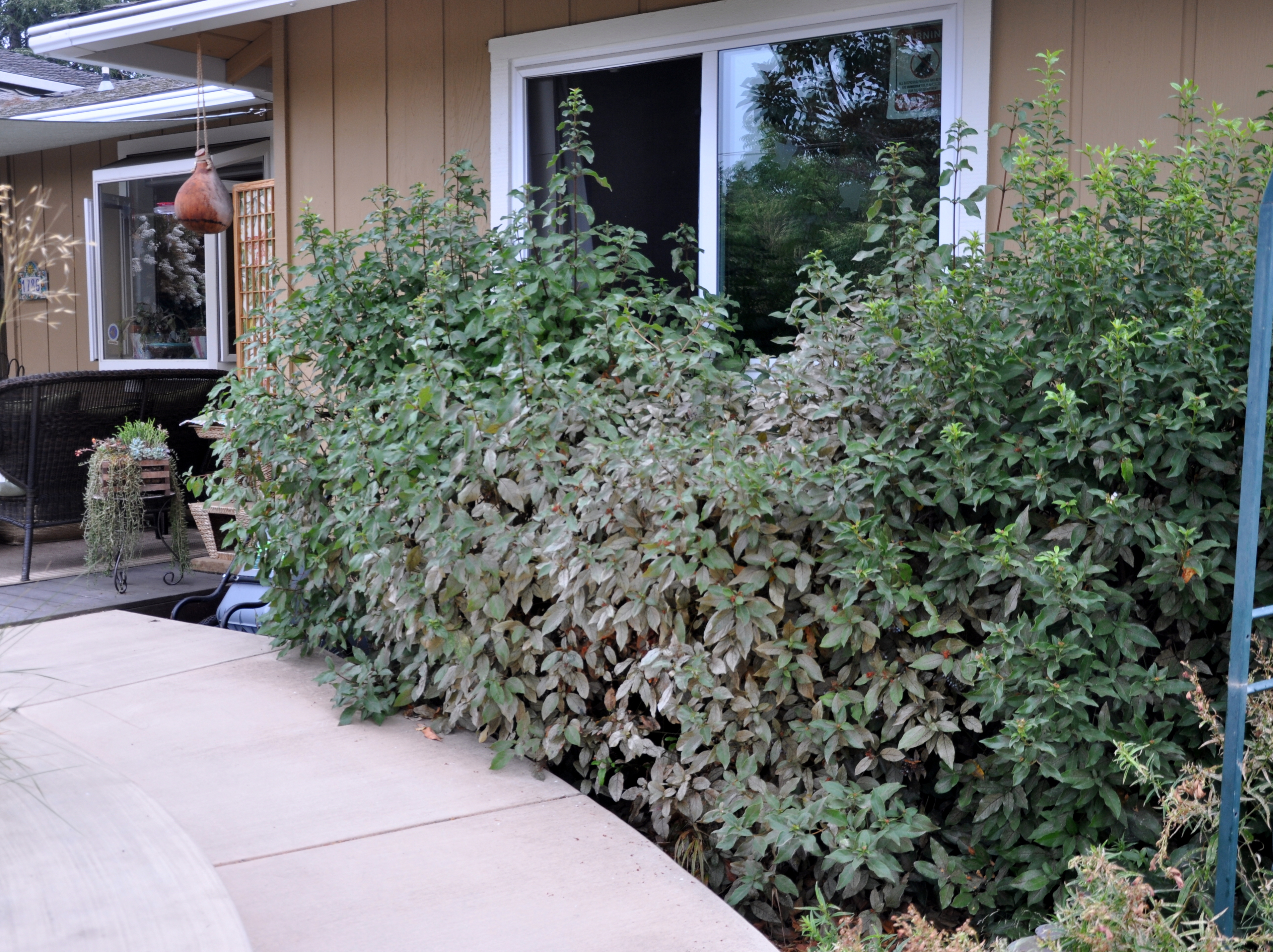
August, 2016

Leaves coated in sooty mold, a product of the “leavings” of insects. Also, possibly scale (dark red area)

Please…invite your friends: scale and white fly

Damage spreading to the plant below.
By mid-summer, sticky, odoriferous goo covered the plants. Some years I give the plants a hard prune, but honestly, how much can you remove before the plant is bare? We ordered lacewing eggs one year, expecting them to hatch and eat the larvae of these pests. The smell goes away in the winter so we initially thought we had solved the problem.
I don’t know if the drought plays a role in this, but this past summer the smell was akin to…how do I say this nicely…vomit. It kept us from spending time on the deck and forced us to close the window at night. When the days cooled down and we wanted to let in the breeze, the pests tickled our nostrils with that nauseating smell.

Planthopper, another garden pest. Several of them jumped out of the bushes while I pruned away the damaged leaves.
They had to go.
While I was away one day, my husband removed one of the five shrubs, leaving a gaping hole next to the deck. We “filled in the space” with our garden cart (how pretty) and the remaining shrubs sat there smelling up the place. Then we were in for another heat wave, and then I traveled, and you know how it goes.
But that smell.
Knowing I didn’t have the strength to remove the shrubs by myself, I did the next best thing: I pruned them down to the thickest branches, using the tools I have.
I’m reluctant to plant something new right away, but the space looks barren. I raked, swept, hand-picked and hopefully removed every last offensive, pest-covered leaf. While working away, I encountered a hopping green bug, sticky aphids, and other unidentified bugs.

Unknown: White fly or possibly the carcass of another insect
When I reached the last of the five shrubs, I spotted a praying mantis. They’re fascinating creatures with rotating heads and stick like bodies. They’re also good for the garden, munching on non-beneficial bugs. Clearly these shrubs were no match for a single bug, no matter how hungry.


After running inside for my camera and attempting some video, I removed his branch and carried him to another part of the garden. They will also eat small hummingbirds, and I didn’t want to take any chances.
Three hours later I had cleared the last of the shrubs, and I had the sore back to prove it. I was also racing the clock for the yard waste pick up. Once a week, on trash day, the garbage collector takes away yard waste. I certainly didn’t want any of those leaves living in my compost pile so off they went.


Short term, I hung a string of lights between a pair of gardening trellises. I don’t want anyone inadvertently stepping off the walkway ramp.
The final score is thrips, seven years and this gardener zero. Going forward, I plan to significantly improve the odds.
Are you following Kerry at Love Those Hands at Home?
If not, you won’t want to miss her sumptuous love letter to Autumn. Here’s an excerpt
Autumn seduces me, energizes me, makes me feel alive. My blood sings and fizzes like champagne when autumn comes to me. – KerryCan
You can read her entire post here.
It’s a gorgeous piece of writing, and one that perfectly captures my feelings of the approaching season.
Even in California with our subtle, seasonal changes, the arrival of autumn is unmistakable. Breezes finally blow through the valley, chasing away the ugly smog. The last of the pumpkin vines shrivel and die, but not before gifting us their wonderful fruit.


Dusk settles in earlier, and for this fair-skinned gardener, working longer hours outdoors is no longer unthinkable.
I cleared out the back corner of the garden, pruning away overhanging limbs, dead leaves and the growing layer of pine needles. Look at this pile?

Pile of pine needles, dead leaves and tree pruning. (Slinky’s tiny feet in the background)

After: I don’t have a good before, but you saw the pile (Slinky’s ears in the lower corner)
Ironically, the pumpkins I planted in May were a complete fizzle, while the self seeded (squirrel-planted) vines were a hit. One of those vines produced four tall, hefty carving pumpkins, ready for our resident, master carver (Mike).
A second vine produced one basketball sized pumpkin, took a rest, then pumped out a second pumpkin, turning a lovely shade of orange.

A third vine tip-toed up on us, producing a perfect little pumpkin the size of a cherry tomato. Then in the dead of night a critter ate it for supper. Boo-hoo! But wait…another pumpkin eventually took its place and it too is turning orange.
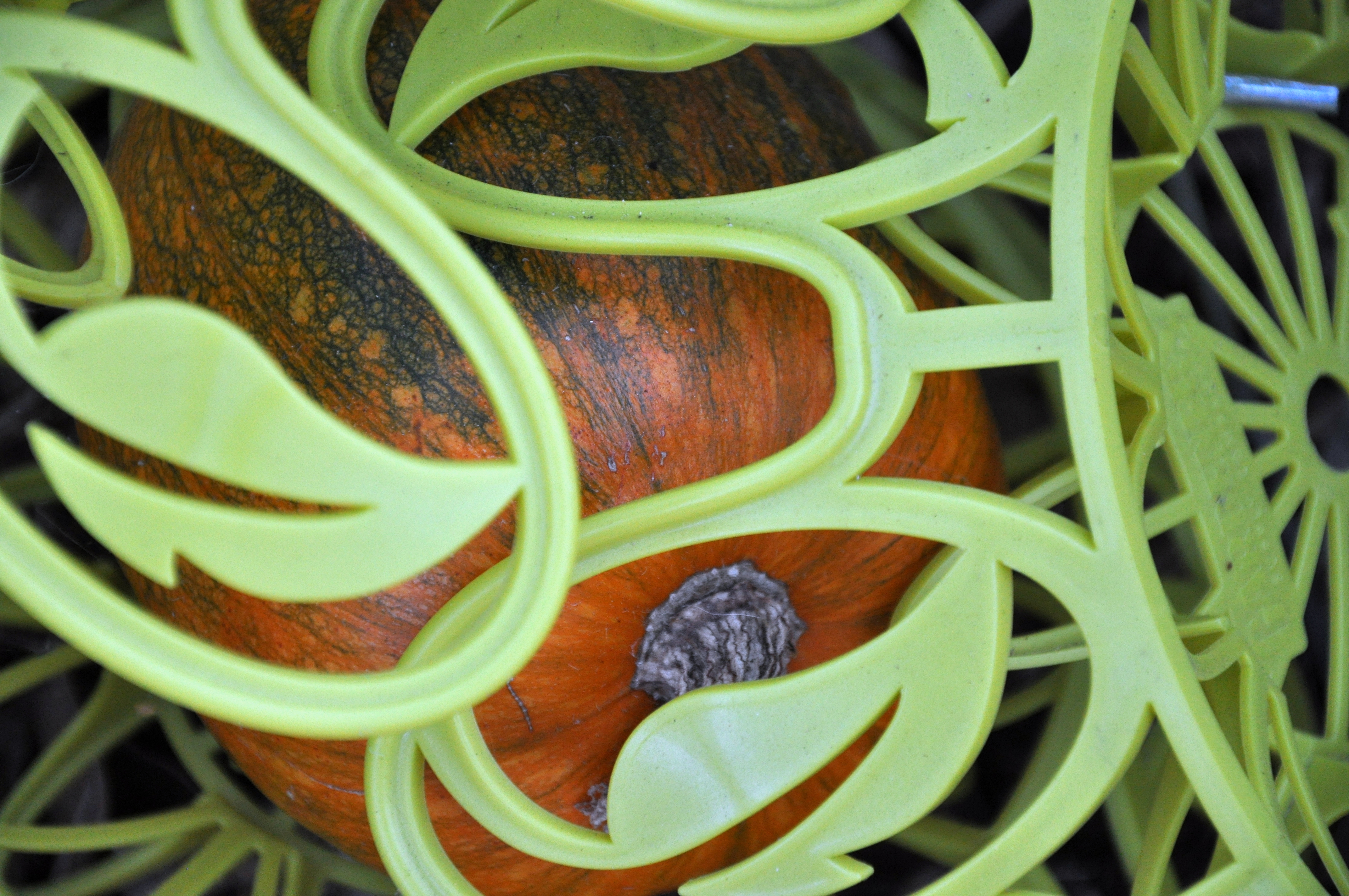
“Under Armour” Pumpkin

Tiny pumpkin, big fortress
Summer is far from over. Even when the autumnal equinox rolls around, we’re still in for a few more heatwaves. That said, the California Gray squirrels have stepped up their game, knowing intuitively what lies ahead. Indoors, Slinky is getting a head start on snuggle weather. She’s resting in my lap on a soft blanket, her coat still shiny on her diminished frame.
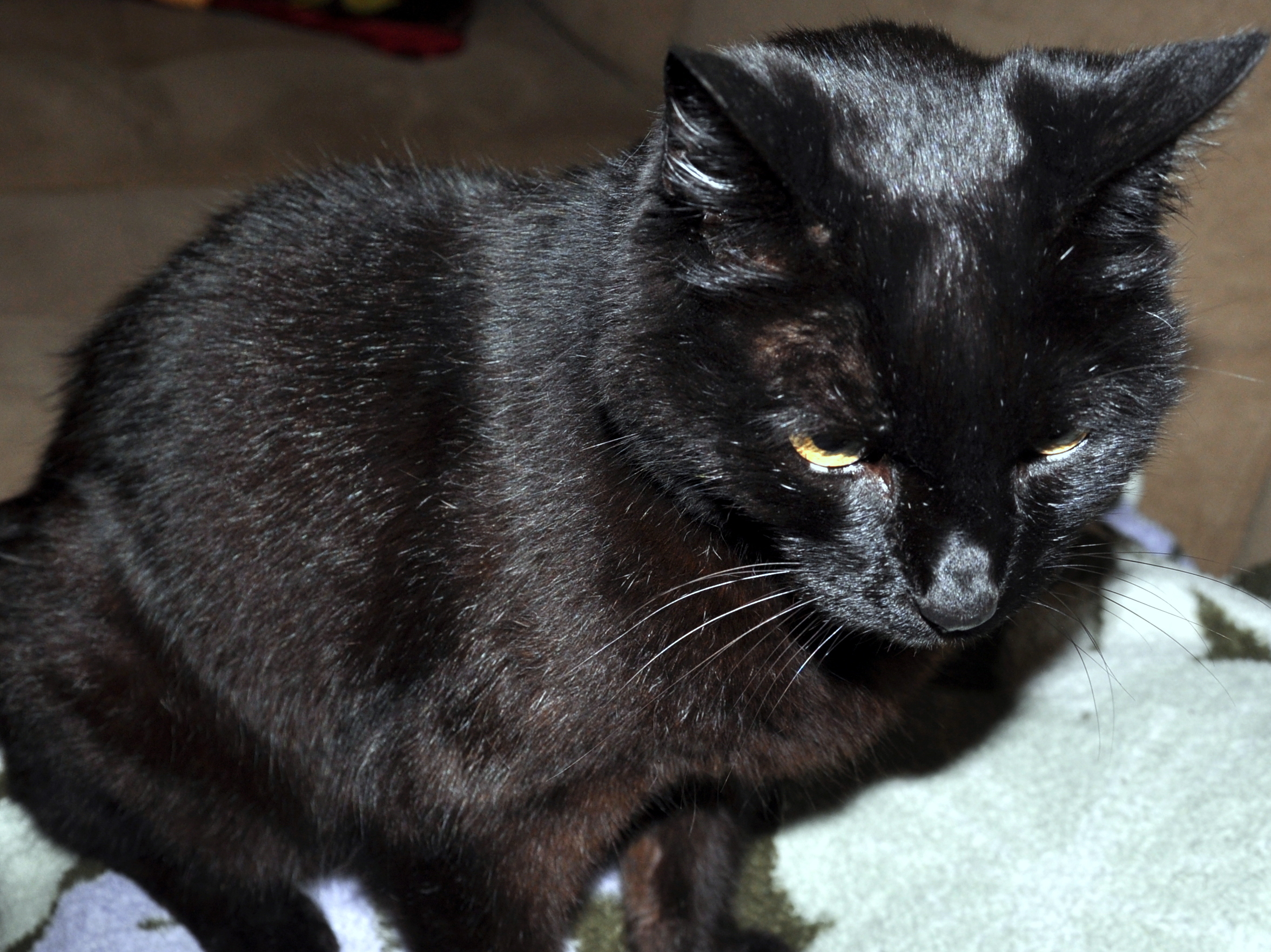
Slinky Malinki
There’s an interesting conversation going on in the comment thread of Kerry’s post on the origins of the use of the word “fall” vs “autumn”. Here’s what I learned:
Fall and autumn are both accepted and widely used terms for the season that comes between summer and winter. Some who consider British English the only true English regard fall as an American barbarism, but this attitude is not well founded. Fall is in fact an old term for the season, originating in English in the 16th century or earlier. It was originally short for fall of the year or fall of the leaf, but it commonly took the one-word form by the 17th century, long before the development of American English. So while the term is now widely used in the U.S., it is not exclusively American, nor is it American in origin. – Source: Grammarist
I love learning the origin of a word. While I know my Southern Hemisphere friends are looking forward to fall, how about the rest of you? Are you ready to say goodbye to summer and to welcome the ‘fall of the year’?
Seriously.
After my squash bug infestation a few years ago, and a follow on year resembling squash bug Armageddon, I stopped planting pumpkins for a few years. With little rain over a four-year period, those pumpkin-sucking bugs easily over-wintered and destroyed my meager crop. Twice.
Last summer, something amazing happened: one noble pumpkin grew in the middle of my former lawn. Without any water and not a squash bug in sight, the plant served up a perfectly formed and cherished pumpkin. I’ve since learned that pumpkin plants can survive on morning dew, taking in the moisture through their straw-like stems and delivering it to the root of the plant. Color me impressed!
This year we had our first season of near-average rainfall. We also installed a rain water catchment system.

Rain Catchment System
I took the plunge and bought a package of seeds. I prepared one of my Earth Boxes and waited for the temperatures to rise. The packet directions said to plant once night-time temperatures were consistently above 50 degrees F (10C) which for San Jose is usually May.
Meanwhile, seeds planted last fall by our neighborhood squirrels took root. They found a home near the patio in the newly planted, drought-tolerant garden. I let them grow of course, but figured the cold nights that followed would dash our hopes. As the temperatures rose and I planted my own seeds, the squirrel’s garden happily meandered along, pest-free and robust.

A pumpkin we will grow
One plant stayed small, and produced a single, perfectly formed round pumpkin. It started out dark in color, almost a pine green, before turning a lovely orange. The sister plant took off across the garden, racing toward the swing and sending out runners in both directions.

The Meandering Pumpkin
The second pumpkin plant produced four tall pumpkins before the vine started dying back.
We were eager to harvest them before the squirrels stopped by for lunch. We put them in our garage to let the stems dry for a few days, then brought them into the house. Typically we wouldn’t be harvesting until September.
As I ready for my trip to Canada on Monday, I’ll leave it to my son to harvest the last three pumpkins. He’s looking forward to it. Meanwhile, the tomatoes are flush, producing a delicious crop. My new favorite is a ‘Black Cherry’, a sweet and juicy heirloom tomato that is melt-in-your mouth delicious. I’m definitely saving seeds for next year.

Heirloom Tomatoes: ‘Mr. Stripey’ and ‘Black Cherry’

Tomatoes and Pumpkins in July
I’m in count-down mode: Edmonton here I come!
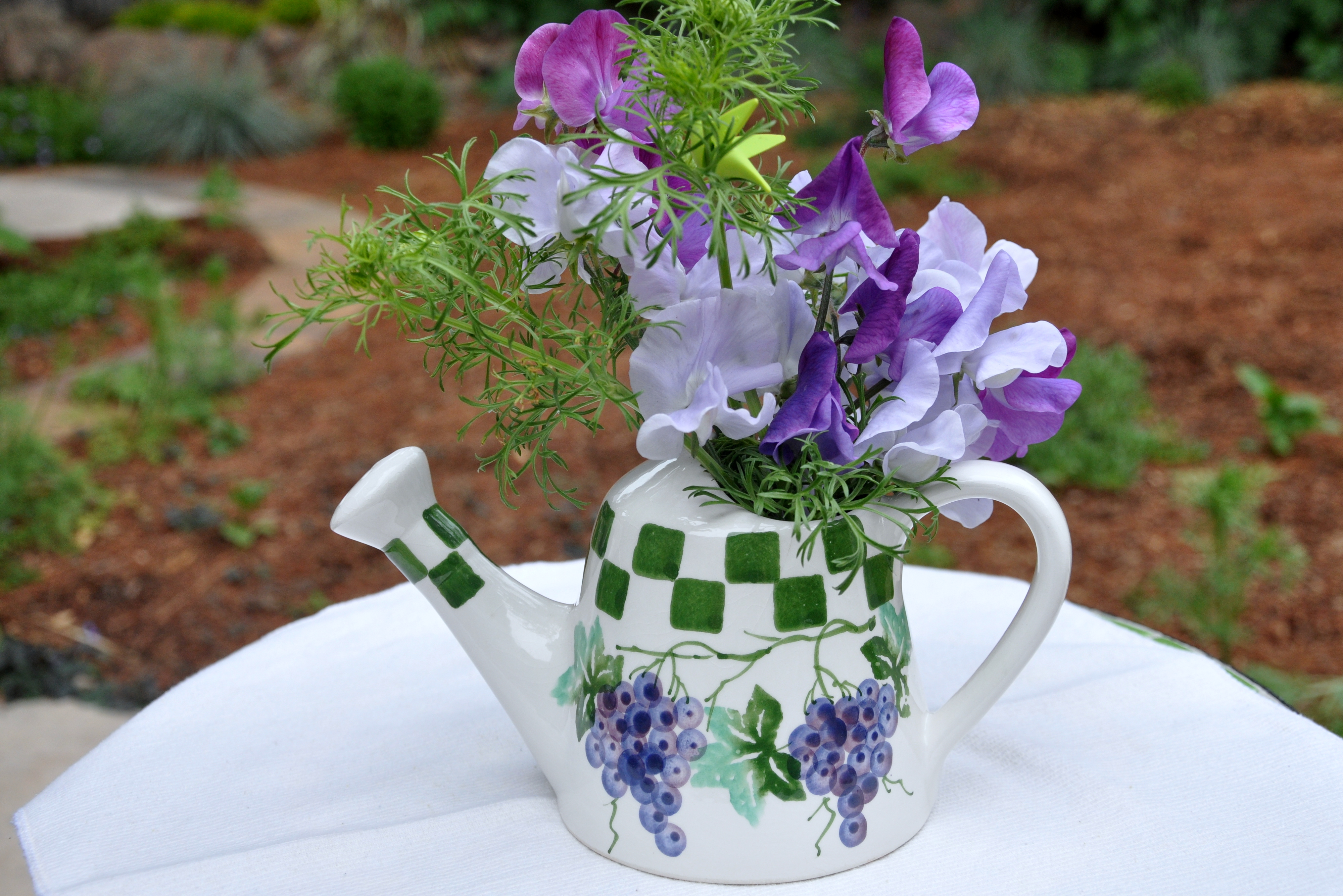
I continuously cut bunches of sweet peas to keep the plants blooming.
When you live in sunny San Jose, the heat waves are inevitable. What’s new, however, is the duration. In the past, the temps would rise for three days, then drop back to a seasonal norm. Now they seem to last five to seven days at a stretch. With my fair, cool-weather complexion I wilt. Sadly, so do the sweet peas.
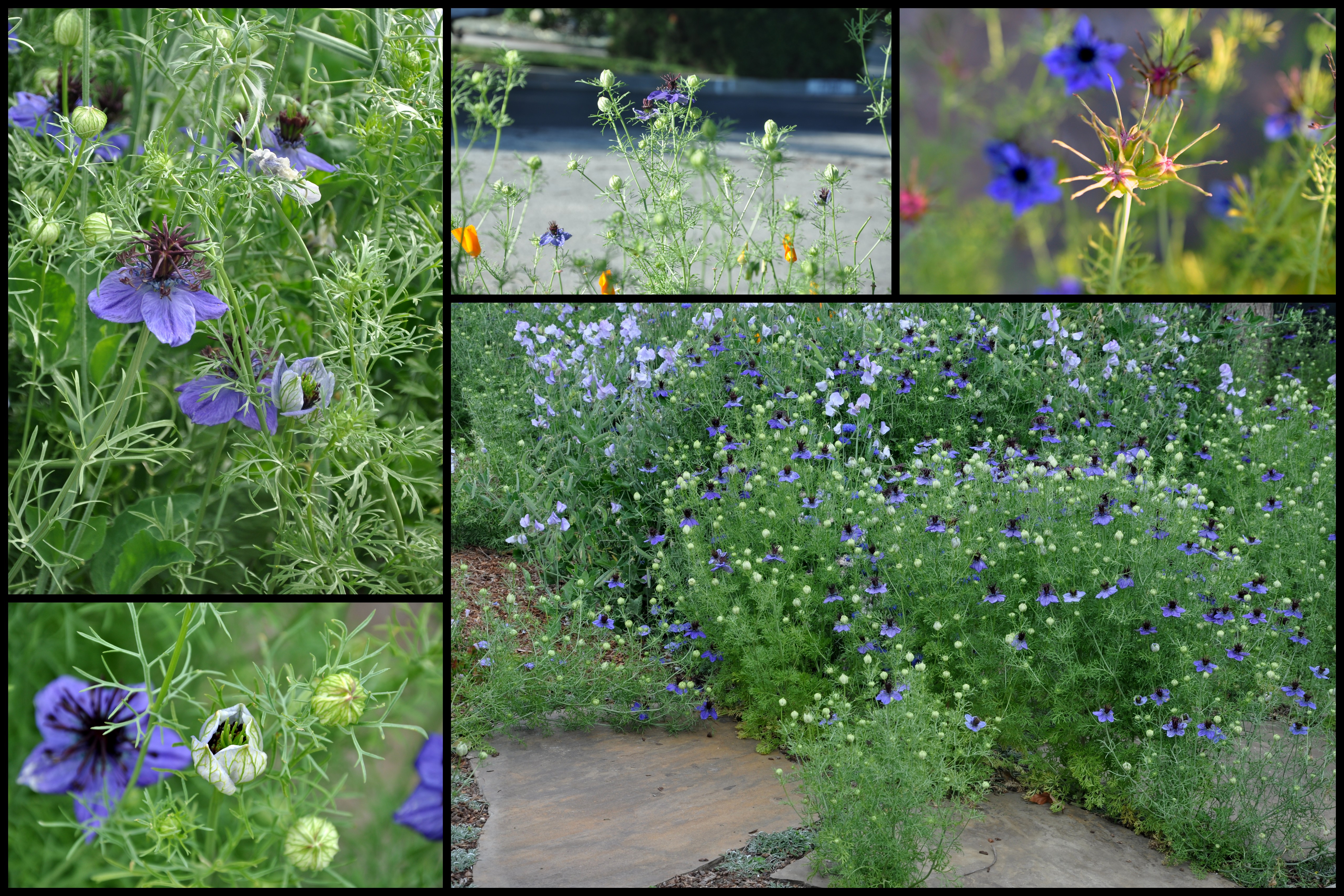
The Jungle, a self-seeded garden of Love in a Mist, Sweet Peas, California Poppies and Cornflowers in their prime.

Snap, crackle pop. There’s beauty at every stage of the cycle.
I’ve thoroughly enjoyed the jungle in all its wonder. Sweet peas self-seeded early this year, followed by love-in-a-mist and then cornflowers. All of the flowers are various shades of purple. I love the way they offered each other support.
One by one though, they’re calling it quits for the season.
Encouraged by Pauline, Lisa and Kelly, I cut blooms several days a week.

Close up view. The tiny hummingbird is a wine glass charm, a gift from a friend.
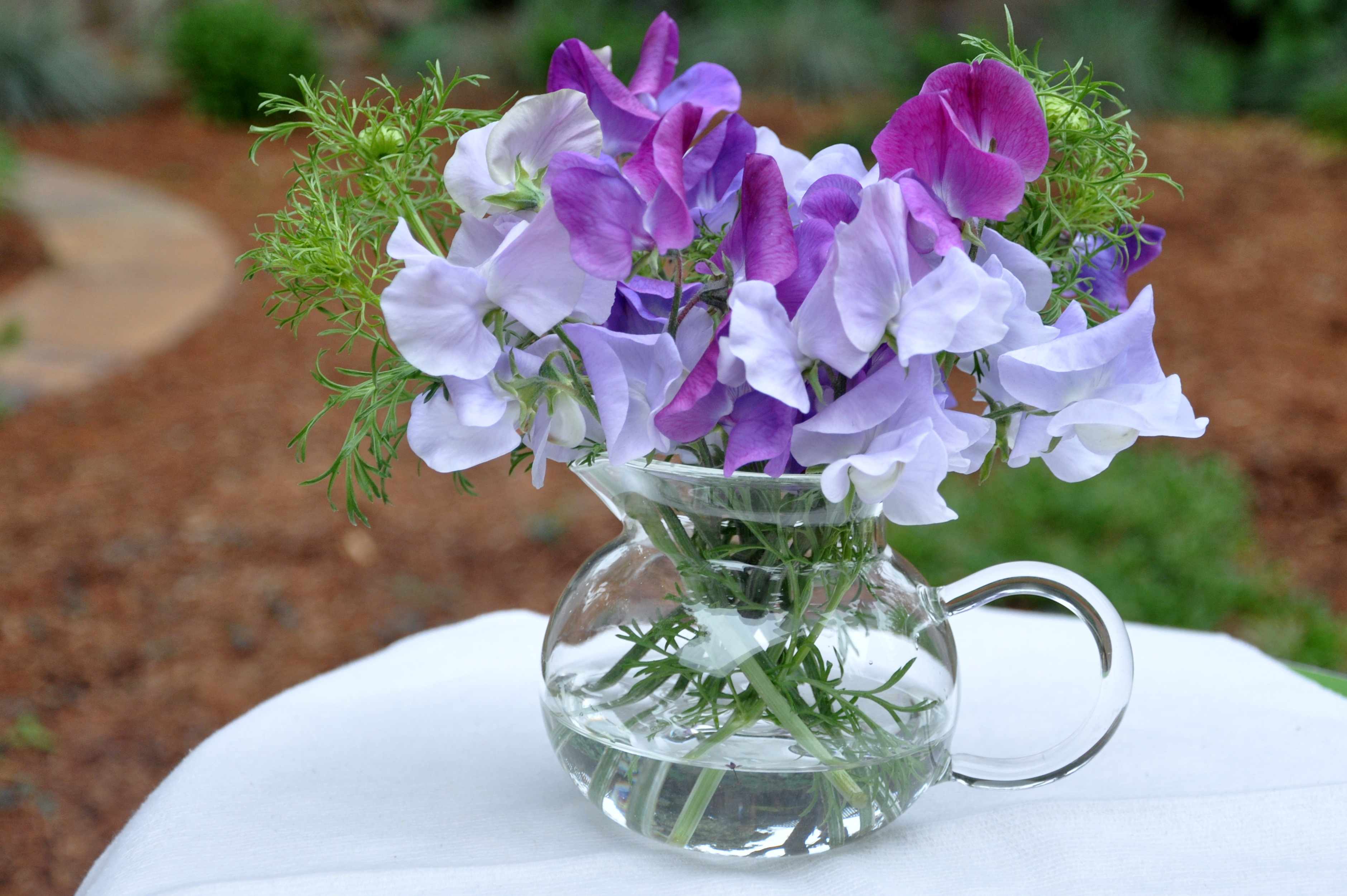
This sweet little tea-pot is also a gift from a friend
I found miniature milk bottles at a craft store for $2, wrapped the neck with purple baker’s twine, then filled them with fragrant blooms. Sweet pea is the birth flower for April, and, coincidentally two of my Pilates classmates have April birthdays. I brought each of them a small bouquet. I enjoyed sharing them with friends and neighbors, and even brought a few to a client.
Alas, the heat descended and the plants quickly dried and went to seed. Sweet peas prefer a cool 65 F (18C). We’ve had sustained temps ranging from 89 – 94 F (31-34C). I left them for a week till they were completely brown, then started pulling them out of the ground. I shook each plant liberally to drop any of the loosened seeds, then made a big pile to sort through on a cooler day. Ha!
Days later, on an overcast afternoon, I sat in a chair in the middle of the pile and harvested seed pods. I learned a few things. If the seed pod is still green, the seeds need to dry before storing. The brown seed pods, fully encased, give up wonderful, dry, ready to plant seeds for the following season.

Harvesting seeds, upper left, a twisted seed pod squeezed out the seeds for next year. Different stages of drying seeds. The garden natives start to fill in.
The most interesting for me though is what happens when the pods are ready to give up those seeds on their own. The pod cracks and then twists so that seeds are wrung out of the pod, dropping back into the soil for next year. That cracked, twisted pod has a beauty of its own.
The birds didn’t seem interested in the dried seeds. According to this Wiki article, unlike edible peas, the seeds are toxic.
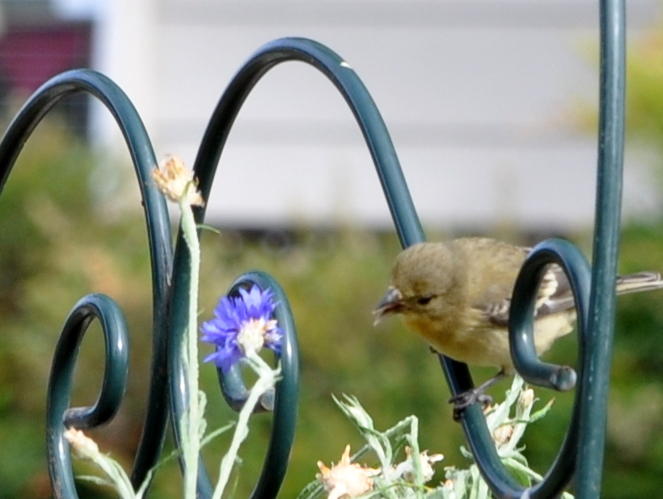
Feathered friends stop by for cornflower seeds
But here’s what happened the minute I cleared away the dried plants. I propped up the bedraggled cornflowers and the birds flocked to the plant by the dozens. I could see three to five at a time eating seeds, but when something startled them over a dozen birds emerged from the plant. They may have been there all along, but with the love in a mist and sweet peas dominating the jungle, the cornflowers were largely out of view.

It looks like they whole neighborhood stopped by. Aren’t they cute?
That too has now gone to seed and I’ve gradually cleared away the last of the plants for the season.
The garden looks a little bare without them. I’m also missing the bees that kept me company for weeks. Even the birds are scarcer than they were.
Yup, it’s a hot, dry summer in San Jose.

 Gardening Nirvana