Hummingbirds: A Route of Evenescence

Allen or Ruby Throated Hummingbird

Our garden is a hummingbird magnet.  They provide cheap entertainment at the feeders and plants year round.   They are especially fond of the Salvia leucantha (Mexican bush sage), a drought-tolerant shrub we have planted curbside and the Flowering Maple (Abutilon hybridum), planted out back.  My husband tends the feeders, ensuring they are always clean and full.

My first up-close experience with this delightful bird was during a game of hide and seek with my sister.  I was hiding behind a shrub when one flew within inches of my face.  I wanted to shout out to the world, “look!”, but I kept my cool and savored the closeness before it took off.

A few years ago a female hummer started building a nest in the crook of our wind chimes.   She flew back and forth from tree to chime before we realized what she was doing.  Within a short time she came to the same conclusion we did: what an impractical place to build a nest.  It was a special treat watching out the window as she worked, but a relief when she moved on.
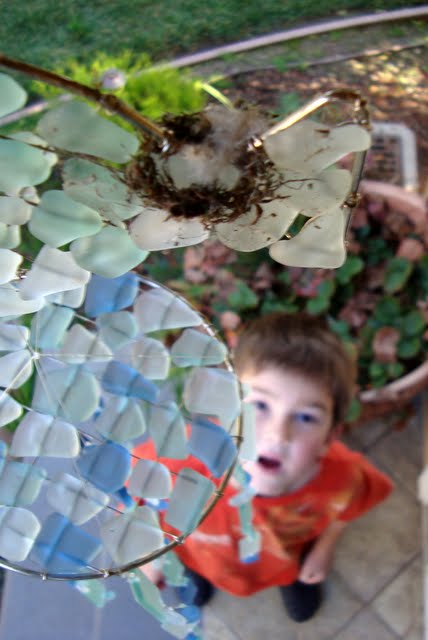
Mesmerized by the Nest
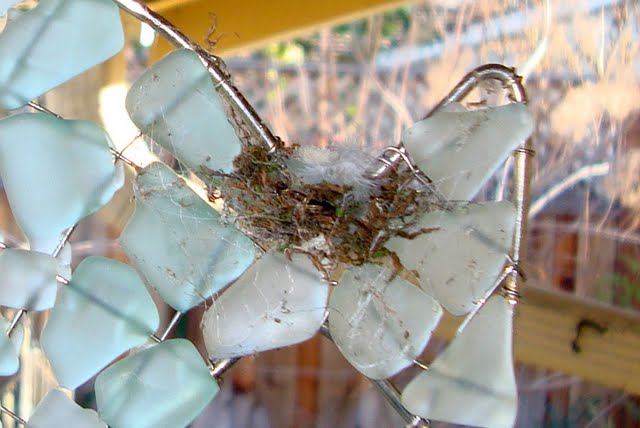
Starter Nest

The feeder outside our kitchen window gets the most traffic.  Beautiful hummers like to rest in the Magnolia tree, swooping in and doing battle for a turn at the drinking fountain.  Last week one of the males started his mating ritual.  He circled the house, then flew straight up into the air, before turning directions and shooting down toward the house.  It sounded like a sharp whistle with every decent, one he repeated many times over.
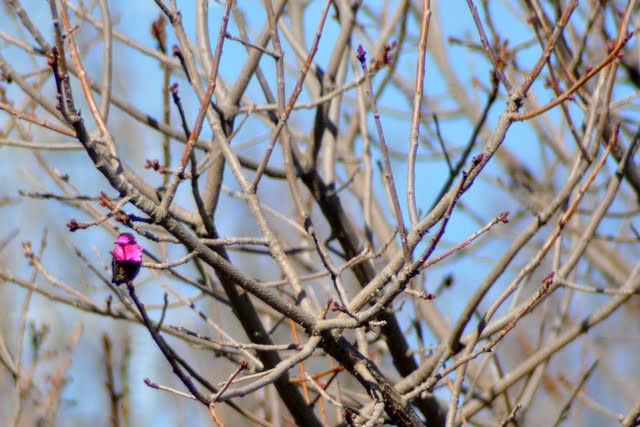
Waiting for a  Turn at the Feeder

That same night we got a text from our son saying one of the hummers had crashed into the back window after dark.  My son and our sitter raced out back and found it cradled in a spiderweb with the neighbor’s cat in hot pursuit.  Quick thinking on their part and the lucky placement of the web saved the birds life. They held the stunned bird for a short time till it recovered and flew away.

According to The World of Hummingbirds, the Allen Hummingbird winters in California while the Ruby Throated Hummer prefers Mexico and Southern America.  The birds we’re spotting don’t seem to fit that pattern, but given our mild, dry winter, perhaps they didn’t fly quite so far.

If you are interested in attracting hummingbirds to your garden, this article is packed with useful information.

This site offers a large collection of hummingbird feeders.  Here is a fun do-it-yourself blog showing an easy and inexpensive way to make your own.

Paul Hood Photography produces beautiful hummingbird prints.  You can find his work on Etsy or Zazzle.

A Route of Evanescence
by Emily Dickinson

A route of evanescence
With a revolving wheel;
A resonance of emerald,
A rush of cochineal;
And every blossom on the bush
Adjusts its tumbled head,–
The mail from Tunis, probably,
An easy morning’s ride.

 

The Curse of the Poinsettia

Poinsettia (euphorbia pulcherrima)

I can’t seem to kill houseplants.  Most of the time, it’s a good thing.  I treat each plant with TLC, ensuring the proper pot size, location, water needs and the occasional fertilizer.  Once a plant finds the perfect corner of my abode, it thrives for years and years.

Back in 1988 I purchased two asparagus ferns from the local Woolworth Garden Center.  They were a bargain at seventy-nine cents each.  I planted them together in one pot and kept them next to my bed in my tiny apartment.  Plants were always my favorite way to decorate.  Unlike nick-knacks, plants change and grow.  And grow they did.  Eventually I split them up, and had two plants for my apartment.  Two years later I moved in with my sister and the plants came too.  Six weeks after the move, the Bay Area experienced a 7.1 earthquake.  The jolt of the quake flipped a mirror off of my bathroom wall, cleared the entire counter of its contents, including potted plants, and landed unbroken on the floor.  We had little damage, but spent a few days cleaning up the various messes it created, scooping up potting soil, broken containers and the like.  The ferns survived.  They moved back to Campbell for five years, and then joined me in Fremont as a newlywed.  By then the plants were quite large and had developed spiky thorns.  We eventually settled in San Jose where we started a family and those ferns, long past the house-plant stage, now live a contented life along the back fence.

Two years ago a Poinsettia came to live with us, a gift from someone who mostly took from our lives.  The plant was a beautiful specimen, grown as a standard instead of a shrub.  It spent some time on the kitchen counter, later moving to the living room as the seasons changed and it needed more indirect light.  Ironically, as the plant thrived, the awkward relationship stumbled, fell, limped along and finally, ended.  The end of the relationship was dramatic and ugly, but necessary for the mental health of me and my family.

Without tricking a Poinsettia into thinking it’s been through a cool, dark winter, they gradually lose their scarlet red bracts.  The tiny flowers also come and go, but through all of this, our plant remained healthy.  I tossed out the glittery holiday-themed pot, moved the plant back to the kitchen, and there it continues to thrive.  My family comments on the plant from time to time, aware of its giver and the frenzied drama that swirled around us. It’s a marvel the plant has survived.

Unlike the ferns that developed thorns to survive, the poinsettia lost its brilliant color as it dropped each scarlet red bract.  It has become a healthy, green and otherwise unspectacular plant, a contrary reminder of a turbulent time.

Flowering Wonders

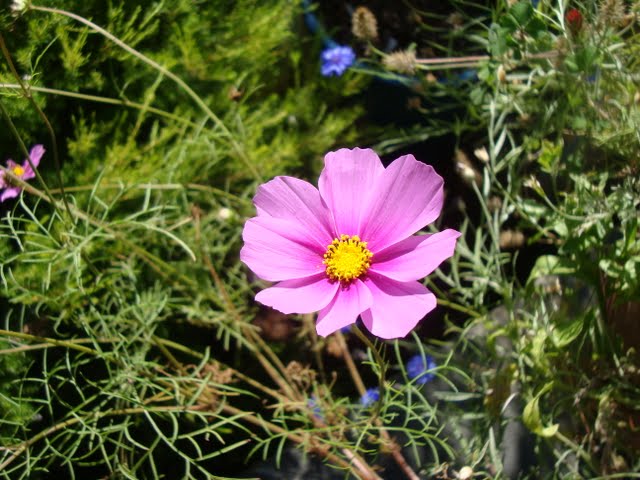
The packet of wildflower seeds we planted late spring, continue to produce a few blooms.  We scattered some of the seeds in the side yard with the sunflowers and the dwarf lemon and they bloomed for months.  We still have cosmos flowering in the large pot outside our sliding-glass bedroom door.

Cosmos

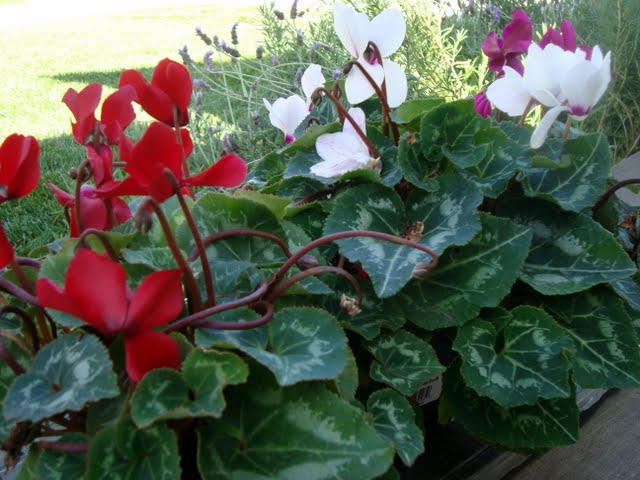
To keep that color going throughout our moderate winter, I plant cyclamen each year.  They were one of my mom’s favorites, and always remind me of her.  A friend gave me a red cyclamen for Valentine’s Day one year, and it bloomed for a month on my coffee table.  When the plant seemed to fail, I moved it outside, but it continued to “decline.”  Little did I know then that this plant is a tuber.  It was simply going into its dormant stage.  We have some planted outside near our laundry room and they make me smile each year when they re-emerge.

Cyclamen

Garden Log: September 17, 2011

Yesterday was all about garden clean-up. It felt great! Tidying the beds and pruning the shrubs appeals to my organizing side.

Here’s what I did:

  • I removed the seed heads from the sunflower stalks and set aside three of them

    Late-season Wildflowers

    for the squirrels.

  • I stripped the remaining leaves from the stalks, and placed them in the side yard to dry. We’ll use them in our “haunted house” on Halloween.
  • I cut a handful of wildflowers and put them in a  vase.
  • I pruned the dinosaur topiary in the children’s garden.
  • I continued my search-and-destroy mission for the invasive plant taking hold in the side yard.
  • Finally, I pruned the Hardenbergia and Jasmin. That job was long past due.

Dinosaur Topiary

I love this time of year when the days shorten, the air crackles and the leaves, even in sunny California, start to turn. The squirrels are busier, the geese are settling in at the neighboring schools and the light winds knock down the end-of-summer smog. Good riddance to that.

Although it’s no longer “PC” to light a wood-burning fireplace,  I must confess to my weakness for that smell. Our fireplace is long gone, but I lift my nose to the wind and catch a drift from the neighborhood hold-outs.

It’s sweater weather. Time to get the broccoli seeds in the ground.  What’s happening in your garden?

Gourmet Squirrel Food: Only The Best For Our Friends

Sunflower Seeds

I just came up the driveway and startled a pair of squirrels who were halfway up the sunflower stalks.  In prior years, the sunflower stalks snapped and drooped early from the increasing weight and the seeds were quickly polished off.  This is the first year they’ve remained standing, due in part to my bungee cord fix.  I gathered the stalks together like a bunch of broccoli and secured them with a pair of bungees.  They’ve supported each other beautifully.

Bungee Cord Fix

I ran inside for the camera and went back to check on the plants.  The squirrels are pulling out the seeds in little groups, shelling them from their perch and littering the flower bed with shells.  I’m reminded of friends in the past who’ve tried giving up smoking:  they would leave little piles of sunflower shells in various locations, just like the squirrels.  I doubt the squirrels are trying to give anything up.  They’re just staying true to the genetic code that says “fall is coming; time to stock up!”

Flowers in Bloom, Seeds Will Soon Set

A Full House

A few flowers in the center and missing seeds on the outside, combine to look like the close-up of some bug.

Cats Among the Plants

Without further ado…

Life Among the Ferns

“I tawt I taw a puddy tat…” ~ Tweety (Looney Tunes)

Kitty Hammock

This better be important...I was napping.

“Nature abhors a vacuum, but not as much as cats do.”                         ~ Lee Entrekin

=^. .^=

“Cats always seem so very wise, when staring with their half-closed eyes. Can they be thinking, “I’ll be nice, and maybe she will feed me twice?” ~ Bette Midler

=^. .^=

“Meow is like aloha – it can mean anything.” ~ Hank Ketchum

=^. .^=

“There is no snooze button on a cat who wants breakfast.”                ~ Author Unknown

=^. .^=

Slinky Takes a Walk on the Wild Side

Just Visiting

Sunflowers: From Seed to Tower in an Hour?

Not really, but it seems that way when a tiny seed produces a nine-foot plant in 90 days.  It’s August, and our flower season is coming to an end.  It’s been glorious.  We planted our neat little row in our front, side-yard next to the garage.  With each day’s comings and goings, we’ve marveled at the spectacle of the sunflowers growing and reaching skyward.

Slideshow: 90 Days in the Life of a Sunflower

The Weight of the Seeds Pull the Flowers Towards the Earth

“The Sunflow’r, thinking ’twas for him foul shame
To nap by daylight, strove t’ excuse the blame;
It was not sleep that made him nod, he said,
But too great weight and largeness of his head.”
~ Abraham Cowley

Garden Log: August 9, 2011

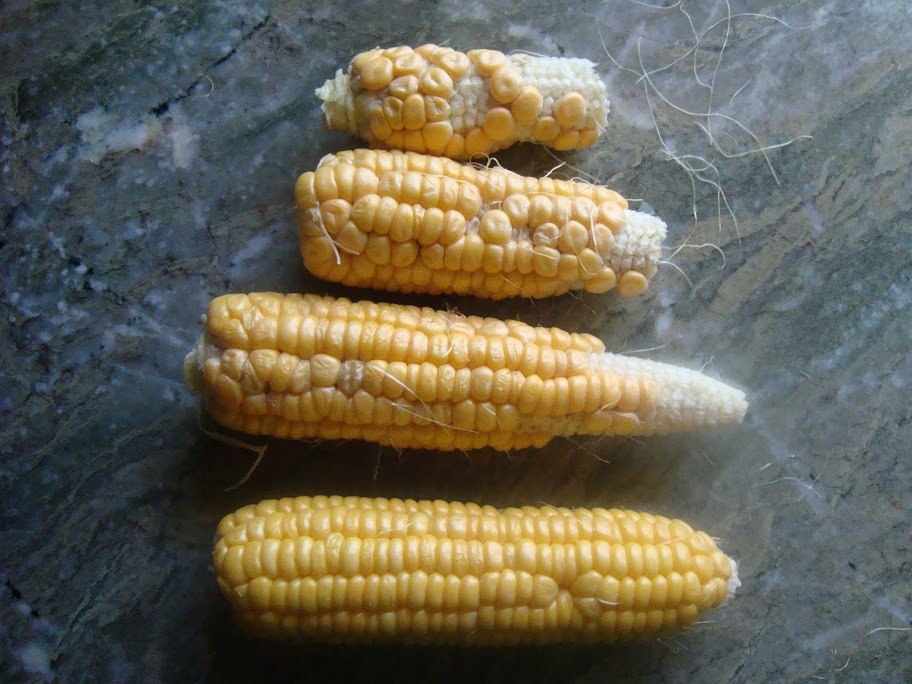
The Autumnal Equinox is a mere six weeks away and our vegetables are showing signs of late-summer fatigue. We were excited to harvest our robust stalk of corn but knew it was best to harvest within two hours of eating for maximum sweetness.

Early August Harvest

I put a pot on to boil, but sadly we were about a week too late. The corn had already started to dry and was flavorless and tough. We’re hoping for better luck next year.

We love to plant tomatoes and pumpkins with corn as an afterthought.  Next year I think we’ll dedicate one-third of the planting beds to a block of corn to increase the likelihood of success.  This is a great primer on planting corn in small spaces: How to Grow Corn

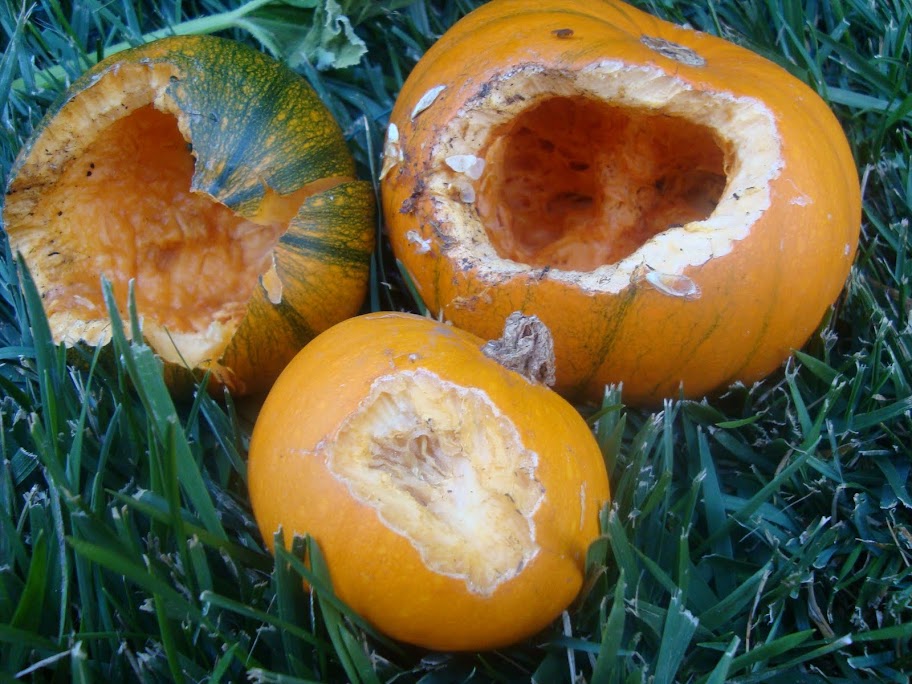
Squirrel Food?

Tomatoes have been slow to ripen this year, due to moderate heat. We had late season rains, and cooler temps, neither of which seem conducive to their ripening. The plants are covered in green fruit, so we’ll hope for some hot days ahead.

Our sunflowers bloomed, but not before one of them reached the rooftop! It’s over nine feet tall. Magic!

Nine-Foot Sunflower

We’ve kept a close eye on our pumpkin crop, fencing off as best we could to discourage squirrels and rats. That said, we’ve noticed a recent onslaught. We harvested a few pumpkins this week after finding several partially eaten fruit. We have two exquisite white pumpkins,our first year planting the (Cotton Candy) variety and several smaller orange ones.

We also planted:

Batman Pumpkins

Dill Atlantic Giant Pumpkins (not!)

Full Moon Giant White Pumpkins

And a few leftover from last year’s carvings.

A handful of pumpkins were left to ripen on the vine. An offering of corn and partially eaten pumpkins rest on the grassy side of the fence to appease the late night snacking crowd.

Show Me Your Teeth

A gardener can dream, can’t she?

YouTube upload: A walk through our vegetable patch: Crunch, crunch, crunch…

Cotton Candy, Lumina or Full Moon Giant

Bagby Garden: How Does Your Garden Grow?

We lucked out with two weeks in the Bagby Garden this summer.  We harvested a few summer squashes but the berries weren’t quite ripe for picking. The greatest treasures, however, always lie in the unexpected: a lizard panting in the sun, bees among the petals of a flower and that earthy, damp smell after an uncommon summer rain.

Bee in the Borage

Latin name: Borago officinalis

Lounging Lizard

This little critter is probably a Western Side-blotched lizard, abundant in the warm, western areas of California.

“A thing is right when it tends to preserve the integrity, stability, and beauty of the biotic community. It is wrong when it tends otherwise.” -Aldo Leopold. A Sand County Almanac. Oxford University Press, 1949.

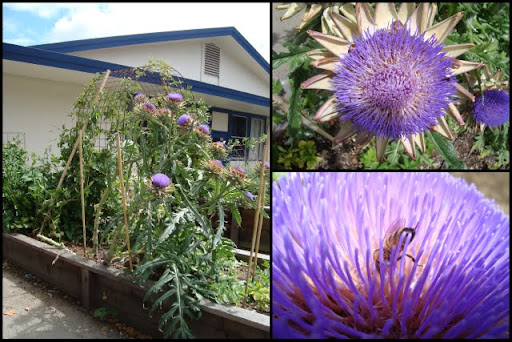
All Out Artichokes

Green Thumb Gardener

Pumpkins Go Viral!

Well…not exactly. But when you say “viral” these days, people notice. In bygone days, it meant you had “the clap.” Now we’re usually referring to our email account, Facebook or Twitter.

I digress…

We have a bumper crop of pumpkins this year. It’s been pretty exciting. Even with the disappointing weather which has been ten degrees below the seasonal norm, the plants continue to send out shoot after shoot. We have five or six varietals, some with leaves the size of dinner plates. We mourned a few losses this afternoon (squirrels!) but the plants are so prolific, that we felt we could afford to be cavalier about our losses.

Bumper Crop