Spring: when the birds sing, the flowers bloom and the intoxicating scent of the garden can bring you to your knees. I snapped photos today, with Mouse the Cat at my heals. We’ve been inhaling the tantalizing scent of freesias scattered throughout the garden.
Mouse tries out a new pair of shoe buckles
Freesia are native to Africa, named after a German botanist and now growing in San Jose. They get around.
Yellow freesia
I bought a bag of assorted colors several years ago, and they’ve come back bigger and better every year. So far I’ve seen yellow, red and white (my favorite) but I think a few purple ones will be up soon. I took a handful to a friend today with a few sprigs of asparagus fern. The wonderful scent lingered in my car even after they were gone.
Red freesia
White freesia near the walkway
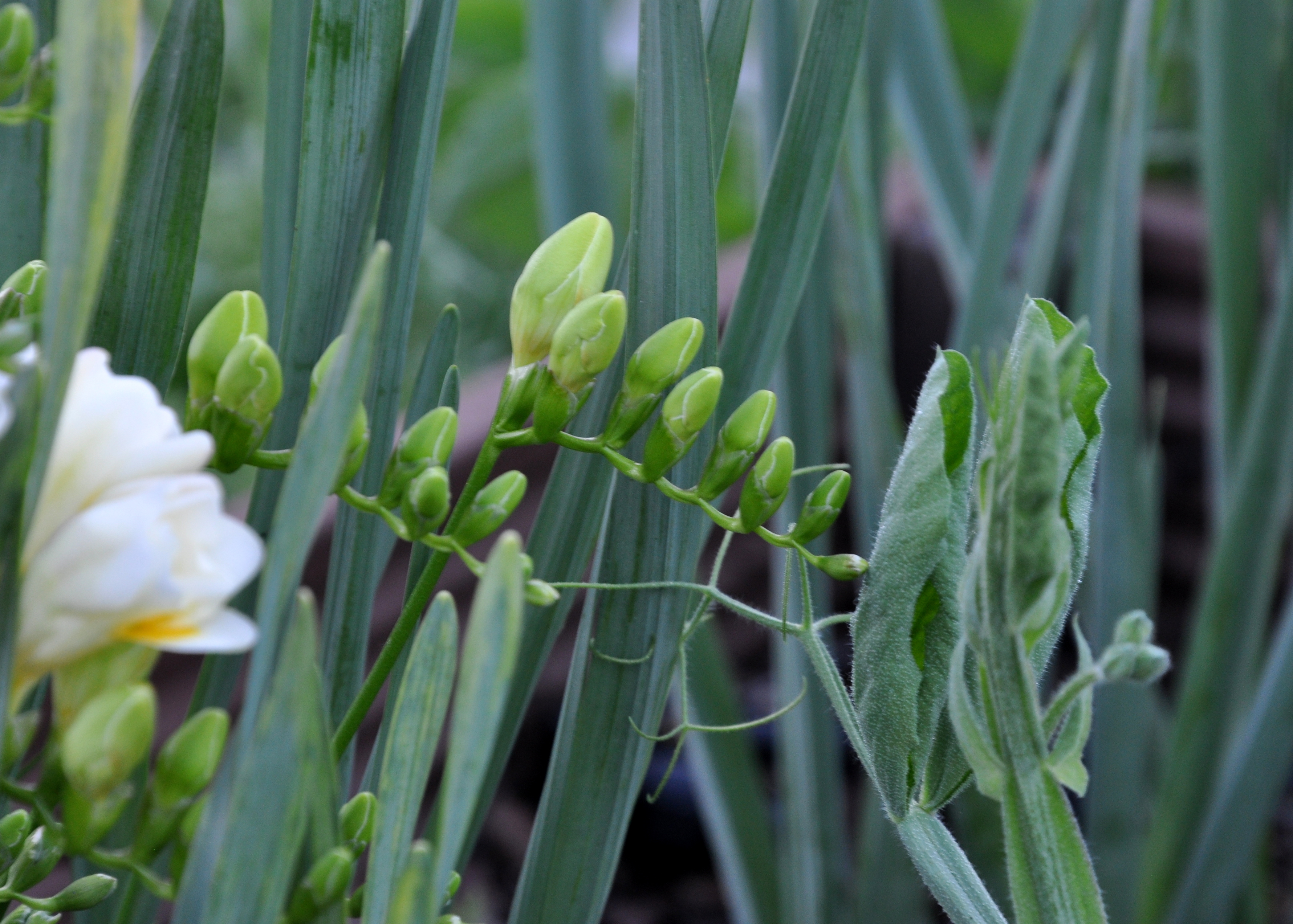
Freesias, sweet peas and daffodils
Freesia toppling over the walkway
Freesia in the curb garden
Wouldn’t it be nice if you could press your nose to your screen and drink in that scent? Perhaps one of those twenty-something technical geniuses will develop a scratch-and-sniff like feature.
The hyacinths are also up dusting corners of the garden with their potent scent.
Purple Hyacinth (William of ‘William and Kate’)
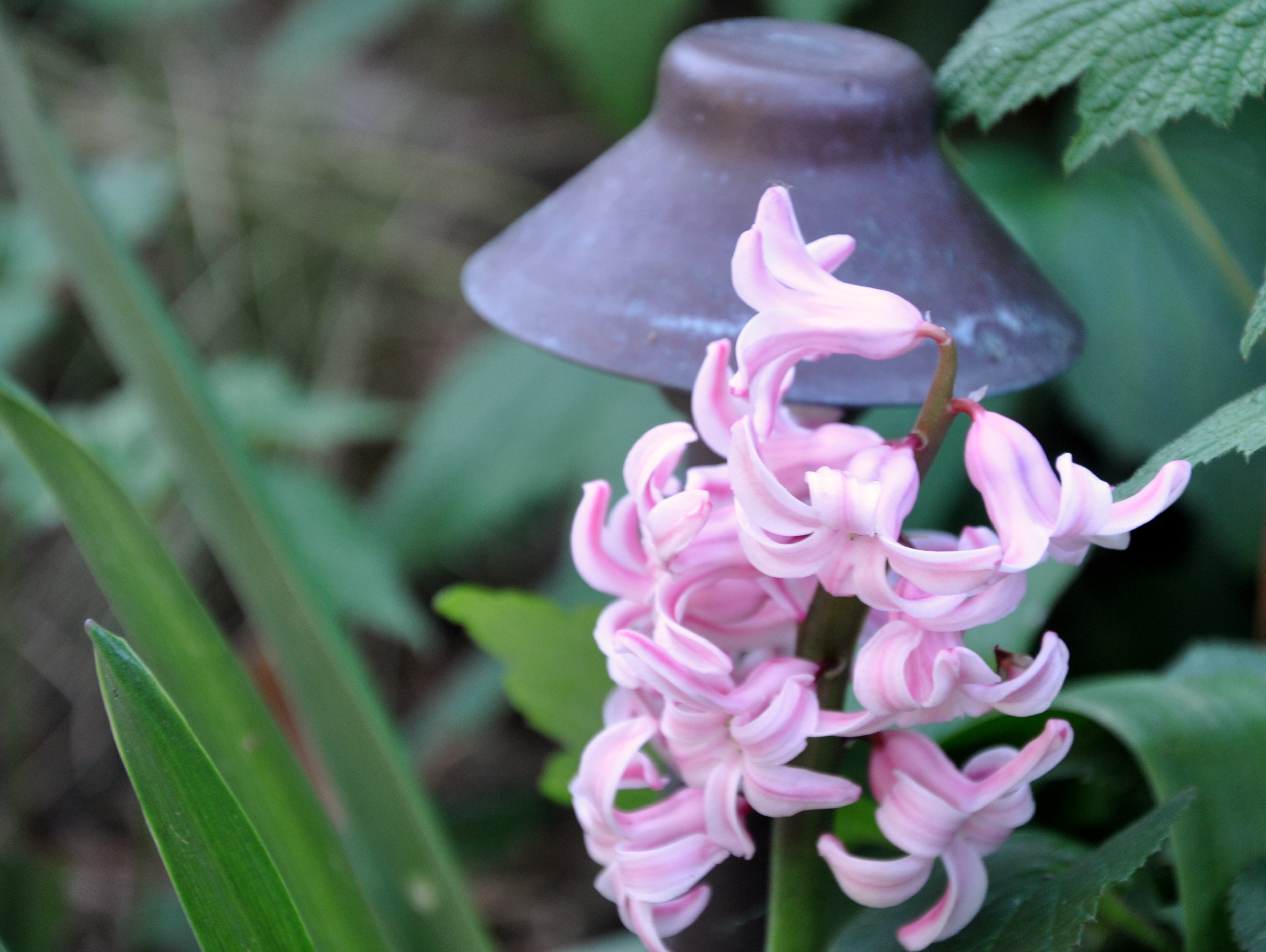
Pink Hyacinth (Kate of ‘William and Kate’)
It’s no surprise that even manufactured scents try to borrow from nature: rose-scented perfume, lemon-scented dish detergent and lavender-infused essential oils. Nothing tops nature.
Along the fence, our jasmine vine is in full bloom, inviting me to linger under its shade. I hope it survives the abuse it will get when work boots hit the ground. It’s time to replace the fence.
Star Jasmine
Star Jasmine vine
Curb garden with daffodil and freesia
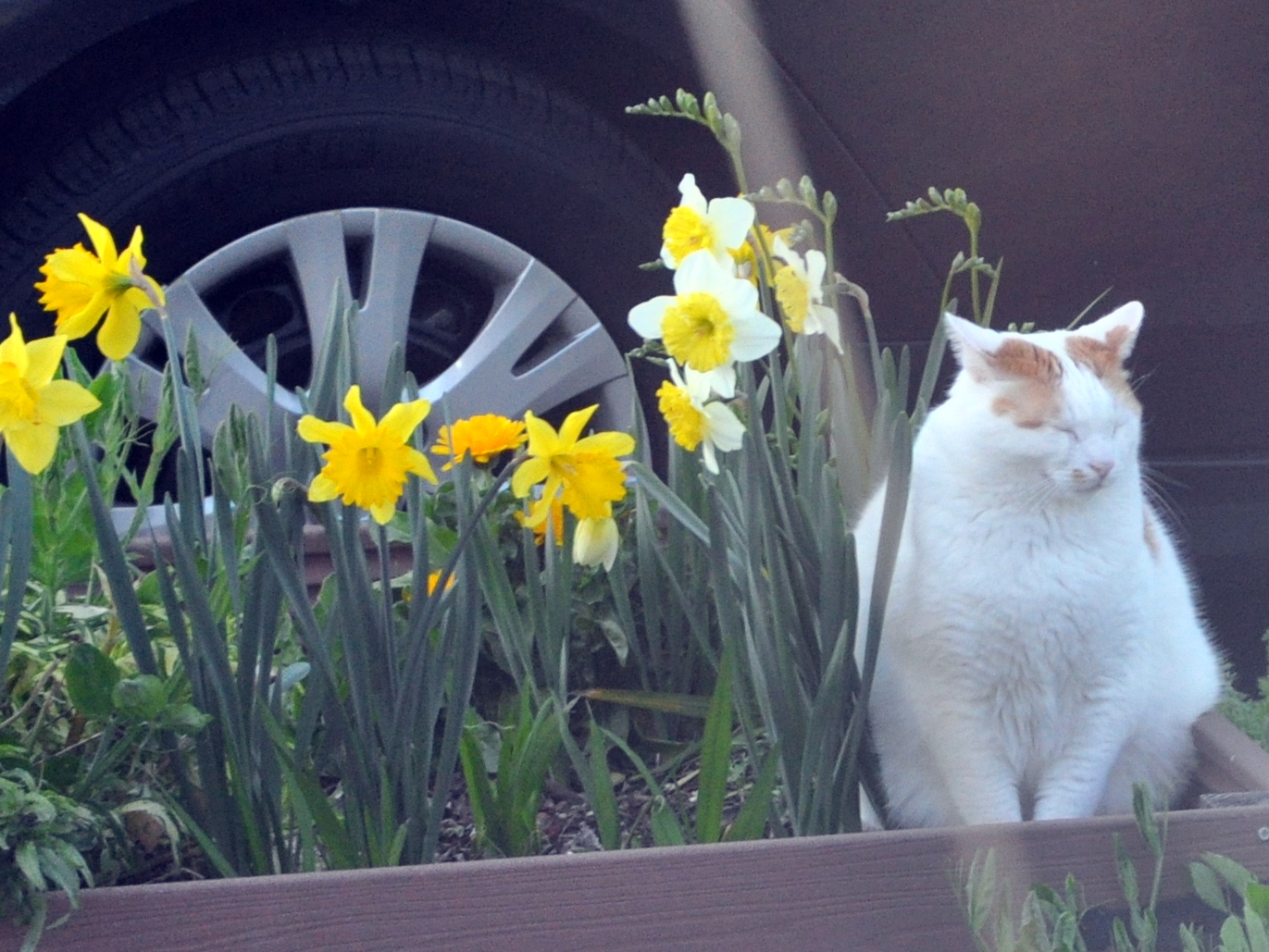
Narcissus: 1) Daffodils; 2) Mouse the Cat
The flower is the poetry of reproduction. It is an example of the eternal seductiveness of life. Jean Giraudoux
So what do you think? Could “scratch and sniff” be the wave of the future? Mmmmmmm
It’s been two weeks since the Anderson Reservoir overflowed its banks in San Jose. After a series of punishing storms in our rain-parched state, there was simply nowhere for the water to go. Reservoirs filled, then overflowed, flooding roads and then neighborhoods in the low-lying Rock Springs neighborhood. When the banks overflowed, the reservoir had reached 105.5% capacity. The water level was almost 4 feet (meters) above the top of the spillway.
We learned over the weekend that:
More than a decade ago, the U.S. Army Corps of Engineers considered a $7.4 million project that would have protected the Rock Springs neighborhood from last month’s devastating floods. But it concluded the project was too costly — and refused to fund it. Source: San Jose Mercury News
Setting aside for a moment the human suffering caused by the flood, Santa Clara County says the cost of the damage is approaching $100 million, “some of which is the tab for repairing dozens of cars and more than 80 housing units with major damage in the Rock Springs neighborhood.” What heartbreak for people, many of them low-income, elderly or disabled, to be displaced from their homes. Lots of finger-pointing ensued: why weren’t they evacuated sooner? Why didn’t the city warn people living in the neighborhood of the risk? The answers seem lame: “we didn’t want to alarm them.” Instead, the waters rushed in, damaging homes, cars and meager possessions, with toxic waters overflowing the banks with contaminants gathered in the floods path.
The better story here is the outpouring of help from the residents of San Jose. Over 2,000 showed up for the first Saturday to help with major cleanup. My friend Jim Reber is hosting a fundraiser for his birthday, requesting donations towards the cleanup of Kelley Park. There’s a photo of the damage to the tea house on his fundraising page. My friend and artist Lexi Granger listed several pieces of art, discounted them, and donated 100% of the proceeds from her Etsy shop to flood victim relief.
Kieu Hoang, a billionaire businessman, donated $5 million to the fund set up by the Silicon Valley Community Foundation. The fund will distribute money to nonprofits providing emergency financial assistance and other support to those displaced by last month’s flooding.
Jim Reber, San Jose Parks Foundation
Heading toward area 10
Japanese Friendship Garden and Koi Pond
Mike and another volunteer shoveling silt
Caked on mud
A pair of unconcerned ducks
That’s me, with the pond in the background
Japanese Tea Garden
Mud caked on the vegetation
More mud and crud
Plastic garbage in the mud
We hosed off our shoes at the end of our shift, turned our gloves inside out and washed our hands.
The still-swollen Coyote River
Blue skies over the suspension bridge in the park
Closed to the public for now
This past weekend, Mike and I volunteered for flood cleanup at nearby Kelley Park, home to a beautiful Japanese tea house and tea gardens in San Jose. Flood waters reached that too, sending water, mud, silt and debris across the park, over the pond and into the tea house. The work was physically exhausting and not all together comfortable, but we felt good to be doing our small part. We had to wear long-sleeved shirts, pants, and closed-toe shoes, along with masks and goggles, provided by the city. Along with the flood debris, the receding waters deposited poison oak and poison ivy spores throughout the park and could lead to problems if we weren’t careful. After an orientation, we walked to “area ten” with a group of volunteers. Mike shoveled silt and mud from the walkways. I picked up trash (mostly plastic!) and pulled weeds along the pathways.
I volunteered for a few hours last week doing flood relief outreach at Sacred Heart Community Services. Sacred Heart is one of four major charities tasked with serving flood victims. I placed phone calls to folks on a list of 350 registered flood victims, providing them details for seeking financial assistance. It was slow work, but with a number of volunteers we worked our way through the list. The worst of the flood damage happened in one of the poorer neighborhoods, and sadly many of the residence have nowhere to go. Two shelters remain open at a couple of community centers. Three homes are red-tagged meaning they are a complete loss, where as yellow and green have some access, but no necessarily power or fresh water. In short, it’s a mess.
If you live in San Jose, here are ways to get involved:
Sacred Heart Community Services: They’re providing outreach to flood victims, as well as distributing personal items (toothbrushes, shampoo and other toiletries), clothing, blankets and food. They have volunteer positions in the clothes closet, food pantry, sorting, phone banking, data entry and other opportunities. They will provide an orientation first. Thereafter you can sign up for shifts on their website.
Start a drive in your community, among friends, neighbors, or co-workers for blankets, bedding, food or hygiene items.
Today’s flooding in San Jose made national news, so I’ve put together a brief post to let my friends know that my family is safe and dry. [drone footage, no audio below]
We’ve had a reversal of fortunes so to speak, replacing six years of drought with one of the wettest winters in recent memory. I’ve lived in the Bay Area for nearly fifty years, and I’ve never seen anything like this.
As our reservoirs reached capacity in early January, we let out a collective sigh. The drought could now be viewed from the rear-view mirror.
It kept raining. Then it rained some more. Powerful, drenching, atmospheric river styled storms, up and down the state. We had brief days of dry weather, followed by more intense storms.
Mountainous regions about twenty miles south had two or three times the rainfall. Nearly 50,000 commuters travel the mountainous corridor daily between Santa Cruz and San Jose. Trees and slopes, barely hanging on after so many years of drought were suddenly deluged with water. This led to collapsed roads, devastating mudslides, falling trees and sinkholes. Flooded roads and lane closures have been a daily occurrence now for weeks.
To our north, friends in Oroville have been dealing with a failed spillway. The Oroville Spillway serves America’s tallest dam. During a recent storm, a section the size of multiple football fields failed, sending water gushing off the sides and threatening homes along the Feather River below. At one point, over 180,000 people evacuated fearing the river would overflow, flooding homes and businesses along its path. My friend Barbara lives just above the Feather River, and has written her personal account Vegan Above The Flood Plane on her blog AtFiftySomething.
Over the weekend, we’ve been closely monitoring the Anderson Reservoir, the largest in Silicon Valley. Due to seismic concerns, officials prefer to keep the reservoir at 68% of capacity. It reached 103% over the weekend, and continued to fill with today’s rains.
I don’t know why San Jose didn’t order a mandatory evacuation. All the signs were there. I checked notifications from my couch all day, as I’m home recovering from a stomach virus. Then the worst happened. The water overflowed the banks along the river, forcing emergency evacuations. Footage shows fire fighters in neck-high water bringing residences to safety. The water is filthy, contaminated with everything in its path. Folks living in homeless encampments had to be rescued from trees. Heartbreaking.
I’ve never been so grateful for a warm, safe, dry home. As soon as I’m well, I’ll be off this couch, finding a way to pay it forward. Our community has already rallied. This rain-loving gardener has never been so happy to see a few days of sun in the forecast. I’ll share more as the news unfolds.
I’ve always loved cats. I like their grace and intelligence, their independence and there warm and affectionate ways. I love all animals, but I grew up with cats and they’ve remained a constant in my life. When you have a soft, mushy heart, one cat often turns into two…or three or a number you’re embarrassed to say out loud. No one wants to be labeled the “crazy cat lady.”
So perhaps it’s not a surprise that this beautiful bit of green moss growing in the garden looks just like a cat.
Look closely at the garden wall
Mossy cat bending over for a drink
I adore the bright green spongy texture of moss. It reminds me of romantic period movies, pixies and garden fairies. I’ve never seen a mossy cat though, so I’m feeling quite special. The green goddess of gardens has graced my garden wall.
Bloggers, Twitter users and Instagram aficionados publish a single, captioned photo mid-week. Wordless…as in no words. Hmm.
Either I lack the confidence to post a photo that I think should stand alone, or I simply have too much to say. I would like to propose a new hashtag called #Wordy-Wednesday. Of course “wordy” sounds like something my 7th grade English teacher might abhor.
“The rain, in Spain, stays mainly in the plane” would never fly when
With that, I think I’ve come full circle. If you’ve read this far, you’ll know that I’m just over the 150 word count, and you’re probably thinking “Alys…get to the point!”
The point is, I like to write, and I like to read what you write and I like to read the comments that you write when I write. Here is my #Wordy-Wednesday.
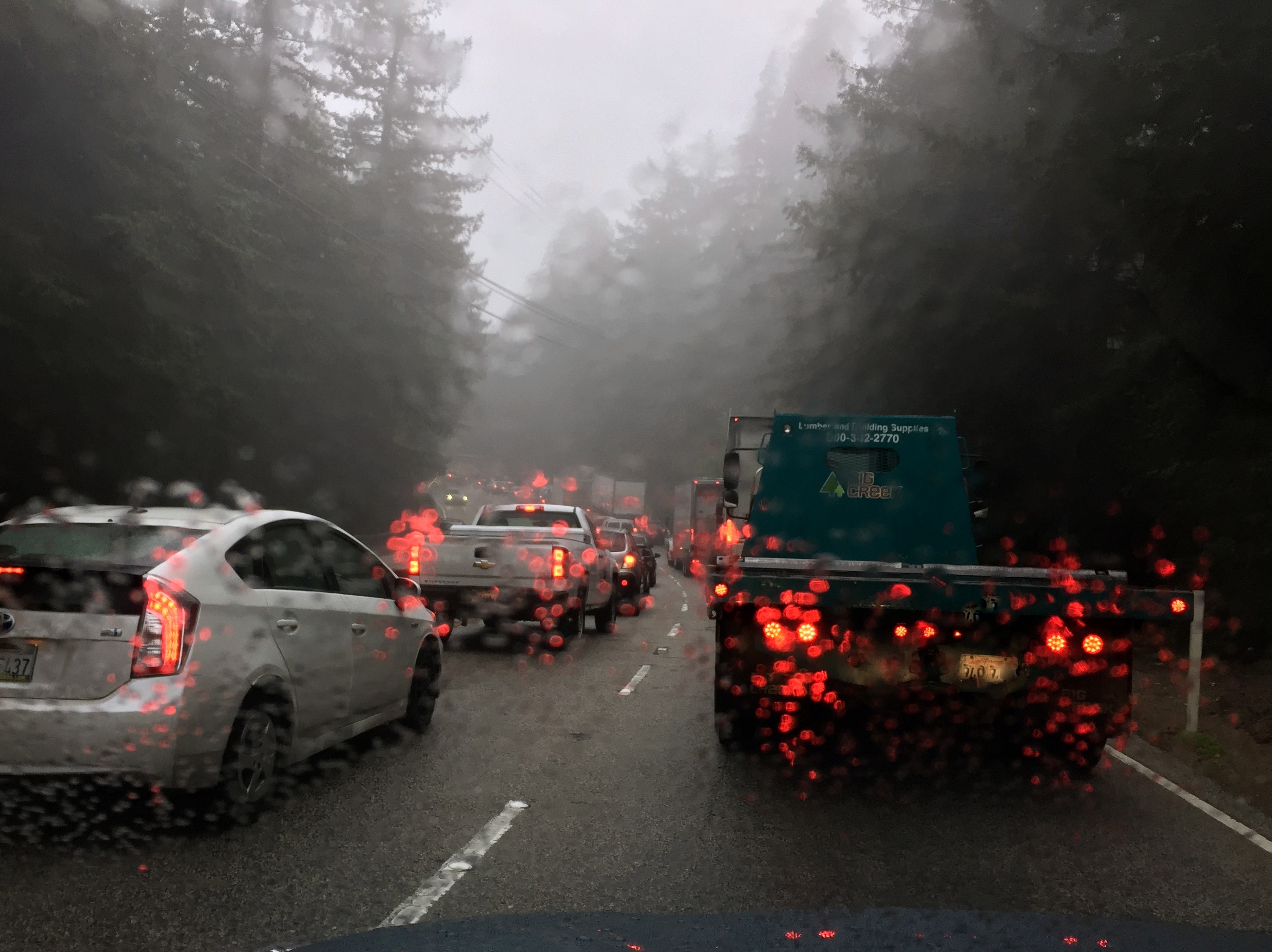
The atmospheric river is back, delivering more heavy rain in back-to-back storms. I headed over the hill (for the appointment I cancelled last month due to the storms) only to be thwarted yet again. The rain cleared for a few hours mid-day and traffic reports said I could get there in about an hour. Crews were clearing a mudslide, with one open lane. Then as I approached the area of the highway without any easy exits, traffic slowed to a crawl and then stopped.
Stopped in traffic on Highway 17
A second major mudslide lay ahead and there was nowhere to go. Close to an hour later, crews created a turnaround and both lanes of traffic slowly made u-turns going back in the direction we came. Nearly two and a half hours later I found myself back home thinking that perhaps I’ll cancel all of my over the hill appointments until late March. What a slog.
The amazing news is that no one got hurt. The massive slide dumped mud, rocks and trees along two lanes of the highway, lifting a man in his truck up and then over the side rails, dropping the truck upside down. The man walked away from the accident unharmed!
Dozens of people worked over night to try to clear and shore up the area. They expect more slides today. Here is some amazing footage of a mudslide in action, taken from the dashboard camera of a police cruiser.
If you click on the Facebook link, then scroll down to February 7th, you can see the video.
Again, no injuries.
Throughout the Bay Area, massive trees are down, homes flooded and at least one home split in two and slid part way down the hill. I’m grateful for the people who keep showing up for work with chainsaws, heavy equipment, and a can-do attitude.
California Gray Squirrel perfecting his two-point stance
I’ve tried to like American football. With numerous invitations to Super Bowl parties over the years, my interest stemmed from a desire to fit in. To be “one with the ball” so to speak. By the time I reached my mid-twenties, however, I threw in the towel. When they were handing out the sports-loving genes, I was waiting in line for a green thumb. It’s a national pastime in the States, culminating in this weekend’s Super Bowl Sunday. I don’t begrudge the fans, as long as they’re well-behaved, but other than fast-forwarding through the clever commercials, Super Bowl Sunday is just another day for me. Weather permitting, I would rather spend the time in the garden.
I consulted the For Dummies series to educate myself on the following football terms, then translated them into phrases that a gardener will understand.
Without further ado, here is your guide to the Super Bowl of Gardening
Down: A period of action that starts when the ball is put into play and ends when the ball is ruled dead (meaning that the play is completed).
Down: A period of time known as winter. Gardening down time.
End zone: A 10-yard-long area at both ends of the field — the promised land for a football player.
End zone: The only zone in which you can’t grow a thing. I garden in zone 9b.
Extra point: A kick, worth one point, that’s typically attempted after every touchdown.
Extra point: When you plant one thing, and two things come up instead.
Field goal: A kick, worth three points, that can be attempted from anywhere on the field but usually is attempted within 40 yards of the goalpost.
Field goal: My goal is to grow a garden as big as a football field.
Fumble: The act of losing possession of the ball while running with it or being tackled.
Fumble: The act of losing possession of the bulb you just dug up when the resident gardener runs after you saying “No! Not the tulip bulbs!!!” This usually pertains to squirrels.
Hash marks: The lines on the center of the field that signify 1 yard on the field.
Hash marks: The indentations left on your knees after pulling weeds all day.
Interception: A pass that’s caught by a defensive player, ending the offense’s possession of the ball.
Interception: The sunflowers saved by a defensive gardener who figures out clever ways to outsmart the squirrels.
Kickoff: A free kick that puts the ball into play.
Kickoff: Also referred to as ‘Spring.’
Punt: A kick made when a player drops the ball and kicks it while it falls toward his foot.
Punt: A kick made when a gardener drops a packet of seeds and tries desperately to keep them from hitting the ground.
Return: The act of receiving a kick or punt and running toward the opponent’s goal line with the intent of scoring or gaining significant yardage.
Return: The act of returning to the garden center again and again because you simply can’t help yourself.
Sack: When a defensive player tackles the quarterback behind the line of scrimmage for a loss of yardage.
Sack: A great place to store and dry last year’s seeds.
Snap: The action in which the ball is hiked (tossed between the legs) by the center to the quarterback, to the holder on a kick attempt, or to the punter.
Snap: The sound a gardener’s neck makes, when she realizes that what she just brushed off her shoulder has six furry legs. A snap may also warrant a trip to the chiropractor.
Touchdown: A score, worth six points, that occurs when a player in possession of the ball crosses the plane of the opponent’s goal line, or when a player catches the ball while in the opponent’s end zone, or when a defensive player recovers a loose ball in the opponent’s end zone.
Touchdown: When you brush your hand across the surface of a lambs ear it’s like touching down.
and finally
Turnover: When, with either a fumble or an interception, one team loses possession of the football to the other.
Turnover: After a full day in the garden, I want to enjoy a hot cup of tea and an apple turnover. Yum!
Wishing you a terrific weekend, on or off the field.
As January draws to a close I’m struggling mightily to find some equilibrium.
It’s been a month of cold and frosty nights. It burns off early, but some of our plants collapsed from the cold.
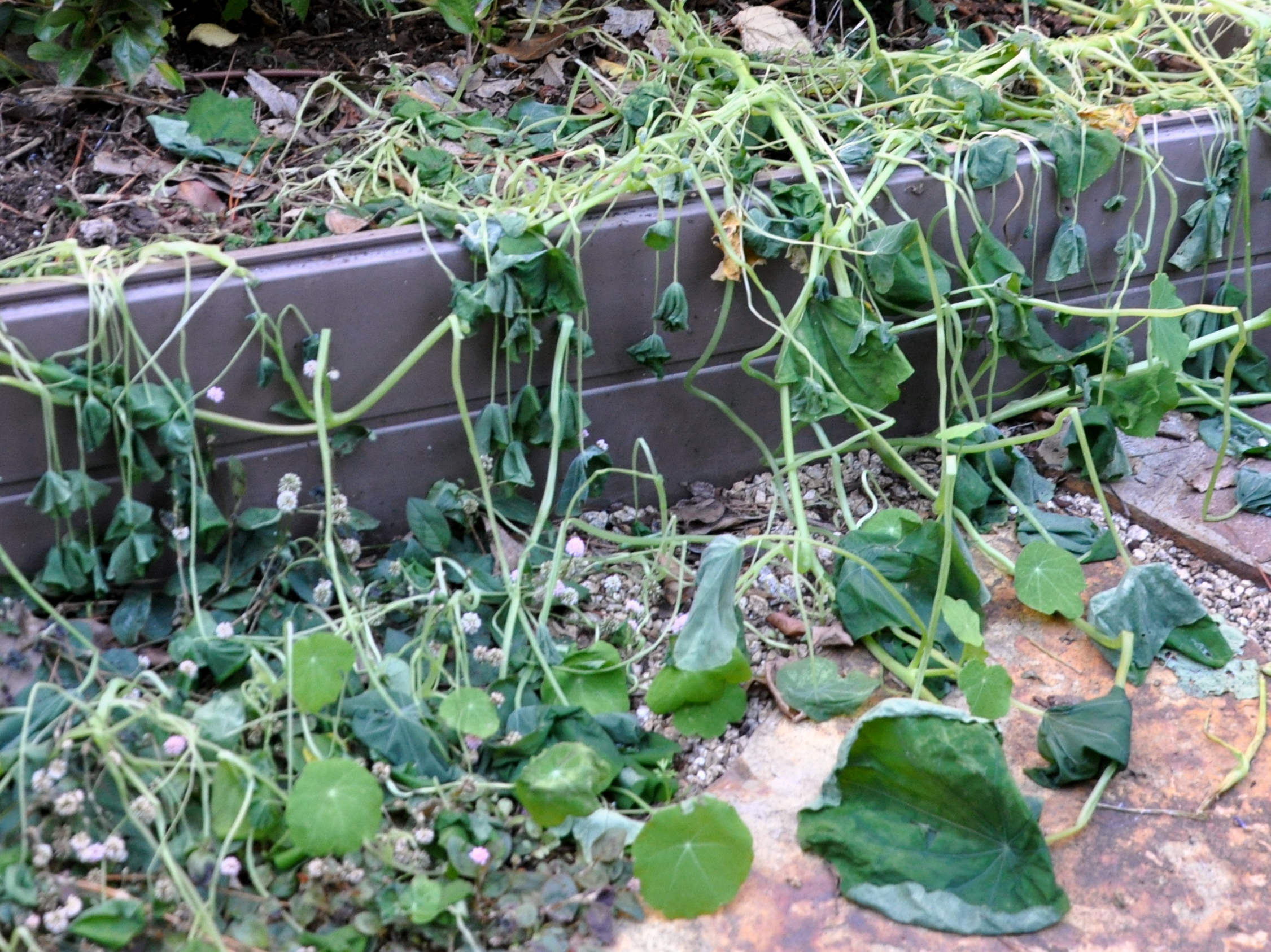
Frozen Nasturtium
These nasturtiums bloomed last spring, died in the heat of summer, then self-seeded in late November. The frost did them in.
Frozen bird bath
Frosty paw prints courtesy of Mouse
It’s also been a month of rain. Cold days gave way to magnificent rain storms. It was too much all at once, but at the same time exactly what we needed. The sky opened up and dumped record-breaking rain on our parched state.
Washed out trail along Almaden Lake
The powers that be declared last week that the six-year California drought is all but over.
Pacific storms in early January have brought widespread, intense precipitation to California, providing relief to some drought-stricken regions but also flooding. According to the U.S. Drought Monitor, about 35% of the state is no longer experiencing drought, and the proportion of areas under extreme-to-exceptional drought fell from 38% on January 3rd to 28 percent by January 10. Cumulative precipitation hit a record high, doubling the historical average for this time of year. While a weak La Niña persists, sea surface temperature will transition back to normal by February 2017. Surface reservoirs, especially in Northern California, are beginning to refill, but groundwater aquifers in many parts of the state remain severely over drafted and will take far longer to recover. Source: Californiadrought.org
Yesterday the temperatures climbed into the high sixties (19 C). A week of unseasonably warm days offered a much-needed dry out for communities with overflowing riverbanks and mudslides. Potholes turned into sinkholes, and the CHP humorously named one Steve. You can read about Steve’s short “life” as a magnificent sinkhole here. I’ve been raking pine needles, removing dead branches and gently pruning damaged leaves.
And finally, it’s been a season of disquieting change.
The country said goodbye to President Obama and First Lady Michelle. Obama the candidate campaigned on hope. Once elected, he brought intelligence and grace to the White House. Obama governed in measured and thoughtful ways, and his presidency was one of inclusiveness. When the US elected its first black president, it gave the rest of the world hope. The United States was not a racist nation after all!
I still don’t know how we got here? January draws to a close in a season of hatred. Inexplicably, this country reversed course. We’re on a maddening and frightening path to the 1930s.
San Jose Women’s March * January 21, 2017
I’m trying to find a balance between action and despair. It’s only about a week since the women’s march and I’m already feeling deflated. Pauline said it bluntly: we’ve elected a mad man.
I attended the Women’s March in San Jose with several friends, my husband and members of our amazing community.
Like all the sister marches around the world, San Jose broke a record. Organizers expected about 10,000 marchers to converge on San Jose’s City Hall. Our numbers swelled to 25,000. This translated into long lines for public transportation, and a march that took nearly two hours to complete. We joked that it was more of a meander or a crawl than a march. We had the time of our lives.
Together we walked in unity along the route from San Jose City Hall to Cesar Chavez Park in downtown San Jose.
It was exhilarating! Women chanted, sang, smiled and laughed. Sometimes we wept. It was an experience I will never forget. 25,000 people coming together in peaceful solidarity.
Here is a quick snapshot of the day:
It’s hard to describe the outpouring of energy, the camaraderie and the joy. As I walked with my fellow marchers, I felt cocooned in a collective embrace.
My phone battery died early so I didn’t get as many photos as I would have liked. I wish I had photos of all the people waving from buildings along the route, the signs, the children, the sea of pink hats. My friend Rosie observed that “the force was with you today with crowds, weather, significance and attitudes.”
We did it! On January 21, over 5 Million of us worldwide and over 1 Million in Washington, D.C., came to march, speak and make our voices heard. But it doesn’t end here – now is not the time to hang up our marching shoes – it’s time to get our friends, family and community together and make history.
Every 10 days we will take action on an issue we all care about, starting today.
Laurie at Life on the Bike and Other Fab Things attended the Women’s March in DC. You can read about her initial impressions here. Check out the photo of the woman elevating her walker along the parade route.
Karen at The Unassuming Hiker doesn’t like crowds. She brushed aside health concerns and marched anyway, with her daughter and other friends. She took a bus from Virginia to be at the DC march. She shares her own unique perspective here.
The Pussyhat Project: A bit about the movement, free patterns to knit or sew.
The expression “results may vary” always make me laugh. Since the early days of advertising, we’ve been sold a bill of goods.
One size fits all (ahem)
Guaranteed results (or your money back)
New and improved
and so on.
Do you ever find yourself applying these terms to everyday life?
Mine would go something like this: I’m going to head out into the world today, knowing full well that results may vary. I’m going to shrug into my one size fits all sweater, which is actually a size large…just in case. Life does not come with guarantees, but if it did, I might be able to get compensation for that big bruise on my shin. (My life’s mantra: slow down, Alys, slow down!) And finally, far from being new and improved I would like to offer up a more accurate slogan: Old and improving. I like the idea of being a better person with the rise of each day, but there is nothing new about the four step maneuver it takes to get out of bed.
These same advertising slogans have been rattling around in my head when I’m in the garden. One example: I planted an old packet of broccoli seeds figuring nothing ventured, nothing gained. A small cluster of seedlings sprouted giving me hope. I thinned them to a respectable number and waited for the plants to take off. They’re not dead, but they’re not growing either. The seedlings remain in a suspended animation weeks after planting. Results may vary.
Broccoli Seedlings: Grow baby, grow!
Last summer I planted our fountain with succulents. It’s a long story for another day, but suffice it to say that is one expensive planter. I’m not well versed on the variety of succulents available, and the nurseries provide scant clues. The pot might say “two-inch succulent” or “four-inch succulent” which tells me nothing about growth habits. As you can see from the photo below, it’s not a one size fits all proposition. The plan was to have the center plant gradually grow up, while its companions to the left and right gracefully trailed over the edges.
Copper planter with succulents, September, 2016
Copper fountain planted with succulents, November, 2016
Nature is as nature does.
As for “guaranteed results or your money back”, I’m pretty sure there is a disclaimer for acts of god or nature. There are no guarantees when it comes to gardening. You can plant a seed, water it, and hope that it grows. Have you seen those seed packets? Those plants are amazing! I’ll buy a hundred, and grow produce for the entire neighborhood. I’ll have vases of gorgeous, fresh flowers scattered throughout the house. It’s guaranteed!
Tulip Bulbs: So much promise, so little return
Darwin knew what he was talking about. It’s all about survival of the fittest. I plant seeds, and they refuse to grow. I plant bulbs, and the squirrels dig them up and either eat them or toss them on the deck. Seedlings pop through the soil but then snails eat them in the dead of night. Plants that overcome these obstacles, must contend with birds, squirrels, rats, drought, stink bugs, fungus, scale and sometimes this careless gardener who forgets to water a dried out pot. Guaranteed!
Finally, new and improved might mean pesticide-laden seeds. I like to garden old school: heirloom plants and seeds in a pesticide-free garden. As I mentioned earlier, old and improving.
Beautiful Illustrations of hope and promise…guaranteed!
And that, my friends, brings me back full circle. Results may vary. Sometimes that’s a wonderful thing. My entire front garden self-seeded once again, with Nigella, California Poppies, Cornflowers and Sweet Peas. They seem impervious to the recent frost. They’re lush and green, planted by nature, watered by recent storms and back by popular demand. Now that’s a slogan to celebrate.
Frosty front garden
Self-seeded trellised sweet peas
Garden closeup
Impervious to the frost
Advertising: the science of arresting the human intelligence long enough to get money from it. Stephen Leacock
If you were running an ad campaign for your daily life, what would you say?
What a week! To say it rained is an understatement. Back to back storms battered California for several days, wreaking havoc up and down the state. Dangerous mudslides, overflowing waterways, downed trees and snarled traffic have been the norm.
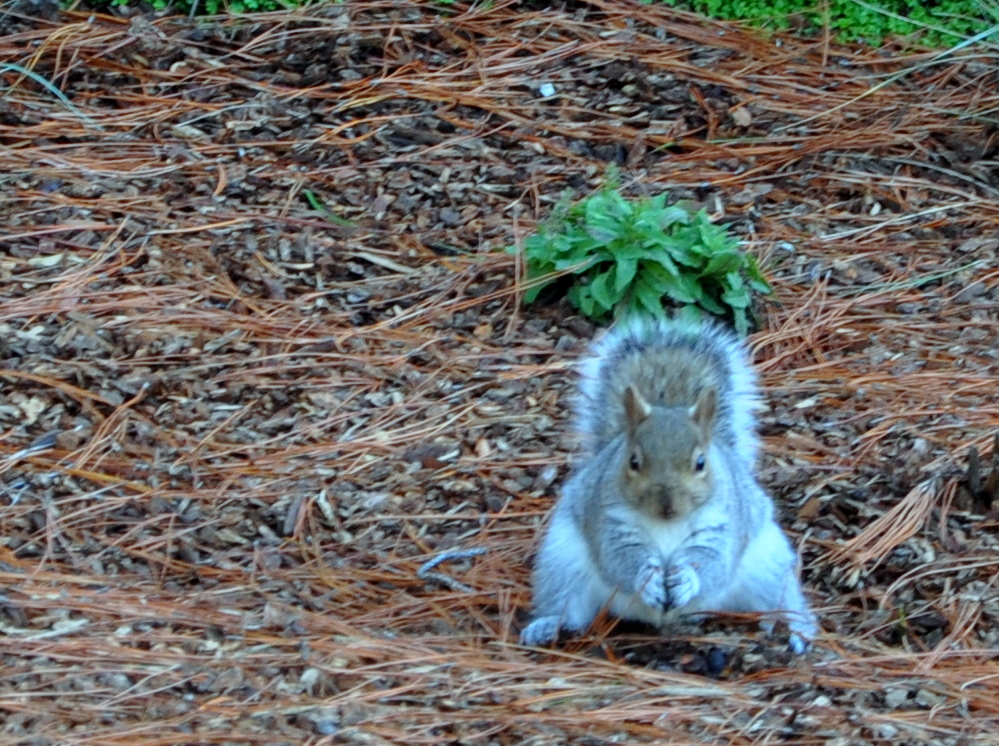
California Grey Squirrel using his tail as an umbrella
Much like the proverbial flood gate, we’ve endured five years of drought and then the rain all flowed at once.
atmospheric rivers come in many shapes and sizes, those that contain the largest amounts of water vapor and the strongest winds can create extreme rainfall and floods, often by stalling over watersheds vulnerable to flooding. These events can disrupt travel, induce mudslides and cause catastrophic damage to life and property. A well-known example is the “Pineapple Express,” a strong atmospheric river that is capable of bringing moisture from the tropics near Hawaii over to the U.S. West Coast.
Flooded sign at the head of Los Gatos Creek Trail
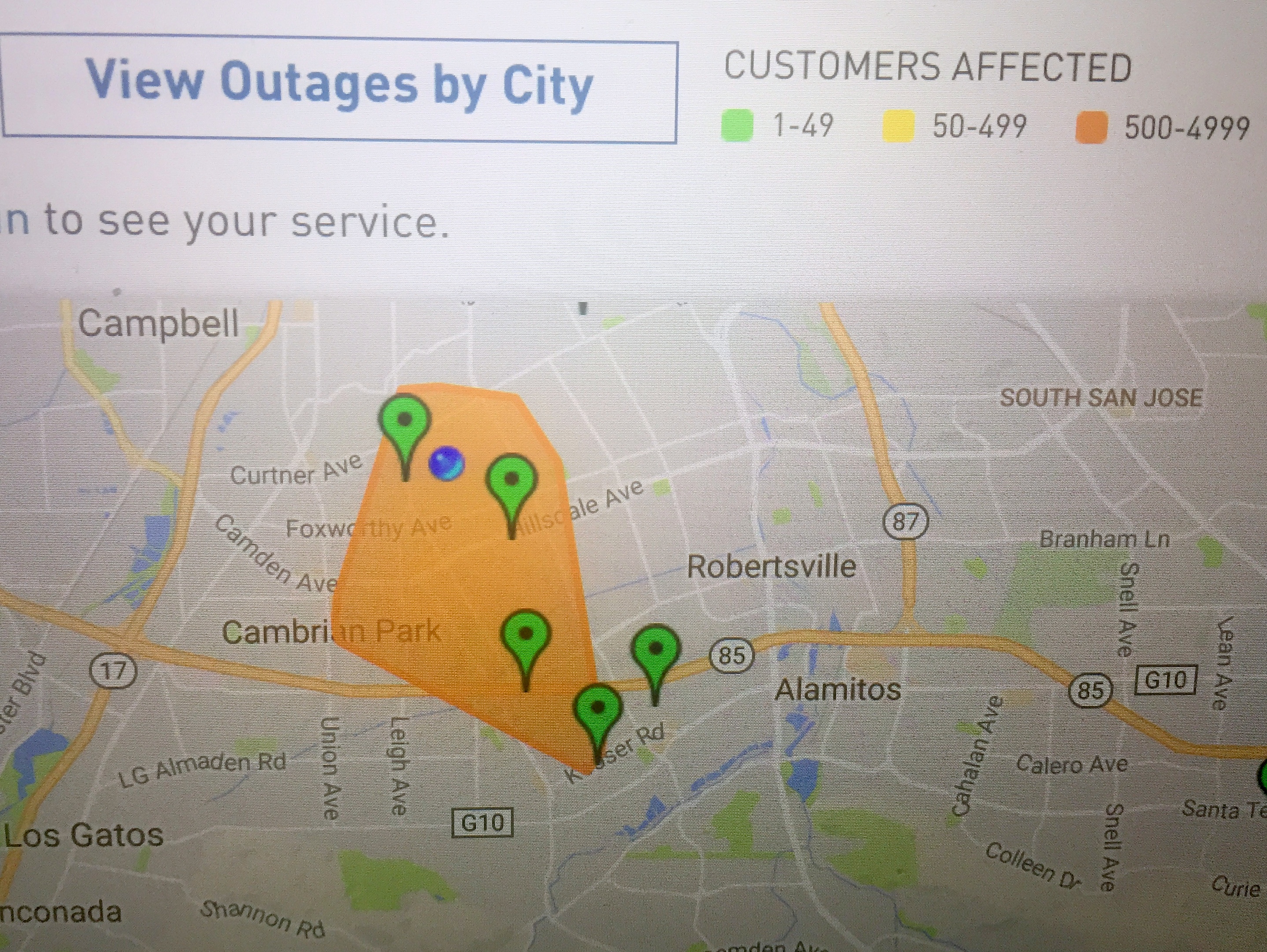
Here in San Jose we’ve been incredibly lucky. Other than losing power for several hours after the first storm, we’ve been otherwise okay. Our street didn’t flood, and we didn’t lose any trees (thank goodness).
From the PG& E website
The only nail-biting experience was my attempt to get to an appointment mid-week “over the hill” in nearby Felton. There are only two ways to get there from here, by highway 17 or highway 9. Both routes travel through winding hills. I checked the traffic reports before heading out (CHP closed Highway 9 but 17 remained open), but it was not to be. Just a few miles in to my trip, the rain started to fall in sheets. There were mudslides the day before, and heavy puddles were already forming. I found a safe place to exit the freeway, canceled my appointment by phone, then headed home. What timing. The traffic had already stalled, backing up for miles in the southbound direction. Another mudslide snarled traffic. My friend who lives in Santa Cruz left work around 6 Tuesday evening, and didn’t arrive home until 2 am. She sat on the freeway for hours, finally got off the road in nearby Los Gatos, until road crews were able to clear one lane. Several of us offered her a place to stay, but I think she was anxious to get home to her dog.
Unfortunately, many others in the state have not been so lucky. When trees endure years of drought, their roots shrink as a form of self-preservation. When heavy rains come along, the ground is quickly saturated and the water has nowhere to go. Massive trees toppled all over the area, destroying cars, a few homes and stalling our Bay Area Rapid Transit. Several rivers and streams reached and then exceeded flood stage, spilling water into nearby communities.
I took this video of Lexington Reservoir after turning back for home on Tuesday. An hour and a half later, it overflowed its banks into the Los Gatos creek flooding the trails and closing the park.
In between storms, I walked with a friend near Almaden Lake. I’ve never seen it so full, and again, parts overflowed washing out trails.
Almaden Lake after a storm
Rising waters
High water levels
Washed out fence and walkway
Flooded walkway
A turtle that lost his way (I moved it off the path into the grassy knoll)
Gathering debris
Flooded walkway
There are many positives in all of this. For the first time in years, most of the state’s reservoirs are full. Snow pack in the Sierra, which provides a third of our fresh water doubled in a week. On January 3rd, it was only 70% of normal for this time of year. After this series of storms it’s 158% of normal!
The day is cold, and dark, and dreary;
It rains, and the wind is never weary;
The vine still clings to the mouldering wall,
But at every gust the dead leaves fall,
And the day is dark and dreary.
My life is cold, and dark, and dreary;
It rains, and the wind is never weary;
My thoughts still cling to the mouldering Past,
But the hopes of youth fall thick in the blast,
And the days are dark and dreary.
Be still, sad heart! and cease repining;
Behind the clouds is the sun still shining;
Thy fate is the common fate of all,
Into each life some rain must fall,
Some days must be dark and dreary.
Beautiful poetry aside, rainy days lift my spirits. I’m not feeling dark or dreary, just hopeful that this could be the beginning of the end of this California drought.



















 Gardening Nirvana