The Rewards of Letting Nature Take Its Course

By early to mid August, our white Japanese anemone are in full bloom. They line the rock wall, taking on more and more real estate with each passing year. They’re considered non-invasive, but prolific bloomers. I’ll say.

Anemones

September, 2012 Japanese Anemones Line the Rock Wall

The blooms are generally spent by November and the flower stocks dry up and turn brittle. The entire stem pulls up easily, no pruning required.

Last year we had some late bloomers so I didn’t get around to “trimming” them back.

Then I had surgery.

And the wonderful consequence is this:

hummingbird collecting fluff

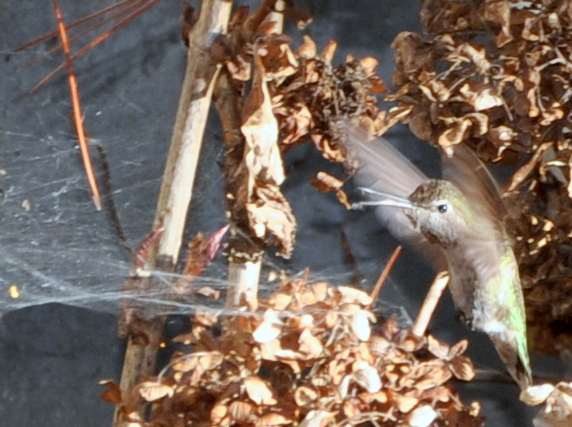
Female Anna’s Hummingbird Gathering Nesting Material

I wish the photos were clearer but I had to share. That’s a female Anna’s hummingbird gathering Anemone “fluff” for her nest. She’s been back several times to gather more, along with others nesting mammas in the neighborhood. She plucked at the fluff over and over till her mouth was full, then flew back to the nest. One of the Anna’s appears to be nesting in the orange tree. That’s the direction she goes once her beak is full. Another one gathers, then heads to the neighboring pine tree.

Fluffy Anemone Seed Heads

Fluffy Anemone Seed Heads

Earlier in the week I sat still in a chair for half an hour hoping to capture this wonderful event on video. I forgot to close the back door, however, and within minutes, one of the kitties was asleep in my lap.

I could have taken him back inside, but once I was resting there in the warm sun, I found myself “in the zone.” Sitting in my wicker chair in the garden, warm kitty in my lap, watching nature unfold was mesmerizing. Alas, the mama hummingbird didn’t return for her closeups so I had to make do with these blurred pics and the happy memory to go with them.

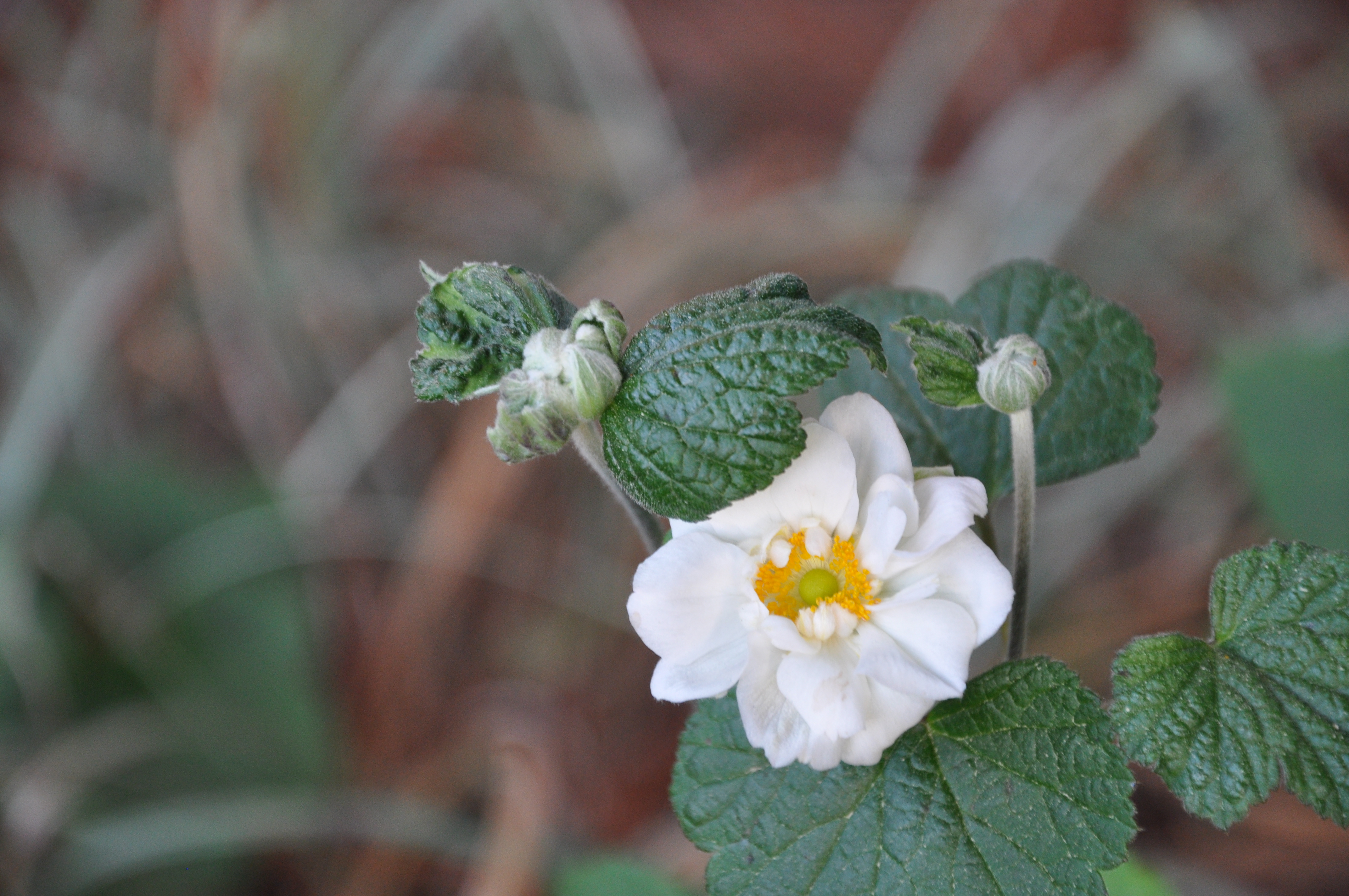
Oh, and remember what I said about anemones flowering in the fall? Check out this one, flowering away in late February.

anemone bloom february

Anemone Blooming in February

I wonder if the lack of rain along with weeks of unseasonably warm weather is playing tricks on the flower’s programming?

The Economics of Going Native

California Native Plants Replace the Lawn

California Native Plants Replace the Lawn

There are a number of things to consider when converting lawn to native plants. Economics is one of them. Up front costs are costly if you are unable to do the work yourself. If you live in the Bay Area/Silicon Valley as we do, labor is expensive.

When we bought this house in our thirties, my husband and I did most of the work ourselves. We spent hours removing ivy, digging a faux creek, planting and hauling stones from a quarry in the back of my hatchback. I mowed the lawn with a push-mower, and reluctantly got down on my hands and knees every few weeks to trim the blades of grass away from the curb.

Then life became more complex. I had two boys, three years apart, one requiring a number of early interventions. My husband traveled for one or two weeks each month and often worked long hours beyond a typical day. It made more sense to pay for big jobs then to attempt to do them ourselves. We’re both pretty handy, but we knew our limits.

Now that life is simpler again, I turned my back for five minutes and  I’m now in my fifties.

What?

So while we now have more time, we lack the strength and the energy. Between the two of us we have problems with our backs, feet and knees. We used some of our savings instead.

Here’s the math:

Professional landscape design and installation: $7,658

This included labor for hauling of old sod and other debris, site prep, laying of irrigation, planting and mulch. A crew of three worked for five days to complete the project.

collage native plant installation

RJ Landscape Crew Installation

Material costs included irrigation pipe and emitters, edging, pea gravel, paving stones for the swing area and plants.

The Santa Clara Water District offered a handsome rebate incentive for converting your lawn. After submitting all the paper work, I received a $2,530 rebate.

landscape rebate application

Santa Clara Valley Water District Landscape Rebate Program

This reduced the overall cost by a third, bringing the price down to $5,128.

I am no longer paying a lawn service, saving $1,800 a year in maintenance alone this year or $3,600 over the next 24 months. There will be additional savings in our water bill as well.

Between the rebate and the savings on lawn maintenance, the overall out-of-pocket cost of the conversion is about $1,528. In three years, the project will have paid for itself.

Why replace your lawn? Here’s a handy list published by Green Town Los Altos:

1. Healthier Creeks. Fertilizers, herbicides and pesticides are top polluters in our creeks, killing aquatic life and spreading disease.

2. Less Storm Water Runoff. Deep roots of native plants and trees surrounded by mulch retain more water on site.

3. More Free Time. Native plants don’t require fertilizer, herbicides, pesticides and benefit only from annual or semiannual pruning.

4. Save Water. Lawns require more water than our climate can provide.  Reducing our draw of water from the Delta and the Sierras helps maintain their ecosystems.

5. Save Money. All the mowing, fertilizer, herbicides and irrigation of lawns cost a lot of money. Native plants need substantially less effort and money to maintain.

6. Cash for Grass. Santa Clara Valley Water District will pay you up to $2000 to replace your lawn. Note: Sadly, this program is currently out of money, but  local citizens can put their name on the waiting list.

7. Good Bugs, Not Bad Bugs. Mosquitoes in our dry summer? There must be a lawn nearby. Frequent watering creates tiny pools just right for mosquitoes to breed. Native plants attract good bugs and birds, ones that eat mosquitoes and other pests.

8. Biodiversity. Other than hardscape, there isn’t a more inhospitable surface to biodiversity than the mono-culture of lawns.

9. Less Greenhouse Gases. Manufacture and transportation of fertilizers, herbicides, pesticides, and mowers has a substantial carbon footprint. Transportation, pumping and treatment of water requires energy. When you save water, you also save energy!

10. Smart Choice. Landscaping with plants that are native to our climate is a smart choice. If you want soft areas for kiddies to roll in, native grasses come in all three flavors: seeds, plugs and sod.

You can read the full article at Green Town Los Altos.

One last thing: An amazing thing has happened since removing the lawn. Now that I’m taking care of the entire garden once again, I feel more connected to my little patch of earth. It’s been a welcome and unexpected gift.

To Prune or Not to Prune?

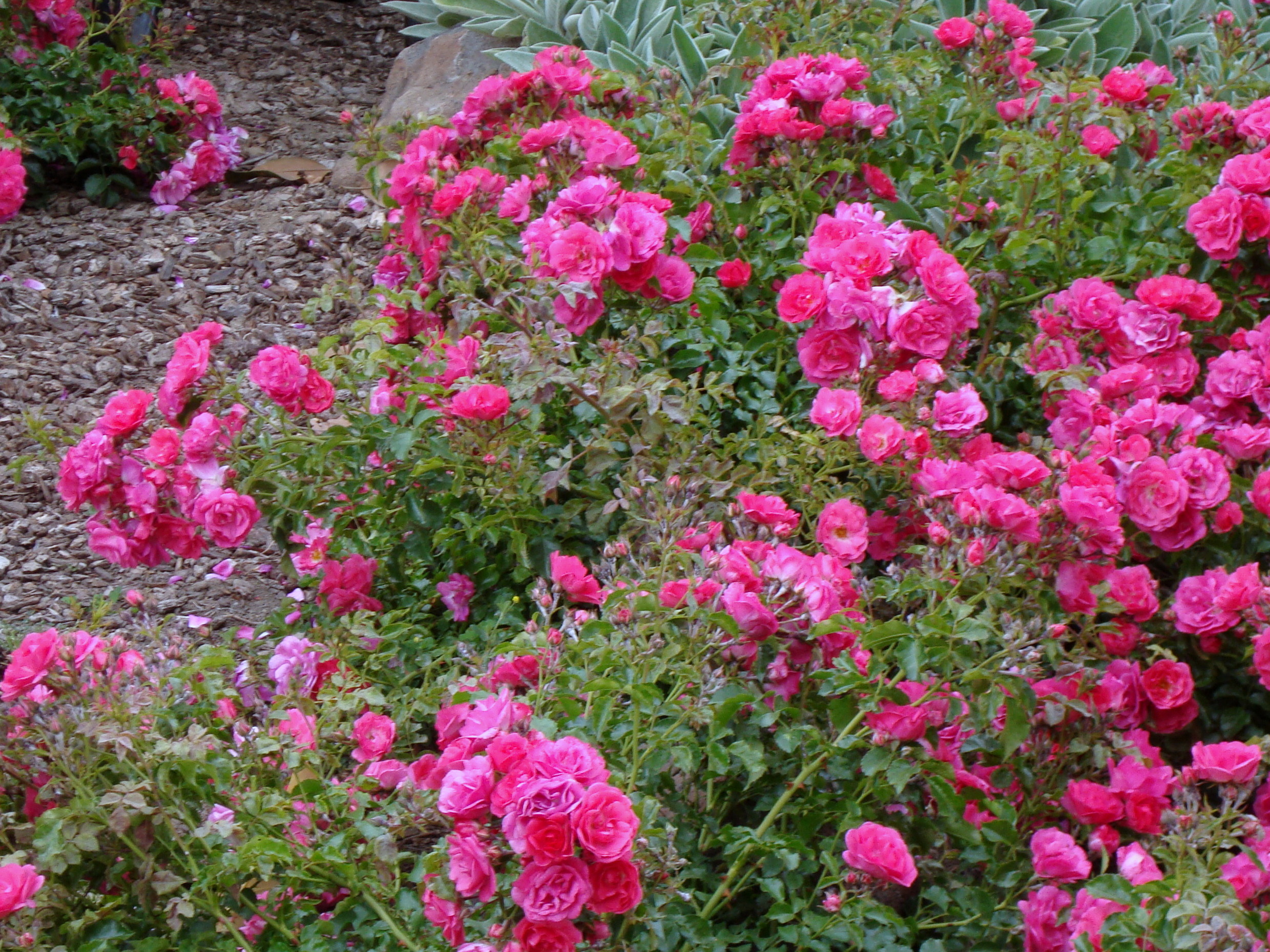
pink roses
There are different theories on the proper time to prune a plant.  When we bought this house twenty years ago there were dozens of rose bushes, front and back. I “hard” pruned them once a year in January, removing crossing branches and dead limbs and leaving little more that a few inches of stem. My neighbor looked on aghast, but I assured him all was well. Sure enough, the flowers bloomed year after year.

I’m not a big fan of roses, so we gradually replaced them with other plants. One of our neighbors took all of the pink roses and transplanted them in the garden of her rental property. It was nice to see them go to a good home.

rose bushes 2010

2010: Rose bushes on their way out.

About five years ago we added some hydrangeas in a few shady garden spots. The first year I pruned the plants in the fall after the blooms turned to a crumbly brown. A few of them came back looking good, but some of the others looked so-so. When I researched the proper time to prune them I got mixed answers. Some of the articles said to prune in the fall if the flowers bloomed on new wood. Others suggested pruning in the spring. I got up close to each plant and honestly couldn’t tell which was which

Last fall I decided to split the difference. I left a few of the plants untouched, while pruning the others just above the buds.

Now I know.

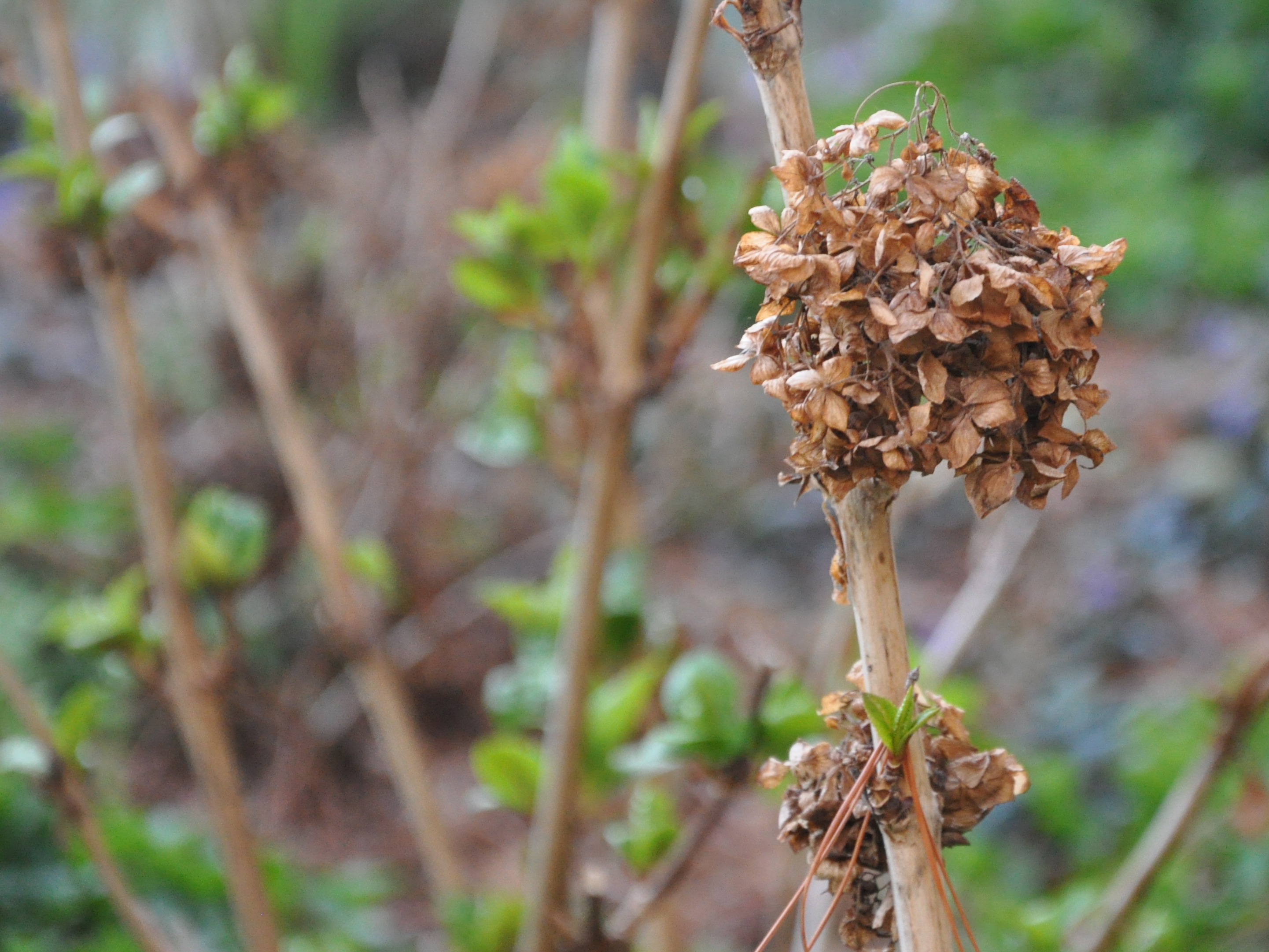
All of the hydrangeas are showing new growth, but the ones I left untouched look healthier. The growth appeared just below last year’s spent bloom. It was a wonderful experience cutting off the dead blooms and exposing the lovely lime green of new growth below. Don’t you just love that color?

Hydrangea: Spent blooms and new growth

Hydrangea: Spent blooms and new growth

hydrangea new growth

Hydrangea: New growth on old wood?

pink hydrangea

Hydrangea: A small bloom…in February.

hydrangea leaves

Hydrangea: New life underway

According to this first article in Fine Gardening, “knowing if your shrub blooms on old or new wood will help you make timely cuts.”

The same site shared this video, saying it depends on when your hydrangea blooms, spring or fall. Since ours bloom in the spring but continue to bloom through the fall, it seems that I should have pruned last fall after all.

I’m back to being confused.

I’ll report back in a few months when the plants are in bloom. Life in the garden is never dull.

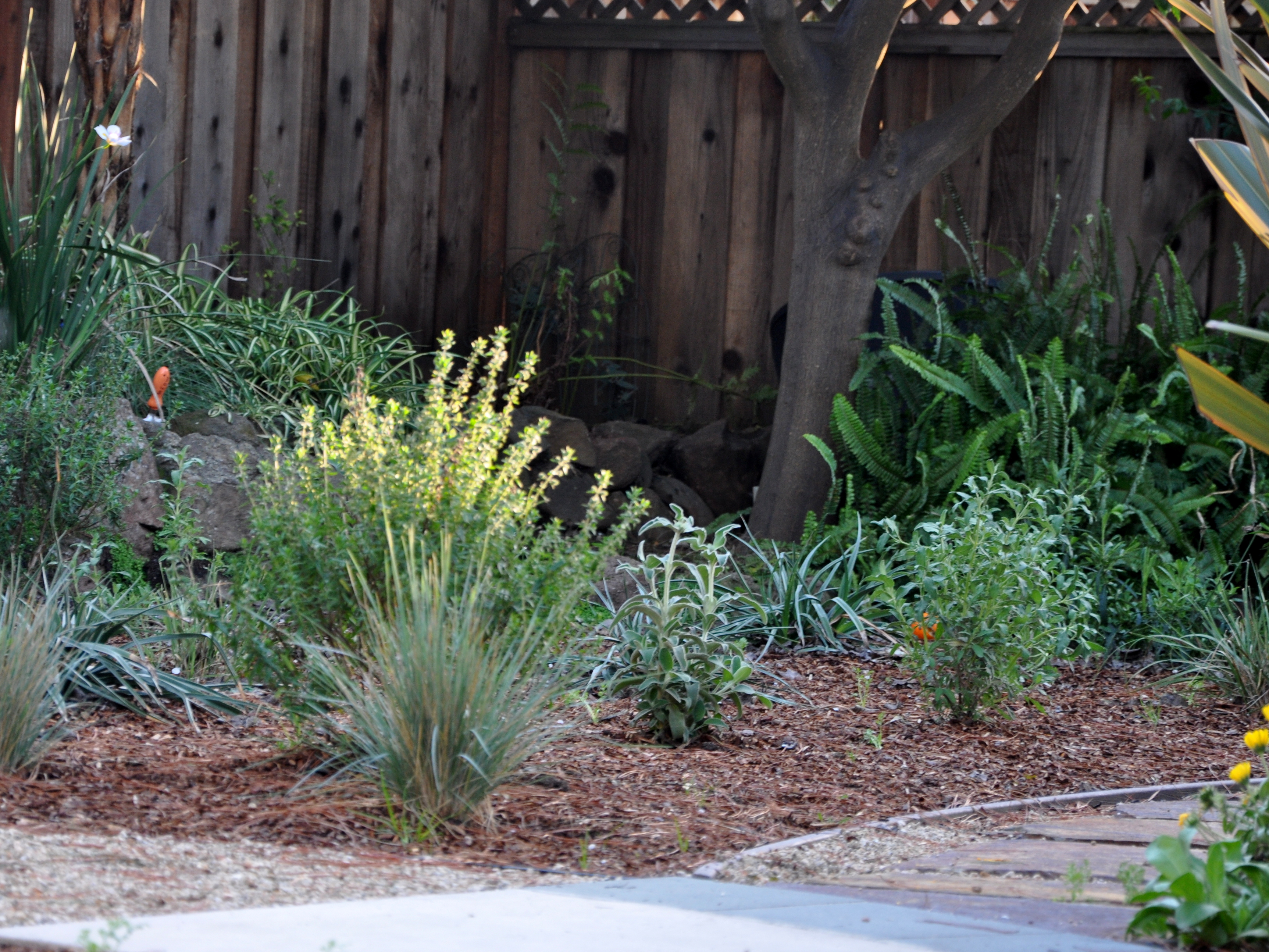
My Garden at Dusk

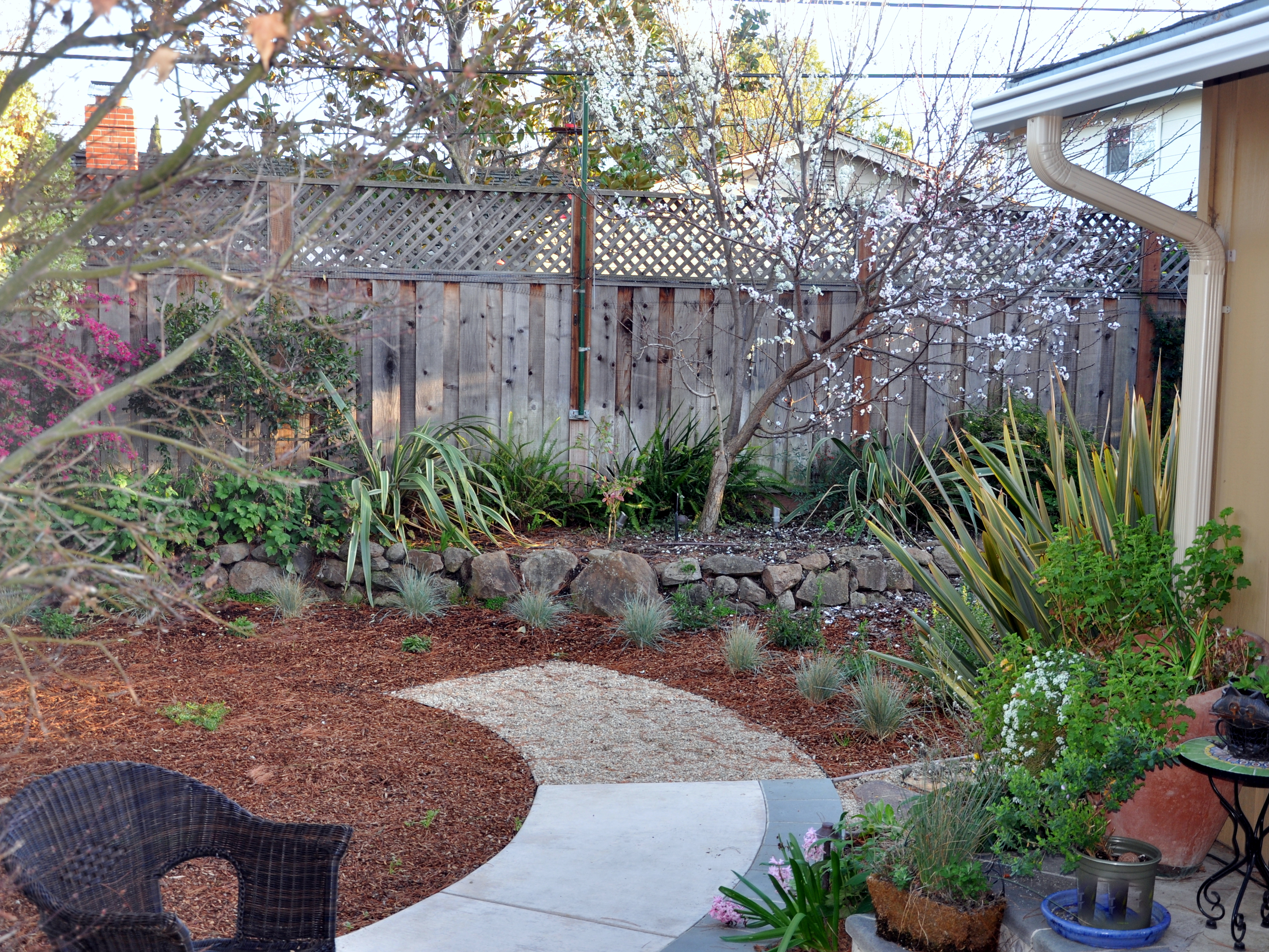
garden at dusk as viewed from back door

View from my back door at dusk

Though our temperatures are unseasonably warm, the sun tells a different story.  The angle of the sun reminds me that it’s still winter. Dusk comes early in the garden.

It rained last night, a welcome bit of moisture in this otherwise dry month. It smells wonderful.

I’m spending half an hour a day in the garden, pulling tiny weeds and bits of leftover lawn. When we converted the lawn to native plants last fall, they offered to put a chemical in the soil to kill any remaining grass. I’m an organic gardener, so I declined. I’m only finding shoots of grass here and there so it’s been quite manageable. I sheet-mulched most of the back garden beforehand, eliminating most of the grass organically.

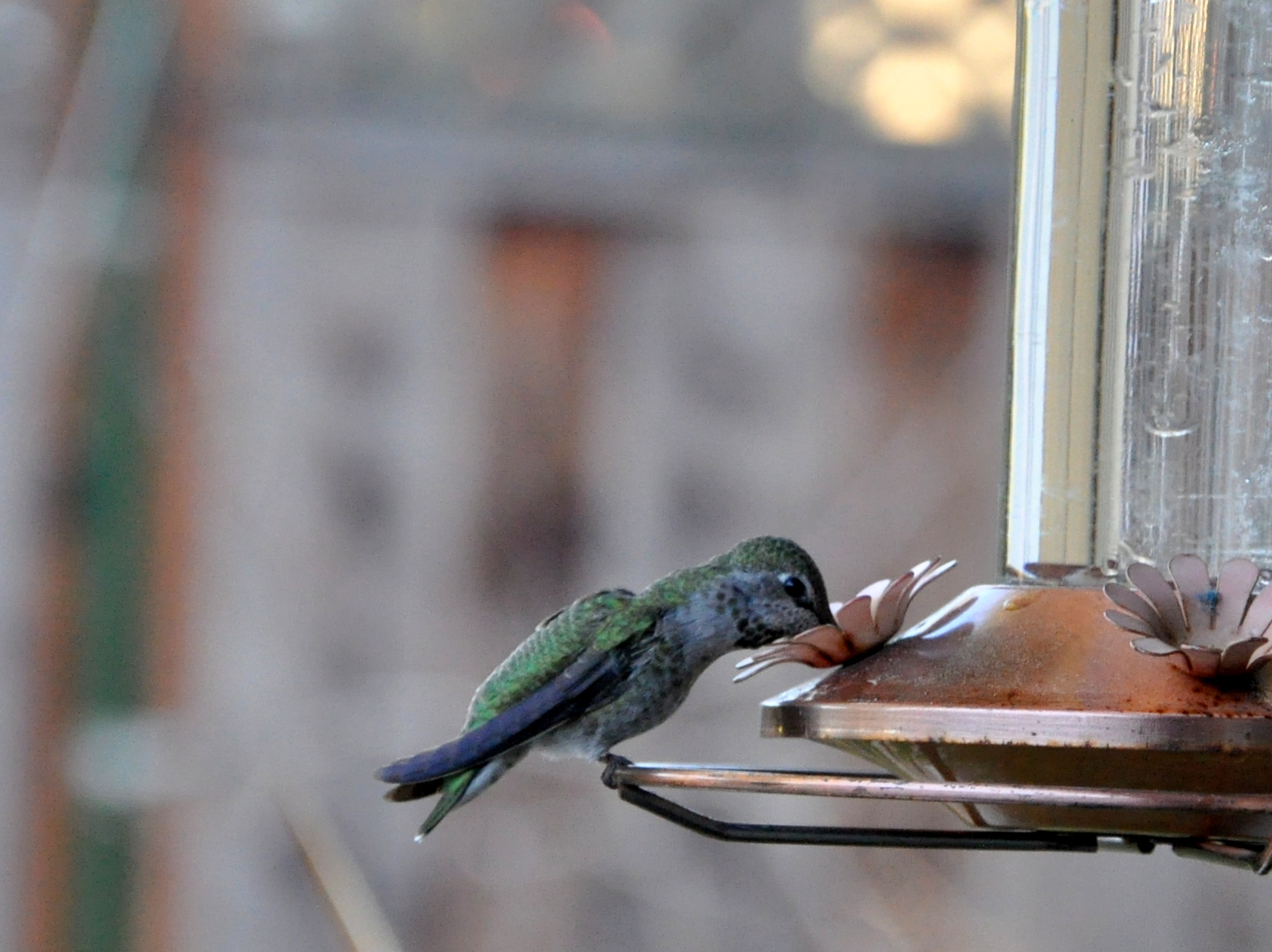
It feels great spending time in the garden. I’ve been sweeping up pine needles, dead-heading the Camellia and enjoying the clean air. I bring in half a dozen lemons each week for our morning lemon water, a wonderful new habit. The female Anna’s Hummingbirds are nesting nearby, which means long drinks at the feeder.  I love hearing them overhead as I work.

female anna's hummingbird at feeder

Female Anna’s Hummingbird at the Feeder

african iris

African Iris

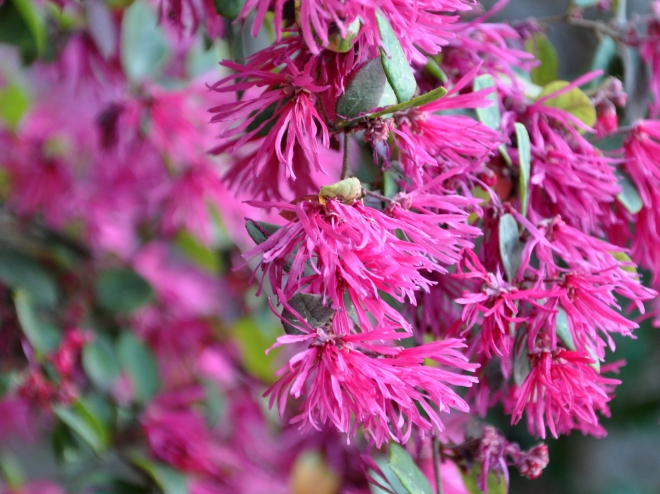
fuschia plant

Loropetalum ‘Burgundy Fringe Flower’

new zealand flax with yellow flowers

These yellow flowers self-seeded under the New Zealand Flax.

plum blossums

Plum blossoms on the four-in-one fruit tree

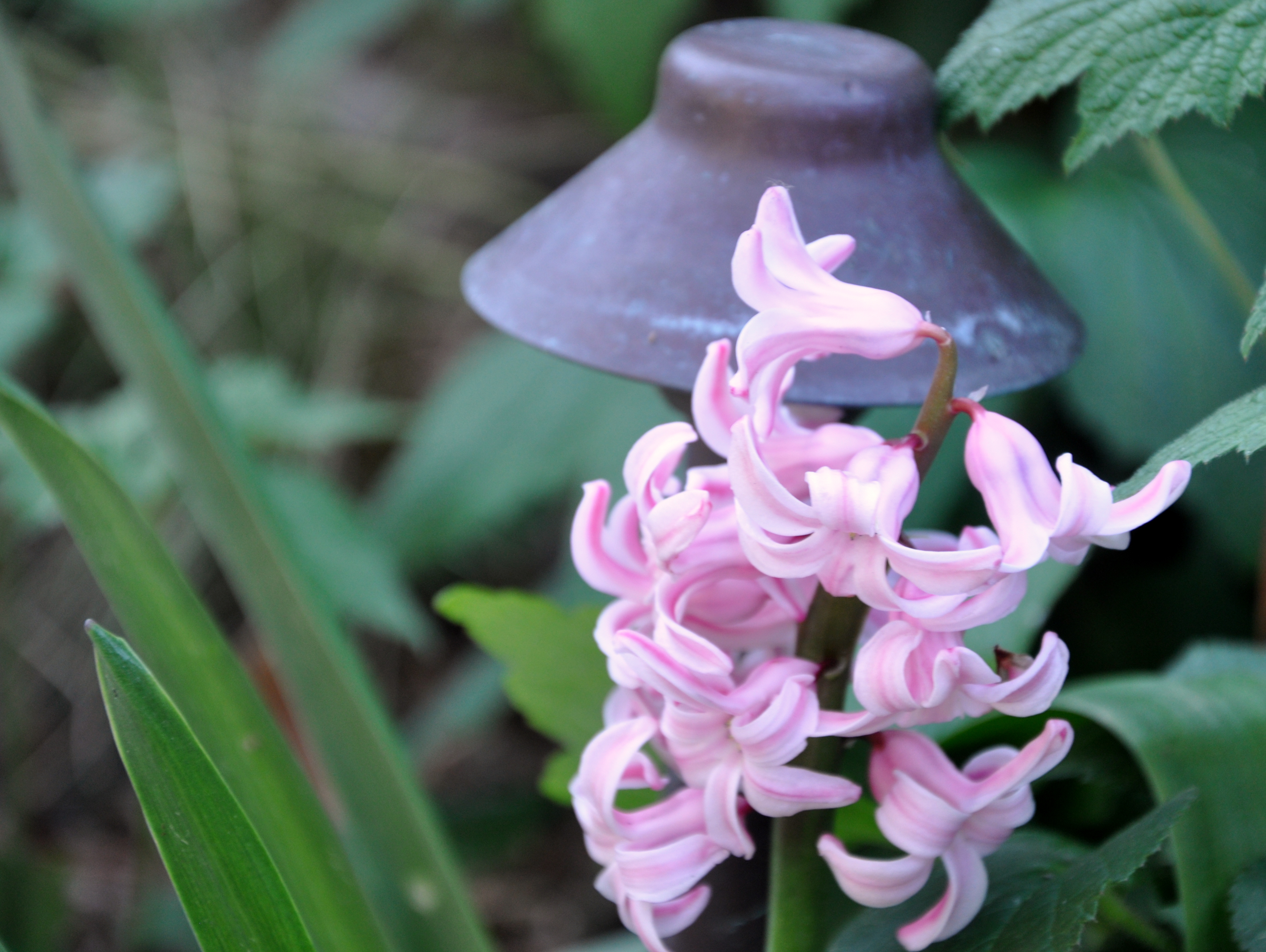
pink William and Kate hyacinth

Pink Hyacinth ‘William and Kate’

Life is busy again now that I’m back to working with clients, so a lot of my garden time is catch as catch can. The time among the flowers and weeds feel like stolen moments but I don’t mind. Time in the garden is always a joy.

Robins and Daffodils and The Case of the Missing Rain

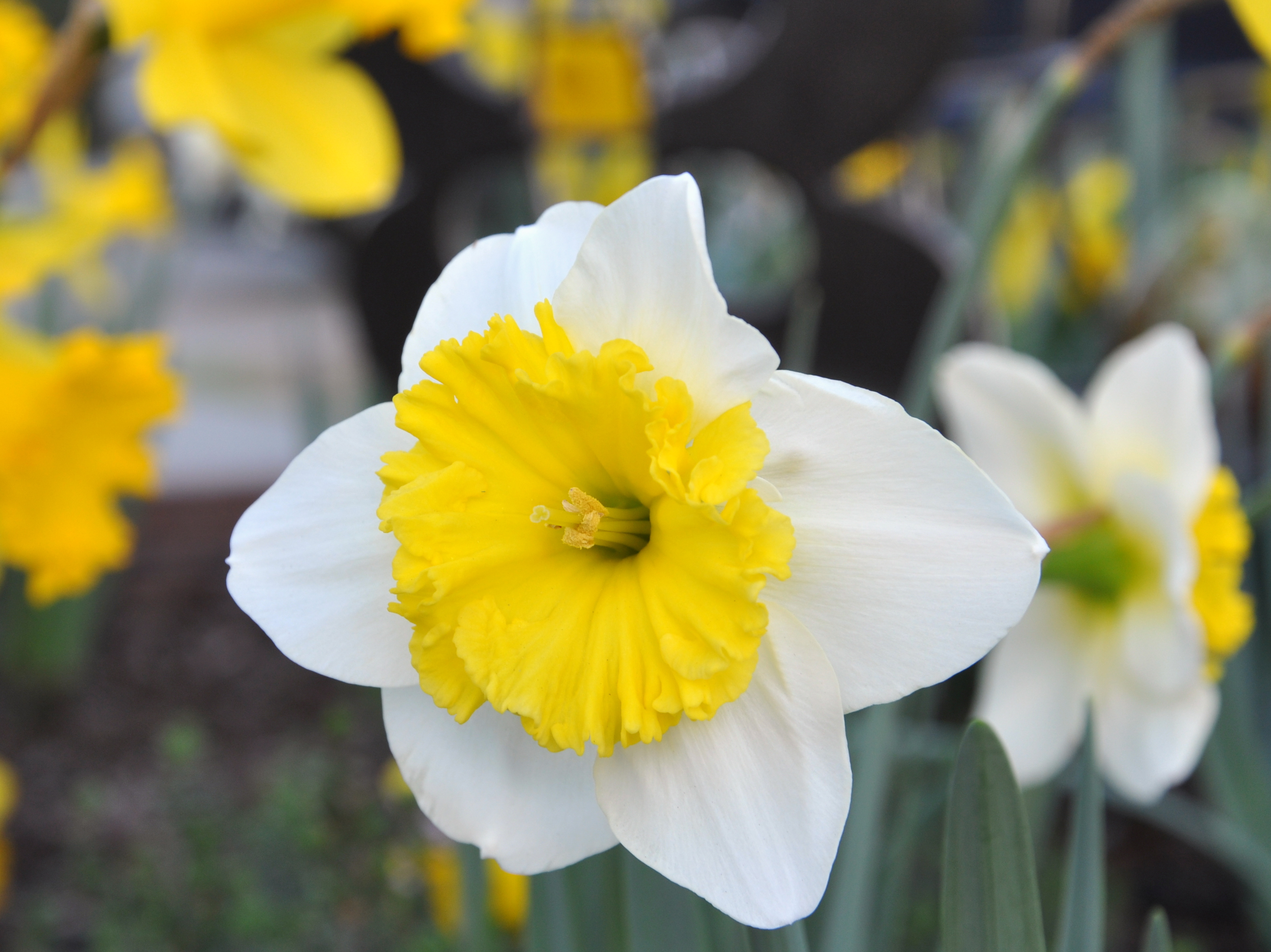
If the Daffodils are up, it must be February. Who needs a calendar when you can look out your front window and see this:

daffodil closeup

Daffodils: Just the Beginning

I’m amazed year after year that those tiny, brown orbs buried beneath the soil know exactly what to do and when.

For years I drooled over the Holland Bulb catalogs, but so many of the flowers need a really cold winter to do well. I tried tulips, refrigerating them first for six weeks in the crisper. Time in the cold environment simulates winter. The first year nothing came up. I wondered if I planted them too deeply or perhaps upside down. Maybe they rotted in the ground? There was no evidence that they’d been devoured by a critter.  I tried again about a decade later, once again lulled by the promise of beautiful tulips in my garden. About half of the bulbs produced beautiful blooms, but by the following year I was down to one.

After a bit of research I learned that Daffodil bulbs (narcissus) are toxic to squirrels so they leave them alone. They don’t require a cold winter and they can stay in the ground year round. Now that’s my kind of bulb.

Using the broadcast method where you toss the bulbs to the ground, then plant them where they land, I filled the curb garden box with 50 bulbs.  Every last one of them bloomed!

daffodil collage feb 5 and 10

Daffodils: February 5th and 10th

daffodil trio

Daffodil Trio

Emboldened, I bought 25 more bulbs the following year, this time the two-toned variety. They’re coming into bloom about a week after the original planting.

pair of two toned daffodil

What’s Up, Buttercup: A Two-toned Daffodil

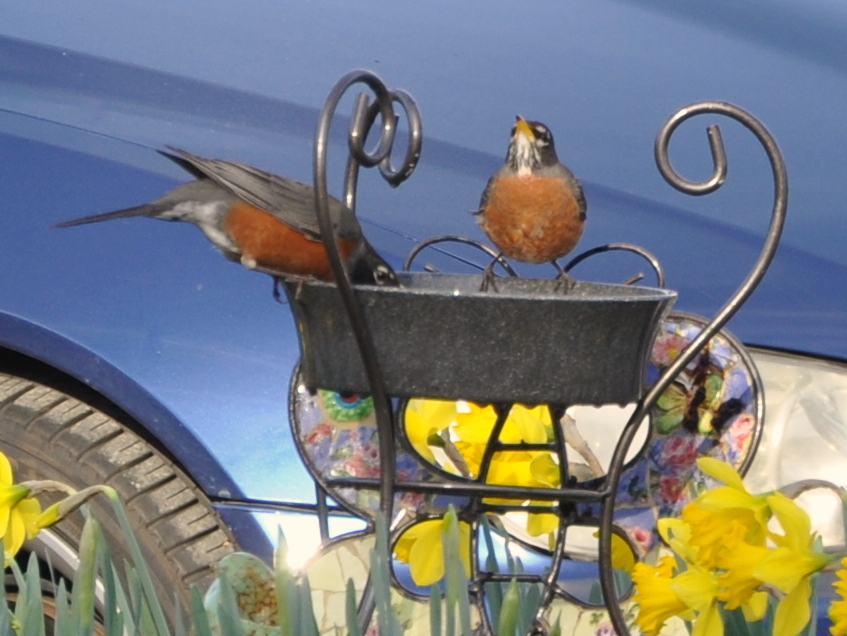
Also outside my kitchen window this past week: A thirsty flock of Robins.

three red robins

Trio of Robins

Though the American Robin is common throughout the States, we don’t usually see them flock in our neighborhood. Over the past two weeks, no doubt prompted by our strangely warm, spring-like weather, they’ve been gathering in nearby trees and drinking at our watering hole. Robins are handsome birds with an equally delightful song.

They prefer a meal of worms, but once the ground is frozen, they’ll migrate and then feast on berries. All that flying back and forth between trees means they’ve left quite a mess in their wake. You take the good with the bad, right?

I made myself late to Pilates last Thursday as I went into the kitchen for some water and fled for my camera instead. There were at least a dozen robins, one sitting in the water fountain, and the rest taking turns for a drink. By the time I put the microchip in the camera, then found a place to take pictures hiding around the corner of the garage several had moved on. I still got a few shots in and around my MacGyvered watering hole and garden.

robins drinking from the fountain

Robins taking turns at the watering hole

The garden is coming alive with color.  We’ve had ten days of unseasonably high temperatures but only a trace of rain. Today, San Jose may tie a record high set in 1943. February is traditionally our rainiest month. In a state that counts its rainfall in fractions, February is the star with an average of 3.31 inches (8.41 cm) of rain. Our annual rain fall is only about 15 inches. It’s February 15th and we’ve only recorded 0.05 inches! So while it sounds uncharitable to complain about blue skies and warm weather…well, I’m complaining.  We desperately need more rain.

If your swimming in surplus precipitation, please send it our way.

The Making of The Miniature Little Free Library

mac approved mini little free library

Photo shoot in the fairy garden before mailing the LFL

This is a follow on post to It’s the Little Things (Even Libraries) published last week. You can catch up with part one here.

It took me years to realize that everyone creates differently. I admire designers that can sketch an idea, and then make it come to life. I tend to work in reverse. Ideas rattle around in my head where they’re examined and discarded. These ideas simmer in my brain before a usable plan comes together.

My first fairy garden miniature library started with a small box. I thought I would do the same with this one, but none of the boxes in my stash seemed right. I visited a craft store, put a couple of items in my cart, then put them all back. Eventually I left the store with a small container of blue paint and a receipt for seventy-five cents.

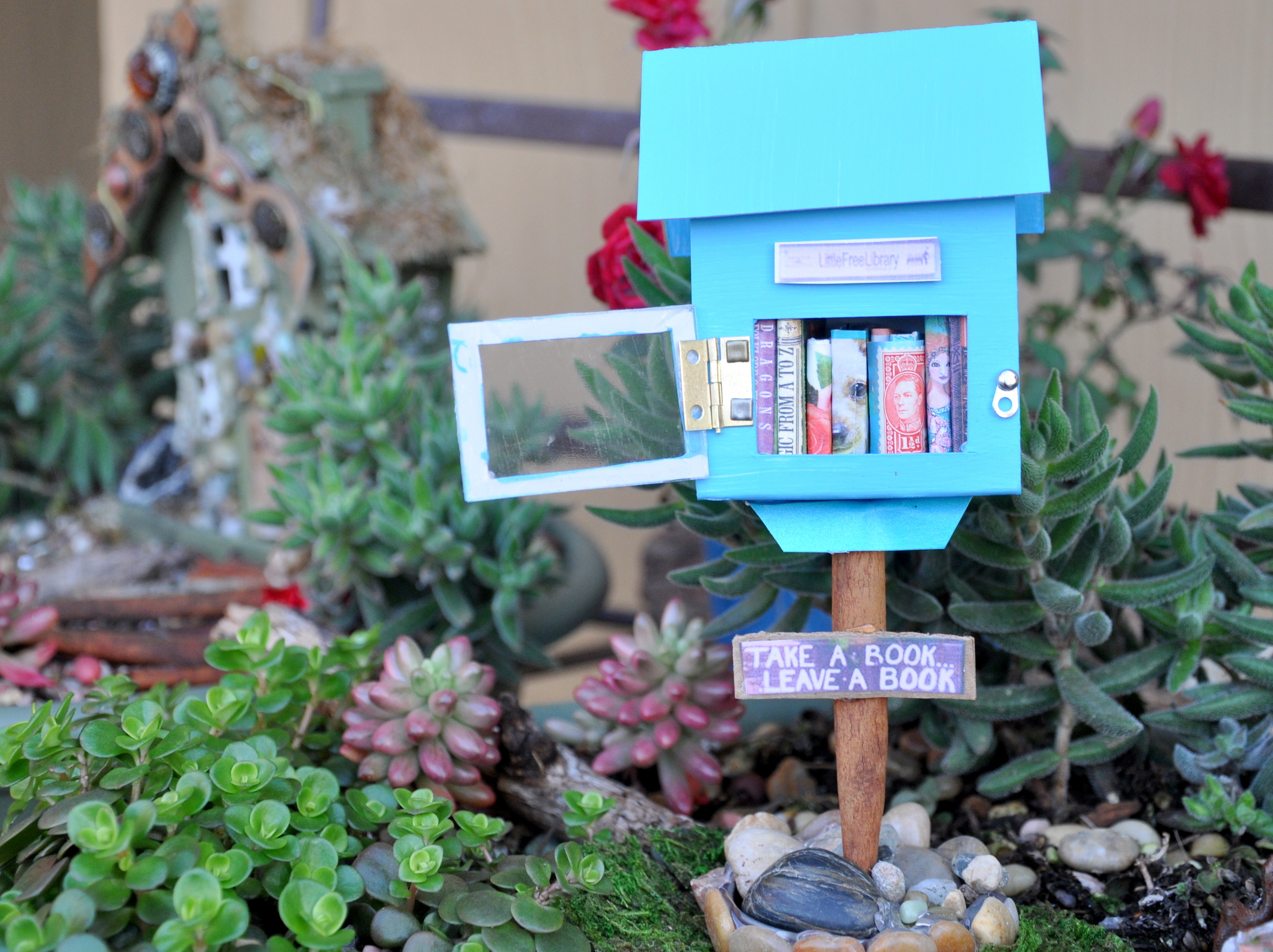
Back home, using a photo of Carrie’s library as a guide, I cut pieces from a thin piece of cardboard. I wanted the library to have a working door, so I cut a small rectangle in the body of the library. I cut a cardboard frame for the door, and backed it with clear packaging from a packet of batteries.

Carries library with miniature

Carrie’s full-sized library on the left, the miniature version on the right

mini little free library construction

Constructing the miniature library

It took three coats of paint to cover the glossy white cardboard, but after two days the color looked even.

If I had it to do over again, I would install the door first, and then assemble the library. It would have been handy to have fairy-sized hands that day. I persevered.

After taping the plastic to the door, I glued a tiny hinge in place. On the library itself, I poked two small holes into the opening, then used tiny brads to hold the hinge in place.
mini little free library door hardware

Door hardware

On the opposite side of the door I attached a “doodad” from my stash, holding that in place with another brad. This allows the door to open and close.

mini little free library open door

Miniature LFL with a working door

Since the opening is small, I made a removable roof so adding books is a breeze.

Carrie’s library sits on a wooden post surrounded by a circle of stones. To replicate the look, I used a cinnamon stick, a small metal lid and a handful of pebbles from my fairy garden stash. I hot-glued the cinnamon stick to the inside of the lid, and then glued rocks into and around it. This gives it weight and stability. I downloaded a copy of Carrie’s library, and photo-copy reduced the two signs to scale. Then I headed to the kitchen, tore off a corner of a box of cat food cans, and used the cardboard to mount the signs.

mini little free library take a book sign

Miniature library stand made from a cinnamon stick, a candle lid, pebbles and hot glue

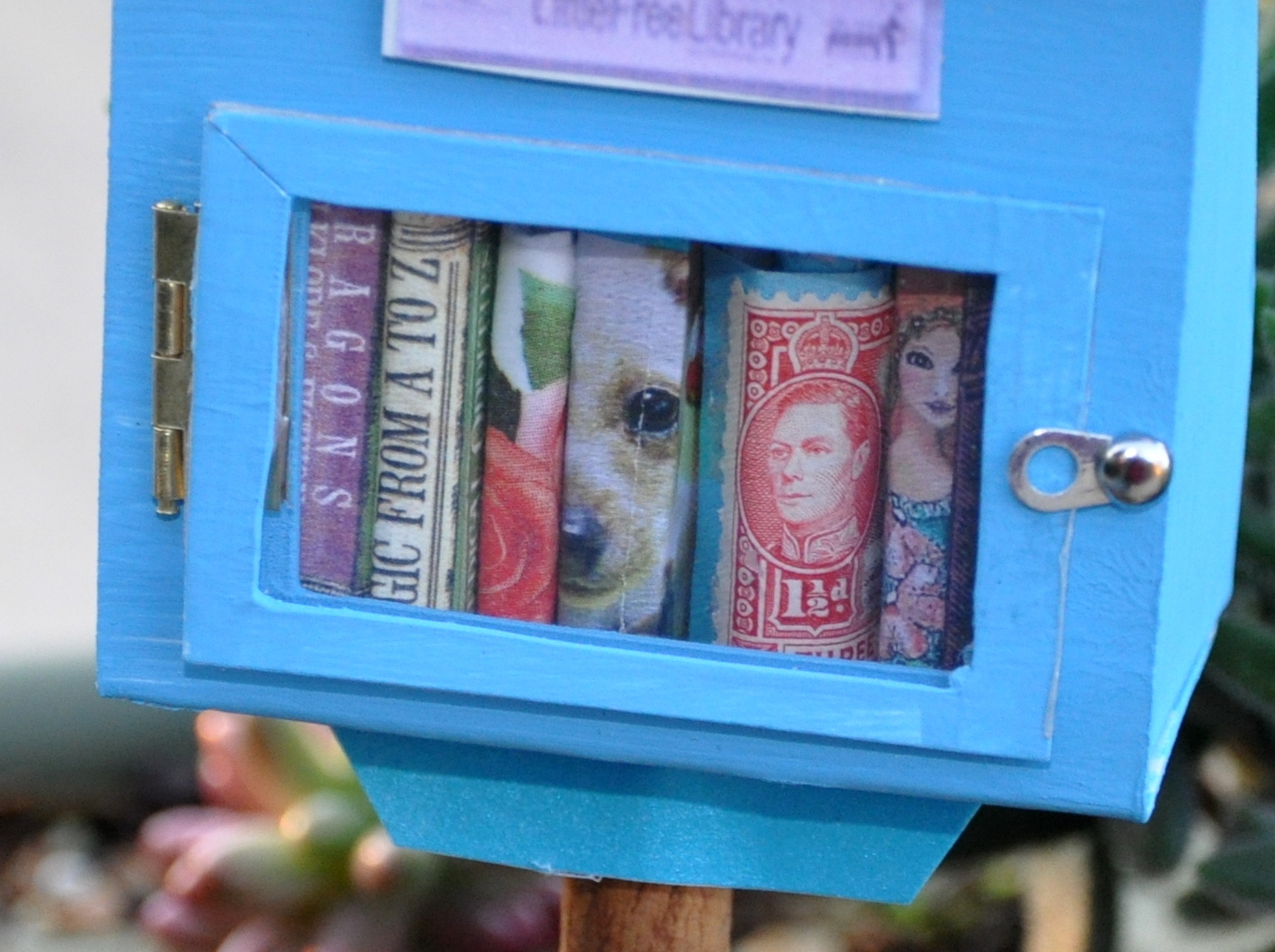
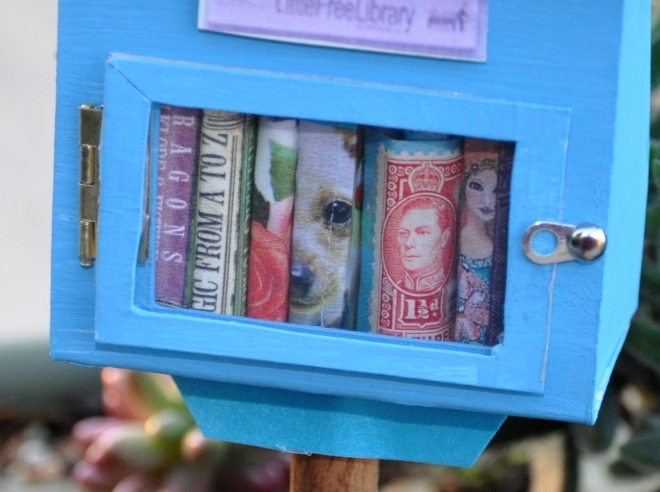
Then on to the books. Again, lots of ideas tried and discarded before I came up with a plan. I used the binding from a couple of paper sample books passed on to me years ago. I cut through all the layers of the sample booklets, and then cut sections down to size.

mini little free library book making supplies

Sourcing supplies for the miniature books. Upper left, clockwise: sample books used for structure, book covers made from a recycled Humane Society calendar, one of my dad’s vintage stamps, floral Washi tape, Graphic 45 printed paper

Each tiny book has a unique cover with a small story to go with it. (The actual books are blank inside, so you have to use your imagination.)

I wrote a six-word story to go with each book, something meaningful to me or to Carrie. Here they are:

Trust, betrayed. Rescued dog’s love, restored.

Flowers. Achingly beautiful. Harbingers of spring.

Magic. How we see the world.

Wanted child. Your new family awaits.

The Wonderland of Alys in miniature.**

Daddy’s stamps lovingly travel the world.

Dragon Folklore. Escape inside a book.

mini little free library collage

Can you match the books with the six-word stories?

**The Wonderland of Alys is a collage art piece by Pauline King, a friend and fellow blogger. The original hangs in our home. The tiny replica of this piece is a sticker, sent to me at Christmas by Julia of Defeat Despair. I couldn’t resist turning one of those art stickers in to a tiny, make-believe book.

Pauline King art the wonderland of alys

A Surreal Week

One of the definitions of surreal is “very strange or unusual”. That pretty much sums up last week.

Monday I received an email from the Santa Clara University provost where my son attends college. They hospitalized one of his classmates with a suspected case of meningitis. Yikes! On Tuesday a second student entered the hospital, then a third. By mid-week we were pretty nervous. I pulled out my son’s immunization records which shows he’s been vaccinated, but a quick call to our pediatrician indicated otherwise. He’s not covered for this particular strain of meningococcal bacteria, common on many college campuses.

waiting for vaccines

Waiting in line for meningitis vaccine

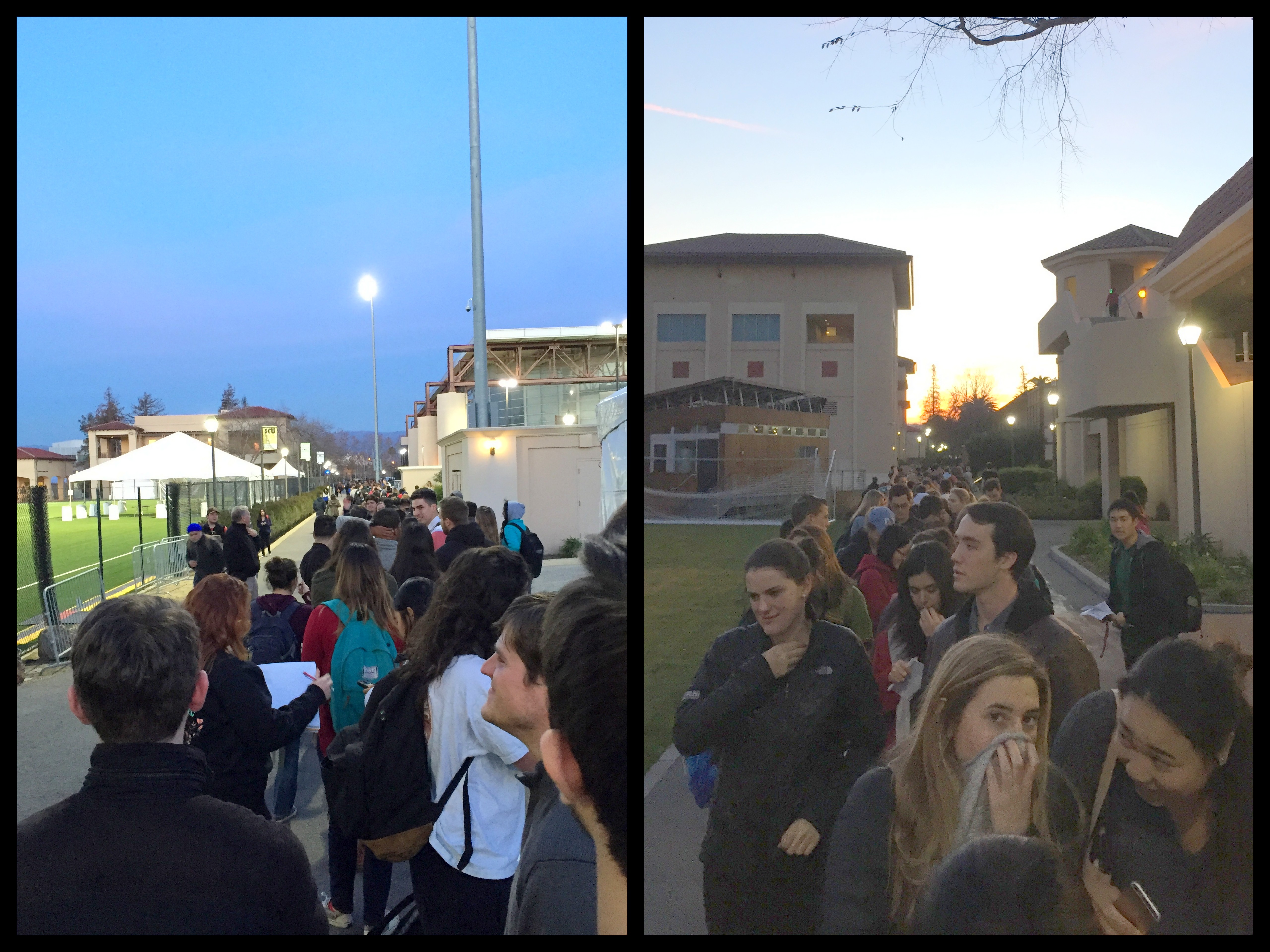
His university handled the details swiftly and impressively, coordinating a free vaccination clinic on campus for all 5,000 undergraduates. My son waited in line for two and a half hours to get his shot, along with everyone else. They were not allowed to return to class without a “vaccine pass.” They have to get a booster shot in thirty days, so they’ll be waiting in line again in early March.

The hospital released two of the three students from the hospital but a third remains under medical care. I can’t imagine what his parents are going through.

Last week also coincided with the lead up to the Super Bowl 50, hosted in Santa Clara, California. My husband works a few blocks away. The city set up detours early in the week, and by Friday all of his co-workers worked remotely to avoid the chaos. What is surely a sign of the times, but disquieting nonetheless, is the level of security for this sort of event. Outside Mike’s office window he could see army tanks, helicopters and security personnel practicing drills in case of an attack. It’s one thing to see this on the news, but surreal when it’s happening in your own back yard. The Super Bowl came and went this weekend without incident, and we’re all relieved to have things returning to normal.

super bowl parking lot photos

Super Bowl 50 Security Maneuvers in Santa Clara

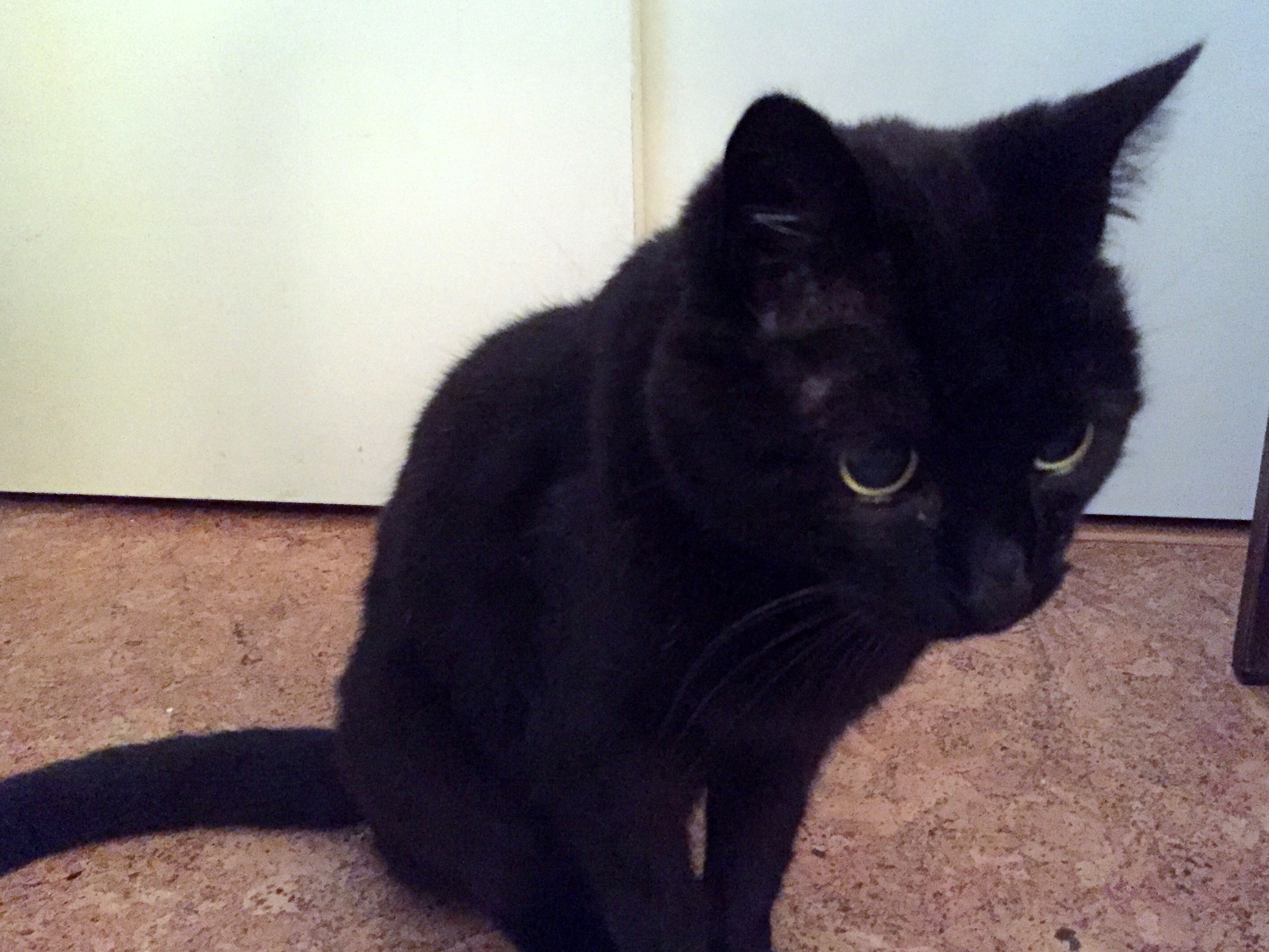
My sweet Slinky, who’s been my constant companion throughout my recovery, started hiding under my son’s bed. We were finishing up a medication for a bladder infection and thought she was simply avoiding us. Then I saw her walk into a wall, retreat, then step over one of the other cats lounging in the hallway. I thought she’d suddenly lost her eyesight. I got her into the vet the following day for a thorough exam and asked them to test for things that might be causing this, anything we might be able to treat. Apparently a spike in blood pressure can temporarily rob them of sight. Dr. Shanker said there was nothing wrong with her eyes and believes there is something systemic causing a dulling of all her senses. He said a blind cat can get around just fine, and can find their food hidden in another room while at the same time easily negotiating furniture. So, my sweet Slinky has now retreated to one room in the house, where she sleeps on a pile of blankets on the floor. She’s eating well and purrs when I pet her, but she’ll also swat at me if she’s not sure that I’m in front of her.

slinky 2016

Slinky

It’s hard not knowing what’s going on. She’s eating, using her litter box…most of the time, and purrs when she finally relaxes and lets me sit next to her on my son’s bed. The few time she ventures out of his room, we find her staring at walls. If I pick her up and bring her to the couch, she gets upset and goes back into hiding. Our vet always says it comes down to quality of life. If she’s not in pain, responds to touch, eats and purrs, then her life is still pretty good.  I have a heavy heart.

And on the subject of cats, last night Mouse figured out how to open the screen door so he could bring in a dead rodent. What a way to round out the week

I have the beginnings of a head cold, I lost my prescription sunglasses and I fell off the sugar-free eating plan I’ve been committed to since January. The Girl Scouts came to the door, Mike bought a few boxes of cookies, and I helped myself to a “sleeve of them”. The scale didn’t go down this week. Coincidence?

Stress eating once again rears its ugly head. I’m back on plan and hope this week is mind-numbingly mundane.

I’m sure you’ve had weeks where you were  happy to draw the curtain on the whole thing. Do you ever stress eat as a result? Do you have any tips for keeping it in check?

It’s The Little Things (Even Libraries)

I’ll start at the beginning.

A few years back I spotted a small, neighborhood library in the nearby community of Campbell. I was smitten! I went back to drop off books, then returned again with my husband. After seeing the library and doing some research, I knew I wanted one too.

little free library campbell, california

Little Free Library, Campbell, California Steward: Carmencita Valerio

In keeping with the tenets of the Little Free Library movement, we started looking for recycled materials. We spotted something that would work at a garage sale, but we mulled it over for too long and it was gone.

Enter my friend Nick, who’s a master carpenter extraordinaire. Nick built our Little Free Library (LFL) from reclaimed redwood fencing and deck material. Perfection.

little free library history collage

Little Free Library Construction and Design: Nick Timmermann Steward: Alys Milner

The books flow in, the books flow out, and an entire community of readers stop by daily to give or take a book. The motto is “Take a book, return a book” with the understanding that you can do either. I’m considered the library steward, but the library belongs to the community.

About six months later my friend Mary Elizabeth asked, perhaps tongue in cheek, “When are you going to build a Little Free Library for your fairy garden?”

miniature little free library

Miniature Little Free Library in the Fairy Garden

How could I resist that challenge? So I did, and of course I blogged about it here.

Fast forward to last November. I received one of those WordPress notifications saying that my (Little)Little Free Library post had a spike in views. Someone shared my post on the official Little Free Library Facebook Page and that’s how I met Carrie Marie.

Carrie is a library steward in Winston-Salem, Massachusetts.  When she saw the Facebook post, she asked if “the artist”…referring to me (blush) would make one. Delighted, I offered to make one as a gift after I recovered from surgery.

Here’s what she said:

Hi Alys,
I would be happy to pay for supplies needed to make us a tiny LFL! My husband and I are in the process of adopting through foster care here in NC and we have Little Free Library #11934. We’d like to teach the child about the concept of the LFL and are incorporating it into other things. I’m very appreciative of your offer! The one you made is darling!!!!!

What a gracious soul! So over the last few weeks, I’ve been plotting and planning and constructing a miniature replica of Carrie Marie’s Little Free Library.

Here is a sneak peek:

Miniature Blue Little Free Library

Miniature Blue Little Free Library

I’m writing a second post with details of how I made it, along with the stories that go with each tiny book.

It’s been a blast!

Stay tuned.

Hummingbirds, Spiderwebs and My Left Foot

hummingbird in flight

Anna’s Hummingbird at the Feeder

Hummingbirds flap their wings about 55 times a second!   The resulting sound is soothing, like a constant heartbeat. We have three feeders in our garden, in addition to several of their favorite flowers. When the plants are in bloom, the Anna’s Hummingbirds enjoy Salvia (we have four) and Abutilon (we have six).

While taking pictures of my lemons for a different post, I could hear one flapping over head.  I took a few shots near one of the feeders, before she flew past me into the shrubs. For the first time, I saw her dip her beak into a spider web. I managed one shot before she flew away.

hummingbird gathering spiderwebbing

Anna’s Hummingbird Gathering Spiderweb for her Nest

Did you know that hummingbirds line their nest with spider webs? They also eat soft-bodied insects when they’re feeding their young. The prospect of a nest of hummingbirds nearby has me feeling giddy.

Footnotes

It’s been almost three months since my foot surgery. If you’re new to my blog, you can catch up here.  Dr. Sheth said I’m actually “ahead of schedule.” She kindly added that she thought my positive outlook and my commitment to following the healing protocol all worked in my favor.  So while I still have some pain and swelling, I have the all-clear for walking again.  I’m one happy woman.